
Peter Whorf & Anthony Wing/Superior Skies
Season 4 Episode 3 | 26m 46sVideo has Closed Captions
Peter Whorf & Anthony Wing/Superior Skies | Episode 403
Peter Whorf & Anthony Wing, Executive Director of the ISO, talk about how the International Symphony Orchestra found a creative way to bring music back to the public. Superior Skies Photography, capturing light over Lake Superior. And the Christianity Interfaith Tour explores what is Christianity. Episode 403
Problems playing video? | Closed Captioning Feedback
Problems playing video? | Closed Captioning Feedback
One Detroit is a local public television program presented by Detroit PBS
Peter Whorf & Anthony Wing/Superior Skies
Season 4 Episode 3 | 26m 46sVideo has Closed Captions
Peter Whorf & Anthony Wing, Executive Director of the ISO, talk about how the International Symphony Orchestra found a creative way to bring music back to the public. Superior Skies Photography, capturing light over Lake Superior. And the Christianity Interfaith Tour explores what is Christianity. Episode 403
Problems playing video? | Closed Captioning Feedback
How to Watch One Detroit
One Detroit is available to stream on pbs.org and the free PBS App, available on iPhone, Apple TV, Android TV, Android smartphones, Amazon Fire TV, Amazon Fire Tablet, Roku, Samsung Smart TV, and Vizio.
Providing Support for PBS.org
Learn Moreabout PBS online sponsorship- Hi, I'm Christy McDonald, and here's what's coming up on "One Detroit Arts and Culture".
The International Symphony Orchestra, and keeping up with fans in the U.S. and Canada during COVID.
Also ahead, our next religious diversity journey has us learning more about Christianity.
Then the art of capturing the skies over the Great Lakes.
And a Marygrove showcase performance.
It's all just ahead on "One Detroit Arts and Culture.
- [Female Announcer] From Delta faucets to Behr paint, Masco Corporation is proud to deliver products that enhance the way consumers all over the world experience and enjoy their living spaces.
Masco.
Serving Michigan communities since 1929.
- [Male Announcer] Support for this program provided by the Cynthia and Edsel Ford Fund for Journalism at Detroit Public TV.
The Kresge Foundation.
Community Foundation for Southeast Michigan.
- [Female Announcer] The DTE Foundation is a proud sponsor of Detroit Public TV.
Among the state's largest foundations committed to Michigan-focused giving.
We support organizations that are doing exceptional work in our state.
Visit dtefoundation.com to learn more.
- [Male Announcer] Business Leaders for Michigan.
Dedicated to making Michigan a top 10 state for jobs, personal income, and a healthy economy.
Nissan Foundation.
Ally.
The Fred A. and Barbara M. Erb Family Foundation.
And viewers like you.
(upbeat music) - Hey "One Detroit", I'm Christy McDonald.
Thanks so much for joining me for "One Detroit Arts and Culture".
All right, we made it.
It is 2021 and concert junkies, theater lovers, and gallery fans are all counting down the days until we can get back to enjoying the arts together.
We've all gotten used to virtual shows making up the difference, and COVID has really made international collaborations difficult.
Coming up we are going to hear from Anthony Wing.
He's the executive director of the International Symphony Orchestra on virtual concerts to satisfy the fan base in Canada and in the U.S. Plus the art of capturing the skies over the Great Lakes.
It's a beautiful story.
And then our next stop on our series of religious diversity journeys, we'll explore Christianity.
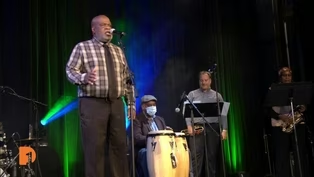
And we'll wrap it all up with a performance from Marygrove with jazz guitarist Ron English.
It is all coming up.
But we're starting off with WRCJ's Peter Whorf and learning more about the International Symphony Orchestra.
(breezy guitar music) - We'd undergone some kind of a renewal.
We had moved into a performance space that we created and we added an art gallery to it called the Iso Bar on the Canadian side.
We had begun to feature small, intimate performances there to go along with the orchestra season.
So when the pandemic happened, we started to, almost right away, to film distanced musical events and to try to get them up onto our, first onto our YouTube channel.
♪ Yeah the truth hits you over the head like an anvil ♪ ♪ Tragedy and lies fill your head to swollen ♪ But in the summertime there was a bit of an opportunity when the (indistinct) city council decided to shut down the downtown core to encourage small, support of small businesses during COVID.
And this happened every weekend for 10 weeks between July and September.
So what we did was we put musicians in the window and we ran a cord out to a speaker on the sidewalk and we arranged chairs in distance pods on the street.
We had different musical acts every every week.
And we would include members of the orchestra in this run.
Almost everyone donated their time.
So it became a big rent party for us, and it kept light on us in the community that we had enough confidence now as an organization to see if we could put on an entire season, but to deliver it online digitally.
- And then there'll be subsequent releases as we progress into the concert season.
- That's right.
Every month between December...
It'll be late December to late April.
And remember that, above all, we're not essential, so we've been struggling.
But we are preferred.
So we're going to try to remain preferred for bridge to communities to try to get the product to them as easily as possible.
We took a look around to see how the larger orchestras in the States had been surviving, and had been even flourishing during this time.
And it was and it was the orchestras who had the strongest community support So that's what's kept us going.
♪ Orange sky don't go ♪ Manhattan looks like someplace else ♪ ♪ It's cloudy with a low fog shelf ♪ - Can you share some broad strokes for maybe kind of the future picture of the international Symphony Orchestra, Anthony?
- Being an orchestra, being a symphony orchestra and having to truncate your lineup, that was doable.
And we're able to do that, of course, because that's part of the experience.
However, being a full orchestra, that means we would be...
Organizations like ours will be the last to be allowed onto the concert stage.
Audiences will be allowed to fill halls before we are allowed onto a stage.
When the Symphony Singers, our choir, perform with us, there's about a hundred people on stage.
And early on in the pandemic, choirs were considered a potential super-spreader thing.
So hence we will be going back in increments, and we look forward to it, but we are focused completely on trying to fulfill our mandate for the communities on a motion capture level.
So we can continue to feed it as sort of... To consider ourselves a sort of content provider.
Only the content is like the most glorious and moving and life-changing content you could possibly have available.
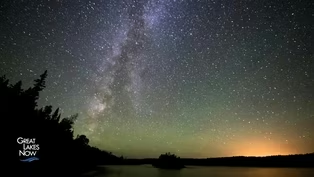
(dramatic piano music) - Now to the art of capturing the beautiful skies over the Great Lakes, from the Milky Way to the Northern Lights.
And this story comes to us from our monthly show here on Detroit Public Television called "Great Lakes Now".
- [Shawn] My photography and cinematography is Lake Superior region based, inspired.
And I've been at this for about 20 years.
- [Narrator] Shawn Malone is a photographer in Marquette, Michigan, and she's been photographing the night sky since 1998.
- When I started out photography, just regular landscape photography, I was using film cameras.
Negative film or slide film.
You would have to wait until you get the film back to see what you got.
So when I got the film back, it was like, wow, I was just amazed.
And then like a once in 11 year event happened in 2004.
And it was an aurora that was in every direction, every color.
And I shot two whole rolls of slide film that night.
- [Narrator] And when digital cameras became capable of capturing low light scenes, Shawn began shooting night sky time-lapses, often featuring the northern lights.
- [Shawn] And then I just really started learning all about space weather data, and that kind of thing in order to try and put myself in the right position at the right time in order to be able to capture the aurora.
You really have to scout out your own undiscovered locations where you are not going to have like a car light ruin your shot.
And if you plan a three hour shot for a time-lapse, that's something that can be an issue.
Here in Marquette County where I'm at, we have a tremendous amount of public access to Lake Superior.
And that allows people a chance to get to a dark sky location facing north over Lake Superior.
That provides me, just geographically, the ability to look directly over Lake Superior and see a completely dark night sky facing north, directly north.
And then I have a field of view that is 180 degrees to the east and west that has no obstruction.
So that's half of the battle in seeing the aurora.
And the number two is getting rid of the obstructions and then being north enough in order to be able to catch display.
So this is one of the best places in the lower 48 to see the aurora.
- [Narrator] Nick Lake is Adler Planetarium's manager of theater experience and presentation.
He's been introducing people to the wonders of the night sky since 2004 in the planetarium's domed theaters.
The real night sky can be less reliable, especially as you get further south.
- The northern lights are visible occasionally from the Great Lakes latitudes.
I've seen them several times from just about halfway up the mid point of the lower peninsula of Michigan, so just North of Muskegon.
With nighttime landscape photography you can allow the lens to drink in more and more light and add in this sort of canvas of light on the picture.
And it really, it will add more than you can see with the naked eye.
Which some people say, "Well, it's, that's not really what it looks like."
But it is in fact real.
It's what is actually up there in the sky.
- [Narrator] One obstacle in seeing or photographing the night sky is light pollution.
- [Shawn] Keep in mind that your night sky cameras now are much more sensitive than your eyes.
So they're really gonna pick up any kind of light pollution that's around.
If you're in Detroit, you just need to get out of Detroit, because it's just gonna be too bright and you won't be impacted by cities further north, where you really have a shot at looking at a nice dark sky.
Same with Chicago, Milwaukee.
- [Narrator] Another source of troublesome light, the moon.
If it's too bright, it can obscure other celestial bodies.
- [Shawn] When you get past the quarter moon, half moon, then you start to lose the darkness of the sky.
So you do have to pay attention to that.
- [Narrator] Satellites are yet another concern.
They've been orbiting above for decades, but they're becoming more numerous.
- Last February, I'm sure you've heard of SpaceX.
They started launching their Starlink satellite constellation.
The goal was to do, every two weeks have a launch of 60 satellites.
To eventually have thousands and thousands of satellites into this mega constellation that is encircling Earth.
And I made it a point to follow the data on the satellite launches and try to track these things and document it.
And it really gives a good look at how intrusive these satellite trains are to the night sky.
And the astronomers are just goin' nuts about it.
So, yes, it's very difficult to do a time-lapse now of let's say a two or three hours shot with the Milky Way going through the frame with just not being able to watch it because it's so jarring from all the satellites flying through the scene.
And it's very disturbing to the point that we don't even know if we can continue with the night sky stuff, because it's just gonna be so busy with these trains of satellites.
- [Narrator] In early 2020, the COVID-19 pandemic meant Nick Lake had to change the way he talked to the public about the night sky.
- When Adler closed to the public in middle of March, I was suddenly thrust into a place where I didn't have domed theaters to present content.
And I was itching for a way to continue to communicate with the public about the wonders of the sky, what they could see, and to inspire them to get out there and look up for themselves.
- [Narrator] Nick now hosts the planetarium's video series, "Skywatch Weekly".
- Hey star gazers, welcome back.
"Skywatch Weekly" is a five to ten minute weekly video series that we started at the middle part of April.
Most of what we talk about is really visible from the northern hemisphere, specifically the mid-northern latitudes.
So the entire Great Lakes region.
We're trying to keep it accessible to all audiences.
There really is no substitute for being out and seeing these things for yourself in the sky.
That's what we hope to inspire people to do that.
To kind of give examples of what you might see if you know where to look and when to look, kind of bringing the wonders of space to you, and then helping you realize that it's right outside your front door.
You can go out there and see a lot of it for yourself.
We really encourage people to start with the moon.
It's the easiest, the most obvious thing to see up there.
So I think our moon, as big and as bright as it is, really allows the imagination to work.
And hopefully inspires people to get out there and see more.
- We can really get caught up in the screens of phones and computers.
So it's really nice to just unplug, calm down, and just take a walk or just observe what nature has to offer.
I think it's really important for people to not forget that.
- I think through the time of COVID, which we're still in and we'll be in for a while, it's been important to find ways where we can still be united and not just separated and socially distanced.
And the sky is a great way to do that.
And especially the moon.
If the moon is full, it's full for everyone.
Everyone that night from the dark sky on planet Earth will see a full moon in whatever phase it might happen to be.
So I think it does lend a sense of unity, a sense of the same sky that we're looking up at.
- All right, this week we're heading to Birmingham in our latest religious diversity journey.
It's all part of our ongoing series to explore different faith communities here in southeast Michigan.
And it's part of a program that's put on by the Interfaith Leadership Council of Metro Detroit.
And we get to learn through the eyes of students.
This week, we learn more about Christianity.
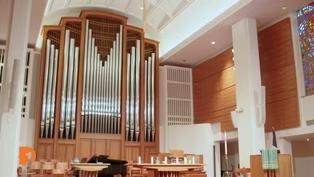
(organ playing Holy, Holy, Holy) - Hi, my name is Reverend Bethany Peerbolte.
I am the Associate Pastor for Youth and Mission here at First Presbyterian Church in Birmingham.
We call ourselves everybody's church.
Our mission is to cultivate Christ's love through mission, inclusion, and community.
So Christianity is really diverse.
It's got 33,000 denominations worldwide.
There's 2.5 billion Christians in the world.
At our core we all follow Jesus and the teachings that we find in the Bible.
So today we've invited Mariah and Lucia to join us on this religious diversity journey through Christianity to learn a little bit more about Christianity and how we practice and what this is.
So I hope that they just learn something new, something they didn't think was in Christianity before.
- Hi, welcome!
- Thank you so much for having us.
- Sure!
- I'm Mariah.
- I'm Lucia.
- And I'm John.
- I'm Bethany.
- I'm Lilly.
- Welcome.
- Come on in!
Yeah, we're glad you're here.
(gentle organ music) - [Lucia] My first question is, what is the Bible?
- Christians have lots of ways of talking about the Bible.
Many of us refer to it as the Word of God because we believe it was inspired literally by the Spirit of God.
We as Presbyterians talk about it as the rule of faith and life, meaning it teaches us everything we need to know about faith in Jesus Christ, and about how to live our lives.
- I love to look at the Bible and see all the ways that God has taught us and shown His love towards us in so many different ways.
- How do you use the Bible?
- Personally, as a pastor, I use it as the basis for my preaching and my teaching.
But the other way that I use it is devotionally.
Meaning I read it and then allow the Spirit to speak to me through what's on the pages.
(tranquil piano music) - Are there beliefs most or all Christians have?
- Yes, there are two beliefs that most Christians have.
The first is what we call the divinity of Christ.
Meaning we believe Jesus is fully human and fully divine.
And the other is this thing called the Trinity.
which is probably one of the most confusing of all Christian beliefs.
But I think Bethany is gonna talk a bit more about that inside in a few minutes.
- Trinity is a very complicated idea.
and some adults don't even understand it.
I've heard it explained a lot of different ways.
but this is my favorite way.
So Lilly, what is this?
- [Lilly] It's an egg.
- [Bethany] Good.
(egg cracking) (tranquil music) (plastic bottle crunching) What is this?
- [Lilly] The yolk.
- [Bethany] And that is?
- [Lilly] The whites.
- Good, so we have three parts that make up an egg, just like we have the creator God, Jesus God, and Holy Spirit God, these three parts that make up what we think about as God.
- What do you think are some misunderstandings that people have of Christianity?
- A common misunderstanding is that Christianity is only one way.
And there are so many different kinds of Christians.
Like I said, we're reforming and we're always moving forward in the Presbyterian church.
So we have accepted LGBT people into full inclusion.
They can be ordained.
They can be elders here.
But some other churches still consider that a sin.
Women in leadership is something that a church might differ on.
So there's lots of different belief systems within Christianity.
So we're not all the same.
(tranquil music) (organ playing Amazing Grace) - [Lucia] So Reverend Bethany, why is Jesus so important?
- So Christians believe that there's a problem in the world called sin.
And sin is anything that's not loving.
And God and humanity have tried to fix this problem in lots of different ways.
But God's final way of fixing this problem was to send Jesus.
And Jesus lived a perfectly loving life and taught us how to do that, and then died on the cross so that we could be saved from our sins as well.
So Jesus is really important to us.
Gustavo, why is Jesus important to you?
- Well, Jesus was the messenger of God and the Son of God.
He showed us how to live a good Christian life by example, showing love and treating others the way you wanna be treated.
He died on the cross for us, and I respect Him a lot for that.
- That makes sense.
What is the white thing that you wear on your neck?
- Yeah, so this is a clerical collar or a tab collar.
It started way back in the Victorian era where they'd have those big frilly collars, and pastors wanted to be more simple.
And so they made this more official.
It was actually a Presbyterian pastor who created this as the sort of clerical collar.
And when I go out shopping, I can take it out so I don't have to be a pastor anymore.
And then I can put it back in when it's time for me to visit someone and be a pastor again.
Pastors also will wear a special robe during worship or stoles.
And the stoles are different colors.
They usually go along with whatever the color of the season is.
So right now we're in ordinary time.
So it's green.
We have, Advent is purple.
We have Pentecost, which is red.
Weddings I might wear one that's a little bit more frilly and white.
So there's lots of different reasons.
And they convey different things.
I have one that's a rainbow stole, and that's to show that this church is open and affirming of LGBT people.
Thank you so much for being here.
You and Mariah had such good questions.
We're so thankful that you came.
- Thank you for having me, I learned a lot.
(organ playing Amazing Grace) - Well, we're glad you guys were here.
It was a great time.
(conversation drowned out by organ) - Yeah, okay, bye.
(violin playing Amazing Grace) - Christianity is the third story in our religious diversities journeys, For our stories on Hinduism and Sikhism, just go to our website, at onedetroitpbs.org.
All right, we are going to leave you tonight with a performance that was recorded at Marygrove in Detroit.
And this is all part of a new partnership between Detroit Public Television and the Marygrove Conservancy to bring performances to us while we are distancing at home.
So here is jazz guitarist Ron English.
Enjoy it.
And I will see you next time on "One Detroit".
Take care.
(instrumental jazz music) ♪ If there was ever a man ♪ Who was generous, gracious and good ♪ ♪ That was my dad ♪ The man ♪ A human being so true he could live like a king ♪ ♪ 'Cause he knew ♪ The real pleasures ♪ In life ♪ To be devoted to ♪ And always stand by me ♪ So I'd be unafraid ♪ And free (instrumental jazz music) ♪ If there was ever a man ♪ Who was generous, gracious and good ♪ ♪ That was my dad ♪ The man - [Female Announcer] You can find more at onedetroitpbs.org, or subscribe to our social media channels and sign up for our "One Detroit" newsletter.
(upbeat music) From Delta Faucets to Behr Paint, Masco Corporation is proud to deliver products that enhance the way consumers all over the world experience and enjoy their living spaces.
Masco.
Serving Michigan communities since 1929.
- [Male Announcer] Support for this program provided by the Cynthia and Edsel Ford Fund for Journalism at Detroit Public TV.
The Kresge Foundation.
Community Foundation for Southeast Michigan.
- [Female Announcer] The DTE Foundation is a proud sponsor of Detroit Public TV.
Among the state's largest foundations committed to Michigan-focused giving.
We support organizations that are doing exceptional work in our state.
Visit dtefoundation.com to learn more.
- [Male Announcer] Business Leaders for Michigan.
Dedicated to making Michigan a top 10 state for jobs, personal income, and a healthy economy.
Nissan Foundation.
Ally.
The Fred A. and Barbara M. ERB Family Foundation.
And viewers like you.
(buoyant piano music)
Video has Closed Captions
Clip: S4 Ep3 | 6m 14s | Christianity Interfaith Tour | Episode 403/Segment 3 (6m 14s)
Performance: "Song for My Father"
Video has Closed Captions
Clip: S4 Ep3 | 2m 59s | Performance: "Song for My Father" | Episode 403/Segment 4 (2m 59s)

Video has Closed Captions
Clip: S4 Ep3 | 4m 28s | Peter Whorf & Anthony Wing | Episode 403/Segment 1 (4m 28s)
Video has Closed Captions
Clip: S4 Ep3 | 8m 16s | Superior Skies | Episode 403/Segment 2 (8m 16s)
Providing Support for PBS.org
Learn Moreabout PBS online sponsorship
- News and Public Affairs

Top journalists deliver compelling original analysis of the hour's headlines.

- News and Public Affairs

FRONTLINE is investigative journalism that questions, explains and changes our world.












Support for PBS provided by:
One Detroit is a local public television program presented by Detroit PBS