
Pewabic, Obsidian Theatre Festival, Birdie’s Bookmobile
Season 8 Episode 52 | 26m 46sVideo has Closed Captions
Pewabic pottery, the Obsidian Theatre Festival, Birdie’s Bookmobile and upcoming events.
One Detroit’s Bill Kubota visits Pewabic to learn about its #TrulyDetroit history and how it’s still going strong today. Details on the 4th annual Obsidian Theatre Festival, which highlights Black stories and storytellers. A Detroit teacher gets more books into the hands of students. Upcoming events on “One Detroit Weekend.” Plus, a performance from Hadassah Greensky and The Swift Voice Singers.
Problems playing video? | Closed Captioning Feedback
Problems playing video? | Closed Captioning Feedback
One Detroit is a local public television program presented by Detroit PBS
Pewabic, Obsidian Theatre Festival, Birdie’s Bookmobile
Season 8 Episode 52 | 26m 46sVideo has Closed Captions
One Detroit’s Bill Kubota visits Pewabic to learn about its #TrulyDetroit history and how it’s still going strong today. Details on the 4th annual Obsidian Theatre Festival, which highlights Black stories and storytellers. A Detroit teacher gets more books into the hands of students. Upcoming events on “One Detroit Weekend.” Plus, a performance from Hadassah Greensky and The Swift Voice Singers.
Problems playing video? | Closed Captioning Feedback
How to Watch One Detroit
One Detroit is available to stream on pbs.org and the free PBS App, available on iPhone, Apple TV, Android TV, Android smartphones, Amazon Fire TV, Amazon Fire Tablet, Roku, Samsung Smart TV, and Vizio.
Providing Support for PBS.org
Learn Moreabout PBS online sponsorship- [Announcer] Coming up on "One Detroit."
We'll tell you the history behind Pewabic Pottery.
A business that is truly Detroit.
- I kinda wanna sell it, John.
- [Announcer] Plus we'll have details on a Detroit theater festival that uplifts Black stories and storytellers.
Also ahead, a Detroit teacher embarks on a mission to encourage children to read it.
- Together.
- [Announcer] Plus we'll tell you what's happening around town this weekend in June.
And we'll end with a performance by Native American artist, Hadassah GreenSky.
It's all coming up next on "One Detroit."
- [Narrator] From Delta faucets to Behr Paint.
Masco Corporation is proud to deliver products that enhance the way consumers all over the world experience and enjoy their living spaces.
Masco, serving Michigan communities since 1929.
- [Narrator] Support also provided by the Cynthia & Edsel Ford Fund for journalism at Detroit PBS.
- [Narrator] DTE Foundation is a proud sponsor of Detroit PBS.
Among the state's largest foundations committed to Michigan focused giving, we support organizations that are doing exceptional work in our state.
Learn more at dtefoundation.com.
- [Narrator] Nissan Foundation.
And viewers like you.
(bright music) - [Announcer] Just ahead on "One Detroit."
We'll talk about what's playing at this weekend's Obsidian Theater Festival in Detroit.
Plus we'll show you how a Detroit teacher is getting more books in the hands of students.
Also ahead, Peter Whorf from 90.9 WRCJ gives us some ideas on how to enjoy the weekend leading up to the 4th of July holiday.
And we'll have an appearance by indigenous performer Hadassah GreenSky at the Kresge Foundation Centennial Celebration.
But first up, a truly Detroit story about a business that's popular among art lovers.
Pewabic Pottery has been a mainstay in Detroit's East Village neighborhood for more than a century.
The distinctive tiles and other ceramic art produced at the pottery are a huge part of the city's history.
One Detroit's Bill Kubota has the story.
(bright music) - [Bill] A fixture on Detroit's east side on Jefferson in East Village, Pewabic Pottery where you'll see a really old clay mixing machine.
- It was made very well back in 1912 and it's still operating today like a charm.
- [Bill] Pewabic Pottery, turning out ceramic vases, decorative and architectural tiles.
A Detroit legacy that goes back to the turn of the last century.
- Well, I think that's kind of the beauty of Pewabic is we started at a time where this was really popular throughout United States, but we are really one of the oldest continuously operating historic pottery.
So not many more left like us.
- [Bill] Pewabic was thriving in the 1920s part of the arts and crafts movement.
A reaction to the industrialization sweeping the nation, especially places like Detroit.
How to bring some humanity, art and beauty amongst all these machine made things?
Meanwhile, dental equipment supplier Horace Caulkins created a kiln to fire enamel for porcelain teeth.
- Horace was a really good business person and so kind of realizing that there was this entire new art trend growing within the City of Detroit, known as China painting, he expanded his line of kilns into kilns for the firing of pottery.
- [Bill] Caulkins began working with a China painter, Mary Chase Perry, - Our founder, Mary Chase Perry, later Mary Chase Perry Stratton was born in Hancock, Michigan.
- [Bill] Hancock in the upper peninsula with its copper mines, including a mine called the Pewabic.
Stratton liked that name.
- Mary was really the artistic vision of the organization and that was something that was fully supported by her business partner.
- [Bill] Education director Annie Dennis has been discovering Pewabic's history, doing a deep dig into the archives.
- We are finding that she had connections to the Detroit Suffrage movement.
And I think it was really inspiring for women artists to find a woman run organization.
And that's no different today.
I think the coolest and best part about Pewabic, and not just today, but just historically, are the people that continue to be drawn to this place and care for it.
- [Bill] Back in the clay mixing room, Cameron Hodge runs the machine that removes excess water.
- This is still one of the best ways that you can produce clay.
My last major position was as a distiller and it was actually a very similar process of mixing a batch of whiskey and then mixing a batch of clay.
So that's actually how I got hired in fabrication.
- [Bill] The molds that shape the clay for a lot of projects, the process, pretty much the same as it's always been.
- Take the slug, put it into the mold, use my arbor press to press it into all the corners.
I like when the public comes around 'cause it's a nice reminder of like, how special this job actually is, that we to make these tiles that, you know, some of them are about 100 years old as far as the design goes.
And we just continuing the legacy and being a part of the history of Detroit.
It's pretty cool.
- [Bill] After the shaping, some get a spray cone.
These tiles and original Stratton design hand painted by glaze technician Cassidy Downs.
Then comes the firing, but the process isn't all old school.
Brett Gray's in the kiln room.
- I have a degree from CCS and ceramics.
Before that, I made custom surfboards and then I ended up here working in the vessel department.
The biggest difference between historic kilns and these kilns are these are all computer controlled.
And we do about five different glazes in here right now.
So as I'm pulling these out, I'm kind of looking over them to make sure everything looks good.
There's no imperfections.
Just came out perfect.
99% of the time, they do.
- It's hard to talk about Pewabic glazes without starting with iridescent glazes because it's really what essentially helped to put Pewabic on the map well over 100 years ago.
- [Bill] Glazes with an iridescent finish.
- So this is a before and after, before it goes into iridescent.
This one has the iridescent on it, which is also a third firing.
- [Bill] Here's where art and science converge.
In the old days, elements like lead and uranium gave these works, which you can see at the museum here that remarkable luster.
These finishes replaced with far less hazardous materials now.
Stratton's work brought together other creatives who established modern Detroit's legacy of art and design.
- I really think it was this network of designers and architects and artists that kind of helped to form the path of Pewabic pottery.
And this group, you know, not only influenced the aesthetics of the City of Detroit and kind of this visual landscape, but also the educational communities.
For example, the Detroit Society of Arts and Crafts is still alive and well in Detroit.
It's now known as the College for Creative Studies.
They also had ties to the University of Michigan.
In fact, Mary helped to found the art program at U of M. The first Wayne State University ceramics classes for the first 15 years existed here at Pewabic.
- [Bill] Pewabic tiles abound around Detroit, projects old and new, the Guardian Building, the Detroit Institute of Arts, Comerica Park.
And now, right now, renewed interest about what's going on at Pewabic.
- You know, the digital age that we're in right now had people refocus on things that celebrate things made by the human hand.
And so we're actually seeing this really incredible resurgence of people, you know, understanding now more than ever why it's important to have artists work and create things by hand.
- I was adjusting to their world, assimilating to their norms.
- [Narrator] The Obsidian Theater Festival is back for its fourth year of telling stories from an African American perspective.
The event kicks off tonight and runs through the weekend at various locations in downtown Detroit.
This year's festival includes four plays, a new musical and a cabaret fundraiser.
American Black Journal guest host, Trudy Gallant-Stokes spoke with co-executive producer John Sloan III from GhostLight Creative Productions.
(techno music) - So, exciting things coming up at the end of the month and we've got a of things to talk about.
But just talk about the impact and you know, what the obsidian the whole theater event is.
- Yeah, so you know, 2020 was a hard year for everybody, right?
It was a hard year because of a pandemic and it was also a hard year because we all had to wrestle with social justice upheavals.
And for some folks, that was shining a new light on things.
And for others, it was a reminder of what we deal with on a regular basis.
And for me as an artist and an activist, I wanted to figure out how to put both of those things into the same energy, right?
And into the same effort.
And so that's where the Obsidian Theater Festival came from.
We have been going into our fourth season, a consistent annual platform for merging Black voices in theater and film.
A place where writers know they don't have to be censored, where directors can get a shot at directing a new piece, where actors can work.
And we pay an employee every year over 100 folks to be able to produce this work.
We film the work, we stream the work online.
And this year, as we go into our fourth season, I'm really thrilled to say that we're also growing the full year long programming and launching and impact arts conference here in Detroit.
So we got a lot of stuff going on in June.
- Magnificent.
And I know in terms of the plays this year, you've got a broad range.
Kind of just touch on the themes and what the plays are that are going to be presented.
- Yeah, we do.
You know, it's difficult, right?
Because we do a blind submission process.
And so we have no idea where these pieces are coming from.
We remove any identifying information from the playwrights when they do their applications just to make sure there's no bias, right?
In how we're choosing and selecting these pieces.
And we really have some amazing work this year.
We've got a piece called "The Sisters Gray," which touches on kind of topically, the interesting intense relationships between Black and Jewish communities.
And we've got a piece called "The Crooked Parts," which is a wonderful exploration of a relationship with the Black trans man and his mother.
And then we have just a couple hilarious pieces in "Black Santa," which is this wonderful exploration of what happens when a little Black girl decides to tell her class that Santa is a Black man from Detroit.
And the upheaval (laughs) that happens in this like white privileged charter school, right?
And then we've got a number, really amazing family centered piece called "The Golden Lock."
Which is this beautiful fantasy tale about a young girl who goes through her mirror into this world of fairies and discovers beauty in herself, in her hair, in her skin.
And so we've got pieces that span the entire spectrum.
We're producing a musical over at the Opera House, we've got a opening night cabaret at the gym.
So we've got options for everybody.
- So tell me about the playwrights, have you seen that change over time, age range, number of people who applied?
You know, once the word gets out, I'm sure, like you said, this is a platform that's not judgmental, not subject to censorship.
So I would think that there'd be a lot of people that wanna jump at this.
- There are.
We get over 125 submissions every year for this type of a festival.
That's a good amount based upon our size.
Remember, we're only four years old, right?
We're toddlers.
And so as we're growing, we're seeing more and more folks come.
And the one thing I do wanna impress upon everybody is this is a Detroit-centered project.
And so 80% of the people that are from this, that are from our work that that we center in our company are Detroiters, are our Black Detroiters.
And that's really, really important to us.
We're also seeing the types of stories shift, right?
And being a writer's an interesting prospect, you start writing a piece in 2020 and it takes you a year or two to get it up and now it's 2022, 2023 and the world has changed around you.
And so we're seeing these pieces that are reflective of that.
We're seeing these pieces that speak to the current politics that are happening around us, whether that is overseas, whether that's right here, whether that's the politic of next door neighbors that might be from different backgrounds and how they relate to each other and how they communicate.
And you know, we're seeing all of our artists really being involved.
Something that I'm really, really proud of is the fact that our playwrights get to have conversation with the directors, with the actors.
And for a lot of these writers, this is one of the first times they've seen their pieces up on a stage.
And that's a huge value.
- Exactly.
And what does that say to young people in the community when they start to see that and understand that there are opportunities for them out there?
- You know, when I was younger, I was blessed to have two parents that are educators and a mother and an auntie that are music teachers.
And so I had access right to a whole lot of work, a whole lot of cultural experiences that I assumed were standard.
I figured everybody has access to this, right?
And unfortunately, not necessarily, yeah.
And DPSCD does what they can.
Organizations like Mosaic Youth Theater or Matrix, they do what we can.
We are also doing our best to provide that platform.
And so one of the things that we really wanna do is make sure that young people, young artists, and also emerging artists of any age, there are some 35, 45, 55-year-olds that wanted shift careers that's and start something new and always wanted to get into this, right?
So we wanna make sure that they have an understanding of what that career path can look like.
- [Narrator] A Detroit teacher is doing her part to spread the joy of reading by making sure children have access to a diverse selection of books.
Alyce Hartman came with an idea on how to get more books in the hands of students at a time when school library resources are diminishing bridge.
Detroit contributor Eleanore Catolico teamed up with One Detroit's Chris Jordan to tell the story of Birdie's Bookmobile.
(techno music) - Because we fit together like beats of a drum, like the chorus of notes and the chords that you strum.
- [Eleanore] Inside room 148, Alyce Hartman reads a book about a eclectic trio of musicians, a squirrel, a grizzly bear, and a chicken.
A group of second graders sit and listen.
In the end, the three talking animals form a band and the students get a lesson on friendship and belonging.
- We make our own music.
We have nothing to prove.
We do our own thing and find our own proof.
- [Eleanore] Hartman is a stem and drama teacher at Detroit Prep.
When she isn't teaching, she's on a mission to grow the next generation of readers as school librarians and school libraries have begun to disappear.
- There are a lack of books in the schools.
- [Eleanore] Hartman launched her pop-up literacy initiative, Birdie's Bookmobile two years ago and hopes to fill a resource gap.
She hits the road and delivers hundreds of books to schools, after school programs, and non-profit organizations across Detroit.
- The books that are distributed, the children get to keep.
They're taking them home, sharing them with their families.
- [Eleanore] Since Birdie's Bookmobile was born, Hartman said she's given away more than 16,000 books.
Today, she makes a trip to Voyager Academy, a K-12 charter school in southwest Detroit.
The school doesn't have a library.
Hartman spent the morning hauling books into the school and gave over 500 to Voyager.
Where does your passion come from to do this work?
- I was an early reader and an avid reader.
My mother was a kindergarten teacher.
So I was always surrounded by books.
I had a large collection of books as child.
I loved reading and those books really opened these avenues of creativity for me.
And so I would always imagine that I was a character.
I would add dialogue and just really pretend, you know, to be in the story.
And I want children here in the city to really enjoy reading as much as I did - [Eleanore] At Voyager, Hartman set up a book fair for the students.
There are books about Kamala Harris and Nelson Mandela, a book called "Soul Food Sunday" by Black children's author Winsome Bingham.
Graphic novels are popular among high school students.
Many of the books Hartman curates include Black and brown characters or books written by authors of color.
- I think I'm really drawn to getting these books into the hands of children so that they can then explore, you know, different career paths and learn more about what other cultures are doing and other characters.
You know, and the stories might differ from the experiences that they've had.
- Something like that.
- [Eleanore] Department serve schools and nonprofits across the city.
- They're looking for books that reflect the community and that's what we're providing.
- [Eleanore] Literacy experts say children of color are still overlooked in mainstream culture.
Diverse books can teach students to be compassionate toward people who are different from them and toward themselves.
When a student sees themselves reflected in a story, their confidence can blossom.
Just ask 13-year-old Kai Fee.
- As Black girls, we don't get very much attention.
- Kai is an eighth grader Voyager.
She picked up the young adult fantasy novel, "The Gilded Ones," written by Namina Forna, an author who grew up in Sierra Leone.
When she saw the cover, she said to herself, "Black girl magic."
- I feel like this book will talk about some things that we have in common maybe 'cause we're both two Black girls and she seems like she's a young girl like me.
So I feel like this could help me like believe more in myself.
- [Eleanore] High school senior Tyler McKinnon picked up two books wrestling with the themes of war.
Sometimes McKinnon can't find books that entice him, so he appreciates the variety Birdie's Bookmobile provides.
- I feel like reading, you know, even like news articles, it helped me like not be ignorant and like, you know, expand my knowledge because I like to educate myself.
- [Eleanore] In the afternoon, Hartman heads to 27th Letter Books in Southwest Detroit.
The bookstore carries historically underrepresented authors.
Erin Pineda, the bookstore's co-owner helps Hartman shop.
She recommends a picture book about body positivity, Pineda's Dog Chai watches the fun.
- The work that like Alyce is doing is so, so critical in getting books into kids' hands so that they can develop a love for literature and for learning.
And like letting them know that they deserve those things because they do, you know.
- Thank you.
- And that's really important.
- [Eleanore] The bookstore supports Hartman's mission by helping her save money on books.
- An ongoing program that we have here at 27 Letter Books is called Roundup for Reading.
And when folks come into our store and purchase something, they are given the option of rounding the purchase up to the nearest dollar.
And that difference helps fund a fund that allows us to give books to Birdie's Bookmobile.
So we are able to give them the books at cost and just, you know, keep that perpetual cycle of like books coming in and being able to go out into the hands of kids in Detroit.
- [Eleanore] Last year, a fire destroyed Hartman's old ride, a bus.
In the meantime, she's using a van.
Still spreading the joy of reading to the children of Detroit.
A joy she hopes will last a lifetime.
- I hope to grow lifelong readers and raise storytellers and have a generation of children who are interested in reading and really find joy in it.
And who are able to just get lost in a book every now and then.
- Raise your hand if you like it.
(kids applauding) - [Narrator] The 4th of July is almost here and that means lots of picnics, parades, and pyrotechnics over the next week.
Peter Whorf of 90.9 WRCJ has a list of holiday activities, summer festivals, and more in today's One Detroit Weekend.
- Hey everyone, I'm Peter Whorf with 90.9 WRCJ.
July 4th is next week and there are many Independence Day events and festivals you can check out.
First up, the Livonia Spree is currently happening through June 30th.
The festival brings in local bands, food vendors, a carnival and more.
The event finale is Sunday night with a beautiful fireworks display.
If you're closer to downriver, there's the Taylor Summer Festival today through June 30th with all of the great Carnival activities we love plus music, food, and this year, there's even a brand new drone show.
And hot air balloons are celebrated at the Michigan Balloon Fest in Howell Friday through Sunday.
There'll be plenty of entertainment, fireworks, and family-friendly activities.
To celebrate the 4th of July holiday, Greenfield Village is holding its salute to America July 2nd through the fifth.
The event shines at night when the Detroit Symphony Orchestra puts on an incredible performance capped off by Tchaikovsky's 1812 Overture, Cannon Fire and a fireworks finale.
And now through September 8th, dinosaurs will be at the Detroit Zoo.
That's right, Dinosauria is back where you can walk the trail and see animatronic beasts along the way.
Don't think these are all of the events happening around here.
There's so much more.
Here's a list of a few of them.
Have a great weekend.
(gentle upbeat music) - [Announcer] That'll do it for this week's "One Detroit."
Thanks for watching.
We're going to leave you now with a performance by Hadassah GreenSky and The Swift Voice Singers taken from the pop-up performances at the Kresge Foundation's 100th anniversary celebration.
Their traditional song and dance is rooted in the Anishinaabe spiritual beliefs and connection to nature, ancestors, and community.
(upbeat traditional music) (upbeat traditional music) (upbeat traditional music) (upbeat traditional music) (upbeat traditional music) - [Narrator] This program is made possible in part by Timothy Bogert, comprehensive planning strategies.
- [Narrator] From Delta Faucets to Behr Paint.
Masco Corporation is proud to deliver products that enhance the way consumers all over the world experience and enjoy their living spaces.
Masco, serving Michigan communities since 1929.
- [Narrator] Support also provided by the Cynthia & Edsel Ford Fund for journalism at Detroit PBS.
- [Narrator] DTE Foundation is a proud sponsor of Detroit PBS.
Among the state's largest foundations committed to Michigan focused giving, we support organizations that are doing exceptional work in our state.
Learn more at dtefoundation.com.
- [Narrator] Nissan Foundation and viewers like you.
(soft upbeat music) (bright music)
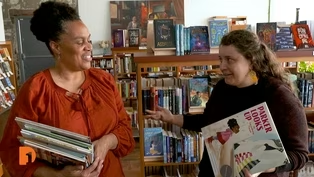
Birdie’s Bookmobile spreads joy of reading to children
Video has Closed Captions
Clip: S8 Ep52 | 6m 3s | Birdie’s Bookmobile, a Detroit literacy organization, spreads the joy of reading to kids. (6m 3s)
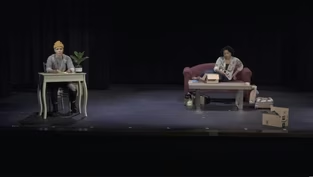
Obsidian Theatre Festival shows Black stories, storytellers
Video has Closed Captions
Clip: S8 Ep52 | 6m 1s | 4th Annual Obsidian Theatre Festival in Detroit highlights Black stories and storytellers. (6m 1s)
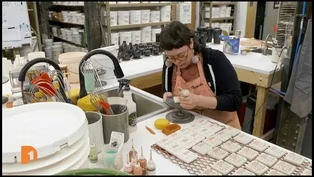
Pewabic: One of nation’s oldest pottery, ceramics factories
Video has Closed Captions
Clip: S8 Ep52 | 5m 58s | One Detroit visits Pewabic, one of the nation’s oldest ceramic and pottery factories. (5m 58s)
Providing Support for PBS.org
Learn Moreabout PBS online sponsorship
- News and Public Affairs

Top journalists deliver compelling original analysis of the hour's headlines.

- News and Public Affairs

FRONTLINE is investigative journalism that questions, explains and changes our world.












Support for PBS provided by:
One Detroit is a local public television program presented by Detroit PBS