One-on-One
Philip Musey; Byron Motley
Season 2024 Episode 2676 | 26m 42sVideo has Closed Captions
Philip Musey; Byron Motley
Writer and Director Philip Musey joins Steve Adubato at the NJEA Convention to discuss his film “The Inventor”, which explores the obstacles Garrett Morgan faced as a black inventor. Filmmaker and Producer Byron Motley talks about his documentary “The League”, which explores the Negro Leagues, its impact on the game, as well as the lives of baseball legends such as Satchel Paige and Larry Doby.
Problems playing video? | Closed Captioning Feedback
Problems playing video? | Closed Captioning Feedback
One-on-One is a local public television program presented by NJ PBS
One-on-One
Philip Musey; Byron Motley
Season 2024 Episode 2676 | 26m 42sVideo has Closed Captions
Writer and Director Philip Musey joins Steve Adubato at the NJEA Convention to discuss his film “The Inventor”, which explores the obstacles Garrett Morgan faced as a black inventor. Filmmaker and Producer Byron Motley talks about his documentary “The League”, which explores the Negro Leagues, its impact on the game, as well as the lives of baseball legends such as Satchel Paige and Larry Doby.
Problems playing video? | Closed Captioning Feedback
How to Watch One-on-One
One-on-One is available to stream on pbs.org and the free PBS App, available on iPhone, Apple TV, Android TV, Android smartphones, Amazon Fire TV, Amazon Fire Tablet, Roku, Samsung Smart TV, and Vizio.
Providing Support for PBS.org
Learn Moreabout PBS online sponsorship- [Narrator] Funding for this edition of One-On-One with Steve Adubato has been provided by The New Jersey Education Association.
NJ Best, New Jersey’s five-two-nine college savings plan.
Atlantic Health System.
Making healthy easier.
Rowan University.
Proudly serving New Jersey for 100 years.
Citizens Philanthropic Foundation.
New Jersey Sharing Network.
PSEG Foundation.
Robert Wood Johnson Foundation.
Working for a more a healthier, more equitable New Jersey.
And by NJM Insurance Group.
Serving New Jersey’s drivers, homeowners and business owners for more than 100 years.
Promotional support provided by NJ.Com.
Keeping communities informed and connected.
And by ROI-NJ.
Informing and connecting businesses in New Jersey.
- This is One-On-One.
- I'm an equal American just like you are.
- The way we change Presidents in this country is by voting.
- A quartet is already a jawn, it’s just The New Jawn.
- January 6th was not some sort of violent, crazy outlier.
- I don't care how good you are or how good you think you are, there is always something to learn.
- I mean what other country sends comedians over to embedded military to make them feel better.
- People call me 'cause they feel nobody's paying attention.
-_ It’s not all about memorizing and getting information, it’s what you do with that information.
- (slowly) Start talking right now.
- That's a good question, high five.
(upbeat music) Hi everyone, Steve Adubato.
I'm here with my colleague, Jacqui Tricarico.
Jacqui, today on this series that we're doing looking at a whole range of interviews we did at the New Jersey Education Association 2023 Convention, Atlantic City.
The programs are seen in 2024.
Tell folks, now I interviewed two fascinating people, two compelling interviews.
Let's tee that up.
- Yeah Steve, this is all a part of this new component at the NJEA Convention this year, their film festival.
Really fantastic way to show some films that have such an impact.
And two of the folks that you spoke to were Philip Musey, who is the writer, director, and producer of the film, "The Inventor, which is about this really incredible inventor, Garrett A. Morgan.
So we could see you talk to him about who was Garrett Morgan and why was he so important.
And then on the backend, you get to speak with Byron Motley, the filmmaker of "The League," another really fantastic interview learning about this film that centers around the Negro Leagues, and specifically, too, in Newark.
- In baseball.
- Jersey baseball, yeah.
And I know that is a passion of yours.
You could tell in that interview you really loved doing that interview with him because you have such a knowledge and history and love for baseball, especially when it comes to the Newark Eagles, and the Negro Leagues.
- Yeah, so let's go back.
Jacqui, I didn't know this until, and Jacqui is also the executive producer for a lot of these interviews.
And as you check out this series from Atlantic City from the NJEA Convention, New Jersey Education Association Convention, many of those interviews were done by Jacqui.
Check them out.
These two I happened to do, but with Philip Musey, "The Inventor."
I didn't know who Garrett Morgan was.
A Cleveland based African American inventor, most notably recognized for the patented three-signal traffic light.
Who knew?
- Yeah, and the gas mask and his film, his short film is all about him inventing the gas mask and not getting the recognition that he deserved for that invention.
And his short film really describes that and sets the tone for that of what that looked like, why that happened.
And then, segueing into exploring why aren't more inventors, especially African American inventors, getting the recognition that they deserve even up until today.
- Yeah, and on the other one with Byron Motley, the filmmaker, producer of "The League."
Again, lemme go through some of the names, and again, Jacqui and I, through our series that we co-anchor called "Remember Them," take a look at some of the greats that we have featured who are no longer with us, who were part of the Negro League.
Larry Doby, the first African American to play in the American League, right after Jackie Robinson broke the color barrier with the Brooklyn Dodgers, but, also, listen to some of these folks.
Satchel Paige, the great Satchel Paige.
These are folks featured in "The League" that Byron Motley produced and took years to put together.
Buck O'Neil.
The great Willie Mays.
People go, oh yeah, Willie Mays.
He played for the San Francisco Giants and then the Mets.
No, no, no, before that he was part of the League.
Hank Aaron, thee Hank Aaron from the Atlanta Braves had the home run record many, many years.
And many people still consider him the greatest Home Run King of all time.
Fascinating, and also, Jacqui, what about, I know you'll appreciate this.
Didn't we do a special on "Remember Them" on Effa Manley?
Tell everyone who Effa Manley was.
- I was just gonna say, let's not forget about Effa Manley who was featured in the film.
And, also, I know that Byron is now working on another documentary all about Effa Manley, baseball's leading lady, if we wanna call her, who was part owner of the Newark Eagles.
- The Newark Eagles were an African American, a Black baseball team.
They were great, they were great.
And many people talk about the Newark Bears who were a farm team, if you will, going to the Yankees.
A lot of the Yogi Berra, Phil Rizzuto, and others, they talk about them as one of the greatest teams of all time, the Newark Bears, but the Newark Eagles, what a team.
I think Larry Doby played for them as well.
Effa Manley ran that team.
Her husband owned the team, she ran the team.
And so what you're about to see is two interviews.
One with Byron Motley, the filmmaker, and producer of "The League, but first off, Jacqui, is Philip Musey.
- Correct, yep, filmmaker and producer of "The Inventor."
- Well, Jacqui said it better than I could.
Let's check it out.
- Slow Jazz Music - Hi, everyone.
Steve Adubato.
We're at the 2023 New Jersey Education Association Convention here in Atlantic City.
One of the really talented filmmakers that we have here is Philip Musey, who is a writer, director, producer of a film called "The Inventor."
Who's the inventor?
- The inventor is Garrett Augustus Morgan.
He was a very sort of famous black entrepreneur who lived at the early, sort of early 1900's.
He invented the traffic light, the three signal traffic light.
- The traffic light, - Yep, yep.
The the one that, you know, everyone uses when they walk.
- And why don't we know him?
- He's under unpublicized.
He's under publicized.
So he unfortunately had to hire a series of, you know, white actors and white attorneys and patent lawyers to stand in for him in order to gain the credibility that he needed to, you know, have his inventions take root.
So a lot of people dunno about him, but we're hoping that we can, you know, publicize his life a little bit more through this film.
- And Philip, this is part of, we're here at the New Jersey Education Association Convention as I said.
There's a film festival going on, and you could have films about all kinds of things, but there's a theme in these films, and that's why Philip is here.
This is not just about racial equity, it's about honoring, recognizing people who have been ignored for way too long, whose contributions for all of us to all of us are significant like Garrett Morgan, what got you involved?
PS.
Morgan used to call himself, and if I'm wrong, you'll tell me, "The Black Edison."
- [Philip] That's right.
- He called himself that.
- He called himself that, yeah.
He was a really self-confident guy.
So because he was actually born to formerly enslaved parents, and he had a very humble beginning.
So, you know, and ended up moving to Cincinnati when he was around 14 years old, worked a series of odd jobs and eventually opened up his own tailor shop.
He started, he started many businesses in the Cleveland area.
He actually ran for city council.
So he was a very, very involved civic figure.
And the way that I got involved in the project actually was through my producing partner, Cabral who - - Who's actually here with you today.
- He was here with us.
Yeah, he did a project on Garrett in the second grade, if you can believe it.
- No.
- In the second grade.
- So he finds out about Garrett Morgan.
He tells you, you go, who's this guy?
- That's right.
- Let's do a film called The Inventor.
- That's right.
That's right.
And I should say that Garrett Morgan is actually very, very well known in the Cleveland area.
And there are a lot of teachers, actually, you know, teachers at this conference who include Garrett in their curriculum.
So there are other second grade students, elementary school students who are learning about Garrett's impact.
And one of the things that we're hoping to do is contribute to that sort of the renaissance of people knowing about his legacy.
- Yeah, the other thing that I read in preparation for this interview with you, Philip, is the safety mask.
Put the safety mask thing and Garrett Morgan in context, I'm thinking, what do you mean the safety mask?
- Yep, yep.
Sp he started a company called the National Safety Device Company.
- What year?
- He patented the safety hood in 1914.
- Right.
And so this was the precursor to the modern gas mask, right?
So he had this idea that in order to enable firefighters and rescue workers to breathe when they were in noxious environments, you could breathe, you know, put on this hood that essentially drew air, clean air from the bottom of you know, closer to the ground.
And you know, he was going around to different fire departments trying to pitch this, this lifesaving device.
He actually tested it himself.
- [Steve] How?
- He would go into these tents and he would light these chemical fires, and he would sit in these tents for 30, 40 minutes and he would come out and prove that he was, you know, unharmed.
- He did it himself?
- He did it himself.
He did it himself, yeah.
- Was he getting blown off by a lot of these fire departments and others who just, even if they thought it was an important safety device, that they weren't buying into him in 1914 because of obvious reasons, race?
- Yep.
Yep.
So this was one of the reasons that he had to hire white actors.
- What do you mean white actors?
For what?
- To convince people that he, so actually what his tactic was, what he would have these actors stand in for him and portray Garrett the inventor, because if he, you know, showed up to a fire department and said, hi, I'm Garrett Morgan, I've invented these hoods.
He was essentially blown off.
So he hired, hired people to pose as the real inventor.
And once he started doing that, sales actually took off.
- This film, "The Inventor," we're talking to Philip Musey, we'll have his website up, his information, so you can find out more about the inventor, a part of the film festival here at the NJEA Convention.
We've been here for many, many years with my colleague Jacqui Tricarico.
The whole idea of a film festival, the whole idea of film as a way of telling stories that are so important that we need to understand that help us understand not just then and the Garrett Morgans of then, but who we are now and where we are now.
Am I making too much of that?
- Yes, yes.
Yeah, I think I'm excited to tell this story because of how relevant it is now.
We're living in an environment where, you know, less than 1% of all venture capital funding that's essentially distributed, goes to black founders.
- 1%.
- Less than 1%.
- Moving into 2024, 1%.
- Yes, less than 1%.
- Not 1924, 2024.
- 2024, in 2024, less than 1% of all venture capital funding goes to black founders.
And so when you look at Garrett Morgan, he was, you know, one and a long legacy of black entrepreneurs, you know, African American inventors and business folks who in this country have built businesses who have built, you know, products and services that have impacted people's lives.
And you know, the more I learn about Garrett, the more inspired I am to sort of do the work of telling additional stories about modern black entrepreneurs and drawing attention to the amazing work that they're doing.
- Yeah.
but for you, in the minute we have left, I'm curious, you're a writer, director, producer, but you're an entrepreneur.
- That's right.
- And listen, we're in the media business.
Half the time we're not doing the thing we really love, which is interviewing people.
We're raising money.
You may get that connection with public broadcasting.
You're an entrepreneur, you're raising money.
- That's right.
- He did the work.
Garrett Morgan did the work.
So many others did the work that I'm not gonna say make it easy or easier for you, but paved the way.
- Yeah, well, it's true that he paved the way for you know, entrepreneurs like me to have sort of the inspiration and a glide path or an easier path, right, to get into conventions like this.
To have our work seen, to have our stories heard.
And one of the things that, you know, I'm really excited to do as an entrepreneur is to create opportunities for other artists to produce work.
- Pay it forward?
- I live in New York City, and I love executive producing, you know, some of my friends' short films and feature films.
And I just love supporting the arts and supporting entrepreneurs and filmmakers.
And that's sort of what gives me, what gets me up in the morning.
- You know, beyond your art, it's paying it forward.
But also, I wanna make it clear that Spike Lee is here.
Spike Lee is here.
He's doing a keynote, he's doing a conversation with Sean Spiller, the president of the NJA.
And that's gotta be exciting for you as well.
- Oh yeah.
- He's pretty good at that, huh?
He's a pretty good filmmaker, no?
- We've all heard of Spike Lee, we've all heard of Spike Lee.
Yeah, he is an inspiration to all of us.
- Well, we're gonna hear more about Philip Musey and I wanna thank you for joining us part of our Arts Connection series on One-on-One part of this very important convention at the NJA.
- Wish you all the best.
Thank you.
- Thank you very much, Steve.
Thanks for having me.
- You got it.
(crowd cheering) ♪ It's you and me against the world ♪ - [Speaker 1] Wherever you had successful Black baseball, you typically had thriving Black economies.
(energetic music) - You have vendors and you have advertising.
You know, people were making money from it.
♪ 'Cause we're runnin', runnin', runnin' away ♪ - But integration was going to kill their businesses.
- It was good morally, but that progress came at a cost.
(energetic music) ♪ Runnin', runnin' ♪ - [Speaker 2] White fans saw a kind of baseball they had never seen before.
- [Speaker 3] The great ball players of the Leagues.
- [Speaker 4] Jackie Robinson- - [Speaker 3] Buck Leonard- - [Speaker 6] Satchel Paige- - [Speaker 7] Willie Mays- - [Speaker 3] Cool Papa Bell- - [Speaker 7] Hank Aaron- - [Speaker 3] Oscar Charleston- - [Speaker 8] Joshua Gibson.
- [Speaker 3] We transformed the game.
(energetic music) ♪ Yeah, yeah, yeah - They are a part of a movement before we coined the term, "Civil Rights Movement".
- Man, they didn't care about making no history.
They just wanted to play ball.
But the pride, the passion, the courage, in the face of adversity, that's the real story.
(energetic music) - Hi, everyone, Steve Adubato at the New Jersey Education Association Convention in AC, Atlantic City.
We're with Byron Motley, who is a tremendous musician, photographer, filmmaker, and producer, and that's why he is here.
Filmmaker and producer of a great film called "The League."
Good to see you.
- Great to be here.
- Tell everyone what "The League" is.
- "The League" is a documentary about the old Negro Baseball Leagues, and it also tells a story about my father, who was the last living umpire from the Negro Leagues.
- Hold on, your dad was the last living umpire in the Negro Leagues?
- In the Negro leagues, yes.
- You grew up around this?
- I grew up around that.
- Where'd you grow up?
- Actually, in Kansas City, but- - That was a big... Kansas City was a huge place for Negro League Baseball.
- Yeah.
So I grew up there.
Unfortunately, the Negro Leagues were disbanded by the time I was born, but I grew up hearing those stories from my father from the time I was a kid.
And it was amazing hearing those stories.
Being a child, you're like "Oh, that's the old people, "that old stuff," but as I got older and realized God, the importance of those stories.
And then I saw the Ken Burns documentary- - [Steve] On baseball.
- Baseball.
- Well, back in '94, I think that was, not sure.
- In '94, yeah.
- So you're watching it.
Does it speak to you?
- It does.
And what it spoke to me was like "This is great, "and I love this, "but these are not the stories I heard "as a child growing up.
"So there's a lot more to this story "than what I'm hearing in this documentary."
- That's how "The League" starts?
- That's- - In your head.
- In my head.
But I'd never made a film before, and it took 24 years to- - Go on back.
I think it you misspoke.
Did you just say it took 24- - 24 years, 'cause I had no idea what I was doing when I first started.
And I went to a friend of mine who had done a lot of movies and everything.
I tried to talk to him about doing this project for me, and I told my father's stories.
He was laughing.
He got it, he got it.
I thought "Perfect."
And I finished, I said, "What do you think?"
He says "I'm not the person to do this story, you are."
And I laughed so hard.
I thought "This man has lost his mind.
"I'm a singer, I'm a songwriter.
"I don't do films."
And it took 24 years to actually get it done.
But I started doing the work 24 years ago, almost here in Atlantic City.
- Well, yeah, hold on one second.
Byron was telling us something.
Stand up for a second, could we get the Dalton on camera?
Bacharach.
- [Byron] Bacharach.
- [Steve] That's not just any name, it's a real name of a team.
- Yes, the Bacharach Giants.
- From?
- From- - Don't say Atlantic City.
- From Atlantic City.
Atlantic City.
The name of the owner, the mayor of Atlantic City at that time, the team was named after him.
- What does Burt Bacharach have to do with this?
- Burt Bacharach was his nephew.
Burt Bacharach was related to the owner.
- The Burt Bach- - The Burt Bach... And Burt did not know that until I met him.
And I said, I said your grandfather... First I said "Your grandfather was..." and I said the man's name.
He says "No, that was my uncle."
I said "Did you know he owned "the Negro League Baseball team?"
He says "I had no idea."
- He didn't know this?
- Did not know this.
Burt Bacharach did not know.
- You interviewed Burt Bach... By the way, we're at the NJEA Convention, you can hear things are going on.
There's a lot of activity here.
But let me ask you something.
You interviewed Burt Bacharach, but you also interviewed some other great Negro League stars.
- Sure.
Monte Irvin.
Oh my gosh, so many.
- I got some names, ready?
- Satchel Paige.
- The Satchel Paige.
The great Satchel Paige.
Buck O'Neil.
- Buck O'Neil.
- How about Willie Mays and Hank Aaron in the Negro Leagues?
- I interviewed both of those guys, yep.
- When you're talking to them, especially Willie Mays and Hank Aaron who became two of the greatest all time Major League Baseball players, their recollection of the Negro Leagues, talk about that.
- Well it was amazing to hear their stories, and to see how humble they were about what they had done, and what they had...
They didn't realize they were creating history, they were just playing a baseball game, like my father.
He was umpiring a baseball game to make a little money, and have some fun.
So, like him, Hank and Willie were just ballplayers.
- [Steve] Right.
- And when they talked about it they were in awe of what that league meant to them.
And they realize the importance of being a part of the Negro Leagues, and what it did for their careers.
'Cause they would not have had a career in Major League Baseball without being a part of the Negro Leagues.
- Jackie Robinson was in the Negro Leagues.
- Absolutely.
- How long?
- One year.
- I was just gonna say one year.
- With the Kansas City Monarchs.
- And Larry Doby.
- Larry Doby for about three or four years with the Newark Eagles.
- [Steve] The Newark Eagles were a big deal.
- [Byron] Huge.
Effa Manley's team.
- Could you do this, because I'm remember them, our sister series, we did a great... Jackie Tricarico and I did a great special on Effa Manley.
Who was Effa Manley, and why does she matter?
'Cause I think your next film is gonna be about Effa Manley.
Talk about her.
- Effa Manley was, oh my God, an incredible woman.
A woman far ahead of her time.
She was a half Black woman, we think.
(laughs) 'Cause she never really revealed.
She said she was white, but she actually was probably a little mulatto.
And if you see a picture of her mother, you know she's definitely mulatto.
But she was the first woman to really co-own a Negro League Baseball team with her husband Abe.
And made stars- - And that was the Newark- - Newark Eagles.
- Eagles.
Now she ran the team.
- Ran the team.
- Made the deals, the sponsorship, advertising deals.
- Did it all.
A woman in a man's space, doing all of that.
- And talk about the baseball Hall of Fame and Effa Manley.
- She's the first woman, only woman inducted into the Baseball Hall of Fame in Cooperstown, the only woman ever, and will probably be the only woman ever in the Baseball Hall of Fame.
She was way ahead of her time.
- Let me ask you something.
You're here at the convention.
By the way, we're talking to Byron Motley, he's a singer, songwriter, photographer, musician, but producer and filmmaker of "The League."
The money part, because those of us who are involved in broadcasting, particularly affiliated with public broadcasting, we're raising money all the time, where'd the money come from for this?
- Mark Cuban's company.
(laughs) - Mag- - Mark Cuban.
- What company put up the money?
- [Byron] Magnolia.
- Magnolia, that's what I thought.
- Yeah.
- That's Mark Cuban's company?
- [Byron] Mark Cuban.
- I should have known that.
But what were you...
Were you self financing before that?
- Yes, for the most part, yeah.
Also, the owner of the Kansas City Royals, when he passed away, his daughter-in-law was friends with my mother, and my mother was telling her about what I was working on.
She said "How can I help him?"
She had gotten all this money from Ewing Kauffman.
And mother told her what I was doing, and I talked to her on the phone.
She says "Would this amount of money be okay?"
I'm like "Yes."
(both laugh) "Yes."
So that got me going.
- How great a feeling when you knew that Mark Cuban's company Magnolia Productions, they were all in?
- Amazing.
I mean what do you say to that?
No?
(laughs) yeah.
- I gotta ask you something.
As someone who's worked so hard, 24 years on this film, and it's part of the, there's a film series going on here, film festival at the New Jersey Education Association Convention.
What's it gonna be like to have so many people not just watch the film, but be moved by it, for you?
- Well that means the world to me.
I mean the fact that people are gonna learn about this history.
And I always tell people don't stop watching the film.
There is so much more information we can learn.
Read a book.
Just do research, and learn more about this incredible history 'cause it's not only American history, not only Black history, but this to me is world history.
There's so many great stories, and people that created this league of really of nothingness.
Of a baseball game that became so important to our culture.
- Before I let you go, I gotta ask you this.
Byron, when baseball was integrated with Jackie Robinson first and then the great Larry Doby from New Jersey after that, it hurt the Negro Leagues.
- Yeah.
- Did it kill the Negro Leagues?
- Pretty much.
- So Major League Baseball, after banning African Americans, they're taking the best players from the Negro Leagues, and so therefore the league- - And they knew that it was gonna kill the league.
That's why Effa Manley fought them so hard because she was like "No, this is what we created."
- [Steve] This is our thing.
- This is our thing.
But you couldn't fight, you couldn't fight the- - Money.
Can't fight money like that.
- [Byron] Yeah, not like that.
- It's a great story.
And it's called "The League."
And Byron Motley is the producer and filmmaker.
You honor us by joining us, my friend.
- Oh, thank you, it's an honor.
- All the best.
- Thank you so much.
- [Narrator] One-On-One with Steve Adubato has been a production of the Caucus Educational Corporation.
Celebrating 30 years in public broadcasting.
Funding has been provided by The New Jersey Education Association.
NJ Best, New Jersey’s five-two-nine college savings plan.
Atlantic Health System.
Rowan University.
Citizens Philanthropic Foundation.
New Jersey Sharing Network.
PSEG Foundation.
Robert Wood Johnson Foundation.
And by NJM Insurance Group.
Promotional support provided by NJ.Com.
And by ROI-NJ.
- (Narrator) New Jersey is home to the best public schools in the nation, and that didn't happen by accident.
It's the result of parents, educators and communities working together year after year to give our students a world class education.
No matter the challenge, because parents and educators know that with a shared commitment to our public schools, our children can learn, grow and thrive.
And together, we can keep New Jersey's public schools the best in the nation.
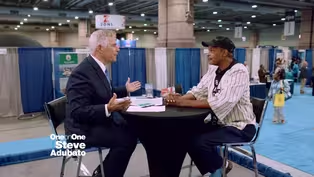
Filmmaker Byron Motley Highlights Satchel Paige & Larry Doby
Video has Closed Captions
Clip: S2024 Ep2676 | 11m 36s | Filmmaker Byron Motley Highlights Satchel Paige & Larry Doby (11m 36s)

Writer Philip Musey Explores Obstacles for Garrett Morgan
Video has Closed Captions
Clip: S2024 Ep2676 | 10m 1s | Writer Philip Musey Explores Obstacles for Garrett Morgan (10m 1s)
Providing Support for PBS.org
Learn Moreabout PBS online sponsorship
- News and Public Affairs

Top journalists deliver compelling original analysis of the hour's headlines.

- News and Public Affairs

FRONTLINE is investigative journalism that questions, explains and changes our world.












Support for PBS provided by:
One-on-One is a local public television program presented by NJ PBS