
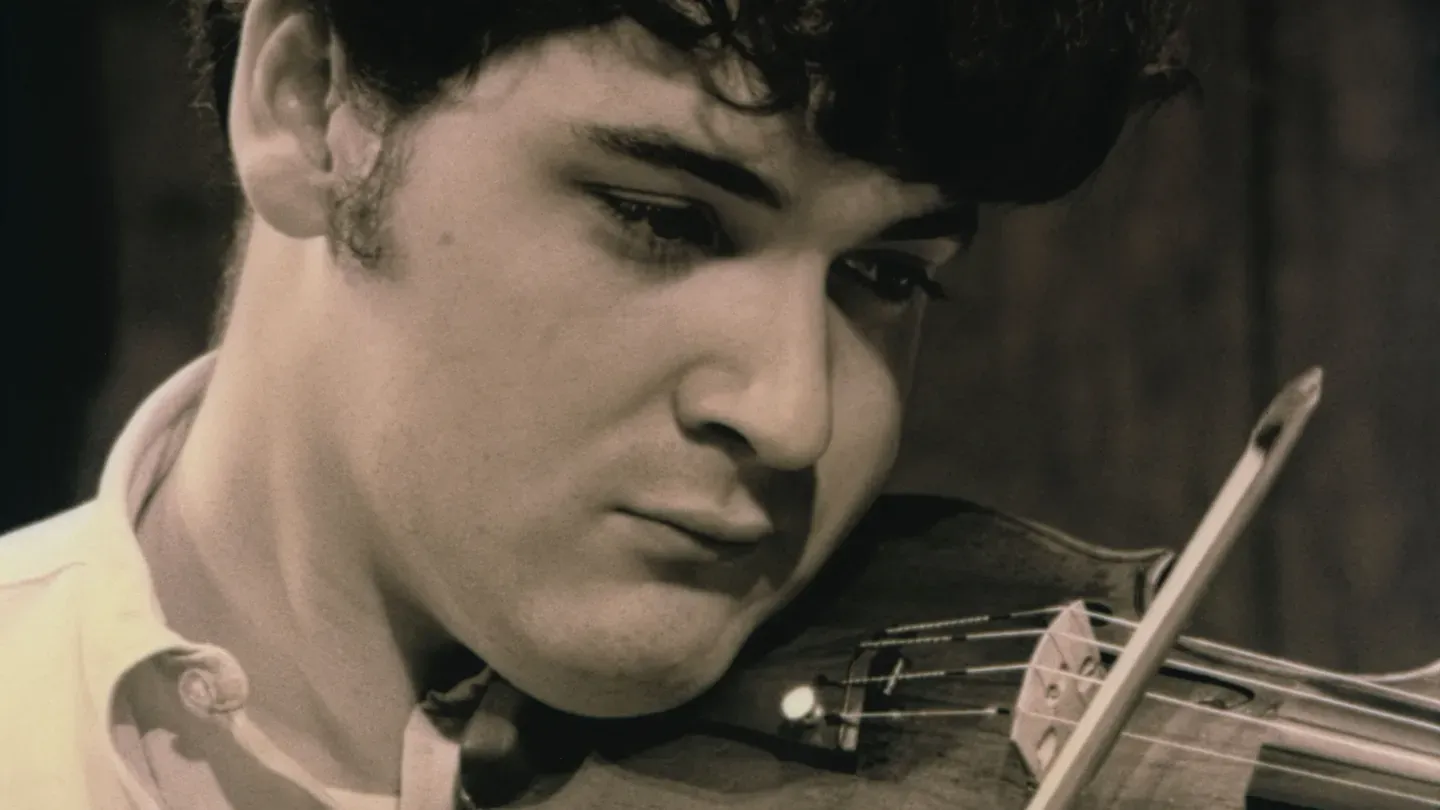
Pinchas Zukerman: Here to Make Music
Episode 2 | 1h 23m 35sVideo has Closed Captions
Follow Pinchas Zukerman’s remarkable journey from rising star to celebrated musical master.
From rising star to celebrated musical master, this remastered portrait captures the early brilliance and charisma of Israeli-American violinist and conductor Pinchas Zukerman, whose legacy continues to inspire after more than five decades.
Problems playing video? | Closed Captioning Feedback
Problems playing video? | Closed Captioning Feedback
Pinchas Zukerman: Here to Make Music
Episode 2 | 1h 23m 35sVideo has Closed Captions
From rising star to celebrated musical master, this remastered portrait captures the early brilliance and charisma of Israeli-American violinist and conductor Pinchas Zukerman, whose legacy continues to inspire after more than five decades.
Problems playing video? | Closed Captioning Feedback
Where to Watch Great Musicians of Our Time
Great Musicians of Our Time is available to stream on pbs.org and the PBS app.
Providing Support for PBS.org
Learn Moreabout PBS online sponsorship-[laughter] -[indistinct chatter] [balls clacking] -Oh!
-One more time.
-[balls clacking] -Almost.
[Christopher Nupen] This man has talent.
Of its kind, one of the most exceptional new talents the world has seen in 25 years.
[balls clacking] Born with a gift from nature, polished by years of painstaking work, and between the ages of 7 and 17, the best teaching that could possibly be found.
-[balls clacking] -[indistinct chatter] [Christopher] A well-spent youth that established him with an international career before he was 21.
[indistinct chatter] [Christopher] His name is Pinchas Zuckerman, and he plays the violin.
[Pinchas] I made it!
-[Man] 28, take one.
-[clack] Ow!
-[laughter] -[Man] Sink the second time!
Glad it's not my finger.
[laughter] [Man] Go on!
[bright, expressive violin] [turns melancholy] -[piece continues] -[waves crashing] [piece ends] [upbeat, cheerful violin concerto] [cheers and applause] [Christopher] This man also had talent.
And he too played the violin.
But no more.
His name is Yehuda Zuckerman.
He was born in Poland, was entirely self-taught, and supported his family with his fiddle from the age of 14.
[Pinchas] [speaking foreign language] [chuckles] [Christopher] Both he and his wife survived the Warsaw Ghetto and were among the few to survive the Auschwitz extermination camp.
They left Poland in 1946 with the clothes they stood up in and their livelihood-- the family fiddle.
[Yehuda] [speaking foreign language] [Pinchas] [speaking Yiddish] [Christopher] In 1948, in Israel, they had a son.
And in the strange way that talent can pass from one generation to another, apparently flowering in the process.
Pinchas Zuckerman seemed to start from where his father left off.
[checkers clacking] He's creaming me, baby!
Ha!
[Christopher] By the time he was 12, those who knew about the fiddle and about talent knew that this boy had something which might, one day, put him among the great violinists of all time.
[upbeat, festive music] [Christopher] This recording was made in 1958 before he was 10 years old.
[piece continues] [piece ends] [applause] [Pinchas] Well, I first played recorder when I was around four.
I had to learn to read music.
And then I played clarinet a short while after that.
I played for about six months, I played clarinet.
And then I had some trouble breathing and things like that.
And my father decided that it was a good time for me to start learning the violin.
I was about seven and a half then.
He bought me a half-size instrument and he started teaching me a little bit to tune it.
And the first thing I learned to do is to tune.
And it was one of the most important things that he thought, was to tune.
So nobody else takes the fiddle out of your hand again to tune it for you, you know, a sort of physical thing, which is important.
So I learned how to tune and that right away made me conscious of hearing, of listening automatically.
And then I played a little bit and we started playing duets together after about a month and a half, very simple sort of [indistinct] duets.
And then one Sunday morning, we went over to, uh... Saturday, as a matter of fact.
Saturday, we went over to my teacher, Ilona Féher, and, uh, she was-- she said that she couldn't take me because she had too many students and there was absolutely no time for her.
And she said, but she will to listen to me in any case.
And so I took out the fiddle.
And her first impression was, because I tuned the instrument, she was so absolutely stunned!
You know, I could hardly play, but I could tune my instrument.
And she was so amazed by that.
She said, "Come tomorrow at seven o'clock in the evening."
[speaking German] [Christopher, interpreting] As a child, he was full of life and fun.
And with other children, he played and fooled about like any one of them.
[speaking German] [Narrator, interpreting] But the moment he had the fiddle in his hand, he was a different person.
There was a transformation.
And what one felt one saw was his soul.
[speaking German] [Christopher] When Ilona Féher says the audience could not sit still in their seats, she means exactly what she says.
And the temperament which she describes was obvious not only to musicians.
Listen to what happens at the end of the first movement cadenza in Mozart's Fourth Concerto, recorded at a public concert when Pinchas Zuckerman was 12.
[fast, somewhat manic violin] [cadenza continues] [orchestra joins in] [enthusiastic applause, piece has not ended] [piece ends, applause continues] [Christopher] That recording was made in 1961, when he was 12 years old.
Here, 12 years later, is the other side of that same temperament.
The end of the slow movement of the same Mozart concerto, filmed in Munich in 1973 with the English Chamber Orchestra.
[serene, moving music] [wistful violin solo] [orchestra joins in] [violin fades, re-enters] [orchestra joins in] [music swells, then softens] [piece ends] [plucks violin a little] [Pinchas] I was born in Tel Aviv, in a hospital which doesn't exist anymore.
And, uh, the first few years of my life, we lived in what's called in Hebrew, a tz'riff.
It's a little sort of shack, which the Swedes were kind enough to give us material to build those shacks.
And, uh... there was water when it was raining, water leaked in.
When it was hot, it was too hot.
When it was cold, it was too cold.
And then after five years, we moved to Holon.
[shouting in Hebrew] I remember I used to play football here.
When we first came to live here from Tel Aviv, when I was about... I was five years old, these three houses were here.
We lived in this one right here.
And there was nothing.
It was absolutely white.
All these things are painted since then.
Nothing.
It was absolutely isolated.
It was beautiful.
Hello.
I was about that age.
[chuckles] [Christopher] He lived here in Holon, on the outskirts of Tel Aviv, for the next seven years.
Then, at the age of 12, Isaac Stern and Pablo Casals heard him play and said that this talent was too big to leave in Israel.
He should go to America to study at Julliard with Ivan Galamian.
Feel that.
Feel it.
Can you see that?
It's like pure sand.
It's pure gold.
Absolutely beautiful.
See, what happened was, when I went to America, you know, my impression first was that I was going to play.
I was going to study, but I was going to play because of all the fuss that was made here in Israel about me.
And here I was going to New York, and I was, you know, the big star.
And I got there, and I went to Galamian for the first time, and he said, you're starting the old Kreutzer, you know, the exercises again.
And it was, for me, such a shock.
Here I was playing every day, almost, in Israel, anywhere possible.
And then I got to Galamian, and he says, you know, you're beginning from the beginning.
And it was unbelievable shock.
[melancholy violin music] [speaking English] When I first walked down the streets, I thought the whole place was gonna collapse, because it gives you that feeling when you're looking down... It gives you that feeling that the whole buildings are just gonna come together, because it's all the skyscrapers, you know, they're just so huge.
I was scared!
Believe me, I was scared.
[laughs] I had my first... -Are you running?
-[Man] Yeah, go on, sure.
I had my first dramatic experience, because I had a bow.
I got a bow from my teacher in Israel.
And, um, you know, those huge radiators they have in the hotels here, and it's so hot.
And, um, I was practicing one day, because I heard that I had to play for Galamian.
And, uh, I was practicing, and the bow tightened because of the heat.
The bow tightened, and I was playing Bruch concerto, the last movement.
And I went, grak!
And the bow split.
And it was such a dramatic experience, because it was a bow as a present from my teacher, going away sort of present.
There was nothing I could do, and I didn't know what to do.
And so I didn't speak any English.
So the only person I went to was my sponsor, and she took me down on 42nd Street to Mrs.
Wurlitzer.
It was my first encounter with the Wurlitzer shop.
And, uh... I, I got myself a lousy bow, which I didn't like.
And it was, it was... Oh, it was terrible.
I was a... It was a terrible experience.
Yes, as a matter of fact, I did.
And of course, I was stupidly saying in Hebrew that Isaac Stern has got seven bows, and why can't I have seven, you know?
[laughs] And, uh... which I got yelled for afterwards, because-- ha!
I was chutzpidik, and arrogant, and so on.
Anyway... [Christopher] So the transplant was not an unqualified success.
He found himself alone in New York.
13, without a word of English, and in difficulties with his schooling, his relationships, and with his playing.
Look at that monster.
[horn honks] [Pinchas] I wasn't able to play at all.
At that time, I started doing funny things.
I started smoking, which I shouldn't have done.
I started playing pool, which I shouldn't have done.
I don't know, now that I think about it back, I don't know if I should, but I shouldn't have.
I think it was good and bad.
And I had some problems at home with these stormings.
I guess it's all growing up pains, in a way.
Except for me, it was doubly hard, because I was by myself.
I was terribly... I was, I was very down at that time.
I was beginning to feel that I really wasn't getting anywhere.
And I knew that I had something to say, and that I had no way of saying it on the fiddle.
And any way I could, I had to bring it out.
The only way I could do it at that time was to go into the Leventritt.
And I worked damn hard for it.
And I went into the competition not knowing the risks, but, uh... I went into the competition.
I played very well in the second round.
The third round, I didn't play so well.
I almost fell on my tuchus, actually.
But... [laughs] But I was... I did, somehow, I made it.
And, uh, I went... Either way, I got a CBS contract because of Stern, with the help of Stern, and I began my career in '67.
I began to play.
[cheerful, lilting flute] [violin and viola follow] [piece continues] [Christopher] Spoleto, 1967.
His first time in Europe at the age of 19.
And his first contact with established professional musicians on an equal footing.
He's been invited by Giancarlo Menotti to play in the chamber music concerts at the Spoleto Festival.
-Sunday is Pinky's birthday.
-Yes.
-Now, it's a secret.
-Yes.
Very good.
A secret.
Yeah, yeah.
-But... -What?
When he says to you, are all of you ready?
Yes?
Yes?
I want all of you to play... -Yes, what?
-Happy Birthday.
Do you know that?
[playing Happy Birthday ] -♪ Happy birthday to you ♪ -[cheers and applause] ♪ Happy birthday to you ♪ ♪ Happy birthday, dear Pinky!
♪ ♪ Happy birthday to you ♪ [applause] [speaking Italian] [applause] [moving, melancholic music] [Pinchas] Well, we played a tremendous amount of music.
In midday in Spoleto, we played concerts in midday, very informally, without... without jackets and ties.
And it's a wonderful, wonderful atmosphere.
And that's the way music should be played.
It's very, just to the people, the way it is.
In '67, I went the first time, and I spent the next two summers again in Spoleto.
Except there was a small difference.
In '68, I got married in May to a wonderful girl called, at that time, Genie Rich.
We went-- she plays flute as well.
And we played together.
We played alone.
She played, I played, I listened to her, she listened to me.
So it was a little bit like a honeymoon.
[music intensifies] [piece ends] My memories of Spoleto are very, very dreamlike.
We went there the first summer.
It was our very first trip to Europe.
And everything was like a fairy tale.
And in Spoleto, we had a marvelous apartment.
It was from 1492.
And neither of us had really seen any of the splendors, so to speak, of Europe.
And it was terrifically exciting.
It was also the first time either of us had played professionally in a solo manner before a public.
And it was very important, I think, that Pinky liked it, and that he thrived on it, and that they seemed to like him.
And Spoleto is such a beautiful, beautiful place.
[flowing piano intro] [violin joins in] [music builds in anticipation] [music calms] [music softens, brightens] [piece ends] Everything has happened rather suddenly, and in a kind of whirlwind fashion.
Um... He entered the Leventritt Competition in 1967 and won it, luckily.
I say luckily only because the competition was such a difficult thing to go through for both of us.
And for him especially, because it had never been questioned for him.
Uh, he had never been-- had to sort of put himself on the line.
And I think competing is completely against his nature and against his whole concept of music.
I think he, he likes chamber music and the whole idea of making music with people, not kind of showing off or having to prove yourself, in a sense.
And I think had he not won, things wouldn't have taken off so quickly.
I think he wasn't ready for it.
Uh, I don't think one is ever really ready if things happen so fast.
[overlapping voices] [Christopher] New York, 1969.
The CBS recording studios to make his first gramophone record at the age of 20.
[Christopher] The conductor is Leonard Bernstein.
The orchestra, the New York Philharmonic.
And the concerto, the Mendelssohn.
[dreamy orchestra, sweet, romantic violin] [chuckles] [music becomes lively] [lowers volume] [Leonard] ♪ Ba, ba, ba, beee... ♪ [clicking] [soft, but lively music] [music intensifies] [tempo quickens] [chuckles] [piece continues] [Pinchas] In the early, early stages, I was terribly influenced by Heifetz.
I had many Heifetz records, which... I think every fiddler has.
[indistinct] It's just the man has something so very special, that, um... It's very, very special.
It's something, the sound and, and... When you listen to it on the radio, you know it's Heifetz.
There's no, nobody else.
You can't mistake it.
And, um... There's an influence in that.
But then, after that, my... because of my association with Stern, I think I became a little more aware of other things that go into playing violin.
And there was Isaac.
And then there was... [sighs] There was Casals later on because of the association again.
And then from Casals became the Budapest Quartet, which came to Israel regularly.
Um... I would say that those people basically are those three or four people that... because later on, you just pick up from, from people here and there.
But it wasn't... It never was, uh... As far as influence directly like that, it was, in my early age, was, was those people.
And later on, it was, of course, association with somebody like Barenboim, which is a... which now has become a trio, which... with Jackie, which is now... a marvelous... I think it's a marvelous thing because we communicate... I've never communicated to other people the same way I do, on a musical level, the same way I do to those two.
And it's a different... There's a rapport, which, which is a very rare thing, I think, in music, and, uh... it happens very few times.
To me, in any case, it's happened so far very-- twice in my life time.
[lively thumping, Latin American-style piano] [Christopher] London, to prepare for a series of trio concerts around England to put all the Beethoven trios on record and one of them, The Ghost, onto film.
[Pinchas] I think the chamber music is a very important part in everybody's training.
[heavy chords progressing higher] Not only fiddlers, but every musician should... Chamber music, for me, is the basics to everything because it means... Chamber music means playing with other people which makes you right away-- confronts you with listening to other people, makes you... your whole structure of playing and thinking changes automatically.
You yourself are not the main point.
It becomes the two other people or the three other people that you play with and that becomes one body, one unit.
[gamely plays along] -[Man] Seven, take two.
-[clack] [soft, eerie music] [music intensifies] [music softens] [mellow piano, cello to forefront] [music intensifies] [lively, almost festive music] [music darkens somewhat] [music intensifies, brightens] [music softens] [music builds, intensifies] [music softens] [mischievous, plucky music] [soft, pleasant music] [music builds, intensifies] [piece ends] [horns honking, traffic] [Christopher] New York, April 1971.
At long last, his official New York debut recital.
He's now 22 and well aware that this is one of the most important hurdles in the difficult transition from boy wonder to accepted concert artist.
[Pinchas tunes violin] The pianist is Lawrence Smith.
[heavy, dramatic piano intro] [violin joins in joyfully] [music darkens somewhat] [music sweetens, somewhat melancholy] [music becomes joyful] [dramatic piano solo] [violin rejoins, music darkens] [music intensifies] [music softens] [music intensifies] [music softens] [music becomes lively] [music becomes gentle] [music becomes lively] [music builds] [music builds] [rapid tempo] [piece ends] [cheers and applause] No, I don't think I played well.
I think, I think I... could've done much better.
I was... There were certain things that distracted me.
I was... Many things, many thoughts while, while playing, you know?
Because of... I don't know.
The first time in New York.
And because I live here.
I think one gets more nervous when one is... in his hometown, so to speak.
You know that your friends know every move that you make and, uh... it's sometimes a little more nerve-wracking.
I don't get as nervous in London, I must say.
I think he does a little bit.
I can always tell if he's nervous if he spends a lot of time in the bathroom before a concert.
But he doesn't ever say, "Gee, I'm nervous."
The only time he said that he was nervous was for his New York debut recital.
I think because he had been a student here and because he felt so much was expected of him, and he wanted so much to do well here.
Well, sure, because when I arrived, I was a kid, and I had no strings attached at all.
And as you grow older, I think one... it gets more and more difficult to get on that stage.
It's... there are more physical problems, there are more psychological problems that get into playing, and, uh... it's basically much harder.
There are many more things involved in it.
[Christopher] But if you feel like that at 23, what are you gonna feel like at 50?
God knows!
[laughs] [Christopher] Copenhagen, May 1971, less than a month after his New York recital, on tour for the first time with the English Chamber Orchestra.
He has already begun to build a very rewarding partnership with these musicians.
A number of highly successful concerts with him as soloist produced such an immediate response to his playing that they've invited him on this tour to play Bach and Vivaldi without a conductor.
The experiment is less risky than it might seem.
This is an orchestra of true chamber music players, capable of performing very well without a conductor at all, and many of them soloists in their own right.
So both for them and for Zuckerman, the real question is whether they'll get as much enjoyment from each other's playing as they're all anticipating.
[exuberant chamber music] [violin and harpsicord] [violin solo] [orchestra rejoins] [violin and harpsicord] [orchestra rejoins, music darkens] [music becomes sweeter] [music exuberant] [music becomes darker] [music brightens] [piece ends] [applause] [Christopher] London, a few days after the tour, to play the Spohr and Mendelssohn octets in the Queen Elizabeth Hall with members of the English Chamber Orchestra.
[music swelling, dreamy] Mendelssohn wrote the octet when he was 16, and succeeded miraculously in combining flawless inspiration, technical virtuosity, and the exuberance of youth.
[music flowing] [music darkens somewhat] [music becomes pluckier] [music becomes exuberant, brightens] [music darkens, more tortured] [music becomes more subdued] [Kenneth] I never cease to be amazed at the range of achievement of this artist.
Everything seems to be in style.
He's such a tremendous musician.
I think that he could probably succeed at anything he wanted to do.
But he's a born chamber music player, concerto player, conductor, anything you like.
Well, to me, he's the... ...the greatest talent... ...the world's had for the last 25 years, I'd say.
[music dark, tortured] [music more fanciful, exuberant] [music more subdued] [music brightens] [music intensifies, more joyous] [piece ends] Very good.
I think that music is an international language.
And when it's spoken with feeling, and it's spoken with understanding... it's... there's no other language that's more beautiful, I think.
Absolutely the greatest.
It's no... There's no... You don't have to know alphabet.
You don't have to know, uh, little punctuation marks.
It's there, and it's... it's... And it just speaks to you.
[Christopher] Talent of this caliber deserves a fiddle to match.
But the best violins were made a long time ago and now cost incredible sums-- if they can be found at all.
Until recently, they've been beyond his reach.
And for the past few years, he's been lent a Stradivari.
But now, with the help of Charles Beare, he has his own fiddle for the first time, a Guarneri.
[Richard] Everybody was getting very anxious about finding Pinky a fiddle because the Stradivari which he was borrowing had to be given back.
And we were sort of telephoning all over the world to see if there was one that would be available.
In fact, we bought tickets to go to Frankfurt on a Saturday morning at 6 a.m.
and drive 20 miles, and we were gonna see a Stradivari that was gonna cost four times too much money, but it didn't matter anything.
And then suddenly I heard that this one was available and, and I sort of thought this might suit him.
So we got it along and he played it and, uh, it was hopeless, and then we fiddled around with it a bit.
And suddenly there it was, and we knew we were okay for a year or two.
Well, because it seems to suit my, my hand.
It seems to suit my sound.
It seems to suit... I don't know.
I've heard other people play on it.
They don't sound as good.
I don't know why those things... I don't know.
Can you... Can you, uh... I don't know what it is, but I think every player wants something different.
Um... Pinky's more at home on a Guarneri of some sort, um, than on a much more valuable Stradivari, for instance.
Another player would be exactly the reverse.
He'd only bring out the best in himself on a Stradivari.
[dramatic music] On the Stradivari, I had to do this... [repeats piece] I had to shake my head in order to make it work, you know, to give the same effect.
But here I can really dig in!
[repeats music, more pronounced] [chortles] [motor running] [Christopher] Munich, May 1973.
On tour again with the English Chamber Orchestra.
They have already completed a world tour and the relationship has now developed to the point where he's to conduct Haydn and Mozart symphonies for the first time.
There are two sides to touring in this way.
The opportunity to work daily with Zuckerman for two weeks produces musical results that give real pleasure and which could not be achieved in the normal concert routine.
But physically, the rigors of touring are appalling.
To make this tour pay, they must give 15 concerts in 18 days from Brighton to Berlin.
Even then, it does not pay as well as simply staying in London.
But they put up with it for the musical results and for the pure liveliness of making music in this way.
Three, four.
[bright, lively music] [music becomes gentle] [repeats theme on violin] [Christopher] They are rehearsing for a concert in which he will appear for the first time in Munich as both soloist and conductor.
Three, four.
[dramatic, stately music] [Christopher] Munich is the musical capital of southern Germany, and has been so for a very long time.
[music becomes lively] 200 years ago, Mozart himself was a popular figure on these streets.
But tradition is often conservative, and it remains to be seen how Munich will react to Zuckerman as conductor.
Conducting has been a natural development of his extraordinary rapport with this orchestra.
It began with Vivaldi.
And his talent as a string player produced an immediate intuitive response, which is the basis of this new departure.
-Pa-de-dum, pa-de-dum... -[players stop] Eight.
Eight.
♪ Da, da, dee, da... ♪ Well, we discuss ideas, and... at the concert, we usually change them!
[laughs] Again, it's all... I can, I can never play one thing twice, you know?
I can never do anything the same.
From day to day, I feel differently.
From one hour to the other, I feel differently.
And if you can communicate that, either with gestures or by... by gestures or by just smiling at somebody, that makes that thing click, you know?
[Christopher] Since it's to be something of an occasion, they've agreed to the concert being filmed for television, which provokes trouble of a completely unexpected kind.
[applause] [begins tuning] [speaking German] [audience shushing, complaining] [speaking English] [applause] Please.
[Man in Audience] [speaking English] [Pinchas] [applause] [Pinchas] Get out!
[Man in Audience] Shut up!
[overlapping voices] [applause] [audience shushing] [Pinchas] How many times... [Man in Audience] [audience applause] [Christopher] Some sections of the press made much of the protest.
But the protester did not, in fact, leave the hall.
And in spite of the tension, or perhaps even because of it, they succeeded in making the concert which followed one of the liveliest of the tour.
[gently building music] [full orchestra joins in] [music softer, more stately] [full orchestra] [music softens] [music intensifies] [music softens, gently builds] [music intensifies, full orchestra] [music softer, more stately] [music intensifies] [music softens] [music lilting] [music intensifies] [music softens] [music intensifies] [music darkens somewhat] [music builds] [music intensifies] [music gently builds] [music intensifies] [music becomes gentle] [music intensifies] [music becomes gentle] [music becomes lilting] [music intensifies] [music slightly mischievous] [music building] [music seems to float down] [movement ends] [music soft and gentle] [woodwinds prominent] [music floats downwards] [music soft and stately] [woodwinds prominent] [music becomes lilting] [music soft and gentle] [woodwinds prominent] [music floats downwards] [music becomes soft and stately] [woodwinds prominent] [music becomes lilting] [music becomes fanciful] [music darkens somewhat] [music floats downwards] [woodwinds prominent] [music soft and gentle] [music darkens] [music brightens] [music intensifies] [music floats up and down] [music soft and stately] [music intensifies] [music soft and stately] [music becomes lilting] [woodwinds prominent] [music lilting] [music soft and gentle] [woodwinds alone] [strings join in] [movement ends] [music fanciful] [music darkens] [music brightens] [woodwinds play theme] [strings repeat theme] [music darkens] [music brightens] [music fanciful] [woodwinds and brass play theme] [soft, stately music] [music becomes fanciful] [music intensifies] [woodwinds and brass play theme] [strings repeat theme] [music darkens] [music brightens] [music becomes fanciful] [woodwinds and brass play theme] [movement ends] [spirited, exuberant music] [music slightly subdued] [music intensifies] [music builds] [music intensifies] [music becomes fanciful, lilting] [music gently floats downwards] [music intensifies] [spirited, exuberant music] [music becomes more subdued] [music intensifies] [music builds] [music intensifies] [music becomes fanciful, lilting] [music floats downwards] [music intensifies] [music builds, darkens] [music alternately intensifies, softens] [music brightens] [spirited, exuberant music] [music becomes slightly subdued] [music intensifies] [music builds] [music becomes fanciful, lilting] [music floats downwards] [spirited, exuberant music] [movement ends] [audience applause] [applause continues] [Pinchas] When it's spoken with feeling and spoken with understanding, there's no other language that's more beautiful, I think.
It's there and it just speaks to you.
ful intro] [Daniel and Jacqueline go off kilter] [Man] One... Everybody here.
Okay?
-[clack] -[Man] With the boarding.
Just keep running, [indistinct].
Just in case I [indistinct].
17, take one.
And slate.
[clack]
 New Episode
- Arts and Music

Innovative musicians from every genre perform live in the longest-running music series.
- Arts and Music
The Best of the Joy of Painting with Bob Ross
A pop icon, Bob Ross offers soothing words of wisdom as he paints captivating landscapes.
 New Season



 New Episode
 New Episode
Support for PBS provided by: