
Pingree, The Peculiar Patriot, Xerxes, One Detroit Weekend
Season 7 Episode 40 | 26m 46sVideo has Closed Captions
Pingree Detroit, The Peculiar Patriot, Detroit Opera’s Xerxes and One Detroit Weekend.
Pingree Detroit Founder Jarrett Schlaff talks about his unique worker-owned business model and the benefits of building a business in Detroit. The Detroit Public Theatre features a powerful one-woman show, “The Peculiar Patriot,” about the systemic injustices of mass incarceration and America’s prison system. A behind-the-scenes look at the Detroit Opera’s “Xerxes.” Plus, “One Detroit Weekend.”
Problems playing video? | Closed Captioning Feedback
Problems playing video? | Closed Captioning Feedback
One Detroit is a local public television program presented by Detroit PBS
Pingree, The Peculiar Patriot, Xerxes, One Detroit Weekend
Season 7 Episode 40 | 26m 46sVideo has Closed Captions
Pingree Detroit Founder Jarrett Schlaff talks about his unique worker-owned business model and the benefits of building a business in Detroit. The Detroit Public Theatre features a powerful one-woman show, “The Peculiar Patriot,” about the systemic injustices of mass incarceration and America’s prison system. A behind-the-scenes look at the Detroit Opera’s “Xerxes.” Plus, “One Detroit Weekend.”
Problems playing video? | Closed Captioning Feedback
How to Watch One Detroit
One Detroit is available to stream on pbs.org and the free PBS App, available on iPhone, Apple TV, Android TV, Android smartphones, Amazon Fire TV, Amazon Fire Tablet, Roku, Samsung Smart TV, and Vizio.
Providing Support for PBS.org
Learn Moreabout PBS online sponsorship- [Announcer] Just ahead on One Detroit, we'll have a future of work report on a Detroit design and sustainable manufacturing business that is co-owned by its employees.
Plus, "The Peculiar Patriot" at the Detroit Public Theatre explores the injustices of the prison system.
Also ahead, Handel's dark comedy, "Xerxes", is coming to the Detroit Opera.
We'll have a preview.
And we'll have some more ideas on what you can do this weekend in Metro Detroit.
It's all coming up next on One Detroit.
- [Announcer] From Delta faucets to Behr Paint, Masco Corporation is proud to deliver products that enhance the way consumers all over the world experience and enjoy their living spaces.
Masco, serving Michigan communities since 1929.
Support for this program is provided by the Cynthia & Edsel Ford Fund for Journalism at Detroit Public TV, The Kresge Foundation.
- [Announcer] The DTE Foundation is a proud sponsor of Detroit Public TV.
Among the state's largest foundations committed to Michigan-focused giving, we support organizations that are doing exceptional work in our state.
Visit dtefoundation.com to learn more.
- [Announcer] Nissan Foundation and viewers like you.
(upbeat music) Just ahead on this week's One Detroit, we'll hear from the playwright and actress in the one-woman show about mass incarceration, "The Peculiar Patriot", playing at the Detroit Public Theatre.
Plus, the Detroit Opera puts on a production of Handel's "Xerxes", a tongue in cheek story about love and the limits of power.
And One Detroit contributor, Satori Shakoor, has some additional ideas on things to do in Metro Detroit this weekend and beyond.
But first up, our future of work series looks at a unique business concept, a worker-owned company.
Pingree Detroit is creating new opportunities for Detroiters and US veterans to learn valuable skills and share in the company's success.
I spoke with Pingree Detroit founder, Jarret Schlaff, about how the business works, the challenges he's faced as an entrepreneur, and what makes it all worthwhile to own a company here in Southeast Michigan.
(upbeat music) (whooshing) (upbeat music) (whooshing) (upbeat music) - So, let's just jump right in.
The first thing I would love for you to do is introduce us, our viewers to Pingree Detroit.
So, what is Pingree Detroit, what do you guys do, what do you sell, where do you work?
Gimme the rundown.
- Pingree Detroit, we are an eight-year-old, worker-owned design manufacturing cooperative, yeah.
Just celebrate our eighth birthday on January 15th, actually, which is exciting.
- Congratulations.
- Thank you.
And so, we take materials.
So everything from leather to seat belts, airbags, otherwise destined for the landfill, we keep those outta the landfill from the big three, and we turn those into everything from the first shoes made Detroit in the fifties to backpacks, purses, wallets, dog leashes, coasters, everything in between.
- How is Pingree doing?
Are we getting ready to expand?
Are we downsizing?
Is it business as usual?
Where are we headed?
What's the condition of the experience?
- Yeah.
So our look would be inspired with a chance of smiles.
So, (laughs) we're pretty excited.
We're in a really good spot.
So we're growing our team.
We're now about to be joining our 13th member of our team and we're worker-owned.
So that means that 77 cents of every dollar and profit goes right back to the workers on our team.
And as we're growing, we're now doing more pop-ups.
Our goals is 250 in-person activations throughout the year of 2023, - Wow.
- which means Eastern Market on weekends.
We're gonna be at the Autorama this month, you know, the auto show, again, doing everything from live shoemaking to selling our goods right here in person, so folks can touch, feel, smell that new car.
- Right.
- We like to say it smells a new car because it nearly was.
(both laughing) And so, - Yeah, yeah.
- we're excited to do that.
And that, really, that growth allows to connect, inspire folks, have them be a part of our story and a part of our mission.
- So one of the things you just mentioned is that you're a worker-owned company.
So, for anyone who isn't familiar with what that actually means, what is a worker-owned company and what made you decide to go that route with Pingree?
- So, worker ownership, some folks are familiar with the term cooperative, co-op, right?
There's energy co-ops, there's food co-ops, there's REI where you can go buy your camping and supplies, a lot of credit unions.
That is a co-op, right?
We have multiple stakeholders where as a worker-owned co-operative, we chose to be this type of model, because we wanna maximize equity and maximize wellbeing not just maximizing profit.
- Right.
- So we wanna be really intentional around designing structure, so that when we do well, our team does well, our neighborhoods do well, and the environment does well.
- So, in this model, how has it been when it comes to attracting talent, retaining talent?
Because if we're talking about the future of work and where things are going, pretty much across every industry, the narrative is we need more talent, we need more people, and we need them to stay.
So, how has your business model helped you maintain that talent that you need?
- By being able to incentivize and offer folks to co-own the company.
- Yeah.
- Not just get another JOB, but, like, to work, to be a part of the meaningful culture to actually create and benefit from all the small ways that you might make that company better to not just, you know, maybe you get a bonus in some other companies, or, sometimes, there's a stock split.
It's great, you know, we just heard about, you know, folks in the unions getting a nice little bump from certain auto companies.
Great.
But what if it wasn't just a small check?
It was regardless of the size of the company, you're sharing 77% of the profits.
- Right.
- Your innovation's celebrated and that could be an additional bump at the end of the year.
So we really wanted to offer and say "If you're gonna join our team, maybe you might make a little less per hour than you would if you're gonna go work in New York or in LA, but you can be a part of something great.
You can be a part of not just making a a good wage, but actually making neighborhoods stronger.
- Right.
- Being a part of solution-driven environment.
- [Will] So what is one thing that could be better about doing business in Southeast Michigan?
- One of the challenges of doing business in Michigan and Detroit is there's sometimes not the critical mass of people in certain areas to where if we did a pop up, you know, downtown right now, for instance, we might need to have a thousand conversations over a course of a week to do really well.
Well, we might only get a couple hundred.
- Right.
- How many folks are actually gonna come into our store?
So, like, for us, being in front of enough people with enough consistency for us to be able to accomplish our goals, to stay open as a business is really important.
And we have consistently had a hard time of just getting in front of enough folks.
We've gotta get really creative and everything from online advertising to more, you know, unique activations.
So for us, one of the hardest things has just been getting enough support from enough folks consistently.
- [Will] What is a good thing about doing business here in southeast Michigan?
- Yeah.
So we often say relationships are our strongest currency.
And I think that one of Detroit's strongest currencies is the relationships, the people.
There's this energy, there's this vibe around cooperation more so than competition.
Yes, we're competing to be our best and bring forth the best thing.
And sometimes we'll have the same product that we're offering, but, like this equipment behind us was donated to us by Shinola.
Like their team mentored us when we first were getting started.
We've collaborated with hundreds, hundreds of individuals from the get-go.
I call myself a co-founder.
I'm the only technical founder, but I would not have started this without hundreds and thousands, literally, of conversations of folks offering to take me to coffee and mentor me, and sharing this resource, and donating this piece of equipment.
We've found so much energy around cooperation, and it's allowed us to not only just keep moving forward and sustain, but actually grow.
And now we're doing the same thing.
Well, you know, our scraps, we're donating.
There's over 30 different small entrepreneurs that are getting our scraps and turn them into earrings, and other products.
And majority of women of color, majority native Detroiters.
So we're really focusing on how can we kind of, you know, as we're getting pulled from someone in front of us, how can we also pull from behind and really embrace those relationships?
- [Announcer] "The Peculiar Patriot" is a one-woman play about the inequities within the American prison system and its impact on the people behind bars.
The show is based on the research and personal experiences of playwright and actress, Liza Jesse Peterson.
And it's playing at the Detroit Public Theatre when Detroit's Chris Jordan spoke with Peterson and the theatre's producing artistic director, Sarah Clare Corporandy, about the powerful production.
(calm music) - I went to go visit Tyreek last month and he said, "Larry barely comes out his cell.
Sometimes not even to eat.
And Larry don't need no pills.
He needs for justice to be served and for them crooked cops to be indicted.
That boy don't belong there.
He's supposed to be in college right now!"
"The Peculiar Patriot" is a love story.
And it takes place on the visiting room floor of women's correctional facility.
So it's about the protagonist, Betsy LaQuanda Ross, who I play, and she's visiting her best friend who's incarcerated, and the audience is eavesdropping in on a conversation.
Junebug is six years old.
Of course he's going to be angry and confused and, and, and acting out.
He don't understand why you can't come home right away.
It came about through my work with incarcerated adolescents at Rikers Island.
I was a teaching artist there for many years, and I also had a boyfriend at the time who was incarcerated.
My whole life, my professional life, and my personal life was immersed in incarceral systems.
So, the play came from those experiences.
- It's just a really amazing and important piece that we're really proud to bring here.
Frannie Shepherd-Bates who runs our "Shakespeare in Prison" program saw the piece out in San Diego and came back and just said, "I think this is a wonderful piece.
I think this is a really important piece and I think it connects strongly with our "Shakespeare in Prison" program."
"Shakespeare in Prison" goes into, it was started at the Women's Huron Valley Correctional Facility, and it's the only women's prison in Michigan.
And we go in there and work with the incarcerated people there to put on a Shakespeare play.
It is a very collaborative experience.
There's not a hierarchy in that room.
We work for nine months with that team to produce the play, to analyze the text, to direct it.
Everyone has a life-changing experience.
It's important for us that our work connects with the community.
And so, to highlight our "Shakespeare in Prison" program that is like our core community program here with this piece and to bring our audience closer to the work that that program is doing, is a real joy.
- The power of art is that people are able to connect to the humanity of the human being as opposed to a talking head just spouting statistics.
I have to credit my director, Talvin Wilks, in the early stages of the development of the play.
I did have a lot of statistics and he said, "This is not a lecture."
He said, "The play cannot become didactic.
You have to lift it into story.
You have to lift it into character."
She was talking about that boy like, like he was disposable!
Like he was a piece of trash!
15 years for what?
When I was a teaching artist at Rikers Island back in 1998, that was my first introduction to the prison industrial complex.
As we know it today, mass incarceration.
And I was there to teach poetry to adolescent boys, 16, 17, 18 years old who were attending high school at Rikers Island.
Yes, there were and still are adolescents at Rikers Island.
And it was a correctional officer, my first week there, who said...
He asked me, he said, "You don't know where you are, do you?"
And I said, "Yes, I'm at Rikers Island."
He said, "No."
He said, "You're on a modern day plantation."
And he pointed to the boys who, again, like I said, were 16, 17, 18 years old.
And he pointed to them and he said, "They're the new crops.
That's the new cotton in Antebellum South."
Slavery was too dirty of a word in polite circles.
So they referred to it as the peculiar institution as a way to, I guess, sanitize it.
And so I took the term peculiar and I said, "Wow.
Slavery has morphed into what we now know as mass incarceration."
So we're still dealing with this peculiar institution.
And I'm a poet and a writer.
So we're always looking at language.
And what is a patriot?
A patriot is someone who supports their nation, their country.
And so, if there's a nation in a country of citizens who are behind barbed wire, who are the people that support them.
Aren't they patriots?
(alarm blaring) (indistinct) [Radio] Over.
(alarm blaring) (indistinct) - People are walking out blown away, speechless, motivated, moved.
When you sit in the space and hear the reactions of the audience, the camaraderie, as Liza's character comes out and reveals herself.
It's therapeutic to be reminded that even a story, that maybe to some of us feels far away, is actually not that far away from all of us.
- I performed this play at Angola Penitentiary in Louisiana back in 2020, right before the pandemic hit.
And there's actually a documentary that was just shortlisted for an Academy award called "Angola Do You Hear Us?"
We found out afterwards, two years later, that the play actually activated the men.
And since that performance, the men who were politically activated, they got on the phones, they called their family members, and they activated their family members to vote for specific candidates.
So, two black female judges were elected in that parish, a progressive DA and a black sheriff.
And as a result of the performance which activated the men, approximately 300 men have been released from Angola Penitentiary.
You know, as an artist, you know, we wanna impact, you know, audiences.
we want our art to do something.
To change to heal, to uplift, to enlighten, to entertain.
You know, every artist has their own, you know, idea and intention.
And I knew that I wanted my play to activate, but I had no idea what the activation was going to look like 'cause you never know.
But I had the blessing of finding out the power of art and activism.
The intersection had direct impact on hundreds of men coming home.
This war on drugs ain't never going to stop.
Especially now.
They wanna put people in prison for as long as possible.
Turning back the clock on everything.
Girl, they've given police precincts more military equipment.
They're going to have armored tanks back up in the hood.
- [Announcer] "The Peculiar Patriot" runs through March 5th at the Detroit Public Theatre.
Each performance has a limited number of discounted or free tickets available to those impacted by the justice system.
A dialogue on the prison issues covered in the play also follows each performance.
Let's now turn to the production of Handel's "Xerxes" opening March 4th at the Detroit Opera.
When Detroit contributor, Sarah Smith, got a behind the scenes look at the show about the ancient King Xerxes.
Smith talks with a countertenor in the starring role, Key'mon Murrah, and Soprano, Lauren Snouffer, who plays his love interest, Romilda.
Plus, she learns more about the production from conductor Dame Jane Glover and Detroit Opera President Wayne Brown.
(Key'mon singing) - Opera's about stories.
Number one, it's music set to text and to reflect, increasingly, the experiences of our time.
(Key'mon singing) - "Xerxes" is a comedy.
So, it's a really great show, 'cause you get every element of what opera can be.
You have the opera's aria form, which is sort of this more serious form that Handel wrote in.
(Lauren singing) - This is a comedy in that there are very much comedic elements.
(actors singing) But I think of it as almost Shakespearean, actually, in that it's like "As You Like It" or "Twelfth Night".
These plays which are essentially comic plays, but, of course, have tremendous undertones of seriousness and suffering.
And all that happens here.
(Key'mon singing) - What makes "Xerxes" entertaining is his drama.
It is hot and cold.
Xerxes, he's up and down.
On a switch, he can go from mad, and then he can go from happy.
So I think that's what it is.
It's the spontaneity of it.
- There are, you know, six characters, and there's a great deal of interaction, and it's not like the normal Handel operas where you have a chunk of recitatives, and then you have long, long arias.
It's much more like a play, it's almost like a Shakespearean play, you know.
There's wonderful interaction between the characters.
- You have these two brothers dueling over a woman, me, who also has a sister who's in love with the person I'm in love with.
And it's this whole hilarious, like, brothers and sisters love triangle.
And then you have these comic characters that are built in into it.
So, you get the serious side of opera, but then it's sort of wrapped up in a comic package.
- It's a newer version.
The music has not changed.
And with that, it talks about preserving tradition, but also innovation to incorporate the culture, to incorporate new experiences and so that there's a greater sense of relevancy between the audiences and the artists themselves.
- It's gonna be a great singing.
There's gonna be a lot of contralto and high notes.
Maestra is perfection.
She's great.
I'm learning so much from her.
She is someone that I hope to be working with for the rest of my life and learning from.
So, her vision of "Xerxes", it's what I'm striving to work for.
- Well, the lovely thing about this cast is that they are not only wonderful singers, but they're all very theatrically alert.
And the the lovely thing is that everybody is bringing huge amount of creativities into the room.
And I love that and the director loves that.
And we're not just saying, "Sing it like this or move there because this is what we say."
We discuss motivation, we discuss who's responding to whom, and all the singers, whether they've done the roles before, and I think only two, possibly three of them, have done the roles before.
One of them has done two of the roles, actually.
But they've all really thought about their motivation.
They're not just singers who want to sing beautifully and spectacularly, though they do.
(chuckles) But really thinking about dramatic motivation, and that I completely love.
(Key'mon singing) - We have a countertenor, Key'mon Murrah, who is kind of just emerging on the opera scene, and everyone is super excited about him, 'cause it's like a one in a million voice.
- Well, it's been a dream of mine from the very beginning when I was a counter, when I first started being a countertenor I started singing "Xerxes'" arias.
So, within a few years to actually play him is great.
(Key'mon singing) - Key'mon is incredible.
He has a a countertenor range, which goes up and up and up.
I've never heard anything like it, actually.
He's going to have a big career, I think, with that voice.
There's no stopping him.
- Everybody's on top of their game.
Handel has always, when writing his music, he's always brought the best singers of the time.
And I really feel, like, Detroit Opera has brought the best singers for this show.
Everybody is extraordinary.
So, I believe the audience will just have a really good time here.
- I think people will come and see a great story with unbelievably wonderful music acted and sung by fabulous performers and played by the Detroit Opera Orchestra, which they know well.
And, with any luck, it should be a cracking evening in the theatre on all levels.
(actors singing) - When you see such talented individuals come together having invested the time in the character and the music, the energy, and to see all of that align into one moment, there's nothing more magical than that.
- I just want the audience to have fun and enjoy the ride.
There's a lot that's going on.
There's a lot of beautiful music and beautiful singing, but it's a different world, and it's not what we live in today.
So, just coming in and just having fun, I think that's what I want them to know.
(Key'mon singing) - [Announcer] And you can see "Xerxes" at the Detroit Opera House on March 4th, 10th, and 12th.
Now, let's take a look at some of the other events and activities in the Detroit area this weekend and beyond.
Here's Satori Shakoor of Detroit performs live from Marygrove with today's One Detroit Weekend.
- Hi, I'm Satori Shakoor with One Detroit, and Detroit performs live from Marygrove.
Here are some fun things going on in and around the Detroit area over the weekend and beyond for you to check out!
Something for the kids!
"The Jungle Book" is taking center stage at the Baldwin Theatre in Royal Oak.
March 2nd through the 5th.
The play is put on by a group of talented young actors from around Metro Detroit who are part of the Stagecrafters Youth Theatre.
I've always enjoyed the story of Mowgli.
This is gonna be a good one!
And on Friday, March 3rd, you can head to the War Memorial in Grosse Pointe Farms for the American Romanian Festival.
Go and take in some beautiful chamber music.
The quartet's performance starts at 7:30 PM.
Then on Wednesday, March 8th, Gayelynn McKinney is performing at the Dirty Dog Jazz Cafe.
Get down there and see one of the country's greatest drummers, the best in the world!
Gayelynn will be performing at the Dirty Dog through March 11th.
There's always so much to do around D-Town.
Here are a few more events happening ahead.
Take a look and hope to see you around!
Have a great weekend!
(calm music) - [Announcer] That will do it for this week's One Detroit.
Thanks for watching.
Head to the One Detroit website for all the stories we're working on.
Follow us on social media, and sign up for our weekly newsletter - [Announcer] From Delta Faucets to Behr Paint, Masco Corporation is proud to deliver products that enhance the way consumers all over the world experience and enjoy their living spaces.
Masco, serving Michigan communities since 1929.
Support for this program is provided by the Cynthia & Edsel Ford Fund for journalism at Detroit Public TV, The Kresge Foundation.
- [Announcer] The DTE Foundation is a proud sponsor of Detroit Public TV.
Among the state's largest foundations committed to Michigan-focused giving.
We support organizations that are doing exceptional work in our state.
Visit dtefoundation.com to learn more.
- [Announcer] Nissan Foundation and viewers like you.
(calm music) (outro tune)
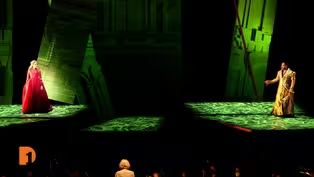
Detroit Opera puts contemporary spin on Handel’s ‘Xerxes’
Video has Closed Captions
Clip: S7 Ep40 | 6m 48s | The Detroit Opera puts a contemporary spin on Handel’s classic 1738 opera “Xerxes.” (6m 48s)
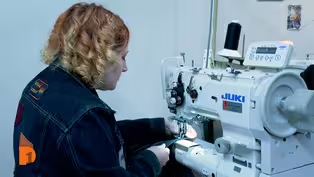
Future of Work: Worker-owned Pingree Detroit
Video has Closed Captions
Clip: S7 Ep40 | 5m 57s | Worker-owned Pingree Detroit creates equity and shares its success with employees. (5m 57s)
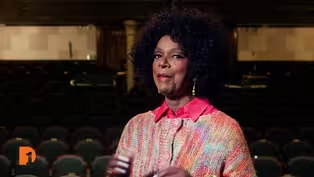
One Detroit Weekend: March 3, 2023
Video has Closed Captions
Clip: S7 Ep40 | 1m 34s | “Detroit Performs” host Satori Shakoor talks about upcoming events happening in Detroit. (1m 34s)
Providing Support for PBS.org
Learn Moreabout PBS online sponsorship
- News and Public Affairs

Top journalists deliver compelling original analysis of the hour's headlines.

- News and Public Affairs

FRONTLINE is investigative journalism that questions, explains and changes our world.












Support for PBS provided by:
One Detroit is a local public television program presented by Detroit PBS