Unspun
Pioneers In Politics: Felix Sabates | Unspun
Season 2 Episode 209 | 27m 35sVideo has Closed Captions
Felix Sabates: From immigrant roots to shaping Charlotte’s sports legacy.
Meet Felix Sabates, a major force behind Charlotte’s rise on the national sports stage. From race team owner to former Charlotte Checkers owner and a key figure in bringing the NBA back to the Queen City, his impact runs deep. But beyond the headlines is a powerful immigrant success story—built on bold risks, sharp instincts, and believing in himself when nothing was guaranteed.
Problems playing video? | Closed Captioning Feedback
Problems playing video? | Closed Captioning Feedback
Unspun is a local public television program presented by PBS Charlotte
Unspun
Pioneers In Politics: Felix Sabates | Unspun
Season 2 Episode 209 | 27m 35sVideo has Closed Captions
Meet Felix Sabates, a major force behind Charlotte’s rise on the national sports stage. From race team owner to former Charlotte Checkers owner and a key figure in bringing the NBA back to the Queen City, his impact runs deep. But beyond the headlines is a powerful immigrant success story—built on bold risks, sharp instincts, and believing in himself when nothing was guaranteed.
Problems playing video? | Closed Captioning Feedback
Where to Watch Unspun
Unspun is available to stream on pbs.org and the PBS app.
Providing Support for PBS.org
Learn Moreabout PBS online sponsorship(lively music) - [Announcer] This is a production of PBS Charlotte.
(gentle music) - Tonight on "Unspun," meet a true power player in the Queen City.
You know him as a winning race team owner, the former owner of the Charlotte Checkers, and one of the people who helped convince the NBA to bring the Hornets to Charlotte, back when this city was still proving it belonged on the big league stage.
In our continuing series, "Pioneers in Politics and Business," we're pulling back the curtain on the deals and decisions that helped shape Charlotte, and tonight, Felix Sabates shares stories behind the headlines.
In today's America, welcome to the spin game.
Believe me, I know, I'm Pat McCrory.
When I was governor and mayor, I played the spin game, I was played by the spin game, but aren't we all done being spun?
Let's take the spin out of the world we're in here on "Unspun."
(dramatic music) What you may not know about Felix Sabates will surprise you.
He came to this country with almost nothing and built a success by taking smart risk, trusting his instincts, and betting on himself when there were no guarantees.
Felix, it's great to have you on "Unspun, Special Edition: Pioneers of Politics and Business."
And no doubt, you are a pioneer here in Charlotte and America.
- Well, if nothing else, I'm old enough.
(both chuckling) - [Pat] No doubt, no doubt.
- I was looking last night at the big room at the club, and I was the oldest guy in there, there was 50 people in there, and I go, "Jesus, I've been here a long time."
- Well, being old's is a privilege too, right?
- Well, you know- - We've got a lot of friends we miss that we grew up with.
- Yeah, my dad used to say, "The devil knows more because he's old than he does because he's the devil."
- Wow.
You know, one way I describe you, kind of the title of this show is "From Cuba to Charlotte."
How did you get from, first of all, Cuba to America?
- Well, I got myself in trouble with the Cuban government in 1960 'cause I joined the underground, the fight against Castro.
- [Pat] And how old were you?
- I was 15.
- [Pat] 15 years old.
- And I was more, you know, I was in the list to be, and my father felt that if he doesn't get me out of there, I was gonna be dead.
It turned out that they got me out of a truck in a country road.
- You were getting in a truck?
- No, I was in a truck with 13 of us that we were going to the mountains to start fighting and they put me in the back of the truck, and they say, "The truck stops, shoot.
Someone tries to open the door, just shoot."
And I had a machine gun.
And the truck stopped, it was a bumpy country road, and something told me not to pull the trigger, and it was my father and the bishop.
I had gone to confession, and I guess the priest I went to confession to must have broken the rule, told the priest, and priest told the bishop, told my father, and they got me out of the truck.
- Your dad pulled you out of the truck?
- Yeah.
The truck went three miles and everybody in that truck got killed, so I was three miles from being wiped out, and a week later, I was in United States.
- How did your dad get out of Cuba with you and your family?
- No, no, my father didn't get out.
- He didn't get out?
- No, I came to America.
I was 15-years-old, I came by myself, no family, no money, no nothing.
He just put me on an airplane, sent me to Miami.
- And once in Miami, what did you do then?
- Well, he had a friend of his that lived in Miami so I had his phone number.
I called him and he was surprised 'cause you couldn't call from Cuba in those days, and he came and picked me up.
I stayed at the airport for about five or six hours waiting for him to come pick me up.
And then they said, now they have a Ramada, but there was a place called the Freedom Towers on Biscayne Boulevard, and all the Cubans had to come in and register to be, that we should be, like it should be today, except it doesn't happen.
So I stood in line for two days so I could get my interview and get a visa.
- Could you speak any English at that time?
- Only curse words.
(both laughing) I knew a few of those.
- That's why I love you, Felix.
- I knew a few curse words.
- So Miami to Charlotte.
- No, actually, I had a cousin that was living in Missouri.
- Yeah?
- But he had been living in Boston, so I went to Boston first, and then when he moved to Missouri, I followed him to Missouri.
I was 16 years old and I was working at a hospital.
I dropped out of school in the ninth grade.
I never finished the ninth grade, so to this day, I'm glad I did it, 'cause if I'd have gone to school, I'd probably be working for a bank or something.
- Who knows, yeah.
- But gave me the opportunity to try to better myself and I went from one job to another one though, washing pots and pans in a hospital, and then I became an orderly, and then the Catholic Church started relocating the Cubans all over the United States and they picked Lexington, North Carolina.
My mother came from Cuba two years later with my little brother, who was a year old, and they helped us set up a house in Lexington and then I was- - This is Lexington, North Carolina?
- Yeah.
And we were there for about six, seven months.
I was working at a furniture factory, and then I worked two shifts, 80 cents an hour, 'cause I was the only one, and we were seven children with my mother.
- [Pat] And what year was this?
- It was 1962.
And then one morning I wake up, there's a cross burning in the front yard and I didn't know what the heck it was.
And I had this black dude that I worked with, he used to walk by my house every morning, he picked me up walking, and we walked to work together, and that morning he didn't show up and I thought, "Something's not right around here."
I did not know that at that time Lexington was the bed of the KKK.
- Wow.
- So when I got to work and told them what happened, the supervisor there said to me, said, "I think you better leave."
So I came to Charlotte looking for a job and got a job, then I moved my mother and brothers and sisters to Charlotte, and then 1965, my father came from Cuba 'cause they wanted him out and it got the whole family reunited, and my dad became very successful in America.
At one time, he had a chain of jewelry stores and Epica stores in Miami and he established that because he was in different businesses in Cuba and he had a lot of American friends and he was able to borrow money and get merchandise and consignment for jewelry, so we opened a store in Miami and I went down there for a week, and I said, "I don't wanna go to Miami.
I wanna stay in Charlotte."
And I got a job at City Chevrolet that Rick Hendrick owns today, but he didn't own it back in those days.
- That was Bruton Smith.
- No, no, no.
- No?
- No, no, it was owned by Cecil Glover and Mr.
Harris.
- Wow.
- Yeah, and I went to work there and I had a guy that I sold several cars to.
His name was Walter Reich, and I said to him one day, "What do you do?"
He said, "Well, I have this little distribution company."
And I said, "I hate selling cars."
"Why is that?"
"I just hate it."
Because being a car salesman was one step below cemetery plot salesman.
(Pat laughing) The thing that we had to do, it was so, so crazy, so I went to work for him, and he gave me West Virginia as my territory.
Think about this, this is 1966.
- Yeah.
- A Cuban in West Virginia.
- [Pat] Wow.
- Everybody said, "You're gonna fail."
Well- - And what was his distribution company?
- When we started, we had manicure sets, we had electric heaters, little six-transistor radios.
Most people don't know what a six-transistor radio is.
- [Pat] Transistor, yeah, right.
- Little square boxes.
- You'd listen to the little AM radio.
- Yeah, that was it, AM radio.
And I became very successful in West Virginia, so he gave me more territory, and then one day he walked into my office and he said he, he had a look on his face that was like, "Hmm," that kind of look.
I said, "Walter, what's up?"
And he said, "You know, I'm an Austrian Jew and the Austrian government's making restitution to the people that lost properties."
He said, "I just got $6 million from the Austrian government."
$6 million, 1967 or '68, whatever year it was, that was a lot of money.
It's a lot of money today, but it feels like, and he said, "I want you to buy the company."
And I said, "With what?
I don't have any money."
He said, "I'm gonna go to the bank.
You're gonna borrow the money.
I'm gonna cosign your note, $250,000."
Which that was like $5 million today.
And I said, "Well, what do you have to gain?"
He said, "Well, you have grown the company tremendously, so you're gonna work hard to try to pay me back, and if you don't pay me back, I take the company back."
And that was his thinking.
I got a five-year loan with North Carolina National Bank and ended up paying it off in two years, so my company took off.
- So later on in your life, and you know, picking Charlotte, I'll brag on you right now.
You helped make Charlotte what Charlotte is today.
Well, you helped put Charlotte on the map by getting involved in things that no one was even thinking about in Charlotte.
- NBA.
- The NBA, for example.
I mean, this was back when "The New York Times" said, "The only franchise Charlotte will ever get is a McDonald's."
- (chuckling) I remember that.
- And yet you got together with a guy named George Shinn.
- And Rick Hendrick.
- And Rick Hendrick, and Bahakel I guess, and put in a bid for a new NBA franchise.
- Well, no, when we went to Phoenix, Bahakel was not part of the deal.
- Oh, I didn't know that.
- No, he wasn't.
But I have spoken to him.
He told me, he says, "If you gotta get the franchise, I want the television rights."
And so it was Rick, Mack Melbourne, and myself sitting in my room, and they said, "How are we gonna do this?"
And I said, "What do you mean how are we gonna do this?"
"Well, if we get a franchise, how are we gonna pay for it?"
I looked at Rick, and Rick looked at George, and George looked at me, and he goes, "How much is it gonna cost?"
And he said, "Probably $25 million."
The three of us combined, we had $25 million.
So I called Cy at home that night.
I said, "Cy, you want the television rights?"
And he said, "Yeah."
But I said, "But you're gonna have to buy it."
He said, "What do you mean?"
I said, "Well, you're gonna have to put $10 million."
(Pat laughing) He went, "So what do I get for $10 million?"
I said, "You get the television rights."
I said, "But let's do something.
Get on an airplane and come to Phoenix."
So he got on an airplane the next morning, flew to Phoenix before we made the presentation, and he agreed to give us $10 million television rights over 10 years.
That's the dumbest mistake we ever made.
He was smarter than all of us were 'cause all we're looking at is $10 million coming right now.
He got the television rights for 10 years for $1 million a year, think about that.
- Yeah.
- That was like- - But it gave you credibility with the NBA.
- Absolutely.
- I mean, you needed that credibility, because behind the scenes, if you've told me you had no money.
- I had little money.
- But you didn't have the money the MBA owners thought you had.
You wore some nice watches to the meeting, I guess, or something and made yourself look like you had money.
- Yeah, but when we went to New York, after they have called us to say, "You were chosen," we go to New York and we sat in the commissioner's office.
He said, "The price is $32 million."
And we looked at each other, "Oh my god, didn't know it was $32 million.
What do we get that from?"
And Cy wrote the check.
- So, and you know, it's ironic, you're talking to the mayor, somewhat embarrassed.
I lost the Hornets when I was mayor.
- I know you did.
- Then later on- - I know you did.
- And then later on got the Bobcats, you know, and they went to, you know, I guess I lost them in New Orleans and I remember going to an NBA owner team trying to keep us, and the deal had already been made, they just didn't tell us.
- Well, you know, I think the county commissioner, whoever was on the board.
- The city council, yeah.
- The city council, they were pretty stupid.
- We got caught up in the arena controversy.
- Yeah, that was the whole thing was we couldn't make it where we were playing at.
- Right.
- And we couldn't get premium prices and all that.
We move out and then a year later you give 'em a new arena.
- Yeah.
- Yeah.
- Yeah.
- So you are the ones responsible.
- Absolutely.
- But actually worked out good.
- It did work out.
- It worked out good for everybody.
- I knew it would.
- Yeah, yeah, right.
(Pat laughing) - But that was tough for me politically.
I mean, God, the hornets were, you know, we sold out nine straight years and next thing we know, but of course, it didn't help that George Shinn got in some controversy, - But it actually worked out good for George because what George did, he moved to New Orleans.
- Right.
- And then he sold the team what we bought for 32 million.
Part of the team was 100% at the time because he moved to New Orleans, he got $385 million.
- Right, right.
- And George is very- - Now what most people don't realize is later on you kept up your ownership, and when Michael Jordan sold recently for- - [Felix] 3.2 billion.
- 3.2 billion, look how times have changed.
- Yeah.
- And we had the new arena.
- Yeah.
- So that helped the, although the city owns it, it was a good agreement.
- Well actually, Bob Johnson- - Yeah, I helped- - Got the franchise.
- Yeah, right, and then Bob sold it to Michael.
- To Michael, yeah.
- And then you kept your ownership the whole time.
- The whole time.
- Up until recently.
- Well, that's my 35-year ring.
- [Pat] Wow.
- I stayed with the Hornets 35 years.
- Now, the NBA wasn't the only sports franchise you helped bring, you were owner of the Checkers.
- Yep, twice.
- Minor League Hockey, twice.
I remember going to a game with you sitting right behind the glass.
And then you also got involved in NASCAR.
- Well, before that, I brought the first soccer team to Charlotte.
- That's exactly right.
You were ahead of your time on soccer.
- Yeah, but you know, we were doing really well playing the old Memorial Stadium, whatever the hell they call that.
- Right.
- And we were doing great.
We were supposed to be playing Richmond, so we got on the bus, I didn't get on the bus, team got on the bus and we got to Richmond, we got a call from the commissioner.
The league is folding tomorrow.
- [Pat] Wow.
- And we were doing good.
- Yeah, I remember it was a big deal to go to those games.
- Yeah, yeah.
- Soccer was, you know, at a peak at that point in time in America and then it went down again, and now it's, look what Tepper's doing in the new Bank of America stadium, it's incredible.
- And I was actually- - You were ahead of your time.
- I don't know about that, I'm just lucky.
- So how in the heck did this Cuban American guy get involved in NASCAR and lead teams like Kyle Petty's team?
I mean, what brought you to NASCAR?
- That's another funny story.
I used to have a building that I own on East Boulevard and the guy upstairs- - I remember your building.
- One of these guys came to me one day and said, "Hey."
And I was friends with Humpy Wheeler because his daughter went to school with me from the time we were in kindergarten.
- Your daughter.
- With my daughter.
- Yeah, right.
- So it was kind of like every year Humpy would give me a ticket for the 3,500, for Doleger and Rockingham, he would call me, so Carol and I, we'd get in the car drive to Daytona, drive, and I fell in love with the sport.
And Danny come see him one day, my neighbor upstairs.
- Yeah.
- He said, "You wanna go to racing?"
1985.
And I go, "Yeah, how much is that gonna cost?"
He said, "Well, we can do something with $50,000."
And I said, "Well, I'll do it."
$300 million later.
That's how I started.
It was kind of a joke.
We're gonna run a couple of races and have a good time.
- But you ended up having an incredible success.
- Yeah.
I remember my first- - Kyle Petty, and Kyle and I became good friends for a while and, man, what a great guy.
- I tell you- - And the whole Petty family.
- I tell you, I was a big Richard Petty fan.
- [Pat] Yeah.
- So we got this push for our national team.
Our first race is in Daytona, so we go to Daytona and we sat on the pole.
I said, I mean, we had all this other thing with fancy trailers and that, we didn't have a trailer.
(Pat laughing) We had a box, a truck.
- Wow.
- Yeah, and we put a trailer, one of the pull trailers.
So I asked my crew chief, "How did we do that?"
He goes, "Boy, well, we knew it was perfect."
And I said, "Well, you go to the pole, what'd you do?"
He goes, "That nitrous oxide really worked good."
I didn't know what nitrous oxide was.
- Right.
- So that night, there's a restaurant in Daytona and two or three of the car owners were there.
And they said, "Hey, congratulations, kid, you did well."
I said, "That nitrous works perfect."
And they all looked at me like, "Really?"
I said, "I don't know what they did with it, but all I know they used it for qualifying and we in the pole."
Well, they turned me into NASCAR.
- [Pat] Wow.
- So this is the morning of the race.
That's how I became really good friends with Bill France.
They called me to the trailer, the NASCAR trailer, and when they called you and they, when they called out owner the day of the race, it's for a reason.
I walked in and he had all of his (instinct) with him.
He goes, "What about this nitrous oxide?"
I said, "We're in the pole."
And he looked at me and said, "Are you that dumb?"
I knew exactly his words.
- Yeah.
- And I said, "Did I do something wrong?"
He said, "That's about as illegal as it can be."
He said, "You're suspended for six weeks, eight weeks, and take the pole away from you."
He said, "But you were honest enough because you didn't know it.
What I'm gonna do is this.
When they drop the green flag, Bobby Hill gonna drive the car, you tell him to drop to the inside of the racetrack and let the other 42 car pass him, and if he gets above 30 place, we're gonna black flag him, and that's your punishment."
- That's how the rules were made in NASCAR.
- Right there in front.
I love it.
- Wow.
- I love those days, man.
I miss Bill France.
I miss, hell, I miss all those guys.
This new generation of guys today, they go by the book.
- But this put Charlotte on the map 'cause you know, we were Charlotte, North Carolina, you know, all the broadcasts, "We're here in Charlotte, North Carolina," you know, and no one knew.
I remember I was a recruitment manager for Duke Power at the time in the late '80s and I'd go to Knoxville, Tennessee, and try to recruit students to Charlotte, and they'd go, "Where's that?"
- Where's that?
- It was in Knoxville, Tennessee, but now, Charlotte's known.
It was the sports helped put it on the map.
- Well, yeah, it's ironic 'cause I told you I never finished the ninth grade, but I got a doctor's degree from UN Charlotte.
(both chuckling) - Yeah, so I wanna talk about Charlotte now and Charlotte in the future.
You helped make Charlotte what it is today.
- Well, I help a little bit.
- No, you, listen, you helped, if it weren't for you and many other leaders, both business and political leaders, Charlotte would be Knoxville.
- Yeah.
- Charlotte would be Richmond.
- Yeah.
- Charlotte would be Greenville, which are all good cities, but they ain't Charlotte.
- No.
- And Charlotte's now a major city, major international city.
And you've gotten involved in a lot of other issues.
We don't have time talking from the airport to charity.
By the way, you do a lot for charity.
- As a matter of fact, when you were governor, you're appointed as co-chair, co-chairman of the North Carolina Airport Authority, which they'd done this in Raleigh, never dissolved.
- Never did, yeah.
- So technically I'm still- - You could still take it over.
- Yeah.
(both laughing) - You've told me this, yeah.
Maybe you should, I don't know, but thank God for the airport.
- Yeah, that airport was to remind me of the old story of John Belk, when he was mayor they asked him- - [Pat] Yeah, why do the planes- - He said, "Why is the airport located there?"
He goes, "Because the planes land there."
- That's where the planes land there.
Yeah, Mayor Belk, he was the mayor, I was just a mayor.
- Well, he was- - Even though I was mayor 14 years, I never talked about it with the Mayor Belk.
I'd go, "You're the mayor, I'm just a mayor."
And a lot of respect for him.
- I love Mayor Belk.
- Where do you think, the remaining several minutes we have, what is Charlotte's biggest challenges that you need to tell the next generation of political and business leaders in order for Charlotte to remain strong and North Carolina too.
You're a big influence in all of North and South Carolina too.
What do we need to do to stay competitive from your viewpoint, your wisdom?
- Not the wisdom, but just from observations.
- Yeah.
- Charlotte had become a generation city and a lot of 'em are political misfits, in my opinion.
They don't realize how good we have it because somebody in Washington telling we weren't doing well, so we need a leader in this community, a Hugh McColl, a John Belk, those guys were in the... The problem today that no one wants to stick their neck out because they're in business, they're afraid they're gonna lose business, you know, socially it's not well-accepted.
I go to the club at night sometime and- - [Pat] Right.
- I'm listening to some of these guys talk.
I'm going, "Where did they come from?"
- [Pat] Right.
- We have to fix the swamp in Washington first and it trickle down to us because you can't convince the young generation that in their 30s and early 40s, they always had a football team, they always had a basketball team.
- They just assumed it happened by accident.
- They assumed it happened overnight and they take things for granted.
You know, I have three children from 60 to 55 and I got five grandchildren.
They're thinking this fall out of the air.
- Before we run out of time, I do wanna ask you this.
What's do you think's your greatest achievement here in Charlotte?
What are you most proud of?
- My involvement with Atrium Health.
- I'm glad you said that because we've been talking about sports, but you are involved with charity and Atrium Health, which used to be the Carolina Medical.
It's another major attribute to the healthcare system, is a major employer and care need.
- Well, I'll tell you a funny one if you have time.
It won't take me long.
I joined the board.
The hospital had 1,200 employees.
That was it, one building.
And we used to have our board meeting in Harry's office, who was the president.
- Harry Durkin.
- Harry Durkin.
And we were still smoking at the board meetings.
That's how far back.
- That's how far back it was, was smoking was the norm in public.
- And now, you know, when I retired from the board after 40 years of service, we had 192,000 employees in 16 states that we have hospitals in so I was really proud of that.
I was involved in the mergers and acquisition.
I was the guy that put together a deal with the nuns at Mercy Hospital.
- Right, right.
- They just built Pineville and they tried to talk to them and they wouldn't talk to, they, so they said, "Okay, you the Catholic in the group.
You go talk to them."
And I called Bishop Curley, I said, "Bishop Curley."
He had just become bishop here.
I said, "These nuns, they have two great hospitals, but they're going broke."
He goes, "I know, we have to give 'em money every year."
I said, "We're willing to buy 'em."
So I sat down with the bishop and Sister Mary for probably six hours.
I talked them into selling, but the name Mercy had to stay, so that's why it's called Mercy.
- And that changed North Carolina too.
- Absolutely, absolutely.
- Felix, we needed you, and we need you still in the future, because one of the reasons I'm doing this show is we record history, and we also let the next generation of leaders know that Charlotte, North Carolina, didn't happen by accident.
It happened by courageous people like you coming from a truck that your dad pulled you out of, and we're forever grateful.
- Thank you.
- And I consider you a friend and a pioneer, and I say that, the ultimate compliment.
- I appreciate that.
- You are.
- I just believe in doing the right thing.
- And you also believe in family and you've got a great family.
- Absolutely, absolutely.
- God bless you.
- Thank you, Pat.
- Thank you very much.
Felix Sabates, pioneer in politics and business, thank you.
- Now I can drink like Johnny Carson.
- You could do- - Like Johnny Carson used to say and drinking my coffee.
It is coffee.
- One-on-one.
Thank you.
(dramatic music) During the national debate on immigration, a lot of attention is focused on enforcement, how it's done, when it happens, and who is responsible.
The debate reached an emotional peak recently in Minnesota where two fatal shootings by US Immigration and Customs Enforcement agents sparked protest and a political leadership conflict between a mayor, a governor, and the President, but this conversation about immigration is not new.
It's been a part of the American story for generations.
Beyond questions of enforcement, the deeper issue is about assimilation.
Every wave of new immigrants arise with different languages, traditions, religions, and skill sets.
Historically, every new group has at first felt unfamiliar to those already here.
Some even feel threatened by these newcomers, meeting them with uncertainty or even resistance.
Most of these groups embrace the melting pot ideal, continuing to celebrate the culture from which they came, while also integrating into the American society.
They adapt to life here, learning English, raising families, building businesses, serving as employers and employees, voting, and even holding elective office.
That's the unwritten strength of this nation and it works because people choose to make this land their home and their country.
Felix Sabates is a powerful example of this American story, building a life few could have predicted.
While he still proudly celebrates his Cuban heritage, he has also become part of the fabric of America, and of Charlotte.
His success reflects the very essence of the American Dream and our community is stronger because he chose to build his life right here.
His story is our story for generations, and it remains our story today.
Well, that's the truth as I see it.
I hope to see you next week on "Unspun."
Goodnight, folks.
(bright music) (bright music continues) (lively music) - [Announcer] A production of PBS Charlotte.
(gentle music)
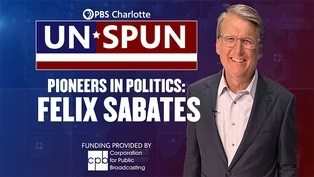
Pioneers In Politics: Felix Sabates Preview | Unspun
Preview: S2 Ep209 | 30s | Felix Sabates: From immigrant roots to shaping Charlotte’s sports legacy. (30s)
Providing Support for PBS.org
Learn Moreabout PBS online sponsorship New Episode
- News and Public Affairs

Top journalists deliver compelling original analysis of the hour's headlines.
 New Episode
- News and Public Affairs

Today's top journalists discuss Washington's current political events and public affairs.


 New Episode
 New Episode
 New Episode
 New Episode
 New Episode
 New Episode
 New Episode
Support for PBS provided by:
Unspun is a local public television program presented by PBS Charlotte