Unspun
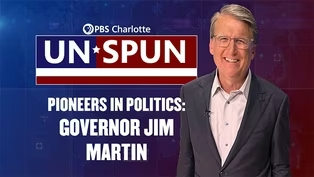
Pioneers In Politics: Governor Jim Martin | Unspun
Season 1 Episode 137 | 27m 8sVideo has Closed Captions
Another edition of Pioneers In Politics, with our special guest former Governor Mim Martin
Another edition of Pioneers In Politics, with our special guest former Governor Mim Martin. He was a chemistry professor from Davidson, and a county commissioner from Mecklenburg who also served in Congress, before winning the Governor’s mansion by making only one promise to North Carolina voters. We’ll talk with Governor Martin about changing politics in Raleigh and Washington.
Problems playing video? | Closed Captioning Feedback
Problems playing video? | Closed Captioning Feedback
Unspun is a local public television program presented by PBS Charlotte
Unspun
Pioneers In Politics: Governor Jim Martin | Unspun
Season 1 Episode 137 | 27m 8sVideo has Closed Captions
Another edition of Pioneers In Politics, with our special guest former Governor Mim Martin. He was a chemistry professor from Davidson, and a county commissioner from Mecklenburg who also served in Congress, before winning the Governor’s mansion by making only one promise to North Carolina voters. We’ll talk with Governor Martin about changing politics in Raleigh and Washington.
Problems playing video? | Closed Captioning Feedback
How to Watch Unspun
Unspun is available to stream on pbs.org and the free PBS App, available on iPhone, Apple TV, Android TV, Android smartphones, Amazon Fire TV, Amazon Fire Tablet, Roku, Samsung Smart TV, and Vizio.
Providing Support for PBS.org
Learn Moreabout PBS online sponsorship(upbeat music) - [Narrator] This is a production of PBS Charlotte.
(upbeat music continues) This week on "Un-Spun," another edition of Pioneers in Politics with our special guest, former North Carolina Governor Jim Martin.
He was a chemistry professor from Davidson and a county commissioner for Mecklenburg, who also went to Congress before winning the governor's mansion by making only one promise to North Carolina voters.
We'll talk with Governor Martin about changing politics in Raleigh and Washington and about bridging the gap between politics and business.
Plus, we'll count down the top five reasons business executives have a tough time working in politics.
(melodramatic music) In today's America, welcome to the Spin Game.
Believe me, I know.
I'm Pat McCrory.
(air whooshes) When I was governor and mayor, I played the Spin Game.
I was played by the Spin G1ame.
But aren't we all done being spun?
Let's take the spin out of the world we're in, here on "Un-Spun."
(melodramatic music continues) Good evening, I'm Pat McCrory and welcome to "Un-Spun," the show that tells you what politicians are thinking, but not saying.
You know, not every election turns out like you think it will.
Believe me, I know.
That's just as true today as it was back in 1984 when popular governor Jim Hunt was stepping down to run for the US Senate and the Democrats had a crowd of big name candidates favored to replace him.
Attorney General Rufuss Edmondson, and Lieutenant Governor Jimmy Green were both proven vote-getters across North Carolina.
And former Charlotte Mayor Eddie Knox was in the race, too.
And 19 of the past 20 governors were all Democrats.
But on election day, the surprise winner by more than a million votes was Republican Jim Martin, a former congressman who had never run statewide before, but who now faced the challenge of bringing a state divided by region and by party back together again.
(light upbeat music) - Here today after such a time of rivalry, our future calls us together in that spirit of unity.
For today, we are all from East and West and Piedmont.
Today, we are all North Carolinians in one united state.
(upbeat music continues) (audience applauds) We are a varied people in North Carolina, republicans, democrats, independents, conservatives, liberals, moderates, in our own communities where we know every corner, every pothole, every tree, we know what the needs are.
And so we must learn to understand and support the needs of others in this united state of North Carolina.
I believe in an open marketplace where alternative ideas and their consequences can be debated and compete for our allegiance.
I believe in a strong two party system as the best way to promote that competition of ideas and to encourage good people to compete for public office and to ensure greater accountability for those who serve.
With its problems, its opportunities and its challenges, the future calls us together.
And so in that spirit, my friends, I begin my service to you today as governor of this great united state of North Carolina, thanking you all for being here and for what you did that we might be here today.
Thank you.
(audience applauds) (upbeat music continues) - Joining us now on a special edition of "Un-Spun" is one of North Carolina's true pioneers in politics.
He's the only two term Republican governor in the State's history who worked together with business leaders and a mostly democratic legislature during his eight years in office to create half a million new jobs, increase spending on North Carolina schools, and finally finish the last leg of Interstate 40 to the North Carolina Coast.
Governor Martin, it's an honor to have you here today on "Un-Spun."
- Well, Pat, I'm glad to be here.
I figured if I come here on your show, I'll be as popular as you are.
- Well, I, (laughing) you've always been the most popular governor in my book, and it is really an honor to have you here.
In fact, one time you said, "The governor of North Carolina's job is the best job in politics."
Why did you say that?
- Well, it is because, you're not just sitting in committees with a bunch of people who outnumber you and are losing a lot of things.
You can do things on your own with your administration.
Now, you can also achieve some accomplishments with the general assembly, but they're gonna fight you on everything no matter what party you in or they're in.
That's just the way it is.
But it was a good experience from the, and for Dottie.
- No doubt about it.
And Dottie was one incredible first lady of North Carolina.
- And people remember that she started the wildflower program along the highways.
- Exactly, whenever you see wildflowers down the middle of the highway, you could thank Dottie Martin for it.
- And I thought it was good that Jim Hunt's administration honored her.
They put up signs that said, "These wildflowers brought to you by Dot."
D-O-T. - Class act right there by Governor Hunt.
Class act.
- Department of Transportation.
- What were the big issues?
- That's a joke thing.
(Pat laughing) - What were the big issues in North Carolina when you were running for governor and how has that changed to today?
- When I was running, the issue was public education, at most, the Democrats have been doing pretty good working with business to grow jobs, but there was a big need for highways.
And I had a slogan, "Better schools, better roads, better jobs," and kind of stuck to those three things.
Now, occasionally I'd say, well, we really gotta have some better prisons and even made a plug for a better lieutenant governor when Jim Gardner was running.
- Right, right.
- But, and he won, the only Republican or the first Republican to be there.
But those were the issues.
That's the main responsibility of the state is to build the economy to take care of the public schools.
And we did.
- What was the partisan struggles at that time?
Here, you had a democratically controlled legislature.
You were the first Republican governor since Jim Holshouser, who was the first since the Civil War.
Tell me the dynamics, and you were an outsider.
You weren't coming from state government, you were coming from the US Congress in a county commission.
- And also a Republican.
Back then, most, I'd say 80% of registered voters were Democrats.
A lot of Conservative Democrats, probably most Democrats then were Conservative.
Most Southern Conservatives, not just the Carolinas, but all across the South were more Conservative, and yet, so you had to run to get Democrat votes.
And when I was elected in '84, I mean here, this is a partisan unique thing.
I had to get more votes from Democrats than there were Republican, because the fact I got twice as many votes from Democrats as the 20% Republicans in order to win.
- And at that time, there were very few independent voters as there are now, there are more independent voters than Republican and Democrat.
- Right, but Lamar Alexander, who was the only other Republican governor, he and I called a meeting of some leaders like Carol Campbell from South Carolina, Newt Gingrich from Georgia, Connie Mack from Florida, Trent Lott from Mississippi.
And we cooked up a strategy to attract the Conservative Democrats to come register in the party whose presidential candidate they were supporting, whether it was Nixon or Reagan or even Eisenhower.
But they just weren't going down the ballot.
And now they do.
And we're a lot more competitive.
We're a purple state.
- Now, there are power struggles between the governor and the legislature today.
And there were during my administration, but that was nothing new.
There were also power struggles when you came in where I think the Democrats tried to challenge some of the power of the executive office, especially governors.
- Pat, when I was there getting organized before the inauguration, I didn't think we needed a veto as the only governor in the world.
I mean, the governor of American Samoa had the veto, but I didn't.
And I'd say even South Carolina's got veto- - Even South Carolina.
- Yes, I tease them a little bit.
Of course, I grew up in South Carolina.
And you know, Warren and Savannah, and they teased me in the campaign, the Democrats saying, "You know, Martin wasn't even born in North Carolina.
He was born in Savannah, Georgia."
And they say, "What do you have to say to that?"
I said, "Well, I had to be near my mother at the time."
And they understood that.
That made sense, you know?
- Yeah, so what did- - But we put that together and it worked.
It took us about two years to create a two party south when the entire south was that way, since the world- - You were the transition of having a bipartisan state versus a one dominant party state of Democrats.
- That's right.
Yeah.
So when I ran for reelection in '88, we had a competitive group.
We weren't quite as many as the Democrats, but we had enough to run people, before then, no Republican had gotten elected to not only court of appeals in Supreme Court, but not even to the Superior Court for about 80 years, 'cause they'd make 'em run statewide party line because that way the Democrats could get all of them.
And by the time I left office, the Republicans were winning all of them, so it got to be more competitive.
- The pressure of protecting executive power is an issue, you, and myself, and Governor Hunt, and Easley, and Purdue, and others have worked on together.
What's your feeling about protecting executive power in North Carolina?
- Well, it's the Constitution.
And if you don't honor the Constitution, it's hard to find what else you do to be trustworthy.
And that started with me because when Holshouser was there, they'd taken away some appointments and he couldn't do anything about it.
And so they started in on me and I didn't think we needed the veto, but that convinced me right away.
So that by the time I had my first state of the state message, I advocated the veto and started working for it, made it a campaign issue.
At one point, got the Senate to approve it, but couldn't get the house.
And so when Governor Hunt got back in, he was able to keep the Senate where they were in favor and got the House to come along.
And then of course, the people voted for it overwhelmingly.
The Constitution says that the offices of the executive branch, the legislative branch, the judicial branch, shall forever be separate and distinct.
Well, that's not true if the governor can't appoint his own boards.
- In fact, you came to help me when I was governor, when the Senate and House controlled by Republicans, tried to take away my appointment authority as governor, and it was Berger versus McCrory.
- In my day, they thought it was a partisan thing, but it turns out it's just a legislature versus the executive branch.
They make an argument that we don't like Royal Governors.
My answer to that was that well, you know, the war's over, we defeated the British a couple hundred years ago.
They're gone.
They're not coming back.
- Yeah, yeah.
- That's, well, I kind of tweak 'em a little bit, but they continued to try.
And so I had to get a lawyer that I couldn't afford.
I had no money for it.
The Attorney General would defend them.
Okay.
He was democrat.
They were Democrat.
And so Buddy Wester, a local lawyer, represented me pro bono.
And of course he gotta be a very famous constitutional lawyer because of that.
- He was on our show last week.
- Yeah?
Was he?
Okay, great.
- Yeah.
No doubt about it.
- He got a recent honor from the Bar.
- So as you look down from an outsider, and what do you think the major issues of today are and the major challenges for North Carolina that the current Governor Stein, who you and I met with recently with the other governors, if you had to give him advice, what would it be?
- Well, the others are still there.
School, board, schools, roads, jobs, all of that's still there.
And Governor Stein understands that.
And so he's gonna do the best he can.
We may disagree some things, but he's a capable person and we'll see how it goes.
But you've also got a new problem that once we got a two party system, it began to split apart.
- Right.
- So that most people, more voters than in either party now have pulled out of both the Democrat and the Republican Party.
And that makes it harder to get the will of the people represented by either of the two parties.
And how that's gonna turn out, I don't know.
Can you get people to go back to the party that they prefer, the one they came from?
I couldn't get anybody to do that.
- Right.
- So maybe one day there'll be a center party.
I find that appealing as something that's badly needed.
Can I do that as a 89-year-old guy?
Try to pitch it?
Probably not, but maybe I can get people interested in starting it.
- Let's move to DC politics.
You were a member of the House for three terms, I believe.
And what's changed there and what would you recommend to people in Congress right now?
- Well, make it six terms, but yeah.
- I'm sorry, I apologize.
Six terms.
- 12 years.
- Right.
- Didn't have a four year term.
Oh, and what was your question?
I was thinking how to correct you there.
- What recommendations, not the first time you've done that, I took your recommendations and corrections a lot.
What recommendations would you make to House members right now in this incredible dynamics in federal politics?
- Well, first of all, I don't know that it'd do any good, I'd say as far as the president, the Republicans are pretty well aligned with doing what he wants to do or at least letting him do it.
I think that Elon Musk was a good choice to come in and find things, but not a good choice for explaining 'em.
He looks like he wants to act like he's Trump and to act, you know, to say what's right on the top of his head, he'd have been better off to turn on those ideas, turn 'em over to the cabinet secretaries and let them take the personnel changes.
Not widespread firing, but do it with attrition.
When people leave office or die, you just don't fill that position.
You can get to the same place without all the commotion.
Other places of a cutting turned over to the legislature, the Congress, let them get credit for it and they'll see that you get all the credit in the world, but they'll get credit too, and they'll deserve it, they'll back that.
- You have a lot of fights right now between the executive branch and the judicial branch, but my commentary is the legislative branch seems to be standing on the sidelines.
- For the most part.
Some of them now are starting to get into the dispute over tariffs.
You know, for years we've been the free trade party.
- The Republican party was free trade.
- And now we've got a president who's not, who wants to use tariffs, hard to tell whether he wants to do 'em for revenue or to punish our allies as well as our adversaries, or whether he wants to use it for bargaining chips as part of his "Art of the Deal" negotiating.
Because one day you'll see one thing and the stock market goes down, the next day there'll be a rumor that that wasn't what he meant, it goes back up, then it goes back down and it's a whipsaw right now.
We were poised to have a recession anyway, I think he's going to have to carry the burden of the tariffs being blamed for it.
And its contributing, it probably helped trigger it, move it a little faster down that road.
That's too bad, but I don't know that he worries about that.
He's got his ideas and I say, don't worry about what he says.
You know, a lot of people say they don't believe a word he says, then I said, don't worry about what he says.
Look and let see what happens, what he does.
And I was not one of his supporters, but I'd say, wait and see, we can't, as voters, we can yell, we can protest, but let's see.
'Cause it might work out to our advantage.
- Remaining two minutes, foreign policy.
The foreign policy environment's changed dramatically since you were in Congress for 12 years, what recommendations you had made, I mean, it used to be Russia against the United States.
Now there seems to be a gray area here.
- Well, we had a lot of anti-communism spirit there.
And one of the amazing things at that time was that Nixon, during his crisis, had the idea that he would be the first president to go to China, to Communist China.
- Right.
- And when you think about it, Richard Nixon could do that and nobody else could.
The Democrats could not have, they'd been accused of being communist.
And I saw an opportunity with Trump, had he chosen to do so, he could have been the president to say, let's get rid of these assault weapons after he got barely missed getting killed by one of them.
And it looked like at one point he was gonna be more conciliatory in that direction, having had a close call, but either chose to or missed that opportunity.
But he can do the same thing with dealing, you notice on Ukraine, he's more critical of the Ukraine president than of Putin.
And of course some people say, oh, that's 'cause you're in Putin's pocket.
Well, it's because you're not going to ever get that settled by attacking Putin.
- Yeah.
- You can't.
And if you want to get it settled, you gotta be nice to him.
I'd like for him to be nice to Zelenskyy as well.
- Me too, yeah.
- Because I supported Biden's effort to get us in there as far as good.
He had a pacifist in his own party and isolationists in our party that made it hard for him.
But did what had to be done.
- Governor Martin, I could listen to your wisdom all day.
The state- - Do you mean time's up?
- The time's up and the- - You gonna pull a cord on me?
- We appreciate your service in Mecklenburg County, state of North Carolina and the United States.
You're the best.
- And you're my buddy.
- Thank you, man.
- Appreciate it.
- It means a lot.
(melodramatic music) (air whooshes) (melodramatic music continues) All right, tonight on our "Un-Spun" Countdown, the top five reasons business executives have a tough time working in politics.
Let's start out with number five.
Number five, business executives are used to giving orders, not taking orders.
Not just from the president they're having to take orders from, but they're also having to take orders from Congressional Oversight Committees who lecture them on how they should do their job on live TV.
Very uncomfortable positions for business executives.
Number four, lack of public relations experience.
This is especially true with political reporters.
Business reporters are much softer to deal with than political reporters who aren't afraid to take a hard left and a hard right.
Number three, private and family life is exposed.
Politicians are used to your family being tact.
Business executives are not used to that whatsoever.
Number two, business strategy is different than political strategy.
Political strategy only looks toward the next election.
Business strategy looks for long-term return to their stockholders.
And number one, the fact of the matter is most business executives are smarter than most politicians.
(exciting dramatic music) PBS Charlotte's Jeff Sonier joins me now for "Un-Spun," one-on-one.
- You know, I think this is the best job in TV news as opposed to the best job in politics.
What do you think?
- This is not a bad job in TV news 'cause we're bringing something unique.
- Yeah, maybe.
- Telling people how politicians think, not necessarily what they say.
- Okay, well the governor says, Governor Martin says that it's the best job in politics.
Being governor of North Carolina, you were there.
What do you think?
- It is the best job in politics.
- Why?
- I think if you ask any governor who's also been a US Senator or Member of the House, they'll say Governor is the best job.
And I think the second best job in politics is being Mayor because you're closest to the people and you can actually get things done and you have a voice and you can set the agenda and you have a bully pulpit to sway public opinion.
- You were an outsider when you went to the governor's office, just like Governor Martin was, an outsider, not part of the whole Raleigh establishment.
What kind of challenge does that present coming in to an organization, not an organization, but a mechanism that you're really never been part of before and then being expected to run the whole thing?
- The biggest challenge is, the people in the state legislature and in the other executive offices don't think you deserve the job because almost every governor came through state government, either as a state legislature or as a member of the council state.
So Jim Martin and I were very unique and it's quite ironic that we're both from Mecklenburg County.
That might have had something to do with it, too.
- Well, I wanted to ask you about that.
You know, with the great state of Mecklenburg, a lot of folks refer to us that way across the state.
What does it mean symbolically and politically to have a governor from the Charlotte region?
- I think it's changed in the last 30 years.
I don't think that stigma is as much honest because now, even in the eastern part of the States, a lot of the second, third generation who grew up in Rocky Mount or Wilson or other parts of Eastern North Carolina have moved to Charlotte.
Their kids have moved to Charlotte.
So they're coming to Charlotte much more than they used to in the 70s and 80s and 90s.
- And you mentioned outsiders have a disadvantage.
What about the advantage of being in Congress like Governor Martin was?
Does that give you a heads up or a headstart when it comes to getting things done?
- Yeah, I think it helped Governor Martin, especially when seeking federal grants and getting federal money and he knew the contacts to go to in DC.
And plus, Governor Martin had such a great reputation both in Washington and as a county commissioner.
And I think that experience helped him as governor.
- Yeah, fascinating to hear you kind of bounce ideas off of him.
You were the kind of the follow up to him.
And it's been 40 years since he was in office, it's really hard to believe that much time has passed since then.
- Well, he was a mentor for me.
In fact, when I was governor, he would come up and visit me and we'd sit down on the porch in our rocking chairs and I would just listen and take his wisdom and advice as much as possible.
He's a man of great stature and I think he was the smartest governor in North Carolina history.
- We can bring in some rocking chairs here if you'd like.
- We can do that next time on One-on-One.
- Thank you, governor.
- Thank you.
(exciting music) (air whooshes) Neither snow, nor rain, nor heat, nor gloom of night stops the post office from delivering our mail.
But when it's the postal service versus politics, well, that's when common sense gets returned to sender.
Just ask Louis DeJoy, who recently resigned as Postmaster General in March.
DeJoy lives here in North Carolina and I think he was our best and most qualified Postmaster General since Ben Franklin got the job in 1775.
DeJoy's a retired logistics executive who was appointed during President Trump's first term and then stayed on through the Biden administration.
During his five years of service, DeJoy designed a long range plan to save the postal service from bankruptcy and to increase efficiency.
He made sure that mail-in ballots received on time in two different presidential elections when the pressure was really on.
And when the White House reached out to the Post Office for help during COVID-19, DeJoy used his background in logistics to send out over 300 million Covid test kits in just five months.
But DeJoy never completely satisfied the political class in Washington who say they want change, but then get mad when someone steps on the toes of the status quo.
You know, it's ironic that DeJoy finally quit after telling two 20-somethings, sent over by Elon Musk, to, "Go take a hike."
At least that's how the press reported his resignation.
So here we have a very successful North Carolina logistics executive being told how to do his job, first by Congress trying to deliver votes instead of the mail, and then by budget-cutting musketeers with no management experience.
Well, no good deed goes unpunished in DC.
Our country deserves better and so did Louis DeJoy.
Well, that's the reality as I see it.
I hope you'll come back next week as we tell you what politicians are thinking, but not saying, (light upbeat music) right here on "Un-Spun."
Goodnight, folks.
(light upbeat music continues) (light upbeat music continues) (upbeat music) - [Narrator] A production of PBS Charlotte.
Pioneers In Politics: Governor Jim Martin Preview | Unspun
Preview: S1 Ep137 | 30s | Another edition of Pioneers In Politics, with our special guest former Governor Mim Martin (30s)
Providing Support for PBS.org
Learn Moreabout PBS online sponsorship
- News and Public Affairs

Top journalists deliver compelling original analysis of the hour's headlines.

- News and Public Affairs

FRONTLINE is investigative journalism that questions, explains and changes our world.












Support for PBS provided by:
Unspun is a local public television program presented by PBS Charlotte