Unspun
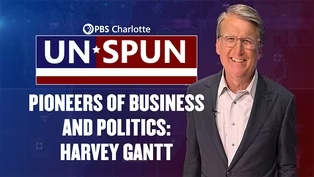
Pioneers of Business and Politics: Harvey Gantt | Unspun
Season 2 Episode 203 | 26m 43sVideo has Closed Captions
Harvey Gantt on Charlotte’s evolution, leadership, and his historic Senate runs.
In this special edition of Unspun: Pioneers in Politics & Business, we sit down with Harvey Gantt to discuss Charlotte’s evolution—and the choices shaping its future. Celebrated for his civil rights and business leadership, Gantt also made history running twice for U.S. Senate in the 1990's against Jesse Helms.
Problems playing video? | Closed Captioning Feedback
Problems playing video? | Closed Captioning Feedback
Unspun is a local public television program presented by PBS Charlotte
Unspun
Pioneers of Business and Politics: Harvey Gantt | Unspun
Season 2 Episode 203 | 26m 43sVideo has Closed Captions
In this special edition of Unspun: Pioneers in Politics & Business, we sit down with Harvey Gantt to discuss Charlotte’s evolution—and the choices shaping its future. Celebrated for his civil rights and business leadership, Gantt also made history running twice for U.S. Senate in the 1990's against Jesse Helms.
Problems playing video? | Closed Captioning Feedback
How to Watch Unspun
Unspun is available to stream on pbs.org and the free PBS App, available on iPhone, Apple TV, Android TV, Android smartphones, Amazon Fire TV, Amazon Fire Tablet, Roku, Samsung Smart TV, and Vizio.
Providing Support for PBS.org
Learn Moreabout PBS online sponsorship(upbeat music) - [Announcer] This is a production of PBS Charlotte.
(gentle music) - Tonight on "Unspun," how politics sets the stage for economic growth.
Civic leadership has helped steer Charlotte's growth for decades.
And one of the most influential forces in the Queen City is an architect, civil rights trailblazer, and former mayor, Harvey Gantt.
As Charlotte works to balance booming growth with affordability, connectivity, and quality of life, Gantt offers a rare perspective, someone who has both designed cities and led one.
Next, we sit down with the man whose imprint is all over Charlotte.
In today's America, welcome to the spin game.
Believe me, I know.
I'm Pat McCrory.
When I was governor and mayor, I played the spin game.
I was played by the spin game.
But aren't we all done being spun?
Let's take the spin out of the world we're in here on "Unspun."
(dramatic music) Hi, I'm Pat McCrory.
Tonight, in this special edition of "Unspun," pioneers in politics and business, we talk with Harvey Gantt about Charlotte's evolution and most importantly, about the choices that shape its future.
Every town struggles with the same questions, how we plan our neighborhoods, how we invest in infrastructure, how we grow without losing what makes a city special?
And for more than a generation, Harvey Gantt has been part of those conversations.
Mayor, it's an honor to have you on this show.
- Well, thank you, mayor.
I'm delighted to be here.
You really make me sound like a hero of some type.
- [Pat] Well, you are a hero.
- But I'm not.
- You are a civil rights hero, you're a political hero, and you've also done some incredible things in business.
And one of the reasons we wanted you on this show and we're having other pioneers in politics and businesses, as, you know, we've got about 100 to 200 people move into this region every week, so they don't know the history.
They don't know you, they don't know me, they don't know how we got to where we are, and it didn't happen by accident.
It happened because of heroes like you who got involved in leadership.
So it's an honor to have you here.
- Delighted to be with you.
- You know, I heard a story recently, and I didn't know this until recently, is that when you first came to Charlotte, you couldn't get a hotel room.
- That is absolutely right.
And I've told that story many, many times.
- I've never heard it.
Tell me briefly the story or tell me what it was all about.
- Well, briefly, I was with my wife, Cindy.
- Mm-hmm.
- We were coming for a job interview.
My daughter, Sonja, was an infant, less than two months old.
And we came down Wilkinson Boulevard in May of 20, I mean, 1965, my god.
- [Pat] 1965.
- A long time ago.
- [Pat] Wow.
- And.
- Wilkerson was the only way to get in 'cause 80.
- That's exactly right, 85.
- That was 85.
- Totally completed by then.
- That was 85, yeah.
- And I had a job interview the next morning with Odell Associates, one of the larger firms in Charlotte at that time.
And we intended to spend the night in a hotel, motel.
And then I'd get up earlier that next morning and go to the interview.
And became- - This was after graduating from Clemson, being an architectural major.
- I hadn't quite graduated yet.
- All right.
- But, you know, graduation is coming.
We were all getting ready for that.
I had to come for this interview 'cause I needed a job.
And I was getting a job at a prestigious architectural firm.
- Very much so.
They had designed a lot of the civic buildings in Charlotte.
- Exactly, exactly.
The library that we used to know, and a whole lot of other buildings, much of Johnson C. Smith's campus.
- [Pat] The school board building.
- School board building.
All those things were Odell Associates.
We were anticipating that interview.
Make a long story short, the Civil Rights Act of 1964 had passed.
So we were talking about a year since that had happened.
So we made an assumption as a black couple that the law had permeated the entire community everywhere.
And so we shouldn't have a problem getting a hotel room.
In those days, they used to have the one-story motel.
- Sure, all Wilkinson Boulevard.
- Exactly.
- Yeah, yeah.
You'd pull in, park, and.
- And we started pulling into the one that looked the most attracted to Cindy.
And we'd pull in there and there'd be no sign that said they didn't have a vacancy.
And then I'd present myself, and all of a sudden, they had a no vacancy situation.
- [Pat] Wow.
- So we did that about four or five times.
- All along Wilkinson?
- All along Wilkinson.
- Yeah.
- Every time I drive down there now, it's changing, of course.
- Some of them still exist.
- But you don't see a lot of them, not nearly the mount.
- No, no, most of them been torn down now.
- But bottom line was we couldn't get one.
And then I went back out to the, what is 85, the 85 corridor, which was operative, that portion of it.
- [Pat] Sure, sure.
- Went to the 85 corridor, went to a Howard Johnson's.
And I took Cindy and the baby and myself in.
And I think we took the heart of the guy who was behind the desk, who might have been trained to say no.
He made a phone call.
And we had a room for the night.
And the rest is history.
I mean, I always tell audiences, "It is amazing what you can do in Charlotte."
I mean, in the period of, from 1965 to 1981, I became mayor of a city that I couldn't find room at the inn until that guy showed up.
- Was that your first visit to Charlotte?
- No, I'd been there before, but not to spend the night.
- Yeah, yeah.
- You know, to look over some things and.
- I'll think of that story the rest of my life when driving down Wilkinson Boulevard.
'Cause when you go down Wilkinson Boulevard, you still go back to the '40s and '50s because some of the old design is still there, the old truck stations, the old gas stations, and so forth.
I'll be thinking of you from here on out when I'm in Wilkinson.
So when you got involved in the community and you got a job, who were your role models?
- That's an excellent question.
I grew up in the church and we went to Friendship Baptist.
And there was a guy by the name of Coleman Kerry, who's the pastor of the church.
But he is not only the pastor of the church.
- This is off of Beatties Ford Road.
- On Beatties Ford Road.
- Uh-huh.
- They weren't even in the facilities that they're in now.
They were worshiping at Northwest Junior High School, what we know as the School of the Arts today.
And they were there because of urban renewal, another element.
- Sure.
- The LBJ Urban renewal.
- Well, I'm not gonna call it the LBJ urban renewal.
I'm just gonna say.
- But he was the president who initiated much of that.
- A lot of urban renewal came out of the politics of the early and late '50s, as well as the '60s when in fact, we were trying to remove slum housing from areas and try provide better housing.
It didn't quite work out that way as a lot of policy that was meant to do good didn't always work out the way we wanted.
- [Pat] Yeah, yeah.
- And one of the tragedies of all that period was a lot of people were relocated, and they were relocated along the Beatties Ford Road corridor.
And the churches were, fell in the eminent domain also.
And they were taken out.
So Friendship under Coleman Kerry temporarily moved to the Northwest Junior High School on a lease that was two or three years.
They had to get out of there and find their own church.
And they ultimately built the physical plant that we have now.
But I got to admire Coleman Kerry for his leadership, his spiritual leadership of that church, but his involvement in the school board and community involvement, and stressing the fact that you can't live in a community and hope that it's gonna be better unless you actually find a way to participate, and he did.
- And that was a big deal then for an African American to get elected to the Mecklenburg School Board.
- Well, that's exactly right.
- Yeah.
- That's exactly right.
And so, in addition to Coleman, the Alexanders who ran a funeral home.
And Fred Alexander very engaged in civil rights.
And long before, I haven't had any aspiration there for going to the city council.
Fred and I used to have these fireside chats over the period of time, just talking about what was going on in the city.
And our chats got more intensive after I spent three years at Odell, and then went away to graduate school and came back having studied city planning.
- [Pat] Yeah.
- And Fred kept saying, "Tell me why certain things need to be in certain locations."
And he'd hear more about politics.
And so we had this very stimulating conversation almost every couple of weeks, just talking to each other.
- So who convinced you?
Or did you convince yourself?
Or was it a combination of, "I've gotta run for the Charlotte City Council"?
- You know what, I never decided to do that.
- You never decided, but you did it anyway.
- I ran, but my interest in politics was peripheral.
- [Pat] Yeah.
- I got to know more about it by spending a lot of time with Fred.
But my interest was such that I'd be delighted to give advice to you as a mayor, to Fred Alexander as someone who was making policy as a city council member.
And he thought it was great that I'd gotten this master's degree in city planning.
And we carried on those conversations.
And then there was a vacancy caused by Fred Alexander.
- [Pat] Wow.
- Fred Alexander was a super politician who got elected as an African American to be one of the first people in the North Carolina Senate.
- I remember well.
And that created that opening.
- Created an opening for a year.
And we were watching the, back and forth, the politics of who is going to be the next dean of black politics in Charlotte.
That's how narrowly we could define it.
Who's gonna succeed Fred Alexander?
And there were lots of folks in the black community that wanted to succeed Fred Alexander, not Harvey Gantt.
- So the council, and the rules back then, I think, are the same rules today.
The Democrats have to elect a replacement for that period.
And so there was John Belk, the mayor and other Democrats on the council, Jim Whittington.
- I don't think there were any, I don't know if there were Republicans at that point in time.
- Oh, yeah, you had a couple of Republicans there, not.
- Not many.
- Only had seven members of the council.
- Yeah, that's true too, yeah.
- And there were a couple of Republicans there.
And they couldn't decide on the people who really wanted it, who should replace them.
And Fred Alexander said, "Well, I know this guy who is knowledgeable.
He's not a politician, but he's knowledgeable about city things and what cities do."
And he said, he came to Cindy and me and said, "Would you be interested in doing that?"
And we thought about it for a couple of days.
He went and introduced my name, and the rest is history.
- Wow.
- I became a member of city council.
- And then you ran for mayor.
- Well, I love city council so much, I decided to run for city council again and again and again.
And ran for mayor against Eddie Knox in 1979.
See, I could still remember those dates.
- Oh, yeah, I do too.
- You probably remember.
- Oh, absolutely.
I remember the losses more than I remember the wins.
That's the problem.
- So, yeah, I got to liking it like a duck takes the water.
Because in a lot of ways, what they did was what I was doing as a professional, putting buildings together to make spaces, to allow people to enjoy those spaces.
And even putting the buildings together, you had to deal with so many different elements, the engineers, the electricians, the contractor.
And I saw in that one year working on the city council after that appointment that, you know what, that's what the city does.
It's led by our mayor, and they work together to make life comfortable for people who are living close together, difference between rural and urban.
And some of the things they dealt with was nothing but infrastructure, streets and roads and security and protection and safety and.
- Sure.
And the airport.
- And the airports.
And all that stuff was, that was right up my alley.
I just thought, "It's wonderful."
And that I would, I was trying to make a decision whether it was taking too much time.
I was running architectural practice with Jeffrey Jeffrey Huberman.
And there was a question as to whether I'd have the time to do it.
But we found the time.
- Yeah.
Running for mayor, I guess was another big decision for you.
I mean, Eddie Knox is, you know, of course, became mayor, but you are never a person to give up.
You keep fighting.
You are a fighter.
- I don't know why you'd say that, but.
- No, well, because history shows it.
You've been a fighter all your life, and you don't take no for an answer.
- Well, sometimes you should take the no for an answer.
I got lots of people that say that.
- When it came to trying to run for office, even after one defeat, you would keep, you'd try again, as I've done.
- As you've done, successfully most times.
- And it's tough.
It's tough to run again.
- Well, if there's something in your gut that says, "I really need to try this again," or, "I really think I'm qualified to do this.
I really think I might have a vision for what might need to happen.
I want to lead.
I want to bring people along."
I loved working with the city council members.
- [Pat] Yeah, I do too.
- Mayors have to be able to do that.
And most importantly, they have to be able to, today, be able to count to at least seven or eight votes.
Back then, it was four or five votes that you, you know.
- Some of those people that you work with, Velva Woollen and others became role models for me and mentors for me.
- Great Republicans.
- Next decade later.
- Great Republicans.
- No doubt about it, no doubt about it.
And wonderful human beings.
- Richard Vinroot.
- [Pat] Richard, Richard, of course.
- We were all.
- We all were friends, in fact.
We all had disagreements, but we, I enjoyed their company then and I enjoy the company now.
- You know, sometimes nostalgia can be very damning in a sense 'cause you remember it better than it used to be than it actually was.
But I can honestly say in the time that I've served in Charlotte, in city government, we disagreed on a lot of things but we could go out and have the proverbial beer afterwards.
- [Pat] Exactly.
- And say, "Yep, I didn't agree with you.
I think you made the bad decision."
But, you know,- - And me and Ella Scarborough and Al Rousso would do the same thing.
- I respect you as a member of this body, reelected by the folks, and that respect is gonna remain.
- So let's talk about some of the issues you had to deal with as mayor and compare them to some of the issues of today.
'Cause I talked to a lot of current politicians say, "Oh, we have all new issues.
They're nothing like it was in the past."
What are the issues that you had to deal with as mayor that our city is still dealing with today?
And maybe are there other issues that we didn't have to worry about, both you and me.
- Hmm.
That's a tough question too.
I'm trying to remember my terms on the council and as mayor, and we were a city chomping at the bit to grow.
I had the benefit of working in an architectural firm that was doing the master plan for downtown.
One of the things that we had created in that master plan when I was working with a lot more experienced architects than myself, but my boss gave me the opportunity to use my planning background to be a part of that team.
And we were talking about building a city that would, that had a variety of different opportunities for housing, obviously, business and retail, and all that stuff.
But housing was the big thing.
And then I added, not I added, but we thought it was also the greatest place in the world to have all the big ticket, what I call big ticket spaces.
That's where you should have the stadium.
That's where you should have the arenas.
That's where you should have the symphony hall.
And those ought to be right at the core.
- [Pat] The convention center.
- The convention center.
All of that should be there selling that idea.
We showed renderings of high-rise housing in downtown, and people didn't think that was great.
And people thought that was crazy.
People would never come, they would never leave Myers Park or other places to come live downtown.
So planning the core of the city was an issue.
But let me talk about some others.
And I give a lot of credit to John Belk and the others who thought the airport was the very important thing that we needed to do.
Should we build a second runway?
We got beat up a lot by that.
People didn't want to spend the money, or we thought they didn't.
There was a 10,000 foot runway we had.
We wanted to build a parallel runway.
Bottom line is that, that mayor and that council took a lot of heat, but we decided to do it.
Third point is, if the Charlotte was going to grow, it was gonna suffocate on all the growth going to Southeast Charlotte.
And this is where I lost favor with a lot of developers in the community.
Because as mayor and prior to being mayor as mayor pro tem, I was pushing the idea, mayor, of let's not allow Southeast Charlotte to be overrun by growth.
We weren't growing at 150 people a day back then, but we were still growing.
And what we did was took advantage of federal loans and grants to build sewer lines in the northwest part of the county.
- Which is not a vote-getter, but it's the smartest long term thing you ever did, and which Atlanta didn't do that for many years.
- Yep, and we built those, and the results speak for itself in terms of those kinds of.
The last point I wanna make before you go.
You don't build these facilities without bonds, which the citizens have to support, without the property tax.
And you don't wanna increase that too fast, or you won't be in office not very long.
So I kept talking about other sources of revenue, which is not something politicians like to talk about, okay?
- Yeah, I've learned that mistake.
- I started this idea of, "Let's have a land transfer tax."
- [Pat] Yeah, that's where the developers went nuts.
- They went crazy.
- [Pat] Yeah, yeah, yeah.
- And I was never, I never trusted again.
- You were thinking long term.
We've got just a few minutes to go, goes that quick.
I could talk to you forever, mayor.
What advice would you give the current politicians about preparing the city for the future?
- We've got a wonderful city.
I said that 30 years ago, and I'm saying that today.
It can be better.
It always can be better.
It is going to be larger.
We have to deal with some of the basics that will occur as the city gets bigger.
Safety becomes a bigger issue than it was when I was mayor.
You know, we're talking 150,000 people when I was there.
Today, well, we're pushing up against 1 million, 1 million people.
Safety becomes very important.
Transportation.
We just passed this bond referendum.
48% of the citizens didn't agree with it, but 52% did let it go, let it pass.
Transportation is huge.
If we are not gonna suffocate on bad air, crowded streets, if we are gonna continue to attract businesses, good businesses paying decent wages, we have to keep looking at the quality of life.
What I object to a little bit is that there is perhaps too much selfishness in the city right now.
There's not, in my opinion, enough pulling together.
Republicans as well as Democrats have, of course, the city- - [Pat] Or among each other.
- Well, well, I started to say it's not nearly parties that are doing it, but even within our own party, the Democrats dominate.
It's a blue city, they dominate.
But we've gotta find a way to trust each other more, to deal with quality of life issues beyond the pettiness of some of the stuff that I see.
- One word to describe to you in the remaining 40 seconds.
One word that best describes you, and best describes you.
- Can you do that?
- I've got one.
I've got one for you.
- That's a tough question, Pat.
I think I want people to realize I care.
- And I'll add a word to it, passion.
I can feel your passion, hear your passion, and so can everyone else.
And I cannot thank you as a citizen of Charlotte and of North Carolina, how much you've done for the city of Charlotte, for the state of North Carolina.
You've been a role model for all of us.
And I thank you for making a difference with, by caring, caring with passion.
- Thank you, sir.
- Mayor Gantt, it's an honor.
Thank you for being on "Unspun."
- Thank you.
(upbeat music) - Harvey Gantt is rightfully celebrated for his courage in the civil rights movement, in business, and as Charlotte's first African American mayor.
But there's one part of his story that doesn't get nearly enough credit.
He ran for the United States Senate twice as a Democrat from Charlotte in the 1990s against Jesse Helms.
Let me tell you, as someone who's campaigned statewide from Charlotte, that's like trying to sell barbecue without picking a side, eastern or western barbecue.
People look at you funny and you don't make any friends.
Charlotte's got a long list of brave souls who tried statewide races.
Cameron Morrison, Eddie Knox, Erskine Bowles, Richard Vinroot, Sue Meyer, and yes, pat McCrory.
I won once, lost three times.
So I've seen the tombstones up close.
The Charlotte glass wall is real.
Why?
Well, first, most of us didn't come through the state government ladder that tends to produce the winners.
Second, there's always been a little distrust about whether a big city mayor really understands the rest of the state.
And third, Charlotte's name ID doesn't travel far outside the I-77 corridor.
If you can't get seen on TV in Wilmington, it's hard to get votes in Wilmington.
Now, Jim Martin and Thom Tillis did break through, but let's be honest, they made sure their mailing address wasn't in Charlotte when they ran.
They were smart men.
But what Harvey Gantt did was something different.
He took the hits, won two primaries and kicked the door open just enough for people like me to believe we could do it too.
So to Harvey and to all the Charlotte names who tried, lost and won a little, lost a lot, thank you for making a crack in that wall.
My hope is that future Charlotte leaders keep swinging at it because somebody's gonna break it for good.
That's the truth, as I see it.
We'll see you next week right here on "Unspun."
(upbeat music) - [Announcer] A production of PBS Charlotte.
Pioneers of Business and Politics: Harvey Gantt Preview | Unspun
Preview: S2 Ep203 | 30s | Harvey Gantt on Charlotte’s evolution, leadership, and his historic Senate runs. (30s)
Providing Support for PBS.org
Learn Moreabout PBS online sponsorship
- News and Public Affairs

Top journalists deliver compelling original analysis of the hour's headlines.

- News and Public Affairs

FRONTLINE is investigative journalism that questions, explains and changes our world.












Support for PBS provided by:
Unspun is a local public television program presented by PBS Charlotte