
September 19, 2023
Season 2 Episode 79 | 27m 29sVideo has Closed Captions
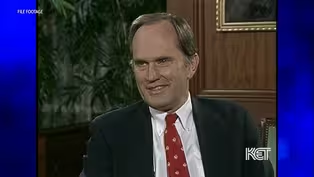
Remembering former Gov. Brereton Jones.
Remembering former Gov. Brereton Jones, the state's highest court considers a gerrymandering case, Planned Parenthood says it will run ads in opposition to candidates who oppose abortion rights, and workers at two Ford plants in Kentucky are still on the job as the UAW strike continues.
Problems playing video? | Closed Captioning Feedback
Problems playing video? | Closed Captioning Feedback
Kentucky Edition is a local public television program presented by KET
September 19, 2023
Season 2 Episode 79 | 27m 29sVideo has Closed Captions
Remembering former Gov. Brereton Jones, the state's highest court considers a gerrymandering case, Planned Parenthood says it will run ads in opposition to candidates who oppose abortion rights, and workers at two Ford plants in Kentucky are still on the job as the UAW strike continues.
Problems playing video? | Closed Captioning Feedback
How to Watch Kentucky Edition
Kentucky Edition is available to stream on pbs.org and the free PBS App, available on iPhone, Apple TV, Android TV, Android smartphones, Amazon Fire TV, Amazon Fire Tablet, Roku, Samsung Smart TV, and Vizio.
Providing Support for PBS.org
Learn Moreabout PBS online sponsorshipGovernor Jones is a wonderful person.
He was an excellent governor.
More reactions on the death of former Governor Brereton Jones.
Well, I think it's really easy and accurate to say that he was well ahead of his time.
Remembering Governor Jones as a crusader for health care reform.
We birthed him.
We got to meet him.
And unfortunately, we had to bury him.
A mother who lost a child to stillbirth shares her story and her mission to prevent others from experiencing the same loss.
Production of Kentucky Edition is made possible in part by the KET Endowment for Kentuck Productions, the Leonard Press Endowment for Public Affairs and the KET Millennium Fund.
Good evening.
Welcome to Kentucky Edition On this Tuesday, September, the 19th.
I'm Renee Shaw.
Thank you for spending some of your Tuesday night with us.
Former Governor Brereton Jones is expected to lie in state in the Capitol Rotunda.
The former governor died at the age of 84.
He was governor from 1991 to 1995.
Governor Jones's funeral has yet to be announced.
We'll bring you more details as we get them.
Today, Governor Andy Beshear announced flags at state buildings will fly at half staff until sundown on the day of interment.
Some of our guests on last night's Kentucky Tonight knew and worked with Governor Jones and they shared their thoughts about him in the future.
Governor Jones is a wonderful person.
He was an excellent governor.
He worked very hard.
He loved the Commonwealth of Kentucky.
He especially loved central Kentucky and horse country.
And he did a lot of good things while he was in office.
And he will be missed.
And our thoughts and prayers are with the family.
And I had the opportunity to work with him very closely for several years and not a finer person.
So we're going to we're going to miss Governor Jones.
Richardson Jones was I would consider him a friend.
We interacted on many levels.
He did a lot of good things.
He was a positive individual.
It was easy to talk to.
He was very much involved and invested.
And it's shocking to me, you know, something never would have thought that would have happened and just found out about it a few hours ago.
But he'll be missed.
Former Kentucky Congressman, State attorney general and state auditor Ben Chandler had known Governor Jones since Jones and his wife arrived in Woodford County, Kentucky, in the 1970s.
Chandler, also a Democrat, was elected as state auditor when Jones became governor in 1991.
Chandler reflected on Jones's legacy as a champion of transformative health care that sought to widen access for the state's most vulnerable.
He had a way about him, a sincerity and a genuine this about him, particularly when it came to certain issues that affected the people that that he represented that really were outstanding and one of them, of course, was his concern about health.
That's very health care.
And he he made that a signature part of his life and he made it that that because he cared deeply and it was transformative and perhaps even more progressive than the time would allow or even now.
Well, I think it's really easy and accurate to say that he was well ahead of his time.
And I would go so far as to say he's still ahead of his time.
We still haven't caught up with his vision of what health care ought to be in this country.
He wanted to see everybody covered in a sensible way, and he put his career on the line to make that effort and had some early success.
I think, you know, a lot of the industries and the powers that be in the health care industry conspired against what he was trying to do.
But but he cared deeply about it.
And I'll never forget him talking about how unfair it was for a person to have a sickness, you know, often not of their own doing, you know, cancer or diabetes or what have you, some some preexisting condition.
And then because you had it, you also had the opportunity to lose everything that you'd worked your life to, to get, you know, it cost you.
It would cause you to be bankrupt, essentially, and you couldn't get insurance.
And he just felt very deeply that that was unfair.
And he spent a good part of his life trying to do something about it, the undoing of that health care reform act.
Do you think that that somehow douses his legacy or contribution to the political landscape?
Well, I mean, ultimately, it was not successful here in Kentucky, But number one, it should have been it was the right thing to do.
And I don't think it harms his legacy at all.
I mean, all you can do, having been in public life most of my life, I can tell you all you can do is give it your best effort and sometimes your best effort enough.
But he did get it done.
He put his effort forward.
It was a far seeing, thoughtful process that would have helped a whole lot of people, the most vulnerable amongst us.
And in my mind, that's what government ultimately is about.
It's try to help those who are most vulnerable.
And that's what Governor Jones tried to do.
He was involved in the health care thing long before the health care reform.
I don't know if that many people remember, but he was trying to get people insured and put together a coalition, a private coalition of health care providers to provide free care for people in need before he even got into public service.
So he was he really walked the walk when it came to this.
And I know I have a great deal of admiration for that.
Yeah.
Governor Jones was also known for his contributions to the horse racing industry.
We have this statement from Keeneland President and CEO Shannon Arvin.
Quote, He believed in racing and worked tirelessly to improve our sport as a founding member of Breeders Cup and the Kentucky Equine Education Project.
A member of the Board of the Jockey Club and by championing formation of the Kentucky Breeders Incentive Fund and quote and in addition to being a founding member of the Breeders Cup, Governor Jones was treasurer of the Breeders Cup board of directors in the 1980s.
Here's a statement from Drew Fleming, president and CEO of Breeders Cup Limited.
Quote, Not only did he position Breeders Cup for a long term success as a founding member, but as governor of Kentucky.
He tirelessly promoted the thoroughbred industry while simultaneously building a legacy that will live on through Airdrie Stud and quote.
Turning now to politics.
Planned Parenthood Action Kentucky says it will run ads in opposition to Kentucky general election candidates who oppose abortion rights.
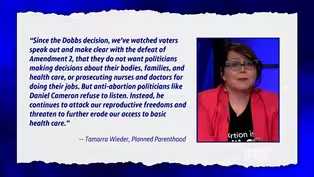
The group's state director, Tamara Wieder, put out this statement, quote, Since the Dobbs decision, we've watched voters speak out and make clear with the defeat of Amendment two that they do not want politicians making decisions about their bodies, families and health care, or prosecuting nurses and doctors for doing their jobs.
But antiabortion politicians like Daniel Cameron refuse to refuse to listen.
Instead, he continues to attack our reproduce two freedoms and threaten to further erode our access to basic health care, unquote.
Yesterday, in an interview with U.S. Radio in Louisville, Attorney General Cameron said he would sign an abortion bill that provided exceptions for rape and incest.
A spokesperson for Governor Andy Beshear said Cameron's opposition to those exceptions has been documented many times and that that is either, quote, a political move or a lie.
Kentucky Democrats took their legal fight over GOP drawn boundaries for state, legislative and congressional districts to the state's highest court today.
It comes after a front line circuit court judge ruled the maps were gerrymandered but did not violate Kentucky's Constitution.
Now, here are the maps in question.
House Bill two redrew state House districts.
The bill became law last January.
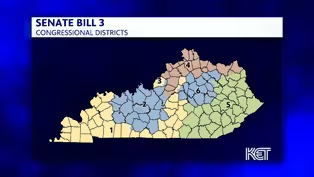
And here's the newly drawn U.S. Congressional District map.
It also became law last January with the passage of Senate Bill three.
Representing the plaintiff, attorney Michael Newberry argued GOP lawmakers offered no reasons for why they made the changes they did to Justice.
Nicole and Justice.
Six questions about What did the legislature say the purpose was for x or Y or Z.
The answer is nothing.
I want to be very clear.
Mr. Trendy may have speculated about something, and Mr. Maddox this morning offered some potential reasons.
There was no evidence offered of the reasons for either of the maps.
The position below was as a matter of law.
It's our discretion and courts need to butt out.
That's been their position all along.
So they didn't offer any evidence.
They just tried to poke holes in ours.
Vic Maddox is an attorney in the Kentucky Attorney General's office.
He pushed back against claims of Partizan gerrymandering, saying his opponents want to strip the responsibility from lawmakers and give it to machines.
The Kentucky Democratic Party is asking this court to institute a revolution in redistricting.
It wants social science metrics that have been created in the last five or six years.
This mapping ensemble and this efficiency gap to be used to take away the authority for redistricting from the third floor of this building to the computer lab of Harvard and the faculty Lounge of Benefit, MIT Chief Justice Lawrence Van Meter said the court would issue a ruling as soon as possible.
What's working and what isn't?
At Kentucky's colleges and universities.
Well, we talked about the state of higher education last night on Kentucky.
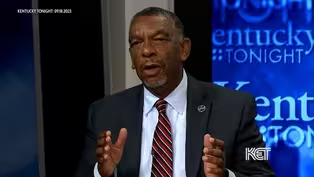
Tonight, our panel included some of the state's leaders in education, including two university presidents and two members of the Kentucky General Assembly.
They talked about enrollment, the cost of college education and federal help that isn't always being used.
You know, there's too many students not going to a college or university in Kentucky.
It's about 50%.
Dr. Thompson can correct me on anything I'll say this evening, but it's about 50% and it's declined for the last few years.
So this enrollment challenge is very difficult for all of us.
Nationally, there's about 1.3 1.4 million less college going students than in 2020 today versus 2020.
So that challenge, whether you're an independent, private institution or a public institution, a large flagship institution, we're all facing this challenge.
The point being is that we're focused on what's good for this economy.
We have a goal of 60 by 30 and 60% of all of our citizens in Kentucky needs to have a post-secondary credential that matters in order to build the workforce and continuing to build the economy.
Proud to say we're at 55%, and that's by the year 2030.
60%, 2030?
Yes, ma'am.
So that's working.
What's not working?
We still have to do a lot better in our financial oversight.
We have to still do better looking at how we're serving our adult population.
We have to do better in serving our low income populations.
Now, my numbers, I hear I hear what's being said here, but my numbers, the ones I look at and I think from the budget suggests that about one third of that money historically would come from the student, about two thirds from the state, roughly.
And now that's flipped, at least from my perspective and the information I've been receiving.
Well, that's bound to create a problem, particularly for those who are on the lower income level.
And that's that's probably my most primary concern at this point.
$54 million was the number.
$54 million of federal financial aid is left on the table every year by Kentucky families to help a family get that first generation student across the finish line.
It is a perceived cost.
And when we do go as as President McFadden said, and look at the return on the investment over the lifetime of an earner, it is significant.
So if there are two key takeaways from your program tonight, families need to pursue every opportunity because the cost can be minimized in ways that are very beneficial to offsetting any any tuition cost and room and board cost.
So, number one, if you've got a student in your home or in your family that wants to go to college, the men and women in post-secondary education in Kentucky want to help make that happen.
So let's all work together to get that done.
We covered a lot of ground last night, including the U.S. Supreme Court's decision ending race based considerations on admissions.
You can see the full hour discussion online on demand at Kate Dawgs kuci tonight.
Workers at two Ford plants in Louisville are still on the job as the United Auto Workers Union says its strike could expand soon.
It's day five of the strike.
So far, workers have stopped working at three plants in Michigan, Missouri and Ohio.
The UAW says if the strike hasn't been resolved by Friday, workers at some other plants will also walk off the job.
And it's not clear which ones.
UAW Local 862 represents 12,500 workers at the two Louisville Ford plants.
The union wants higher pay for workers and the end of a quote, two tiered system that means lower pay and fewer benefits for newer workers.
Lexington could change its alcohol sales law.
And a western Kentucky man is getting creative as he looks for a kidney donor.
Our Toby Gibbs has all of that and more.
And our Tuesday look at what's happening.
The headlines around Kentucky, the Lexington Fayette Urban County Council could change sale hours for alcoholic drinks on Sundays.
WVXU reports that the proposed change would allow businesses to sell alcohol starting at 6 a.m. instead of 11 a.m..
This new start time would be in line with sale hours for the rest of the week.
Council members plan to discuss the proposed change in November.
Last week, the Bardstown City Council discussed a proposal that would limit where the homeless population is allowed to congregate in the city's downtown area.
The Nelson County Gazette reports the proposed ordinance would ban homeless people from camping or being on city owned or leased property between 8 p.m. and 8 a.m..
The ordinance also prohibits homeless people from living in abandoned or vacant properties.
If approved, violators could be cited for third degree criminal trespassing, which is a misdemeanor.
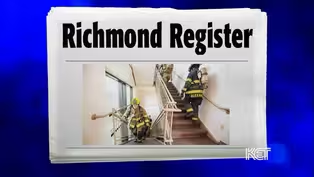
A memorial service and stair climb was held at Eastern Kentucky University to remember the lives lost during the 911 attacks.
The Richmond Register reports that ex College of Justice, Safety and Military Science hosted the event last Monday.
The event included a retelling of that day from a local retired firefighter.
A bell ringing to honor the thousands of people who died.
And a video showing reactions and news coverage from that day.
A 55 year old veteran has found unique ways to find a kidney donor through a yard sign and t shirt campaign.
The Paducah Sun reports that Anthony Cobb is hoping his efforts will get him closer to a kidney transplant after undergoing a heart catheterization procedure in 2020.
In the meantime, Cobb is on dialysis to maintain his kidney function.
With headlines around Kentucky, I'm Toby Gibbs.
Last year, Congress passed a resolution declaring September 19 National Stillbirth Prevention Day.
The day honors the more than 20,000 American families who lose a baby to stillbirth every year.
Supporters of new federal legislation aimed at increasing awareness and education about stillbirth say if passed, fewer families will have to suffer this profound loss.
It is a bit mind blowing that it's 2023 and we're still having this conversation.
Stillbirth is a crisis in the United States.
Every single year we lose more than 21,000 babies to stillbirth.
So our organization exists to raise awareness about stillbirth.
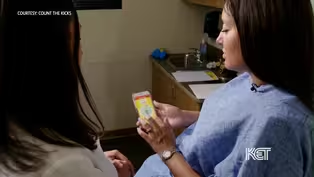
We are most known for our count the Stillbirth Prevention Program.
It is an awareness program for expectant parents in the third trimester of pregnancy to get to know their baby's normal movement patterns in the third trimester and to speak up if they notice a change.
And the reason why that's important is because there's a lot of research that shows a change in a baby's movements in the third trimester is an early indication that sometimes the only indication that there might be something going wrong with that pregnancy.
It's not always possible to determine the actual cause, but we know that there are some risk factors that increase the mother's chances of having a stillbirth.
So, for example, if a mother is above a certain age and that is in our population above the age of 35, she's at an increased risk of stillbirth.
If she's a smoker, if she has high blood sugars, which is otherwise known as diabetes, has high blood pressures as well.
Those could be contributing factors.
Now, sometimes also the babies are not formed the way that they're supposed to and they have structural abnormalities and that can put the baby at an increased risk of a stillbirth.
And unfortunately, despite all of our efforts and everything that we can do, we can definitely decrease the number dramatically.
But we can't prevent all stillbirths.
But it is a team effort.
So we always tell our expecting mothers whether they're high risk or low risk, to keep a close eye on the baby's kick count.
And if she's not feeling the baby move, then that would be an indication for her to call her doctors.
The count, the kicks AB has saved lives.
We have saved more than 100 lives that we know of collecting stories for moms and doctors in 35 states and in five countries.
And Iowa, where we started, we've seen a 32% stillbirth rate reduction.
So behind all of that data and the numbers of babies that we know we can save are real life stories of moms who write us and doctors who write us and say, I was paying attention, I was using your app.
I noticed a change in my baby's movements.
I alerted my doctor.
They ran tests.
They noticed that my baby was in distress and they made a decision to get that baby here safely.
The risk of stillbirth, you know, generally is about one in 160.
But if you follow the ultrasound schedule, that is for those people that are deemed to be high risk of stillbirth, and they do what we call a biophysical profile, which is when they look at certain things in the baby to tell us that the baby is healthy and happy, that number drops to one in 1250.
We see the tide changing in America.
That stillbirth has often been overlooked.
But I would say in the last two years we are really starting to see Congress pay attention.
We're seeing public health leaders pay attention.
The Maternal and Child Health Stillbirth Prevention Act was introduced in Congress this summer.
There's overwhelming bipartisan support for it in both chambers because everybody wants babies to arrive safely.
And what this legislation would do is add the words stillbirth and Stillbirth Prevention to Title five.
There is some confusion with some state health departments about whether they can even use their title $5.
And it's also they're taking their cues from Congress because that's where the money comes from.
So if Congress isn't listing it as a priority, then it's also become not a priority for them.
And that needs to change because there are so many proven intervention efforts that if you just had that education there, that lives would be saved.
We just need to have more of the conversation in the prenatal space with more expectant parents.
Members of Healthy Birth Day are on Capitol Hill today speaking to lawmakers about stillbirth prevention legislation.
One law of a mother has also been a vocal supporter of stillbirth, prevention and education.
Ray Hofmann.
Jagger has written about her experience losing a child to stillbirth in 2021.
She says more than a quarter of all stillbirths can be prevented with education and information sharing.
I think the problem with understanding stillbirth is that it's so stigmatized people don't talk about it.
I think the first step to prevention is telling our story.
We knew Tim Fox Allen, but we had as much planned as possible.
We had a name, we had a nursery already, we had lots of clothes.
We had all the things that someone would have when they're expecting to have a living baby that breathes grace.
Pregnancy with Evie was very uneventful, successful, as I think we naively assumed that foxes would be the same way.
And I remember thinking, know, this is just another visit.
We had a textbook normal, healthy pregnancy.
It was our 32 week checkup.
The OB went to find the heartbeat and she couldn't find it.
And then she tried another machine and couldn't find it.
And then the reality set in that, Oh, our baby doesn't have a heartbeat.
That means our baby is dead.
And that was when our reality changed as we know it.
I begged to be induced that day, even though I knew that our baby was going to be born on Thanksgiving Day.
But I think we both, especially Rae, wanted to induce and just be done with the nightmares as soon as possible.
But turns out it's not super soon.
It was still like 24 hours from when he was finally born.
So it was it was a long time.
It's cruel in our country because there is no place to birth where you don't hear the sounds of moving heartbeats and babies crying for the first time in their moms so happy that they have this baby.
And then you are in between those rooms and it's silent.
You hear no heartbeat.
Your doctor is not coming in or your nurse to check on the baby.
And you know, is the baby safe?
Is the baby going to be born?
You are just there on your own trying to come to terms with the fact that you are going to meet your baby just like everyone else.
But then you have to also plan a funeral.
So we birthed him.
He was real.
He existed.
He had a name.
We got to hold him.
And I think that helped me.
This reminds us that although he is not with us now, he was real.
We birthed him.
We got to meet him and unfortunately, we had to bury him.
But he's very much still a part of our lives.
And having him here reminds our daughter that, you know, she had a brother that isn't here and that he's still a part of our family.
We have created a space for him in our family where he can be talked about and it's not as much of a hard thing to bring up anymore.
He is just fully synthesized into our family with us.
I think what we needed from anyone, which we didn't know was someone to just sit with us and be with us and not say anything because what what is there to say, really?
Words fall short and then we really wanted people to just ask questions what he looked like.
And even now we love when anyone mentions his name.
I am a mom of three.
One, you know, is not here with us on Earth.
And then I have two babies when we hold the ball and you mix it with nap time.
My husband and I both realize that it is entirely up to the birthing person to advocate for themselves to find out how to have a living baby.
So the next time we wanted to have a baby, we had to learn about count the kicks and making sure we were getting accurate kick counting measures.
We had to learn what to ask for as far as different ultrasounds and non stress tests, and many people don't know those things until something goes horribly wrong and they lose their baby.
The longest nine months of my life, you know, after you've been through a stillbirth, it sort of pulls the veil away a little bit and you realize and nothing is guaranteed to anyone.
And anything can happen even if it's a less than 1% of the time can happen.
And it was hard up until the day I was born to allow ourselves the possibility that he was going to make it.
There's this whole when you're in you that you feel I can never be filled again because it's just sadness and grief for so long.
And when I comes, there's it's not a replacement, but there's, there's space in you that that sort of gets filled again.
You've been been in the valley and now you're you're up up again.
Oh oh, now your star sigh is are sweet and happy rainbow baby who is just happy to be here And we know we have a baby to hold and we know that life is short and to cherish every single moment we have with him and our daughter.
The Jaggers say that unlike many parents who lose a child to stillbirth, they had an autopsy done to determine what caused Fox's death.
They found out he had an entire uterine growth restriction, which is preventable.
They add color and beauty to the great outdoors, and butterflies are more than just decorations.
How a Frankford nursery is teaching people about the role they play in the balance of Nature.
You'll see that and much more tomorrow night on Kentucky Edition at 630 Eastern, 530 Central, where we connect, inform and inspire.
You can get to us all the ways you see on your screen through Facebook and Instagram and download our app on PBS video app.
You can see our show there on your mobile device and smart TV and send us a story idea and public affairs act, dawg.
Thank you so much for watching.
I'm Rene Shore and I hope to see you right back here again tomorrow night.
Take good care.
Video has Closed Captions
Clip: S2 Ep79 | 3m 18s | Education leaders, university presidents and KY General Assembly members discuss ed costs. (3m 18s)
Headlines Around Kentucky (9/19/23)
Video has Closed Captions
Clip: S2 Ep79 | 2m 18s | Lexington could change alcohol sales law and a KY man searching for a kidney donor. (2m 18s)
Planned Parenthood's Political Ads in Kentucky
Video has Closed Captions
Clip: S2 Ep79 | 1m 6s | Planned Parenthood plans ads in opposition to KY candidates who oppose abortion rights. (1m 6s)
Video has Closed Captions
Clip: S2 Ep79 | 4m 18s | Efforts to address the stillbirth crisis in the United States. (4m 18s)
Remembering Gov. Brereton Jones
Video has Closed Captions
Clip: S2 Ep79 | 6m 8s | Former KY Gov. Brereton Jones, governor from 1991 to 1995, died 2023 at age 84. (6m 8s)
Video has Closed Captions
Clip: S2 Ep79 | 5m 20s | A Louisville family shares their experience with preventable stillbirth. (5m 20s)

Video has Closed Captions
Clip: S2 Ep79 | 42s | Workers at two Ford plants in Louisville are still on the job as the UAW strike continues. (42s)
U.S. Congressional District Map
Video has Closed Captions
Clip: S2 Ep79 | 2m 4s | KY Supreme Court considers Congressional Maps enacted during the 2022 legislative session. (2m 4s)
Providing Support for PBS.org
Learn Moreabout PBS online sponsorship
- News and Public Affairs

Top journalists deliver compelling original analysis of the hour's headlines.

- News and Public Affairs

FRONTLINE is investigative journalism that questions, explains and changes our world.












Support for PBS provided by:
Kentucky Edition is a local public television program presented by KET