
September 21, 2023
Season 2 Episode 81 | 27m 29sVideo has Closed Captions
The candidates for governor talk to the Kentucky Chamber of Commerce.
The candidates for governor talk to the Kentucky Chamber of Commerce, funeral arrangements are announced for former Gov. Brereton Jones, a state lawmaker proposes eliminating the sales tax on diapers, online sports wagering begins in one week, and the Lexington African-American Sports Hall of Fame.
Problems playing video? | Closed Captioning Feedback
Problems playing video? | Closed Captioning Feedback
Kentucky Edition is a local public television program presented by KET
September 21, 2023
Season 2 Episode 81 | 27m 29sVideo has Closed Captions
The candidates for governor talk to the Kentucky Chamber of Commerce, funeral arrangements are announced for former Gov. Brereton Jones, a state lawmaker proposes eliminating the sales tax on diapers, online sports wagering begins in one week, and the Lexington African-American Sports Hall of Fame.
Problems playing video? | Closed Captioning Feedback
How to Watch Kentucky Edition
Kentucky Edition is available to stream on pbs.org and the free PBS App, available on iPhone, Apple TV, Android TV, Android smartphones, Amazon Fire TV, Amazon Fire Tablet, Roku, Samsung Smart TV, and Vizio.
Providing Support for PBS.org
Learn Moreabout PBS online sponsorshipThe candidates for governor talk taxes and spending.
What's the right plan for Kentucky's future?
We treat every human being with respect and looking at what they need, no matter if they have health insurance or not.
A Northern Kentucky health care initiative is ready to do more for those in need to be able to come full circle and be there representing your your other your grandfather's lineage.
And the history is is amazing.
Honor honoring the legacy of a Kentucky Derby pioneer.
Lexington was founded actually one year before the signing of the Declaration of Independence and Lexington is two years away from blowing out the candles on a very big birthday cake.
Production of Kentucky Edition is made possible in part by the KET Endowment for Kentucky Productions, the Leonard Press, Endowment for Public Affairs and the KET Millennium Fund.
Good evening and welcome to Kentucky Edition on this Thursday, September the 21st.
I'm Renee Shaw.
Thank you for winding down your Thursday with us.
Your taxes, your schools, your roads.
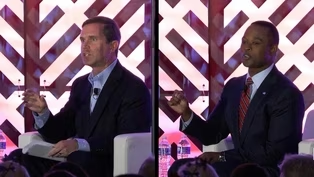
The candidates for governor had money on their minds as they talked to the Kentucky Chamber of Commerce during a dinner last night in Louisville.
The big item on the menu, the state income tax attorney General Daniel Cameron says get rid of it.
Governor Andy Beshear asked, though, what would take its place.
Our Toby Gibbs has the highlights.
On the issue of tax reform, I will be the only candidate here tonight that will tell you that I want to eliminate Kentucky's income tax.
30 years ago, Kentucky and Tennessee were essentially the same size.
But because Tennessee has a pro-growth mindset, it's moved past us in terms of its population.
I want people, whether they're traveling 65 south or 75 south, to make the the judgment and the decision to stop here, because we have a tax environment that keeps people here in the commonwealth of Kentucky.
At the end of the day, this is about your hard earned money and making sure that you keep it in your pocket.
Groceries are more expensive, gas is more expensive.
Securing child care is more expensive right now.
And so, again, I don't think you should be penalized for deciding to get up every morning and go to work.
We need to put more money in your pocket so you can pay for those things.
The Kentucky General Assembly has already cut the income tax twice, but Attorney General Cameron said that's in spite of Governor Andy Beshear.
When our legislature decided to make the commonsense decision to give you more of your hard earned money, there was one person in Frankfort that stood opposed to that.
Andy Beshear vetoed that legislation because he did not understand how important it is to get money back into your pockets.
Cameron talked about more than just taxes.
He also talked about making it easier for people and goods to get from point A to point B.
We also need to take care of our rural roads because most of us, that's where we're doing a lot of traveling in state is on those rural roads and we've got to keep our people safe.
There's no question about that.
And I'm going to prioritize those rural roads when you talk about our navigable, navigable waterways.
I mean, we have more navigable navigable waterways than the majority of the states here in this country.
And because of it, we're able to transport coal and other commodities on our rivers.
We've got to make sure our ports and our barges that they're getting the right attention.
And I'll certainly be the governor and as as the next governor of this commonwealth to prioritize that beginning in January of next year.
When it was his turn.
Governor Beshear touted the state's economy, pushed for higher educator pay, and pointed out that he did sign an income tax cut.
But he says a complete elimination of the income tax would force other taxes to go up.
With us having the three biggest budget surpluses in our history, including $1.55 billion this last year, and I know we'll get to it, that means we have plenty of money to give our public school educators the big raise they deserve when we have that type of economy.
Our people ought to benefit from it.
That's why I was able to sign a decrease in the income tax.
We've been able to lower the property tax rate.
I believe, three times since I was governor.
We were able to use enough general fund to backfill the road fund to freeze the gas tax.
And the the property tax on vehicles when it was hurting people the most.
A rush like my opponent talks about to get to zero on the income tax as quickly as possible would turn us into Kansas.
You can only do it one or two ways.
First, he would dramatically increase the sales tax and apply it to things like groceries and medicine because you can't come up with enough revenue otherwise, or gut public education, public safety and health care.
Now everything in moderation is the way we get where we're supposed to go and make sure that we can fund those essentials for our families.
At the same time, our public school educators are heroes, but they have been villainized over and over and over.
It is time we lift up our educators.
And you know what, folks?
The way we catch up a kid in math is to make sure there's a math teacher there every day.
Our education first plan would provide an 11% across the board raise for every public school employee that move us to the mid-twenties on teacher pay.
But you know what it would also do?
It would allow us to hire enough bus drivers to make sure every child is safe and that every child could get to school.
But that plan also goes back and funds universal pre-K, because if we want to improve reading scores, how about we make sure that no child starts kindergarten behind when it's so hard for them to catch up?
So the number one thing that will help us catch up our kids is to actually fund public education.
The way we should.
For Kentucky Edition, I'm Toby Gibbs.
Thank you.
Tell me.
Funeral arrangements are now set for former Kentucky Governor Brereton Jones.
Governor Jones died Monday after a long illness.
He will lie in state in the rotunda of the Kentucky state capital on Monday from 10 a.m. to 7 p.m. Eastern Time.
His family will be there to greet visitors beginning at three that afternoon.
JONES His funeral will take place on Tuesday at Forks of the Elkhorn Baptist Church in Midway, followed by a private burial.
His family sent along a statement saying, quote, It was his love of horses that brought Burton Jones to Kentucky, but it was the people of the Commonwealth that made his life so incredibly fulfilling.
Our family has lost its hero, but our hearts are filled with immeasurable gratitude for both the precious time we shared and the incredible outpouring of love we've received in the wake of his passing.
End quote.
Governor Brereton Zoie Jones was 84 years old.
A state lawmaker hopes to make diapers more affordable.
Testifying before the interim Joint Committee on Appropriations and Revenue yesterday, State Senator Kasy Chambers Armstrong said she intends to file a bill next year that would make diapers tax exempt and Kentucky the law.
The Democrats said families can spend up to $2,000 a year in diapers.
Nationwide, one in two families struggle to afford diapers, which can lead to other problems.
Some families resort to washing and reusing disposable diapers, turning them inside out, or leaving their child in the same diaper all day, hoping that that child won't develop a severe enough diaper rash that they need to go to the hospital.
Families will make decisions to buy less food for themselves or for their other children because they just don't have enough money to make ends meet.
Other families will keep their kids home from daycare because they cannot afford the amount of money they need to send diapers with their child to that program.
And some families will lose their jobs as a result of that.
Nearly 20 states have already made diapers, sales tax exempt.
Senator Chambers, Armstrong said results in those states are remarkable.
We see families in low income neighborhoods buy 6% more diapers, and we see the purchase of children's pain.
Medications in those same neighborhoods decreased by 6.2%.
Babies are healthier.
They aren't getting severe diaper rash.
Families are better able to meet their needs.
A fiscal impact statement estimates the bill would mean a loss of more than $6 million to the state's general fund.
Senator Chambers Armstrong said the money saved by families will likely be reinvested back into the state's economy.
The bill is one of many that will be considered during the next Kentucky General Assembly, which begins in January.
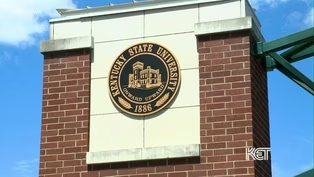
Kentucky is one of 16 states that has underfunded historically black land grant universities.
That's according to the U.S. Department of Education and Agriculture.
Federal officials wrote to the governors of each state asking them to increase funding.
In a letter to Governor Andy Beshear, officials said the state has underfunded Kentucky State University by more than $170 million over the last three decades.
The calculation was based on funding that would have been allocated had it been proportional to the funding given to non HBCU's.
The letter also notes the economic and cultural significance of HBCU institutions as they generate nearly $15 billion and more than 134,000 jobs a year, while only representing 3% of higher education institutions.
Land grant universities were founded on federal land to further agricultural instruction and research.
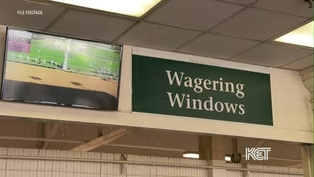
One week from today, fans will be able to bet on their favorite sports teams.
Online in-person betting began a few weeks ago following the passage of House Bill 551 earlier this year.
The Kentucky Horse Racing Commission has approved licenses for eight mobile wagering providers, including Caesars, Bet, MGM, DraftKings and FanDuel.
According to the governor's office, sports betting is expected to increase state revenue by about $23 million every year once it's fully implemented.
Pre-registration for Mobile betting is now live.
Today, Governor Andy Beshear talked about how legalized sports betting is going so far.
After the first two weeks of retail wagering, initial numbers indicate over $4.5 million was wagered on sports in the state.
That is a strong number, but we believe it will grow, signified greatly once online begins.
We're hearing from our mobile partners and not all of reported, but there are well over 60,000 mobile accounts that are pre-registered.
Already, Kentuckians can pre-register with any licensed mobile application and deposit initial money in their accounts in preparation of the launch.
The governor also says bettors could have new sports as options.
The Sports Wagering Advisory Council is recommending the addition of Formula One racing.
The National Rugby League Australia and the Professional Firefighters League or the Fighters League rather, and the Universal Ticket Tennis League.
It will be up to the racetracks and the mobile apps about whether to add those sports.
And Louisville today, a group of state and local representatives gather to take questions from the city's Spanish speaking community.
It's believed to be the first town hall of its kind in Kentucky.
This town was set up in a black only gathering for the soul crushing beginning when authentically happy.
I see KING Tonight is a very special night because for the first time in the history of politics in Louisville, we are having a town hall for Spanish speakers.
And then it will still sports.
It has their own little council.
We are going to be holding their meeting mainly in Spanish, which is different because usually if there's interpreters in the room, it's because everything is in English and the interpreters will speak it right after that.
So tonight we're going to do it backwards and way.
In a way, we are shifting the power that the language in itself it brings to the dynamic of people who come from other places.
The way that we pick the topics was that we ask the community to submit their questions.
The pattern in the questions was health or health systems and employment issues, whether whether it was finding employment as professionals that were licensed from other states or discrimination at work in our offices as a supportive role for Damaris, who initiated this.
And we live in a very diverse district.
We have the highest number of Cubans per capita in Jefferson County outside of Miami.
Most of them live in District 21 in 2024.
There will be election.
There's many, many Latinos here in Louisville, 36,000 and something, according to the latest statistics that I pulled up.
I wanted to start preparing the Latino community to understand what this role is.
What are the rules are to speak up about their needs and participate more and potentially run for county commissioner or for councilperson or any other office that fits their skills and their interests.
What actually, it's a problem that affects more than one third of Kentuckians high blood pressure and the World Health Organization says it's just getting worse.
A new report from the W.H.O.
says that between 1990 and 2019, the number of people with hypertension doubled worldwide, going from 650 million to 1.3 billion.
Hypertension means blood pressure of at least 140 over 90.
And the report says four out of every five people with hypertension don't receive adequate treatment for it.
The American Heart Association says as of 2015, 36% of Kentuckians had high blood pressure, compared to 31% of all America.
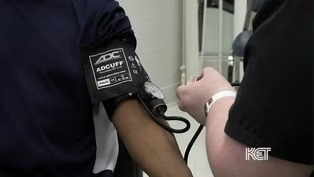
An initiative started by nursing students at Northern Kentucky University to provide free health care recently received much needed funding, which they say will help them expand their services and reach the Nurse Advocacy Center for the Underserved or in Asia.
You started in 2006 and has six locations in Covington, including a clinic and a building for low income senior citizens called Golden Tower.
More in tonight's look at medical news.
People don't choose to be homeless.
There's a lot of, I guess you want to say stigma that people who are homeless or underserved are lazy, that they don't deserve health care.
They're not paying for it.
That so they shouldn't get it.
And in all of that, we want to take that stigma away from that.
You know, we treat every human being with respect and looking at what they need, no matter if they have health insurance or not.
Right.
They deserve to have a health education on how to keep themselves healthy and they deserve to be cared for.
And that's that's really what what Nike stands for.
We care for anyone who comes to us here at Golden Tower.
We provide, you know, all of the residents with health care in this little clinic that we're in here.
A lot of the residents don't have the ability to, you know, go to other facilities to get care.
And they just rely on the resources we have here, whether that's checking blood pressure, know blood sugars.
We are going to provide flu shots in the near future for them as well.
So they really rely on just those little things to keep up with their health.
I teach them you can intervene for people even if they don't have health insurance, they don't have food.
A lot of them don't have transportation.
So I teach the nursing students what other factors you have to look at when you're caring for somebody, not just like hospital based diagnoses.
So when you're out in the community, you have to look at all of their social needs too, because they're a whole person.
This man, Brown and other nurses, they will always check my blood pressure and whatever my major, he will do it for me.
He'll try to help the best he can.
The benefit of providing health care where people live is the trust.
Okay?
Particularly those that are underserved.
They've dealt with a lot of things in their life.
Right.
That maybe haven't been fair.
You know what?
We could say that, you know, structural racism, things like that.
This grant will pay for expansions in all four counties.
It will it will allow us to have access to whatever vaccinations that is available through Frankfort, that it comes from the Kentucky Department of Public Health.
And after two years, we can see if this can be refunded and it can go on because we've never had anything like this before.
Our Lynn Brown is our only nurse who goes between all six sites and she's only one person.
She's a superstar.
But it's wonderful that I can hire two more nurses and a community health worker to help Lynn expand access.
One of the constants, James, I'm always hearing at every site is we need more time.
We need we need to hear more because there's more to do there, more people to take care of.
So that that grant will help us provide more services.
We're going to have more people.
That's that's my vision is that that money, as we expand, we grow and then we can continue to take better care.
The two year grant totals over $500,000.
And I see you has ten volunteer nurses and serves about 2000 people.
It's a big birthday for the Kentucky Derby, which will turn 150 years old next year.
But the celebration has already started.
This weekend, the winner of the first Kentucky Derby, Oliver Lewis, will be inducted into the Lexington African American Sports Hall of Fame.
Attending the event, his great, great grandson, actor Rodney Van Johnson.
Van Johnson tells us growing up he didn't know about his connection to Lewis.
Now he wants everyone to know about his great, great grandfather's accomplishments.
It was very hard to believe that African-Americans were jockeys back then.
My great great grandfather, Alvin Lewis, was the first African-American jockey to win the Kentucky Derby, which is an amazing feat with in itself one of the biggest races in the world everybody is attracted to.
And to know that that history started with a small African-American boy is pretty amazing.
19 years old.
I can't imagine being on a beast like that.
So that means that he had to train for three or four years.
That makes him 14.
Then you got to go back.
You got to bring them in.
Put them on at nine.
But I'm on it.
Ten.
I can't even imagine putting my child on a horse at that age with a hat, not a helmet, not, you know, all of this.
Every family had to do whatever they had to do to survive.
Back then, it was very difficult.
So a lot of people had different occupations outside of being a jockey.
My great great grandfather was also a bookie.
Back then, bookies weren't considered a notable job, but now bookies and gaming and betting is huge.
So when Oliver won at 19 and he did a couple more races and decided to not race again and do gambling, can you blame the guy?
Why put your life out there and be hurt?
And there were so many, you know, women, men and women who who died, who are in the graves that died, who died because they were trying to feed their family by getting on this, you know, thousand pound beast to ride so they can make money.
As in everything.
African Americans are always waiting for things to happen that a long time coming.
So now we're here.
Fast forward and this amazing history that's going to be celebrated next year.
And the 150th anniversary just bought everything full force for me.
So since my mom has it in her years and all the family members around the years, I'm pretty much the person is going to be taking over the legacy to keep the hope alive.
Every year there is some type of black history, but last year kind of affect me pretty much because my son was in high school at the time.
He was a senior and information came up and they were asking people, I was like, he's like, Hey, my great great grandfather won the Kentucky Derby.
Now that was everybody looked at him like, you know, he's 63, almost 62.
Like, wait a minute.
He's like, yeah, the history is.
So his teacher pulled up the information and found out all the information was true and factual, found out my name and the connection.
And it was it was huge.
So to be able to share that type of history and that type of lineage with your kids, with my kids right now is pretty amazing.
To be able to come full circle and be there representing your your other your grandfather's lineage.
And the history is is amazing.
Honor.
Van Johnson said he plans to make a documentary on his great, great grandfather's life.
We're wishing the city of Lexington an early happy birthday and it's a big birthday.
Lexington was founded in 1775, so it terms 250 in the year 2025.
And even though that's two years away, a birthday bash is already in the works.
Lexington was founded actually one year before the signing of the Declaration of Independence.
Imagine that.
I think that's pretty special.
So here we are, 248 years later getting ready to celebrate our 250th birthday in 2025.
We're planning a year long party celebrating all things Lexington.
I've appointed a group of people from all over town to help plan this party.
This commission is going to need a lot of help and ideas from the public.
We have people that make everything from beer to beer, cheese and everything in between, and we want that maker community to be a huge part of this.
We also want to take this opportunity to look at every way that we can make this city better.
We're starting early.
The city is going to commission a major piece of art to dedicate during our birthday year, and we're going to ask for artists from all over the country to submit ideas.
So that in itself will take the entire time.
We're hoping to commission a piece of music that can be heard by the public for free.
One focus of the Commission will be the month of June 2025.
We're calling it Coming Home Month.
We're going to invite anyone who has ever lived here, who has family here or would like to visit here, and to see all that we have to offer to come to Lexington for a month long cultural experience.
One of the first steps in our commission's work is a 2/50 birthday branding competition.
The other thing that we're looking forward to is using this as a platform to invite companies from other other states who might want to move here.
People to see opportunity here for economic development, people who may want to move here just on their own and live here because they see what a great place we are.
And everybody that's here and everybody that that participates in this has that opportunity to make sure that this 20, 2025 is a launchpad for Lexington for the next 250 years.
Lexington wants suggestions from the public about the 250th birthday celebration and you concern yours too.
250 Lex at Lexington.
K y dot gov.
Helping a tree can help Kentucky's Bourbon industry.
And a Kentucky congressman is introducing a bill to protect those trees and to protect the key Kentucky industry.
We'll tell you all about the bill and the tree's role in all of this tomorrow on kentucky edition, which we hope to see you for at 630 Eastern, 530 Central, where we inform, connect and Inspire.
You can subscribe to our email newsletters and watch full episodes and clips at ket dot org You can also find us on the PBS video app on your mobile device and smart TV.
Send us a story idea to the address on your screen and you can also keep in touch with us all the ways you see on your screen.
Facebook X, formerly known as Twitter and Instagram to stay in the loop.
Thank you so much for joining us tonight.
Tomorrow is Friday and I hope to see you right back here again for Kentucky Edition until I see you then.
Have a good night.
Take good care.
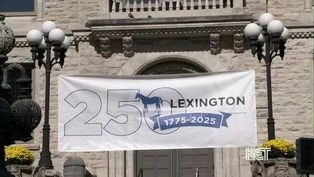
Celebration Planning For Lexington's 250 Birthday
Video has Closed Captions
Clip: S2 Ep81 | 2m 58s | Lexington, KY will turn 250 in 2025 and celebration plans are already being made. (2m 58s)

Funeral Arrangements for Gov. Brereton Jones
Video has Closed Captions
Clip: S2 Ep81 | 1m | Details of the funeral arrangements for former Kentucky Governor Brereton Jones. (1m)
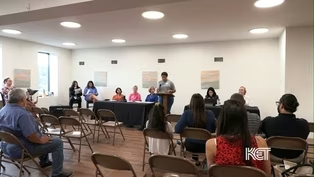
Hispanic Town Hall in Louisville
Video has Closed Captions
Clip: S2 Ep81 | 2m 46s | State and local representatives held a town hall for the Spanish speaking community. (2m 46s)
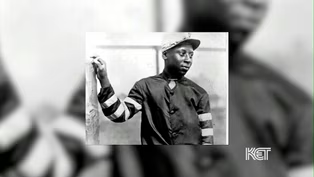
Honoring A Horse Racing Pioneer
Video has Closed Captions
Clip: S2 Ep81 | 3m 47s | Family of the first Kentucky Derby winner is carrying on his legacy. (3m 47s)
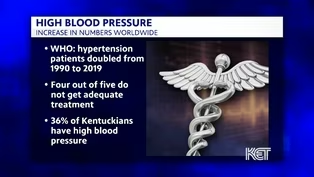
Increase In Blood Pressure Worldwide
Video has Closed Captions
Clip: S2 Ep81 | 48s | A third of Kentuckians deal with high blood pressure and WHO says it's getting worse. (48s)
Kentucky Underfunded Historically Black University
Video has Closed Captions
Clip: S2 Ep81 | 1m 1s | U.S. Dept. of Ed. and Ag. says Kentucky underfunded Kentucky State University. (1m 1s)
Mobile Sports Betting In KY Starting Next Week
Video has Closed Captions
Clip: S2 Ep81 | 1m 38s | In one week fans will be able to bet on their favorite sports teams. (1m 38s)
Nurse Advocacy Center For Underserved To Expand
Video has Closed Captions
Clip: S2 Ep81 | 3m 43s | More funding given to the Nurse Advocacy Center of the Underserved. (3m 43s)
Recap of KY Chamber of Commerce Speeches
Video has Closed Captions
Clip: S2 Ep81 | 5m 3s | Gov. Andy Beshear and A.G. Daniel Cameron's speeches to the KY Chamber of Commerce. (5m 3s)
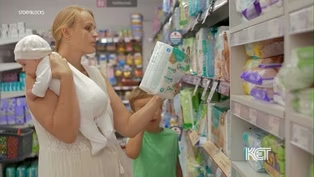
Tax Exemption Bill For Diapers
Video has Closed Captions
Clip: S2 Ep81 | 2m | State Senator Cassie Chambers Armstrong plans a bile that would make diapers tax exempt. (2m)
Providing Support for PBS.org
Learn Moreabout PBS online sponsorship
- News and Public Affairs

Top journalists deliver compelling original analysis of the hour's headlines.

- News and Public Affairs

FRONTLINE is investigative journalism that questions, explains and changes our world.












Support for PBS provided by:
Kentucky Edition is a local public television program presented by KET