
September 20, 2023
Season 2 Episode 80 | 27m 29sVideo has Closed Captions
A new ad makes abortion a key issue in the governor's race.
A new ad makes abortion a key issue in the governor's race. Sen. Mitch McConnell says a government shutdown will hurt the GOP while Sen. Rand Paul says a budget deal can't include more money for Ukraine. Departing Education Commissioner Jason Glass talks about his decision to leave Kentucky.
Problems playing video? | Closed Captioning Feedback
Problems playing video? | Closed Captioning Feedback
Kentucky Edition is a local public television program presented by KET
September 20, 2023
Season 2 Episode 80 | 27m 29sVideo has Closed Captions
A new ad makes abortion a key issue in the governor's race. Sen. Mitch McConnell says a government shutdown will hurt the GOP while Sen. Rand Paul says a budget deal can't include more money for Ukraine. Departing Education Commissioner Jason Glass talks about his decision to leave Kentucky.
Problems playing video? | Closed Captioning Feedback
How to Watch Kentucky Edition
Kentucky Edition is available to stream on pbs.org and the free PBS App, available on iPhone, Apple TV, Android TV, Android smartphones, Amazon Fire TV, Amazon Fire Tablet, Roku, Samsung Smart TV, and Vizio.
Providing Support for PBS.org
Learn Moreabout PBS online sponsorshipThis is to you.
Daniel Cameron.
Ahead, a new ad in the governor's race and it doesn't pull any punches.
My employer has given me given me a directive that I think is morally and constitutionally wrong and I'm not going to carry it out.
And so it's time for me to go.
Kentucky's outgoing ad chief on why he's moving on.
While there's something magical about a butterfly and there's something for us, especially maybe magical about our native butterflies because they're so important.
And a Frankfort greenhouse is educating Kentuckians on how butterflies keep nature in balance.
Production of Kentucky Edition is made possible in part by the KET Endowment for Kentucky Productions, the Leonard Press Endowment for Public Affairs and the KET Millennium Fund.
Good evening and welcome to Kentucky Edition for Wednesday, September the 20th.
I'm Reene Shaw joining you from our Katy studios in downtown Louisville.
Thank you so much for joining us tonight.
U.S.
Senator Mitch McConnell of Kentucky, the Senate minority leader, has a message for his fellow Republicans.
He says a government shutdown always hurts the GOP politically.
Without a spending plan, the government would shut down September the 30th.
House Speaker Kevin McCarthy is having trouble winning over a group of conservative House Republicans.
That group wants steep cuts to many domestic programs.
But it's believed the Senate would reject that plan.
Speaking yesterday, Senator McConnell says a government shutdown never accomplishes anything.
He also talked about continuing support for Ukraine, a stand that puts him at odds with some in his own party and even in his own state.
I think all of you know, I'm not a fan of government shutdowns.
I've seen a few over the years.
They never have produced a policy change and they've always been a loser for Republicans politically.
On another issue, I'm looking forward to seeing President Zelenskiy on Thursday.
I think it's always good to remind everyone that a good portion of the money allocated to Ukraine is being spent in this country to rebuild our industrial base.
It's also important to remember we've not lost a single American.
And so these people in Ukraine who are fighting for their independence are taking on one of the two big adversaries.
We have, Russia and China.
That is not an argument that impresses Kentucky's other U.S. senator, Republican Rand Paul.
Paul says he won't go along with a bill that prevents a government shutdown if that means giving more money to Ukraine.
They're talking about saying the only way government stays open, the only way we avoid a shutdown is by shoveling more American taxpayer dollars to Ukraine.
They're going to link keeping the government open with more money to Ukraine.
And I'm here to say that I'm not going to agree to it and I will not let them shut down the government simply because they want to send more of your hard earned tax dollars to Ukraine.
I think the American people fund an endless war in Ukraine or the unit party threatens to shut down the government.
This is a clear dereliction of duty and I will not stand for it.
Senator Paul says American taxpayers have already provided more than $113 billion to Ukraine.
Congress has until the end of the month to avoid a government shutdown.
Time now for a midweek check in of some major political news this week so far with Ryland Barton, managing editor of Kentucky Public Radio.
It's good to see you in person.
Good to be with you.
So a lot to get to in the short time we have.
Let's talk about the governor's race first.
Of course, there's lots of ads and they are really ramping up in intensity and messaging.
So let's talk about what's happening just this couple of days or so or so.
I think the big discussion right now has to do with abortion rights and and whether or not there should be exceptions to Kentucky's near-total ban on abortion.
This is remarkable because this had largely not been part of the discussion throughout the race so far.
And just within the last week or two, it's become the central issue.
Part of this came to light when Governor Andy Beshear in his campaign issued an ad calling out Daniel Cameron for not supporting any any exceptions to the ban for like instances of rape or incest.
And that comes because Cameron has repeatedly said that he supports the the ban as is he is.
When asked if he had supported any exception, he would just say he supported the policy as is.
He has since kind of walked that back a little bit and said that he does support, you know, if the legislature would pass some sort of exceptions involving rape and incest, he would sign them so that he wouldn't push for them necessarily.
He has I mean, I guess he hasn't come out and said that yet.
And we'll we'll see as this discussion continues to evolve in these final weeks of the campaign.
But I think it's really remarkable to see a, you know, a Democratic governor in a pretty conservative state, a state that has repeatedly elected a lot of, you know, anti-abortion lawmakers at every level of government to actually be advocating for some semblance of abortion rights here, actually be his campaign, be pushing for, you know, these exceptions of rape and incest.
It really kind of some of the the the smallest I mean, it depends to some some modicum of exceptions to to this near-total ban.
So it's really changed how people have talked about abortion for the first time in the in the post Dobbs era, the first time since the Supreme Court ruling last year.
And we're finally kind of starting to see, you know, Republicans shifting their messaging a little bit on it and the pre Dobbs air.
It was really a, you know, a full antiabortion message.
But now there's seems to be some nuance emerging here, some some change to the policy.
Well, and today there was a Beshear ad dropped that it features a young girl who talks about that at age 12, she was raped by her stepfather.
And here is part of that ad to tell a 12 year old girl she must have the baby of her stepfather there who raped her.
It's unthinkable.
I'm speaking out because women and girls need to have options.
Daniel Cameron would give us none.
So this is pretty compelling to have this first person testimonial, this lady from Owensboro, Kentucky.
This could move the needle in the conversation.
Yeah, it's a pretty jaw dropping ad and her calling out Daniel Cameron by name for not supporting these exceptions.
It's pretty quickly, I think, for Cameron and his campaign to come up with some answers here on what he actually would support.
So he came out with an ad saying or at least a video online, trying to clarify some of his positions on it, saying that, again, that he would support some exceptions if passed by the legislature and then going and attacking Governor Beshear and really painting him with a very extreme brush, saying that he supports abortion up to the ninth month of pregnancy, which I don't think I've ever heard the governor said say that and and saying that he's you know, these are similar policies to what happens in North Korea and China really kind of reacting pretty sharply to the governor's messaging in this.
It seems to really have hit a nerve with the with the Cameron campaign at this point in the in the race.
Yeah.
So just a few more weeks to go.
And we are also the Supreme Court's been busy this week.
Today, they had another hearing, but yesterday they took up the redistricting issue and some pretty interesting arguments were made there.
And this is about the House, the state House maps and the congressional district map.
Yeah, this whole redistricting session happened last year.
This legal fight has been going on for a while.
If you remember, a lower court ruled that, yes, the maps are gerrymandered.
The politics that did that did come into account when lawmakers drew these maps.
However, there's nothing illegal about about gerrymandering.
That is what the ruling was at the Franklin Circuit level.
So now the Supreme Court is taking up that decision on appeal and it was really interesting to see how the judges were coming out and grilling the lawyers on this on this issue.
I think one really notable remark was from Justice.
Justice Nicol from the westernmost Supreme Court district, and he was calling out that one district in the congressional map, the first District, which extends from the western tip of Kentucky and hooks into into Franklin County in central Kentucky.
And it didn't used to do that.
And this is James Commerce and this is Commerce District.
He called it the so-called Colmer block, which I believe is a term coined by UK political science professor Steve Voss.
That being because Congressman Comber maintains residences in both Monroe County and South Central Kentucky and in Franklin County, it was interesting to see that he was you know, he was kind of seemed like a little perturbed about that.
He said that if you know any anybody who wants to represent this district should should want to live in the traditional boundaries of that district and didn't want it to be drawn, drawing itself out of the kind of, you know, the conventional idea of what the western Kentucky district is.
And there were other justices who are expressing some skepticism about the maps, too.
But you never know, based on those discussions, exactly how the court's going to rule.
But it's going to be soon, right?
They said they would make a ruling soon.
We don't know how soon Soon is.
But we know that the filing deadline is earlier for the 24 races.
So it's like, I think the seventh or the 6th of January.
So hopefully a decision would come before then.
Yeah, this has happened a couple of times in a row for during these even numbered years, having to move that filing deadline around.
Secretary of State Adams hinted that lawmakers might have to push that back if a ruling or the court might force the force lawmakers do that.
This would also, you know, if the maps are struck down, force the legislature to take the maps back up, redraw them so you just couldn't revert back to the previous decennial census.
If I remember correctly, there was they do that a bit like ten years ago.
But that's the thing.
Every ten years something like this happens.
Yeah.
Now.
Well, thank you.
I want it's always good to see you.
Thanks, Renee.
Education Commissioner Jason Glass unabashedly admits that he's leaving the job out of refusal to carry out a sweeping new law that some believe is harmful to LGBTQ plus students.
The measure mandates restrictions on school bathrooms and student preferred pronoun use, as well as banned certain medical services for transgender youth.
Dr. Glass believes history will reflect on state lawmakers decision with regret.
He was appointed in 2020 by the Kentucky Board of Education.
His four year contract was set to expire in September of next year.
His last day His last day, though, is September 29th next week.
I talked with him and from Frankfurt's Cate studio there this morning about his time as education commissioner.
I reflect back over these past three years and it's really been a delight even in the hard times.
I've loved this job and loved the opportunity to do this work.
And roles like these, you sort of know that this is in the cards.
It can happen to you.
If you look back at Kentucky's recent history, it's what's happened to people.
So we knew that going in and we were prepared for that.
So I'm I'm grateful for the time that we've had and what we've been able to accomplish these past couple of months since I've announced my resignation.
We've been working to carry out the responsibilities that come with the job, the things that are necessary to execute, and then also make preparation for the interim commissioner and then a permanent replacement.
So supporting the board in that and trying to keep moving forward.
The vision that Kentuckians gave us around deeper, authentic learning experiences for students, innovation in education and stronger collaboration with our community.
So that's what Kentuckians told us they want and that's what we've been trying to deliver on.
Any regrets?
Oh, sure.
Yeah.
I mean, I think you could always go back and replay all sorts of decisions and say you wish you had said something differently or done something differently, but that's part of life.
And there are maybe not regrets, but learnings.
Right.
Yeah, right.
When it comes to SB 150, which was the sweeping bill that affects transgender youth, do you have any misgivings about how you approached and went against that measure?
Yeah, I certainly have lots of learnings from over the past few years, but I don't have any regrets or anything differently that I would have done in this situation.
I maintain that this bill is wrong for Kentucky.
It's wrong for our country.
It's put students at risk and in danger.
It's troubling from a number of perspectives in terms of government overreach into educational and medical decisions.
And it's an anti LGBTQ bill, and these are important people in our society and in our world that we need to bring in to the circle and not further marginalize.
So I'm proud of the stand that I've taken against it.
And leaving is perhaps the most disruptive and significant thing that I can do to say that this is wrong.
And so I'm proud of that decision.
Dr. Glass says a new Kentucky law requiring Senate confirmation of a new education chief could impact the Board of Education selection.
He fears the position would have to survive a political litmus test that he says runs afoul of decades old education reform efforts to ensure the commissioner is, above all, a professional educator.
We saw in Mississippi, which has a similar confirmation procedure as Kentucky now, they had a professional educator that had previous superintendent experience, previous state level leadership experience in North Carolina, moved to the state, took the job, worked at it a few months, and then failed confirmation because of largely political litmus test issues.
So Kentucky is on that path.
And again, I think we'll have to see how the Senate decides to handle the confirmation proceeding.
Does it really become a vetting of the person for their professional qualities and what they bring to the role?
Or are they looking someone that is going to be a yes man or yes woman to their agenda?
Your new role begins when and Michigan.
It begins on October 9th.
So I'm excited about that.
Haven't had the chance to work in higher education before, but the role really was sort of crafted with me in mind.
So I'm excited about that.
It was it was a position they had, but they added some things to it to make it even more exciting for me.
So it's about improving the learning experiences of students in higher education and expanding the concurrent enrollment and extension programs that Western Michigan has with that whole region, working with high schools and and school districts in that area.
And they have an entrepreneurial team that focuses on strategic planning and on communication and marketing around education.
So I'm excited to play in that sandbox.
So I think I think it's going to be a wonderful experience.
I'm looking forward to it.
Glass has accepted a job at Western Michigan University as associate vice president of Teaching and Learning and begins there October 9th.
He'll be charged with improving the learning experiences of students and expanding enrollment and extension programs at the university.
It's his first job in higher education.
Almost a quarter of all rural hospitals in Kentucky are at risk of closing.
That's according to a report by the Center for Health Care Quality and Payment Reform.
We talked to the president of the center who says the way rural hospitals get paid needs to change to keep communities from losing essential health care services.
There are a lot of rural hospitals all over the country that are struggling because they're losing money delivering patient services.
Kentucky has 72 hospitals in total rural hospitals.
And we've estimated, based on the most recent data, 42% of those have been losing money on patient services.
That's a total of 30.
30 rural hospitals have been losing money.
16 of those hospitals we have estimated, are at risk of closing over the next 6 to 7 years because those losses have been sufficiently large and sustained that they may not be able to continue operating.
And the ones that are of most of concern, ten hospitals, which is 14% of the total, are at immediate risk of closing.
And that's a that about the 10th highest number in the country.
Those are all hospitals that are really provide critical services in their own communities.
And so if they close, there may be no no health care services left at all.
Rural hospitals can't operate if they don't receive enough revenues to be able to cover their costs in about half the patients in rural hospitals have some kind of private insurance.
The issue is that in big hospitals, private insurance plans tend to pay the hospital a lot more than Medicare does, and often much, much more than it actually costs the hospital to deliver services.
The exact opposite is true in small rural hospitals.
Medicare is, in many cases, their best payer.
Many state Medicaid programs provide special payments to be able to help sustain rural hospitals.
But private insurance plans don't don't do that.
The other problem is that it's not even just enough to pay for individual service delivery because rural hospitals actually deliver two kinds of services and they only get paid for one.
If someone has an emergency and they come to the emergency hospital or to the Royal Hospital, the hospital gets paid for the emergency care.
They may not be paid enough, but they get paid for that.
But the hospital is also standing by, waiting with a physician ready to go in case there is an emergency.
And that's also a service to the community.
But the hospital doesn't get paid to be available.
It only gets paid to deliver as a service.
What we argue for is that not only do hospitals need to be paid adequately whenever they deliver a service, they also need to receive a payment for their standby capacity, what we call a standby capacity payment that says a hospital should get a certain amount of money to be able to operate an emergency department, to be able to have maternity care services available, those essential standby services so that the hospital will know that it has adequate revenue coming in to support that service regardless of how many people need it.
And the people in the community will have the confidence that that service will be there.
The report does not list the Kentucky hospitals at immediate risk of closing.
Reed tells us that's because the financial status of the hospitals can change.
And I don't want to imply these are the only rural hospitals struggling and addiction treatment and sober living community is taking its services on the road.
Step Works has six residential centers across Kentucky.
They are now helping more people in rural communities with a new mobile unit.
Our Laura Rogers takes us inside.
We be able to go ahead and prescribe their medications for them.
Lynn Miller is a medical assistant on board the intensive health mobile Health care unit.
I have the EpiPen in here.
The van is outfitted with everything needed for basic health care needs.
I have four glucose patients can also get blood work, mental health counseling and addiction recovery care.
Here I can check their sugar if it might be too high.
We offer every service that we offer in the office so patients can come to the mobile unit and receive primary care.
They can have psych med management.
We offer counseling either over the unit or with our partners.
Johnson says the majority of their patients are homeless.
They're people without access to health care through traditional means.
The mobile unit launched in July, made possible by a $2 million grant from the Health resources and Services Administration.
Having the ability to help people on the street and taking our care to them, that's quite remarkable.
Jonathan Rondeau Is the data coordinator collecting basic information from patients.
And those numbers can help as far as the general population that we see and who we are actually giving care to.
A survey that will provide a closer look at things like food and housing insecurity, demographics which can provide a wider look at community issues.
Been taking their blood pressure to their temperature.
A lot of our patients are very excited to have this in their community.
They struggle to find transportation or to to seek services outside of their community.
They're also very encouraged that there are people that can treat their specific illness and their specific disease right here at home on this particular day.
The unit is set up in Glasgow and the parking lot of a mental health clinic.
One of the unit's partners, along with area health departments, mental health is is just as equally important.
And a lot of times it goes hand in hand with addiction.
So we do offer both services to to seek a therapist as well as to seek help for addiction.
The staff tells me their goal is to offer compassionate care while erasing stigma.
So even though we've got more encouraging attitudes towards addiction, people in recovery, people in addiction still feel that.
And one of the main things that we're combating with the mobile unit is eliminating that stigma and encouraging our patients to come out of the shadows.
And more people are doing so as intensive health works to spread the word of their services.
At their busiest, they may see 5 to 6 patients a day.
Like if I was going to take their temperature, I was telling a patient today he has how are things going?
And I said, you know, they're going slow and steady.
We are building that patient workload and trying to help people.
I said, But even if we help one person a day, it is worth having this mobile unit out because sometimes that's one life saved.
The Herseth Grant funds that project for four years.
Joyce Johnson tells me their goal was to be able to sustain their services past that time.
The intensive health mobile unit makes weekly stops in Barron, LaRue, Nelson, Marion and Grayson counties.
For Kentucky Edition, I'm Laura Rogers.
Thank you so much, Laura.
As we previously reported, the Medicaid program is also expanding services to include mobile crisis intervention teams funded by the American Rescue Plan Act.
According to Kentucky Secretary Eric Friedlander, those new services should be starting in the spring.
Wilson Plant Company is a nursery nestled in the middle of Frankfort.
It is a 100% woman owned business, and it's looking to do more than just sell plants.
It's opened a butterfly greenhouse, educating guests on the importance of this tiny insect to the whole commonwealth.
Sit back and smell the roses.
During this week's Arts and Culture, a segment we call Tapestry.
You know, in the last five or ten years, there's been a lot of talk about pollinators and the problems that we're having with our crops and the just the general conservation and preservation of our pollinator species.
Specifically in this case, we're talking about our butterflies.
And so we actually took a greenhouse structure that we had and basically just sort of created it into a really great butterfly house experience.
Throughout the course of our our season, we would have around 5000 butterflies.
And on any given day, you might find anywhere from 200 to 1000.
Some butterfly houses might have some tropical species, but but we made a choice that we wanted it to be only our native species, which then very interesting for me is that it's all ages.
And I always kind of think of our butterfly greenhouse as something for children.
But what I learned five years ago when we opened was I think adults are every bit as amazed by the butterflies as children.
And so what we are trying to show really is the connection between butterflies and plants.
And there is no greater connection without plants.
There are no butterflies.
And without butterflies and pollinators, there are no plants.
So that is impossible to ignore.
But in many cases, our our our gardens and our fields have turned in the lawns, which is okay.
It's okay to have a lawn.
But what we're really trying to do is promote planting plants, annuals, perennials, vegetables, even herbs, trees and shrubs that the butterflies need for their survival.
It's very important that there's a there's diversity in plants and that something that has largely gone away.
So we do we spend a lot of time promoting the gardening aspect of it.
And I think most people now know that it's important that we preserve our monarch.
You know, there are specific things that we do here to make sure that we're perpetuating those monarch populations.
So I think there's just something magical about it.
I think that butterflies represent life, and everyone thinks the butterfly is beautiful and they're symbolic in so many ways of so many things.
Mm hmm.
Love, Butterflies.
The butterfly house will hold a tag and release event this Saturday.
After that, the butterflies migratory paths can be tracked and studied.
Sounds like a good deal.
Well, you'll hear from the candidates for governor tomorrow.
Governor Andy Beshear and Attorney General Daniel Cameron are both speaking tonight at a Kentucky Chamber of Commerce dinner just a couple of blocks away.
Highlights from those speeches tomorrow on Kentucky edition, which we hope to see you for at 630 Eastern, 530 Central, where we inform, connect and inspire connect to us all the ways you see on your screen.
And we do hope that will send us an email about some story ideas at the address you see on your screen.
Thank you so much for watching.
I'm Renee Shaw.
Take really good care and I'll see you tomorrow night.
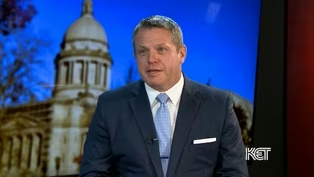
Education Commissioner Jason Glass
Video has Closed Captions
Clip: S2 Ep80 | 5m 20s | Ed. Comm. Jason Glass reflects on his time serving in Kentucky and why he's leaving. (5m 20s)
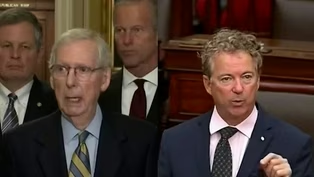
KY Senators On Possible Government Shutdown
Video has Closed Captions
Clip: S2 Ep80 | 2m 44s | KY Senators Mitch McConnell and Rand Paul weigh in on the possible government shutdown. (2m 44s)
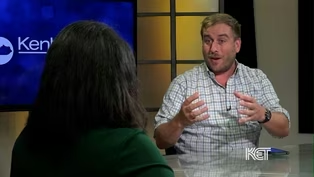
Midweek Political Check In With Ryland Barton (9/20/23)
Video has Closed Captions
Clip: S2 Ep80 | 6m 34s | Abortion a key topic in Gov. race and KY Supreme Court considers congressional maps. (6m 34s)
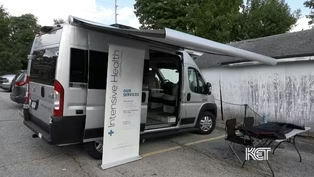
Video has Closed Captions
Clip: S2 Ep80 | 3m 45s | A new mobile healthcare unit from Stepworks is helping people in rural Kentucky. (3m 45s)

Protecting Butterflies in Kentucky
Video has Closed Captions
Clip: S2 Ep80 | 3m 9s | A new butterfly greenhouse to educate guests on the importance of butterflies. (3m 9s)
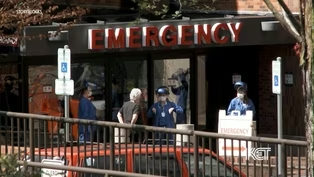
Rural Hospital Closure Risks in Kentucky
Video has Closed Captions
Clip: S2 Ep80 | 3m 44s | Almost a quarter of all rural hospitals in Kentucky are at risk of closing. (3m 44s)
Providing Support for PBS.org
Learn Moreabout PBS online sponsorship
- News and Public Affairs

Top journalists deliver compelling original analysis of the hour's headlines.

- News and Public Affairs

FRONTLINE is investigative journalism that questions, explains and changes our world.












Support for PBS provided by:
Kentucky Edition is a local public television program presented by KET