
Placemaking Increases Quality of Life, Talent Attraction
Clip: Season 6 Episode 47 | 8m 34sVideo has Closed Captions
How Michigan's placemaking efforts help attract, retrain the future of workforce talent.
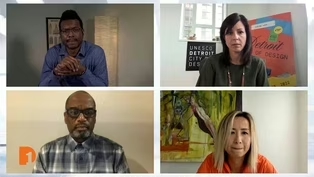
Future of Work host Will Glover examines whether Southeast Michigan has the infrastructure, amenities and investments to attract and retain the future of workforce talent, the barriers against placemaking efforts, how the future of work intersects with residents’ quality of life, and the need for strategic city planning and public transit in Michigan with a panel if expert guests.
Problems playing video? | Closed Captioning Feedback
Problems playing video? | Closed Captioning Feedback
One Detroit is a local public television program presented by Detroit PBS
Placemaking Increases Quality of Life, Talent Attraction
Clip: Season 6 Episode 47 | 8m 34sVideo has Closed Captions
Future of Work host Will Glover examines whether Southeast Michigan has the infrastructure, amenities and investments to attract and retain the future of workforce talent, the barriers against placemaking efforts, how the future of work intersects with residents’ quality of life, and the need for strategic city planning and public transit in Michigan with a panel if expert guests.
Problems playing video? | Closed Captioning Feedback
Where to Watch One Detroit
One Detroit is available to stream on pbs.org and the PBS app.
Providing Support for PBS.org
Learn Moreabout PBS online sponsorship(bright music) Michigan is aging and the population growth rate has been relatively flat over the last decade.
Attracting young talented people to live, work and play in the Glove State is a major factor in Michigan's growth and future economic health.
One way to lure entrepreneurs, new families and knowledge economy workers to the region is placemaking.
Veteran journalist and author John Gallagher has covered placemaking for years.
- There's general agreement that placemaking involves a variety of building types and sizes and uses.
So you're mixing retail, residential, civic, entertainment, commercial, I mean almost everything but industrial.
There needs to be a variety of transportation options.
Not limited to cars, but including buses, trams, bicycles, bike lanes.
The district needs to be very walkable and a very heavy emphasis on what's good for pedestrians.
So wider sidewalks, a lot of sidewalk cafes.
Really safe intersections where people can cross quite easily.
Probably some civic space like parks or plazas and all done up in a very lively walkable way.
So as you said, people can live and work and play within a relatively compact area.
- Anika, I'd like to bring you in because I think the term placemaking and the thought process behind it can be a little elusive for anyone who's not directly familiar with it.
So with the work that you do, I would ask if you could just explain a little bit about what the specifics are, what are we talking about when we're talking about what makes a good place?
What are the physical elements that go into that type of planning and makes a place attractive for someone to wanna live?
- When we think of placemaking, we should be thinking about communities that are amenity rich, that are places where you would want to raise your family, that you can thrive no matter where you are in your life, whether you're a single person, as a single young person or a single older person.
- Ned, I'd like to bring you in to talk about what creating good places and designing and developing places around those accommodations.
What does that do for business?
- Businesses especially, well, all businesses thrive on people.
So it could be people walking by that are customers, or it could be employees that are coming to work in an office location and in both cases, those folks are looking for the same thing.
And I think sometimes we over complicate this.
We think of it as something that they have in other places as Anika said in Europe or in bigger cities or whatnot.
But placemaking to some extent is pretty simple.
Places that people feel comfortable, that have safety, that have lighting, that have crosswalks, that are designed with the current residents in mind.
Now you say, oh, that will attract other people.
Well sure, because people want to be around those things.
- [Will] Director of Planning for the Southeast Michigan Council of Governments Kevin Vettraino points out that this isn't just a matter of having more cafes and nicer crosswalks.
- What we need to be thinking about is how are we designing our spaces and our land use, regardless of where you are in the region.
Are our roads and our sidewalks and our transportation networks supporting places that people feel comfortable, people feel safe that are accessible.
I think that word has come up a couple times and accessible is for all ages.
We're a aging region, we're an aging nation and that's not anything that's new.
We've been thinking about it for a long time, but we have to make sure that our places are accessible, open and equitable for all.
- [Will] Although progress is being made all around the state, the debate about how public investment is allocated remains.
- I can tell you for statewide and some of the trends that we're seeing is that we continue to lose younger people, right?
Because we are not investing with young people in mind for our urban centers.
With losing young people as an economic base, you end up losing your future middle class working family base, right?
And that is regardless of race.
We're seeing across the board, younger people are going to school in Michigan and then leaving and finding other places to live.
- Where does Michigan stand regionally in comparison to Ohio, Illinois, Wisconsin, these other places that are Midwestern towns and states that we are in direct competition with?
- Yeah, well, I think we've lost ground in a lot of ways.
Our output, our economic output statewide, even though it's growing, is growing a lot slower than other cities.
We used to be a top 10 state in terms of economic output.
Now we're about 13th or so.
We were dead last in some areas.
That was a big discussion point up at Mackinaw recently.
I don't think Ohio or Illinois are necessarily better than we are in terms of placemaking.
I think the modern American urban landscape is mostly sprawl land, but I think Michigan really needs to wake up.
In terms of educational achievement, we're lagging.
In terms of amenities for young people, we're lagging.
Our population is just flat, whereas the Sun Belt continues to grow.
- Since 19990, 1980, 1990, we've dropped in per capita income in Michigan precipitously.
We're now down to 34th in the country whereas we used to be in the low teens.
We are relatively a much poorer state than we were 30, 40 years ago.
And I will even challenge your premise of how are we competing with Ohio and Illinois?
The answer is John's correct.
We're not competing very well with them, they're beating us.
But I'd argue that we don't even wanna compete with them 'cause he also correctly pointed out that even Ohio and Illinois aren't really doing all that well in this area.
But other states like Minnesota, or I think he mentioned Seattle and Washington and Boston, Massachusetts.
Those are the states we should be competing with and they're kicking our butts, so let's just be honest with it.
They're moving right up.
And going to what Kevin talked about on the things we need to do, these aren't accidents.
It's not like, oops, we accidentally made a nicer place.
These are investments.
They require us to make long term investments in things like transit and walkability and safety and education in schools.
And Michigan's dead last in almost all of that stuff.
Behind Ohio and Illinois, but way behind Washington, Virginia, Colorado, California, a lot of other states are intentionally doing a lot more than us and if we don't change that, we're gonna keep slipping further and further behind.
And I think the very first thing we need to do is change our mentality of who we're competing with.
- John, I would like to give you the last word.
What is your thought as to what is the low hanging fruit, what should be our main focus?
- Public transit.
We have an appalling lack of public transit and if you travel to any of the great cities, London, Paris, Berlin, New York, Chicago, Washington, you can get anywhere on public transit and you don't need a car.
And that is an economic development tool as well.
That's great for business.
It's not just that it's kind of convenient to get around.
It really is the stuff that makes the whole society go.
So reliable, safe, relatively inexpensive public transit is the key.
- [Will] When most people think about Detroit, they think of the city's rich history in the auto industry
Detroit Brand Deviate Fashion Discusses Design in the City
Video has Closed Captions
Clip: S6 Ep47 | 6m 41s | Can Detroit become an international fashion city? Detroit's Deviate Fashion thinks so. (6m 41s)

The State, Future of Michigan's Budding Design Industry
Video has Closed Captions
Clip: S6 Ep47 | 6m 44s | Design is everywhere. Explore the state and future of Michigan's budding design industry. (6m 44s)
Providing Support for PBS.org
Learn Moreabout PBS online sponsorship New Episode
- News and Public Affairs

Top journalists deliver compelling original analysis of the hour's headlines.
 New Episode
- News and Public Affairs

Today's top journalists discuss Washington's current political events and public affairs.


 New Episode
 New Episode
 New Episode
 New Episode
 New Episode

 New Episode
 New Episode
 New Episode
Support for PBS provided by:
One Detroit is a local public television program presented by Detroit PBS