
Plant Breeding Scientist
Clip: 4/20/2026 | 2m 25sVideo has Closed Captions
Plant breeding scientists develop new, hardier species of crops.
Plant breeding scientists develop new, hardier species of crops.
Problems playing video? | Closed Captioning Feedback
Problems playing video? | Closed Captioning Feedback
America's Heartland is presented by your local public television station.
Funding for America’s Heartland is provided by US Soy, Sustainable Agriculture Research and Education, Rural Development Partners, and a Specialty Crop Grant from the California Department of Food and Agriculture.
Plant Breeding Scientist
Clip: 4/20/2026 | 2m 25sVideo has Closed Captions
Plant breeding scientists develop new, hardier species of crops.
Problems playing video? | Closed Captioning Feedback
How to Watch America's Heartland
America's Heartland is available to stream on pbs.org and the free PBS App, available on iPhone, Apple TV, Android TV, Android smartphones, Amazon Fire TV, Amazon Fire Tablet, Roku, Samsung Smart TV, and Vizio.
Providing Support for PBS.org
Learn Moreabout PBS online sponsorship♪♪ >> Well my name is Kent Bradford and my work is involved in seed biology, seed production and related to improving crop varieties for production in agriculture.
>> It is true that seeds are little miracles, that's certainly true.
>> This is a wild tomato species.
In a very real sense seeds are critical to our future.
And in a large fraction, Not all of our agriculture but a very large fraction of our agriculture depends upon being able to reproduce seeds annually.
>> Wow, this is nice.
The seeds that are used by farmers to grow crops have to be produced every year or at most every other year to provide good quality seed and efficient agriculture requires uniform crops that germinate quickly and establish quickly and grow rapidly.
We need to be improving crops because the environment, the tests, the markets and so on are changing all the time.
>> For example, the size of watermelons has shrunk recently from large watermelons that used to be the case to the small personal watermelons.
And that's all done by developing new varieties that appeal to consumers.
>> We have so many new tools that we didn't have in previous years.
In the last 20 years certainly our ability to understand the basis of traits that we want has improved enormously.
It's as if it's a GPS for breeders.
>> I think if someone is looking for a career in plant science, this area of plant breeding and seeds is a great place to be.
Its really the intersection between the technology and the practical aspect.
They way to think about seeds in agriculture these days, in a sense, they're the microchip.
They're the heart.
>> You plant a seed and that carries all of the traits, all the efforts that the breeders have put together.
And the more that we can do that, the less we have to add later.
The less fertilizer we have to add later, the less pesticide we have to use to control diseases.
The ability to now feed 6 and a half billion people is largely due to plant breeding.
Clearly as we go towards 9 billion people in the next 30 years, we're going to need to double food production again and we simply cant do that without improved varieties.
♪♪
 New
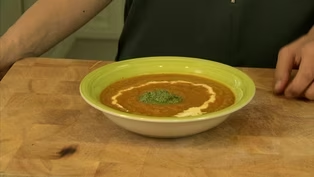
NewFarm to Fork Roasted Carrot Soup
Video has Closed Captions
Carrots are good for you – and tasty, thanks to this Farm to Fork carrot soup recipe. (6m 51s)
 New
NewVideo has Closed Captions
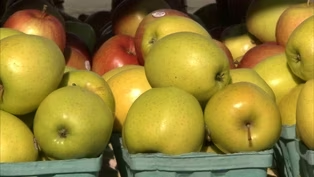
Forget New York City! A “Big Apple” tradition at this Empire State location is all about apples. (3m 54s)
 New
NewVideo has Closed Captions
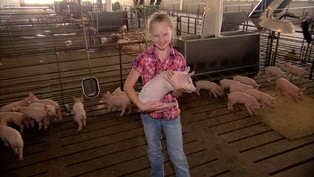
An Ohio farm family finds new ways to market their products to overseas consumers. (4m 26s)
 New
NewVideo has Closed Captions
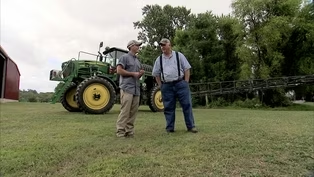
A father and son farming team brings new ideas to their Virginia operation. (4m 51s)
Providing Support for PBS.org
Learn Moreabout PBS online sponsorship

- Food
Christopher Kimball’s Milk Street Television
Transform home cooking with the editors of Christopher Kimball’s Milk Street Magazine.











Support for PBS provided by:
America's Heartland is presented by your local public television station.
Funding for America’s Heartland is provided by US Soy, Sustainable Agriculture Research and Education, Rural Development Partners, and a Specialty Crop Grant from the California Department of Food and Agriculture.