
Playing New Notes in Dementia Research
Clip: Special | 5m 17sVideo has Closed Captions
During a musical interlude, Dr. Karen Ashe outlines developments in dementia research.
During a musical interlude, Dr. Karen Ashe outlines developments in dementia research.
Problems playing video? | Closed Captioning Feedback
Problems playing video? | Closed Captioning Feedback
Art + Medicine is presented by your local public television station.
Distributed nationally by American Public Television Distributed nationally by American Public Television
Playing New Notes in Dementia Research
Clip: Special | 5m 17sVideo has Closed Captions
During a musical interlude, Dr. Karen Ashe outlines developments in dementia research.
Problems playing video? | Closed Captioning Feedback
Where to Watch Art + Medicine
Art + Medicine is available to stream on pbs.org and the PBS app.
(bright music) (bright music continues) - When I'm stuck on a problem, music can transport me into realms that help me solve it as if my right brain is helping my left brain come out of a ditch so that they can work on it together.
(bright music continues) I'm Karen Ashe, professor of neurology at the University of Minnesota and the director of the N. Bud Grossman Center for Memory Research and Care, and I'm also the CEO of a company called Myriel.
(bright music continues) I went to medical school at Harvard and in my third or fourth year, I went into the library and looked at different journals.
I knew that I needed to pick a profession whose journals that I would enjoy reading for the rest of my career.
And I loved the neurology journals and I thought, "Wow, this is so neat."
(bright music continues) When I was a resident in neurology 40 years ago, one of my teachers told me that the diseases that caused dementia are waste basket diseases.
(bright music continues) Neurologists love to classify diseases according to their causes and put them neatly into filing cabinets but we couldn't do that with dementia because we didn't know what caused them.
(bright music continues) People can get dementia as they get older.
Dementia is what results when certain aspects of mentation break down, aspects like memory and language, abstract thinking, behaving appropriately, doing calculations, having a sense of direction.
Alzheimer's disease is the most common form of dementia.
It's one of many forms of dementia.
(bright music continues) We are studying mentation and how it goes wrong.
We all have millions of memories and they're like metaphorical light bulbs.
Our brains can strengthen and weaken memories by increasing and decreasing electrical activity, (bright music continues) and we've found a molecule called caspase-2 that decreases electrical signals and weakens memories.
We need caspase-2 normally, because we can't handle millions of memories all at once, just as we wouldn't want all the lights on all the time.
But the problem in Alzheimer's disease is that caspase-2 is on overdrive, so we can't recover our memories.
We began to try and make a drug to block caspase-2 and this year, we developed a prototype that can repair the synapses in cells that are growing in a dish.
(bright music continues) We're excited because we think that these drugs will not only prevent, but also reverse memory problems.
Even more exciting, we think that the memories that are lost are still there, but could be recovered by this drug.
(bright music continues) So we started at home base, and it took 10 years for us to get to a prototype which is a compound that restores synaptic function in neurons growing in a dish.
We hope that in four years, we'll be at second base which means we'll have a compound that gets into the brain and restores memory function in mice.
I would say, we would be at third base when we have compounds that are safe in small groups of humans, but we will not get to home base again until the drug is shown to be both safe and effective in two large groups of patients.
(bright music continues) It's every scientist's dream to make the world a better place, and we work very hard to try and make discoveries that will help us make the world a better place.
(gentle music) (birds chirp) (birds chirp) (gentle music)
Art + Medicine: Healthy Aging | Preview
Preview: Special | 30s | Exploring healthy aging through an artistic lens. (30s)
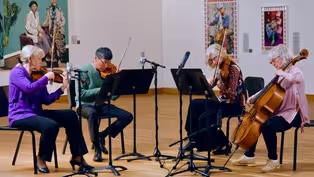
Borodin's String Quartet No.2: Nocturne
Video has Closed Captions
Clip: Special | 5m 44s | Alexander Borodin's String Quartet No.2 in D Major: III. Nocturne. (5m 44s)
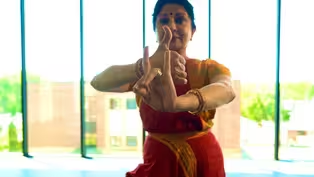
Dance into your 70s like Ranee Ramaswamy
Video has Closed Captions
Clip: Special | 4m 48s | Founder of Ragamala Dance Company, Ranee Ramaswamy describes how to dance into your 70s. (4m 48s)
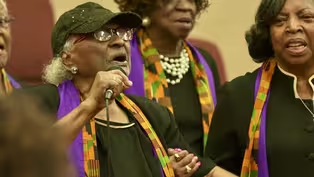
Dementia-Friendly, Amazing Grace Chorus
Video has Closed Captions
Clip: Special | 7m 4s | The Amazing Grace Chorus is dementia-friendly and celebrates Black history and culture. (7m 4s)
King Lear Excerpt Featuring Raye Birk
Video has Closed Captions
Clip: Special | 2m 3s | Raye Birk performs an excerpt of Shakespeare's King Lear. (2m 3s)
Video has Closed Captions
Clip: Special | 3m 45s | Original jazz composition "Levity"performed by the Ari Nahum Trio. (3m 45s)
Video has Closed Captions
Clip: Special | 8m 7s | Artists Seitu Ken Jones and Soyini Vinelle Guyton look to leaving a legacy. (8m 7s)
Morning Walk by Joyce Sutphen, Film by Zack Grant
Video has Closed Captions
Clip: Special | 1m 45s | Poem "Morning Walk" by Joyce Sutphen, featuring Debra Magid. Film by Zack Grant. (1m 45s)
A Note to His Doctor, by Kevin Hadduck, Film by Tess Nelson
Video has Closed Captions
Clip: Special | 1m 40s | A Note to His Doctor, by Kevin Hadduck. Film by Tess Nelson. (1m 40s)
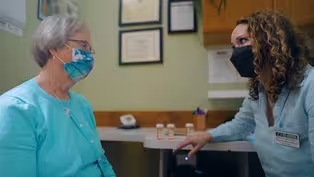
Serving Older Patients in the Pharmacy
Video has Closed Captions
Clip: Special | 4m 15s | Medication therapy management and de-prescribing are important when serving older adults. (4m 15s)
When Death Comes by Mary Oliver
Video has Closed Captions
Clip: Special | 2m 8s | Candace Barrett Birk performs Mary Oliver's poem "When Death Comes" at Lakewood Cemetery. (2m 8s)
Why is it Important to Talk About Aging?
Video has Closed Captions
Clip: Special | 1m 34s | Artists answer, "Why is it important to talk about healthy aging?" (1m 34s)
Providing Support for PBS.org
Learn Moreabout PBS online sponsorship
- Arts and Music

Innovative musicians from every genre perform live in the longest-running music series.
 New Episode
- Arts and Music

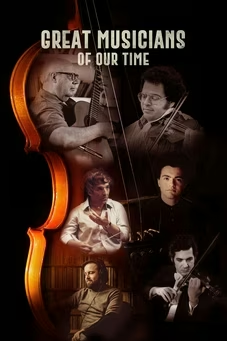
Intimate portraits of six of the most influential and celebrated classical music artists.
 New Episode








 New Episode
 New Episode
Support for PBS provided by:
Art + Medicine is presented by your local public television station.
Distributed nationally by American Public Television Distributed nationally by American Public Television