Traverse Talks with Sueann Ramella
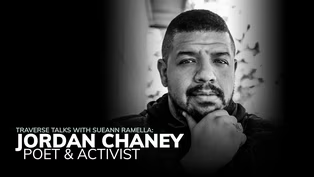
Poet Jordan Chaney
10/19/2021 | 35m 13sVideo has Closed Captions
Poet Jordan Chaney on acknowledging, learning from and healing racism.
How can you acknowledge racism and heal it? In this episode of Traverse Talks with Sueann Ramella, Poet Jordan Chaney is a Black Indigenous Person of Color, lecturer, poet and an artist from Pasco, Washington. He gives advice on how to be a true ally, setting and respecting boundaries when it comes to talking about race, how to recognize trauma and allow everyone to ‘F-up’…and that means forgive.
Problems playing video? | Closed Captioning Feedback
Problems playing video? | Closed Captioning Feedback
Traverse Talks with Sueann Ramella is a local public television program presented by NWPB
Traverse Talks with Sueann Ramella
Poet Jordan Chaney
10/19/2021 | 35m 13sVideo has Closed Captions
How can you acknowledge racism and heal it? In this episode of Traverse Talks with Sueann Ramella, Poet Jordan Chaney is a Black Indigenous Person of Color, lecturer, poet and an artist from Pasco, Washington. He gives advice on how to be a true ally, setting and respecting boundaries when it comes to talking about race, how to recognize trauma and allow everyone to ‘F-up’…and that means forgive.
Problems playing video? | Closed Captioning Feedback
How to Watch Traverse Talks with Sueann Ramella
Traverse Talks with Sueann Ramella is available to stream on pbs.org and the free PBS App, available on iPhone, Apple TV, Android TV, Android smartphones, Amazon Fire TV, Amazon Fire Tablet, Roku, Samsung Smart TV, and Vizio.
Providing Support for PBS.org
Learn Moreabout PBS online sponsorship- [Sueann] Most of us think I'm not a racist and that includes me.
But when I saw video of a black father doing his daughter's hair, I remember thinking, oh, he's so gentle and loving, he's involved.
And when I saw black men at the park with a golden retriever, I thought, oh no, pit bull, that's weird and he seems outdoorsy.
Had I internalized images of black men as dangerous unloving and caring, is that why those images stood out to me?
How can you acknowledge racism or racist thoughts and heal them?
In this episode of "Traverse Talks," Jordan Chaney is a black indigenous person of color, a lecturer, poet and an artist in Pasco, Washington.
He gives advice on how to be a true ally setting and respecting boundaries when it comes to talking about race, how to recognize the trauma and allow everyone to F up and that means, forgive.
You mentioned about how true allyship comes from people reading or listening to videos or podcasts to help them understand black indigenous people of color struggles, can you tell us about some of your favorite authors or podcasts, some resources?
- [Jordan] That's a perfect entry point into this work because recently (chuckles) I was on a date, I was on a date with this woman who is an HBCU grad and she was like, wait a minute, your mom is white?
And I was like, yeah and she said, and you were raised by a white woman?
And I said, yeah.
She said, well, where do you get all your "wokeness" from right?
To quote unquote "wokeness" from?
And I immediately said, well from black women and I can name them specifically because they have been the women who have ceded my conscience and my consciousness around this work for the last, I'd say decade plus and it's women like C. Davida Ingram and Natasha Marin author of 'Black Imagination,' Ijeoma Oluo, Reagan Jackson, of course, Serenity Wise, DiShondra Loving these women who I've surrounded myself with have, I would say healed me of certain illusions, unbeknownst themselves, but they're examples that they've set in the work that they've done created a bridge, I think into awareness for myself as far as what I would say this work does.
So those are the kinds of people I've surrounded myself with as far as how I've learned how to interpret the world around me.
So, it's worth that much upfront to talk about the educational aspect of this for our allies and friends, to read these books, to really understand it, so that you can engage in a clean way that doesn't cause infection or harm, right?
'Cause when we talk about racism and dismantling systems, we're not talking about deactivating a bomb, the bomb went off hundreds of years ago, we're talking about healing a wound.
So the bedside banner and the approach and that touch should be held in that regard, right?
It's a seriousness.
- [Sueann] With your talks, you talk about setting boundaries when you're having conversations about race, can you name them, list them for us?
- [Jordan] So with the boundary setting, it's important like I always say and I did this inside of a church even.
I say, we gotta give each other room here to F up and that means forgive.
I automatically understand that if I'm having a conversation with somebody about race, first, the person who is the oppressed, who is the target of racism and oppression must agree that this conversation is allowed to happen with them in particular.
Anybody can talk about racism anywhere they want, because that's how the First Amendment works, but when I go down to the Southwest and I go onto a reservation, I have a tribal liaison that shows me all the things not to do or to do so that I don't disrespect and cause further harm to already vulnerable and oppressed community and it works out really well.
- [Sueann] Well, what you're doing is you're showing regard for another person's culture and I think it's difficult for the majority to realize that even in the United States, there are different cultures and different ways of approaching and being, so that's amazing.
And you mentioned harm in your safety net rules, you have the chance to F up, but forgive, 'cause we're all learning at the same time and working through this together.
But you also mentioned the person needs to give you the permission because this is a trauma.
- [Jordan] Hmm.
- [Sueann] So talk to me more about that.
- [Jordan] Absolutely.
In activism we have three ways of handling people, like we have call in, call out and counsel and we try to like...
So if somebody's violating us in some way or somebody is harming the community, we try to call them in and say, hey, are you aware that you're doing this, that or the other?
And if they are, then they can easily correct it.
We begin to call people out once they are harming themselves and others and they refuse to stop, right?
And then that's where cancel comes in, it's like, there's a full push to counsel somebody.
So in my talks, I say, okay, we have room to F up, in this safe space that I'm agreeing to talk about this trauma, I will allow you to ask me questions that are normally traumatizing and triggering for black people and I will help work you through it to the point where I can lead you to do the work yourself.
So what I wanna read to you right now is my final counsel letter to a friend who violated all of my rules for how we talk about it, she demanded that I talked to her about race because we've been friends for so long and she doesn't understand the impact she's having and she's ignoring my boundary.
So this is the text message that I sent to them and I'm not gonna disparage the person and there's no indicators in this, but my final text was, "I verbalized my boundary about having conversations about race with you, because you have already made me feel psychologically unsafe with cultural incompetencies around this subject that are highly triggering and even traumatizing conversations for BIPOC people and black people, I ask politely you push back.
Demanded that I educate you on how you are pushing racial boundaries and just basic common courtesy boundaries of when a person doesn't want to talk about their trauma.
Racism is trauma for me, so is sexual assault, I'm a victim of both.
You wouldn't force a conversation about sexual assault onto a victim, how crazy would it be to expect a victim of sexual assault, to have a forced conversation about that with their victim after pleading not to?
You are completely unaware of the harm you have caused me, yes, your privilege protects you from having to actually learn this stuff, change and grow, it's a shame.
That's why I asked you how many black friends do you talk to about racism with and you couldn't answer.
You couldn't because I was your only one and I gave you fair warning, I said that I don't want to talk about racism with you because you are already in violation.
I never spoke to you about this 'cause I saw this response coming 400 years away and I said I do not wanna be your token and have to educate you on a topic that you truly don't have a handle on and that is not healthy or safe for black people or BIPOC community in this crisis that black people are suffering in.
You are not safe for black mental health, please read those resources I sent you and please do not ever demand another black person or BIPOC person to educate you on your abuse, it's not okay, it's racism and there is help, read."
And that was painful to write only because I didn't want to lose a friend, but I didn't know what to do after I had no other recourse, but to make a strong boundary and hopefully later there's gonna be room for forgiveness if they can come back and see what they did, right?
'Cause I know that she just doesn't know, she just doesn't know what she did, right?
- [Sueann] I might get this story wrong but a friend of mine mentioned a story about when there's a person who is afraid of snakes and they see a rope and they believe it's a snake, you cannot convince them that it is a rope until they are ready to see.
And sometimes I wonder if just the level of maturity for a lot of our citizens is not there or their empathy or their hearts are not open.
And then I just wanted to ask you, how can you sense?
Because I feel you are a teacher, you're an educator, how do you sense when somebody is open to learning?
Are there clues?
- [Jordan] Oh yeah, even before this conversation, I had another conversation with two older white friends of mine who openly admit to we're white and we don't know and is it safe?
They've heard some of my safety rules and these are rules that I set for myself, that I won't speak for every black or BIPOC person out there, but boundary setting is almost common sense, but around this subject they did the right things, I could tell that there was empathy, I mean, you can see a facial expression or curling of the shoulders and a leaning in that makes you feel safe.
They didn't interrupt me when it got emotional, they allowed me to express trauma and these two people are trauma-informed.
And that's great because that is what racism is, but there should be a new line of work research behind being racially trauma-informed.
Because there are so many of us, right?
That are so afraid to lose even our white friends who don't understand that we will stay in silence because we don't like awkward conversations or loss either.
And these people they create space and they let you have the floor and I can easily just go ahead and I feel safe to even, even if I step into educating them, once I catch myself out, I'll reroute them to resources so that they do the work themselves because that's important and they are.
I see a wave of it happening.
- [Sueann] Oh, I'm so glad to hear that.
I mean, it's pretty courageous of you to offer yourself up as a educator and somebody that people can approach and talk to.
How did you get to that place to allow...
I mean, what you're doing is pretty vulnerable.
- [Jordan] Yeah, maybe it comes from... My mom was a poet, a Pisces, a hippie (chuckles) a wild child and she was a storyteller too and so she taught us to kind of live with our hearts on our sleeve, we always heard, I love you from our family, we always were encouraged to create and speak and choose our own religion, so she laid a foundation to be vulnerable.
Now I'm at a point where I'm willing to have these conversations I'm willing to lean into this work because the recourse is despondency and despair and that is not gonna serve the course, it's not gonna serve our children, it's not gonna serve our peers, it will not serve the work.
There's plenty of reasons to be in despair, there's plenty and reasons to be despondent, I understand people's obsession with Netflix or Escape, because this is daunting to the human species what's happening, but I have nothing but hope and I have love and joy in my heart and it's not insouciant hope, love and joy, this is hard one hope, love and joy.
I'm very aware of what is happening around me and what the work is gonna look like, but I do not feel exhausted or tired, I refuse to say, I'm tired, I am tired, I'm beyond that.
(chuckles) I'm fired up, I'm fired up about this work.
- [Sueann] You sound like you're responding to a higher calling.
- [Jordan] Yeah, it feels like it.
(bright hip-hop music) - [Sueann] All right, so now I have a question that's little weird.
I often think of when you have a person, a white person, someone in the majority, they're like a fish in a pond and then what Black Lives Matter and this work is doing is sometimes lifting them out out of the pond so they can see the land for the first time and how bizarre that might be for them, because they have only known their own perspective and never realized that they were privileged.
What can you say to a person who is just now dealing with like, oh my gosh, I had no idea.
- [Jordan] I'm gonna give you this one for free 'cause this is an important one.
First, like you can't talk to a frog stuck in a well about the sea, right?
So this frog that you're talking about, who finally comes up out of the well for the first time and is looking at to sea, they see something that they can't really interpret and so when I opened up my talks, I set up my safety net and I talk about room to F up, I go into the definitions of racism, right?
And a lot of times people think that racism is just the N-word and I'll say, well, there's more than that, tight?
It's institution structures, let's talk about the power dynamics of racism.
And then what I'll do to drive home my point, is I'll bring up sexism and I say, look, I work with kids at the Juvenile Justice Center and some of these kids are going off to see long sentences and prisons and what have you.
And what do you think their number one fear is?
Not just these kids who will go off to prison, what do you think their fear is and almost every man's fear is of going to prison.
We are immediately thinking of sexual assault.
Now, the only place that as men or these young boys really truly have to fear sexual assault of that type, is when we've committed a heinous crime and we get sent off to a deep, dark dungeon and we're overpowered by one or more men, why does a woman fear this?
They can go on the wrong date, they can leave the gym, the grocery shopping, being left alone at a gas station, I mean, a lot of a woman's psychological bandwidth is used for her protection from sexual assault in some way in our society.
This is where power comes in.
So, as a man I inherit a lot of power, I don't have to spend a lot of psychological bandwidth on my personal safety from sexual assault, unless it's prison.
This privilege that I have of having all this safety as a man in this man's world, this inheritance that I have, I best do something with it if the other group of men are spinning this inheritance in malicious and diabolical criminal ways against women, creating an unsafe.
Now, let's take that whole idea of power and apply it to racism, racism is race plus power.
Imagine what it's like being a black man and how much mental energy, psychological, emotional energy you spend for your safety.
I have to be careful when I go to parks to not a white person off, if they call the cops, I can get the "Karen."
If I get pulled over by a police officer, if I reach for something and the officer just fears me or anything, that's a death sentence.
How often do I drive?
Everyday.
When I go into stores and I don't buy something...
I feel I'm constantly being targeted and looked at, those are small incidents though.
But as a black person living in this society, where you're outnumbered by a system that has just proven to target you, you just walk around feeling like this could be your last day.
It's a lot of mental, psychological, emotional bandwidth that gets taken up, I'm stuck in a place of unsafety, I cannot totally always be emotionally healthy, therefore I can't reach the levels of my brain that help me lead to prosperity and greatest basis of safety for myself or the people that I care about, I'm constantly... Black men, black people we're on a wanted poster, it doesn't matter which one of us, we live on a wanted poster, that's terrorizing.
- [Sueann] With that, have you allowed yourself to dream of a world where the United States has acknowledged and worked to heal the wounds of the past and like, what would a day in your life be like, when we have come to this place?
- [Jordan] I love that question because I'm obviously, a dreamer and a visionary and I spend a lot of time dreaming up what a new civilization would look like.
And at the first protest I spoke at, I wanna say it was a week after George Floyd was killed, I spoke of this civilization that I see and it's a civilization that is a product of justice No, I don't wanna ware that word down because we hear it by rote, we chant it by rote and it begins to lose its weight 'cause we think of it as this abstract thing, like it's just a word so we see a gavel, a woman with a blindfold on.
But justice is an actual spirit and a law, it's like gravity and what comes as a result of a fair society is safety and what being trauma-informed teaches us about safety is when you have somebody who has trauma and you get them to feel safe, they can access their emotions in a healthier swifter way, right?
They're no longer emotionally locked in.
And when you're emotionally healthy, you begin to access areas of your brain, where you can formulate plans and execute in a logical way that assists your prosperity and your survival.
When we can actually move into a just society and we get our world feeling safe and emotionally healthy and thriving and working together for a prosperous saner world, we unlock the magic of our species, of our beings.
I mean, even in my own personal healing, if anybody's watched me over the last four years, I've lost over a hundred pounds, this is the result of healing.
And it wasn't just the weight, the weight was what people physically saw, but I have an art studio downstairs, I have murals that I'm making in the community and other ones that we're working on in other places, I did not feel safe or emotionally healthy enough, right?
Being depressed, that's not emotionally healthy, I mean, you can't unlock that side yourself.
So when we begin to heal and we make a just world, we'll have an advanced civilization within a decade, (chuckles) if we really had justice and safety in this world.
- [Sueann] Oh my goodness!
I'm just imagining all the creativity- - [Jordan] Could you imagine?
(laughs) - [Sueann] So you mentioned earlier that your mom is white?
- [Jordan] Right.
- [Sueann] What would you say to other white moms who are raising black?
- [Jordan] My advice would be to get them in community with their own in some way so that they understand themselves, they have reflection and connection this will make them feel safer, right?
Imagine being raised in all white home and you're black in a racist society, you're not going to feel 100% safe and understood and seen all the time, for all the good intentions of all the great white folks that I know, they still F up.
And I can see it in a time-lapse, right?
What this will look like, accumulation of trauma or accumulation of not being able to speak your truth or being invalidated because you're outnumbered simply so you don't speak, right?
'Cause you speak, you get in trouble, you get emotional as a black person, you get in trouble.
My advice would be to encourage not only the family to educate themselves, but to encourage them to get their children in community with other black people, it's crucial.
- [Sueann] The United States is getting more mixed.
How do you see...
I'm asking you to predict the future a little bit, but as we become more mixed as a society, is that gonna solve problems?
- [Jordan] You can mix and match us and I have a lot of faith leaders and motivational speakers who will say something to the effect like we just all gotta just come together, if we just come together.
This is an autopilot thought, this is like a warm fuzzy thing because we are already together, we are already very culturally diverse what will we have more of is diversity with the same injustice.
If we don't point our eye towards the systems and structures that are in place and begin dismantling, you can have all the colors of the rainbow dancing and eating each other's foods and wearing fashionable clothes from one another's cultures and heritage or what have you, but if you do not set the civilization on the principles towards justice, towards equity and equality, you're just gonna have a more colorful mess, a more stylish mess, a more inclusive mess, right?
- [Sueann] 'Cause you haven't dealt with the pain and the wound deep in.
- [Jordan] Right, we're not being sincere.
It's why I refuse to take public photos with police officers.
Even if behind the scenes I'm doing genuine work with anybody from the department, I refuse to take photos with them for the public, for the simple fact, I'm not gonna posture for anybody or anything, that's harmful, it confuses people.
Say hey, there is no problem, they're shaking hands and smiling, this is not about our innate kindness and goodwill as human beings, this is about what the weight of the American state and how the police officer carries it and how that's being handled.
Ibram X. Kendi said that the only way to undo racism is to consistently identify and describe it and then dismantle it.
When we think of dismantling racism and ending systemic oppression, right?
Some people might have it in their psyche that we have to jump in a time machine and travel back to when they have the declaration of independence signing and all this and we shred it up and then all of a sudden it dissolves.
No, racism and institutional structural racism is happening all around us right now and you have to be able to name it and spot it because it's so pervading.
It's hard for the average eye to separate salt from sugar, but like you said earlier, people are not reading, people are not interpreting and communicating, people are reacting.
(bright hip-hop music) - [Sueann] Okay, Jordan, for my dad, who is a loving father, white guy, what would you say to him about All Lives Matter?
- [Jordan] (chuckles) This is what I would tell him.
I would share with them this story about how I think it was in 2000, geez, 15 or 2012, Westboro Baptist Church came to Pasco, Washington, they came to protest a dead US Marine.
They were having a funeral for a United States Marine out at the track, Westboro Baptist church, condemns homosexual marriage and I believe they were making some stance and message, they had "God hates fags" on their rainbow colored picket signs at this funeral, okay?
At a funeral.
The families endured more pain and suffering as a result of this level of gaslighting and harassment that they sued the Westboro Baptist church for $10 million in one, why?
Because they're grieving.
And so when people hold up their All Lives Matter picket sign, what they should know is that a community is grieving.
When we say Black Lives Matter, we're talking about a specific person that died at the hands of injustice at the disproportionate rate that black people experience it, show some respect for the grieving, we're grieving somebody.
All the other stuff about all lives matter, we know all lives matter, we treat it, we act it out, and our actions tell you that we believe that all lives matter.
We are specifically talking about black death injustice at the hands of the police state and when people hear that and hear this argument, and if they give me a yeah but, I begin to just pull my energy back and I move on because it's gonna be more psychological labor and emotional labor that I don't owe them.
- [Sueann] So you grew up in the Northwest, right?
- [Jordan] Mhhh.
- [Sueann] What are some moments of living in this area that you love and some moments that hurt?
- [Jordan] The moments that I have absolutely loved here, one snapshot, I'm a black man that's made my living as a poet in a considerably racist region and I was able to raise my son and pay our bills in this region, that's one of the things I absolutely love.
This community also helped me go to Athens, Greece, I got to write for Wine Press Northwest for a couple of years and perform at wineries, those are some moments that I really love.
Moments that have really have made it uncomfortable and agonizing is watching the leadership.
There's been a lot of people that I had made friends with over the years, whether it was city council people or chiefs of police, or just basic community leaders, whether they're faith leaders or whatnot.
The leadership that I've seen over the last few years has made me not feel safe in this community.
And I can't turn my back on the community 'cause there's so many people here that I absolutely love and will always stay connected to.
But I know that this region does not understand the level of harm that it actually causes to black and BIPOC community, but also to themselves, right?
'Cause these stories are getting out, About the sun downtown, history here and about the current, I mean, (chuckles) anybody who wants to look at what the city council feels or thinks or what chiefs of police in this region think, they just have to do a few Google clicks, they'll get a general feel of what the leadership is perpetuating around here.
And again, if they know it and they're continuing to do it, it's inhumane.
- [Sueann] Can you remind us what a sun down or sunset town is?
- [Sueann] Yeah, so here right now, I'm in Pasco, Washington and the neighboring city is Kennewick, Washington.
Kennewick, Washington was a sun downtown all the way up until...
I think they took the last sign down in 1974 and it was on I want to say on the Green Bridge, that used to be right next to the Cable Bridge, and it said that black people had to be over that bridge and home by sundown.
I know this to be true because my white grandma who has black children used to be escorted by the sheriff from Kennewick over into Pasco.
Sun downtown was basically Jim Crowism, it's the Jim Crow laws, around what black people were and were not allowed to do pre-civil rights movement and post-civil rights movement.
So it continued, they used to call the Tri-Cities, the Mississippi of the North or the Birmingham of the North gentrified black people of the Pasco and then he erased them with mass incarceration and the making blackness pretty much illegal, like (chuckles) we were wiped out over here.
And the east side of Pasco used to look like Atlanta and everybody remembers that, Juneteenth used to look like Atlanta and it was beautiful, but we psychologically and emotionally and economically haven't felt safe and we'll migrate away quietly usually.
- [Sueann] I had a question about, other than educating yourself as an ally, do the work on your own, read the books, find a mentor or a friend that you could speak to about these things with.
What other tips do you have for those who want to be an ally?
- [Sueann] I love what Ijeoma recently said, I saw a quote floating around of hers, it's Ijeoma Oluo author 'So You Want to Talk About Race.'
She said something to the effect that we want your allyship but when you think of your allyship, you gotta ask yourself, can the recipient eat it?
Can they spend it?
Is your allyship actually tangible?
And basically kind of referring and leaning towards, is your allyship performative?
'Cause we do see people show up who just want to absolve themselves of their own white guilt and show all the black people in the world how safe they are.
And we love to see it, we love the extra kindness in the manners that we get from people who are wanting to show how safe they are.
But it's not that that's disingenuous, but it's happening in such a swell that we're like, that's great that you're kind, but this has nothing to do with our feelings.
Argue with your uncle at Thanksgiving and if he's a city council person, influences policies, right?
Like make your allyship tangible.
You notice how we don't have any statues of civil rights activists that are white?
Like (chuckles) why are we throwing ourselves into a fire that we didn't start?
And I kind of remind some of my activist friends like, remember we are helping them dismantle a system that we didn't create, okay?
Let's keep the focus clear here.
We didn't enslave ourselves and oppress ourselves for centuries to arrive here, but we are committed to the work because what other recourse do we have?
And I'm even fighting for the person that doesn't even agree with me, like I'm fighting for the Kanye west and Candace Owens, even though I cannot stand that they have platforms in the messaging and the confusion they're causing, I want black people to be whoever they wish to be and not feel any obligation.
I was mad at a lot of black people when they started for not speaking up and saying certain things and I'm like, I got to the point where it's like well, I mean, honestly, they didn't start it, why am I mad at them?
That's a by-product of this system, it's a by-product of white supremacy.
I can't call black people Tom's any more than I would call them the N-word because these are not terms that came over on the boat with us, you know what I'm saying?
We're at the effect of a system that we didn't create, so that's where my grace and compassion forgiveness comes in on folks that are not doing the work, but it is so necessary and is so incredibly necessary for our group and our collective survival that we do push back.
I know that in this work none of us are trying to be a figurehead, none of us are trying to be the spokesperson for the whole black society or community like that's not where none of us are, we want everybody speaking up and marching to the beat of the drum of their heart and speaking the truth.
Like we wanna be on the same page with the truth, not trying to speak for one another, we're not trying to have figure heads, we're not trying to have some one leader prop us up and they can manipulate and hurt them and take them down and then the movement stops, like it's better that we are all singing the same song, even if it's off key.
But I ramble, I digress.
- [Sueann] No, not at all.
I mean, Jordan, that's a wait.
So what do you do for yourself for self care and what would you recommend to others?
- [Jordan] One of my quotes and I have it hanging up here in my apartment, "Self care is anti-oppression."
And Audre Lorde said something to the effect that, when she takes care of herself, man, that's not for selfishness or bougieness, it's an act of political warfare.
My responsibility in this fight is first to Jordan, therapy, roller skating, I'm a vegetarian, I create every day, I either paint or write because it's what keeps me from being despondent and in despair and I keep the energy of creation flowing through me.
Even when I get to swells of anger and I lose my shit and I'm like, ah, I rarely...
I won't even break a cup that I own, I'll pull out a canvas or I'll pull out my pen or a roller skate out, I'll let the energy pass through me.
I'm very big on the self care being anti-oppression because oppression is what precedes depression and despondency.
We have no structures in place, I know that amongst the black community and BIPOC community, I know self-harm is up, I know mental health issues are up because we don't have structures in place to help us be resilient in these times and not only is the pandemic wiping us out, but black death injustice is wiping us out.
If they'll put a knee on our neck and public, imagine what they're doing in HR departments, imagine what they're doing at any gateway into prosperity is just unfair itself.
But again, I'm committed to it because I hope, right?
I must hope that we will get there.
(chuckles) This work, right?
Somebody once told me it's best not to begin, but once begun better finish.
The effects of this thing we're fighting, right?
This white supremacy monster, this machine wants to ware you down psychologically first, they hopes that it will just efficiently, you take care of yourself, don't fight, don't speak, gain weight, sit around, don't reach your goals, your dreams.
So, self care and educating yourself becomes your most anti-oppressive acts.
You take care of yourself, you continue to reach your dreams, you go to therapy, that is your fight.
If you can't go to the protest and you can't write articles or any of that, take really good damn care of yourself and preserve yourself because that's the end game anyway.
So do that, do that now.
- [Sueann] Jordan, thank you so much for sharing your time and your thoughts with us.
- [Jordan] Absolutely, absolutely.
(bright hip-hop music) I have this little excerpt that I'll share with you before we end it.
And I say, now this offended me because my history predates the Brighton (indistinct) strange fruit, the news, blackface, pearly whites and shuffling shoes on menstrual shows.
My lineage predates the cotton gin, Jim Crowism and even slave boats.
My history is as golden and sun-kissed as Cleopatra's skin, it's ISIS tinted and our black faces get tarred and feathered in the news.
They think we are all one mass monolithic group that were all ministers to society or boys in the hood or that we're all old dog and Snoop.
And for as much as I love Tupac, the greater majority of us have nothing like Bishop in the juice.
It's true, our history predates new age, so-called soul food, Cadillacs and coops.
The history books forgot to tell you that in our gene pool, math geniuses and architects swam.
The very hands that raised the pyramids all the way up to the stars from golden sand, were black hands.
- [Sueann] Poet, artist, and activist, Jordan Chaney.
Check out his work and resources online at poetjordan.com.
This is "Traverse Talks," I'm Sueann Ramella.
Poet Jordan Chaney - Conversation Highlights
Video has Closed Captions
Clip: 10/19/2021 | 3m 45s | Conversation highlights from poet and activist Jordan Chaney. (3m 45s)
Providing Support for PBS.org
Learn Moreabout PBS online sponsorship












Support for PBS provided by:
Traverse Talks with Sueann Ramella is a local public television program presented by NWPB