Traverse Talks with Sueann Ramella
Poet Ross Gay
11/10/2021 | 24m 46sVideo has Closed Captions
Poet Ross Gay On Tenderness And Finding Delight.
In this episode of Traverse Talks with Sueann Ramella, poet and professor Ross Gay discusses ways to recognize and incorporate tenderness into your life. Sueann and Ross cover everything from the benefits of gardening to why he doesn’t often give advice. Listen to his episode now or stream Traverse Talks with Sueann Ramella, wherever you get your podcasts.
Problems playing video? | Closed Captioning Feedback
Problems playing video? | Closed Captioning Feedback
Traverse Talks with Sueann Ramella is a local public television program presented by NWPB
Traverse Talks with Sueann Ramella
Poet Ross Gay
11/10/2021 | 24m 46sVideo has Closed Captions
In this episode of Traverse Talks with Sueann Ramella, poet and professor Ross Gay discusses ways to recognize and incorporate tenderness into your life. Sueann and Ross cover everything from the benefits of gardening to why he doesn’t often give advice. Listen to his episode now or stream Traverse Talks with Sueann Ramella, wherever you get your podcasts.
Problems playing video? | Closed Captioning Feedback
How to Watch Traverse Talks with Sueann Ramella
Traverse Talks with Sueann Ramella is available to stream on pbs.org and the free PBS App, available on iPhone, Apple TV, Android TV, Android smartphones, Amazon Fire TV, Amazon Fire Tablet, Roku, Samsung Smart TV, and Vizio.
Providing Support for PBS.org
Learn Moreabout PBS online sponsorship(upbeat music) - I'll be honest with you.
I've often told my friends, if you need anything, call me, I will be there.
I will help.
I have a friend who has two kids and I will watch them anytime.
Usually not a problem, but I rarely ask her for help or anybody else really when it comes to my kids.
Isn't it interesting how easy it is to help someone else, but it's so hard to ask for help for yourself?
Poet and professor Ross Gay says, "We need to hold up our need and show our interdependence".
He's the author of "The Book of Delights", "Catalog of Unabashed Gratitude", and co-creator of "The Tenderness Project".
He'll offer ideas and suggestions for getting comfortable with vulnerability and how to allow tenderness into your life.
We'll also chat about basketball as art in this episode of Traverse Talks.
(upbeat music) So the Tenderness Project, I want to know, why do you think tenderness is so important?
- That project that my friend, Shayla Lawson and Essence London and I've been doing, it feels like among the things that I, we are interested in studying is in fact how we are the, you know, the recipients or the sharers, we were in the midst of tenderness.
I think it can be hard to sort of like tap into that understanding or even just sort of, you know, just sort of being like, you know, who is tending to you today, or like, what kind of tenderness did you receive today?
Or how are you tended today?
I feel like it's not necessarily built into a lot of our, you know, daily sort of practice, like conversational whatever.
And I think we were sort of thinking actually, and I've been thinking this a lot myself, that how we witness is part of how the world gets made.
So if you do have the practice of being like, how have I been the beneficiary of tenderness today?
You start to realize, oh okay, maybe it was someone held the door open for me, or maybe it was that the tree made a sound that was profoundly beautiful, you know, or maybe it was just the look that someone gave you as you both saw something beautiful.
So anyway, it feels like it's part of this thing of trying to study what it is that makes our lives, you know, beautiful, livable.
- Yeah.
And something we want more of.
- Yeah.
- Studying it to figure out how to have more of it.
And- - Yeah.
- When are there some times in your life that you recall or have experienced deep tenderness?
- All the time, I was just having a beautiful conversation with my friend Rose and we were just sort of, you know, we were in our masks and talking about, you know, just basically like, we both needed a little bit of like, you're great.
You know, we were both needing that.
And so even after the conversation, I was like, oh, we both just sort of helped each other out a little bit.
Like, it'd be sort of gentle small ways that in a conversation you can kind of be like, oh yeah, you're going to be great at that".
That feels like a deep tenderness that I was just in the midst of just, you know, an hour ago.
You know.
- Was it because you were offering up that you were insecure about something and Rose was able to help you feel more secure in yourself?
- Yeah.
Yes And vice versa, yeah.
- Nice - I think we did it for each other.
- So when I view tenderness, I almost think it touches on vulnerability that in our society, we don't want touched.
- Yeah.
- We're not comfortable with that.
- Yeah.
- Especially for men.
- Mm-hmm.
- And I'm curious how you would suggest we facilitate more tenderness with our young boys and our young men?
- Yeah, what a good question.
You know, one thing like just sort of across the board, I feel like we have a unfortunate notion of what freedom or independence means.
And there's this thing that I think is really way more interesting than actually the fact of our lives, which is our interdependence and our need and that our need is actually, you know, as beautiful a thing about us as there is.
And I think part of the, you know, performance of being a kind of self-sufficient person, quote unquote, or a grown person, or like whatever, the other kinds of designations we apply is that you start to imagine yourself or pretend you aren't like constantly in need and that can be brutalizing.
It can be brutalizing into oneself.
And then the ways that I feel like we try to imagine that or impose that outside is also a kind of brutalizing, you know?
So to imagine oneself as a discrete individual, not entangled with the microbes in my stomach, not entangled with all of the things that make the air breathable, not entangled with the water, not entangled with the people, you know, all of the creatures that we are amid.
So I feel like one thing like, I feel like need like sort of holding up our need and holding up our interdependence and holding up our entanglement and you know, like Robin Walt Gilmore teaches us, reminds us, calling it something like gratitude, you know?
- Yeah.
I like that.
- Yeah.
Yeah, something like that.
(both laugh) - From your, some call it balling work, there's some really great weaving of sports and then art and artists.
Do you see sports as an art form?
Do you see that as art form?
- Oh yeah, totally.
Totally.
Yeah, I think of it as an art and I probably think of it as more of an art, like pickup basketball, you know what I call real basketball, basketball without rep where the space itself is this kind of wonderful area where we're constantly figuring out what the rules are at any given moment.
There's not like someone telling us what the rules are or imposing the rules on us.
We're like, you know, we're playing and we're like, alright, well this is a foul in this game, or this isn't a foul in this game.
That to me feels deeply artistic.
Not to mention the, you know, the million ways that people in the game imagine things with their bodies and relationship, you know, that are just very much like dance - Yes.
- Very much, you know, like a lot of the other sort of arts that we think about.
Yeah, totally.
Do you?
It seems like you do too.
- Oh, yes.
I mean, just as you were talking, I was imagining with all respect to the men and the women in basketball, if they were wearing leotards and tutus that they are dancing.
- Totally, yeah, absolutely.
(upbeat music) - In one of your interviews, you were discussing how gardening helps you have joy, because it is taught you about the seasons and particularly about death.
- Mm-hmm.
So I was wondering, because I feel like we live in a society that really doesn't like to talk about things that are difficult or that we would rather hide away from things then to face them.
- Yeah.
- What have you learned about death that helps you prepare for your own?
- You know, there's something really, the more I garden.
And I realized this the deeper I got into gardening, the more I'm gardening and sort of just sort of with the tempo of things, coming and going.
The more I am, just more sort of at ease with the idea of the cycles.
And also, you know, when you're in a garden, you also know that, you know, when plants return to the soil, they're sort of living again by nourishing what comes next.
And I sort of feel like when I'm able to sort of really be steady in that by gardening a lot, I feel more, I just sort of feel more at ease.
I just sort of feel more at ease around death, for sure.
You know.
- That's good.
- Yeah, yeah.
- I mean, I wish more people could experience, well gardening and also that.
- Yeah, yeah.
- I want to talk about your experience with delight and your book The Book of Delights.
Have you always been someone who is able to see and find delight?
- I don't know.
You know, I'm a little bit, maybe, but I'm also like a little bit of a, I'm a little bit of a melancholy person.
You wouldn't like necessarily get it.
I know.
But you know, like always when I was a kid, like my partner and I laugh about this, like when I was a kid and still like, I'm moved by really melancholy music, you know, kind of melancholy stories.
And so I don't, you know, I don't actually know, like, I don't think I'm like particularly gifted at noticing what's delightful.
I think, which is part of why I wrote that book, you know, part of why I wrote that book was just sort of like engage in the practice - I see.
- Of attending to what delight is.
Yeah.
- I'm glad you did because it's so inspiring.
I mean, I feel as if we are naturally prone to being a little melancholy and negative, and then we have to practice for the beauty and the things we want.
And after reading excerpts from your book, and I just have to tell you right now that while I was getting to know you, I was starting to notice all the things that I found delightful.
And then in this video I was watching about you had two little buns in your hair and I- - Yeah yeah.
- Love it.
And I was like, oh, I love when men do things with their hair.
And then- - Yeah yeah.
- You have a very handsome smile, a very nice handsome mouth and a great smile.
So I just wanted to tell you that I found that delightful while doing my work, and I have to say it was, it's that kind of full circle.
It's I'm reading about your work in the delightful projects and essays while finding you delightful.
(Sueann laughs) - Yeah, yeah.
I mean, that's one of the things that I think is that is interesting and moving about the book, is that when you witnessed someone, like sort of being delighted, you're a little bit like, oh, delight.
Oh yeah.
You know, (Ross laughs loudly) It's a little bit like that.
Like, I feel like on both sides actually talking about, I haven't thought about it quite like this, but like, I think so much of the, my compulsion when I, when something like, you know, blows me away, it's just so beautiful.
I'm often I'm like, hey, you gotta check this out.
But I think there's also the thing of like, when you witness someone else finding delight, you're like, what are they doing?
You know, like, someone's like, oh, I'm looking at a beautiful bird or something.
You're kind of like, what's going on up there?
You know?
- Yeah.
- It's kind of a lovely thing to understand.
Like if you were to witness sometimes, if you carry this through the world in a certain kind of way, other people might kind of be like, oh yeah, what is that?
- Yes.
Well, you're making me think as a parent, too.
I have to, at times I have to stop myself.
But when I see my children getting so excited about something, sometimes I feel, and I don't know why I do this or the, my immediate reaction is just to kind of poo poo it and let's move on.
You know, this is a grownup world, let's get going.
Then I have to be like, no, actually it's very special.
They just discovered this rock.
(Sueann laughs loudly) - Yeah, yeah.
- Let them have it, because the world is so full.
- Totally what a gift to sort of be around people.
Kids I think are so good for that to be like, oh my gosh, that is magical.
- Everything's so new and delightful.
- Everything's so new and delightful.
- Yeah.
(upbeat music) For you personally, you are biracial.
And if I remember at your mom is white and your dad is black, both American though, correct?
- Yep, yep, yep.
- Okay.
But I feel as if there are differences in culture amongst us, even though we are all under the umbrella of Americans.
And so I'm curious as a child, who's biracial, what type of cultural differences did you notice in your mother's world and in your father's world?
- Yeah, that's a tough question.
I, you know, there's sort of like a certain kind of immediate thing, which is that my father, you know, lived as a black American.
And so there were certain, I think awareness, whether or not he expressed them, I understood some things about the world from my dad.
And again, like whether he expressed them or not.
My dad was a man who is full of silences.
And my mother was not conscious in a lot of ways.
She was a white woman and walking through the world.
So she did not bring a lot of the sort of awareness that my father had.
So there was that.
And so a lot of that was sort of unarticulated.
It was not something they were speaking about.
It would just more be things that I was probably like seeing without even knowing that I was seeing, you know, and on other levels, you know, my dad grew up in Youngstown, Ohio, which is a steel town.
And my mother grew up in very small town in Minnesota, like 500 people, you know, she went to a one-room school house.
She literally had never met a black person, you know, and my father lived in a more, you know, a more sort of city, you know, a lot of folks from all over at the mills.
So there, and, you know, there's just like profound differences that I don't even know that I could totally pull apart in terms of like cultural and experiential and you know, all of these kind of differences, but they were profound.
And like part of my work now, even in just sort of getting to know myself and getting to know who my folks were and imagine who my folks were and are, my mother's still alive.
My father died on a little while back, but he's still so present with me.
I'm still getting to know him you know, I feel like a lot of my work is trying to understand these things that were so much sort of in retrospect, oh, I was intuiting things or I was interpreting things, but I wasn't necessarily being told things.
- Wow.
Yeah.
- Yeah.
- My, I always, I apologize to my producers, but I'm always bringing up my mother She's from Korea.
My dad's a white guy from Pennsylvania.
Like how I just throw that away.
He's just a white guy from Pennsylvania, but my mother is without ever purposely teaching me things, I picked up on the cultural differences and I knew that there was two worlds while I could call my dad's friends their first names, my mother's friends, you did not call them by their first names ever.
- Yeah, yeah.
- So there was already a difference between how I treat people in this world and how I treat them in this world, according to their customs.
- Yeah.
- And I found it odd as a little kid, but also how easy it was just to grow up with that and let it absorb.
But not until I was an adult did I understand it more that this isn't a normal experience for everybody.
So I'm always curious when I meet somebody who has a foot in different cultures or races, what they pick up on or what they learned or struggled with.
So, but I'm curious to know as a half black, half white, but you probably, I'm assuming identify as a black man?
- Mm-hmm.
- What advice do you have for other biracial kids?
- You know, I don't do advice too much, you know, I don't do a whole lot of advice.
- Tell me why?
I mean, that's good, but tell me, I wanna- - I'm just sort of like, um I think maybe I'm more, I'm more interested in like inquiry.
Like I just don't, because I don't feel like I'm sure of anything.
You know what I mean?
- Oh.
- So I feel like, you know, I just sort of feel like, all right yeah.
Like goodbye.
- I think that's fascinating.
But I feel as if that makes you more wise, admitting you're not sure of anything.
Are you tapped into like the other world?
Cause sometimes, I mean, I hope this doesn't sound too bizarre, but just by reading some of your work and your videos and the things you notice, even though you say you know, you don't feel like you are, have the superpower of noticing delightful things.
I feel as if though when you do, you are and are not here, you're able to look past this moment and see these little things that have deep meaning.
- Hmm.
- When did you get enlightened?
- I'll let you know when I have.
I, you know, I practice, I feel like a lot of this stuff is just practice.
So like witnessing these things and being able to sort of, you know, pay attention, I feel like that's practice.
And I feel like it's practice that is more capable of doing and less capable of doing at different times.
Like, you know, when I have a bunch of annoying deadlines, you would not, that person isn't in the book you know, that person is like, ah and like.
But the person who can like see, you know, the mini flower that every flower like that, that's the one who's like, oh yeah, this was a delightful essay.
Let me write this essay.
So that's sort of how I feel about it.
And I kind of feel like I'm curious about all these different experiences and I'm certain that they're all going to be different than mine.
So there are, you know, overlaps of course, like we sort of wonderful, you know, like I feel like you and I could probably actually, if we had like another four or five hours, we could kind of find lots of overlap and lots of divergences too, you know?
- Yeah.
- And then I feel like I'd know more about my experience.
That's part of it.
Yeah.
Like I feel like if we talked about it or if I was talking to, you know, a young biracial kid or whatever, I feel like I could have a nice conversation, but I, I feel like I'd know more about my experience from having the conversation.
I wouldn't feel more, I don't think interested in like giving that person advice.
I don't think, but I think I'd be more like, oh, now I understand things better just from the conversations.
- Oh, Ross that's so deep.
Because when I speak with other kids, other kids, god, I'm 42.
When I speak with other people, I do learn more about myself after getting to know them.
And so I could see where that comes from.
What advice could I possibly have when we're still all learning who we are in this world on this plane and whatnot.
- Now that's beautiful advice We're all learning who we are on this, you know, on this earth, on this planet, etc.
That's like beautiful advice.
- Oh - You know.
Yeah.
- That's made me feel so great.
I'm going to have like the best day.
Yes.
(upbeat music) So what are you working on now?
Probably many things.
- I'm working on a handful of things.
Yeah.
I have this book that just came out and it's a long poem that sort of studies this basketball move by Dr. J who's an important basketball player from the seventies and eighties.
And then I'm actually also working on this collaborative book between myself and this young writer named Noah Davis and it's essays about playing basketball, but we had this long one-on-one basketball game for a couple years.
And we started writing essays back and forth.
Just like for fun, maybe we did like an independent study or something, and then they were piling up and it's kind of turning into a book, but there are these really lovely kind of wonderings about basketball, wonderings about masculinity, about tenderness.
Like all of these things have come up as being, he's, he was a high level basketball player and I played football in college and all that, and then coached a lot of basketball.
So I could be sort of basketball, you know, experienced life and that's going to be a really interesting, like a cool book, - Yeah.
- You know, - That's a really cool book.
- That's a great idea.
I'm so, and it's so how it started so organically.
- Yeah, yeah, yeah.
It really started because we were like playing ball and then, you know, I think I was like, oh, you could probably , I was like, you could probably get an independent study by, we can just like read some books and write a little bit and you could knock out a couple of credits.
And then it was like, all right, well, this is a thing.
- It worked.
You made that come true, man.
- Yeah, yeah.
- So what other projects do you dream about tackling some day?
If you could tell me your wishlist of things you want to create.
- I have this little poster and it says, make beautiful blank together.
And I just blank meaning PCs, - You're so kind.
- Yeah, yeah, didn't want you have to bleep anything out, but I just want to make stuff with people, you know, and you know, I have a lot of like wonderful beloved sort of co thinkers who I feel like, you know, maybe there will be books together.
Maybe there will be dances.
There will be, you know, performances.
There will be theatrical stuff, opera stuff, gardens.
You know what I mean?
- Yes.
- You know, little book clubs, little study groups.
- I love it.
This sounds perhaps a little morbid, but it might speak to your melancholy thinking so.
When your time on this planet is over, what would you like people to say about who Ross Gay was?
- You know, part of me doesn't want to care.
You know what I hope though is that, that I, you know, I'd even to say, but I kind of hope that I, as I leave that I also left something, you know what I mean?
Like that, like we were with, I want some witness, I would love to have to leave some witness behind, you know?
- Yeah.
- Something like that.
- Wow, you are the least egoist person.
I think that's wonderful.
- Oh, it's in there, like, that's why I said I would like to, like, I would like to want to just.
- I would like to be that way.
- Yeah, yeah, yeah.
- Oh, fantastic.
One of my last questions is you have your work with your students and your personal work, and then your work with justice.
I don't really want to ask you to choose, but what do you think fills you up more or that you have more influence in?
- I don't, I can't tell about influence, but I feel like the older I get, the more I'm realizing, like all of this work is kind of the same work and everything, all of this is like trying to figure out how we be together, how we take care of one another.
That's really, and it's all just, you know what I mean?
It's all, it feels like little iterations of the same sort of little iterations and attempts at the same basic questions.
Like how do we take care of each other?
- Oh my gosh, that's beautiful way to end this interview - Hmm.
- Taking care of one another and the connections facilitating that.
So Ross, thank you so much for your time.
- Thank you.
- I'm glad we connected and that I got to know your work.
I feel so fortunate.
- Thank you, thank you very much.
- Thank you.
Well, um, good luck.
- Thank you.
- Bye.
- Bye bye.
(bright upbeat music) - That's Ross Gay, poet and professor.
I hope you'll get a chance to enjoy his book, "The Book of Delights" and check out "The tenderness project."
This is Traverse talks.
I'm Sueann Ramella.
(upbeat music)
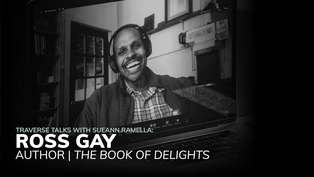
Poet Ross Gay - Conversation Highlights
Video has Closed Captions
Clip: 11/10/2021 | 3m 35s | Conversation highlights from poet and author Ross Gay on finding tenderness and delight. (3m 35s)
Providing Support for PBS.org
Learn Moreabout PBS online sponsorship












Support for PBS provided by:
Traverse Talks with Sueann Ramella is a local public television program presented by NWPB