Traverse Talks with Sueann Ramella
Poet Ryka Aoki
12/21/2021 | 43m 52sVideo has Closed Captions
Ryka Aoki On Culture, Transphobia And Giving It Your Best.
Ryka Aoki shares how growing up in the U.S., she has a hard time seeing what happens on a societal level, but still wants it to be better, as well as her personal experiences as a transgender woman. She talk about her experiences with people’s reasoning for their hatred, exploring nuance, and sharing personal stories. Ryka is a poet, author and winner of the Academy of American Poets award.
Problems playing video? | Closed Captioning Feedback
Problems playing video? | Closed Captioning Feedback
Traverse Talks with Sueann Ramella is a local public television program presented by NWPB
Traverse Talks with Sueann Ramella
Poet Ryka Aoki
12/21/2021 | 43m 52sVideo has Closed Captions
Ryka Aoki shares how growing up in the U.S., she has a hard time seeing what happens on a societal level, but still wants it to be better, as well as her personal experiences as a transgender woman. She talk about her experiences with people’s reasoning for their hatred, exploring nuance, and sharing personal stories. Ryka is a poet, author and winner of the Academy of American Poets award.
Problems playing video? | Closed Captioning Feedback
How to Watch Traverse Talks with Sueann Ramella
Traverse Talks with Sueann Ramella is available to stream on pbs.org and the free PBS App, available on iPhone, Apple TV, Android TV, Android smartphones, Amazon Fire TV, Amazon Fire Tablet, Roku, Samsung Smart TV, and Vizio.
Providing Support for PBS.org
Learn Moreabout PBS online sponsorship(upbeat music) - [Sueann] Is it too naive to think we all want to be good, a good kid, a good friend, a good partner, but what if there is abuse in those relationships?
In this conversation with Ryka Aoki, you'll hear how she navigated trauma, the facade of the nuclear family, and her identity as a Japanese-American transgender author and poet.
Listen for when she says, "This is about being the daughter I want to be."
Ryka is the author of "Seasonal Velocities" and "Why Dust Shall Never Settle Upon This Soul," finalists with the Lambda Literary Awards.
- [Ryka] I don't go out very much.
Then I realized I've not touched another human being since last March.
- [Sueann] Besides your mom?
- [Ryka] Besides my mother who I just kind of held back and forth and things like that, but no, nothing.
And it's what we do.
- [Sueann] You know, Ryka, I've been very thankful that I have two children and a husband that I can touch.
- [Ryka] Yeah, I know.
And actually you say touching my mother, but I mean, it really is when it's not necessary, I don't.
Because, God forbid, anything should happen, I try to stay completely isolated because I said if you need me, you will call, I will come over, I will take care of you and with no worry.
So I'm here, I don't wanna put you in any risk, but I just want you to know that should you call me to come over, I have you in mind and I'm doing anything.
- [Sueann] You're a good daughter.
- [Ryka] Thank you, I mean, I just wanna, I mean, that's my mom.
- [Sueann] How much of that do you think is your, I mean, you're of Japanese descent and I assume most of your culture is similar to Koreans, which is my mother.
That is a Confucius familial piety, so how much of that is just ingrained in your DNA?
- [Ryka] I think nearly a hundred percent, nearly a hundred percent.
I think that, if you see some of my writing, I do talk about abuse.
And my parents weren't always that great.
There's a reason that I left home as soon as I could, never came back.
- [Sueann] So how did you stay back in touch with your mom?
- [Ryka] Well, there were some times where I didn't, I lost a lot of people during the time of AIDS.
And even nowadays, you know, after I get off the phone with you, I could find out that a friend has died and it's like, oh crap.
And then I just go to my coffee and I keep going because I'm just expecting people to die throughout the year, because you're a trans woman of color and these things happen.
- [Sueann] We're really gonna dive into that.
- [Ryka] And pardon me to those trans women and those queer people who need to be separate from their parents, I'm not saying, and I don't wanna invalidate that.
However, as a Japanese woman, I've noticed it never ends well when parents die or children die before, there is not at least some sort of understanding.
It doesn't necessarily need to be a resolution, but some channel of communication with which you can say either I love you.
If I don't like you, maybe I love you.
If I don't love you, maybe I respect you.
I may neither like you, love you, nor respect you, but I will still care for you because this is my duty.
And at some level there needs to be something there.
And when I first was going back to see my parents, I did not really want to deal with them.
But I said, this is not about me and my parents, this is about me and the daughter I want to be.
- [Sueann] Oh, Ryka, this thought process you have, I feel our nation needs to think about deeply because we have an older generation who, well, is having a hard time adjusting to changes.
- [Ryka] And we will when we become older, and we have to have that kind of compassion.
- [Sueann] Yeah, but I also worry about when is it an unhealthy boundary?
I don't know if it's the Asian in us or the cultural understanding, even with our Hispanic brothers and sisters who have this family first attitude, even through trauma.
And there's some richness to that, but also it can be very frightening for others who are not used to that type of cultural understanding.
- [Ryka] And I think that that's one of the, I don't wanna criticize the country that we've all have some investment in.
It's very difficult for me to say something like down with the United States because that brings dishonor to my great-grandparents who came here seeking a better life, do I tell them they made a mistake?
No, because when I've been to Japan, I realized why they left.
It's a prosperous country now, but it wasn't always that way.
And it's not as if Japan doesn't have blood on its hands, a lot of blood, right?
But one of the things, if I may, as an American citizen who's an immigrant coming in, is I really think that we messed up when we started privileging the nuclear family.
When I think it became mother, daughter, kids, this pod in the universe, we forgot our tribes, we forgot our peoples, we forgot our aunties, our uncles, our great aunties, our calabash if you wanna think of Hawaii.
- [Sueann] I am so excited to hear you say that.
I feel as if we have this hyperindividualism that has gone way too far on the pendulum.
And the nuclear thought of the family, the burden is so heavy.
I love when they say it takes a village, but nobody has a village.
- [Ryka] Yeah, it's really, I think the problem with the United States, one of the problems, and again, and I know this sounds like I'm playing both sides, but there are both sides.
The United States is such a wonderful country and it's capable of so much more.
And I love this country.
But there are also some things that I find difficult.
And one of them is that because our system is based so much on turning a profit, there's always this feeling that you're being cheated.
When you buy a car, you always feel does the next customer get a better deal than you do?
And so there's always this mistrust built in.
So we have tightened our circle of who we can trust to the bare, bare minimum because we're so afraid of being betrayed.
- [Sueann] I'm speechless.
You have given words to some thoughts that I haven't been able to really solidify, as if there isn't enough for everybody.
- [Ryka] Yes, and I think that one of the things and one of the great illusions we have in this country is that there isn't enough for everybody.
And then this goes back to our own feelings of self-worth because we feel we don't deserve the abundance.
(upbeat music) - [Announcer] This podcast, like so many programs on NWPB, is brought to you courtesy of donors, people that watch and listen to NWPB for thought-provoking programs like "Traverse Talks," people who give what they can to pay for current programs and technology for future programs.
You can join them, donate any amount that is right for you at nwpb.org.
Thank you.
(upbeat music) - [Sueann] You had an interview a while ago and you mentioned not having a womb.
Do you really think that's necessary in order to be a woman?
- [Ryka] I think thinking about it had to be very necessary.
I think that, well, I'm 55 years old now, and whether or not I have a womb is a moot point.
And I guess at the end, you just age out of it and said, I must be a woman because what else?
I am me, I guess, there we are.
But I think this isn't specific to being transgender.
But I think that as transgender people, because of our journeys, our process of this, quote unquote, transition, we explicitly think about it more.
What does it mean to be a woman?
And part of it is, do I miss having the ability to procreate, to feel the experience of giving birth?
And I think I'll always wonder and I'll always ask myself, am I missing something inherent?
But then I look at somebody like, say, Senator Duckworth who is missing parts of her body that she actually sacrificed and gave up.
And I'm thinking none of us are truly this idea of complete, or whole, or ideal.
But that doesn't mean we can't be ideal paragons and examples for others to follow, we can't create, and we can't believe that maybe we can give birth to something that may not be what we expected, but it will be alive and we can love better anyway.
(Sueann laughing) - [Sueann] Ah, Ryka, I've done deep dives into many of your interviews and you've got my producers out upset, but just like feeling like a good poet would do, a good writer would do.
You have a poem called "A Letter Undelivered."
- [Ryka] Mm-hmm, yes.
- [Sueann] So that line in "A Letter Undelivered," "Would you love me if I was a girl?
"Would I love you if you did?"
Are you asking, do you love me for me, am I worthy of that love?
So many people don't feel like they're worthy of love and so we feel that whole.
- [Ryka] Oh my gosh, I think sometimes it even goes beyond that where it's not even the question that am I worthy of love, but it runs into, do you hate what you've become?
- [Sueann] Oh my goodness!
- [Ryka] And so what can sometimes happen is remember, I mean, I always tried to be a good kid growing up.
If you told me that I was going to be some sort of iconoclast, I would go, no, in fact, still I find myself very much, I might be transgender, but in a lot of ways, I'm a very traditional woman.
I actually do not identify as gender queer, but I know a lot of friends who do, and we're just clear of where our boundaries are.
And I know that gender is a fluid thing.
But I just happen to be very, very happy with she, her and we're done, and (speaking in Japanese).
So however, I think that a lot of people, when they become something that supposedly emancipates them, there is still this guilt that they betrayed the people who raised them.
They still betrayed their heritage.
I don't know if you're aware of this so much, but there's also these undercurrents in the Asian community about the Asian men and Asian women and the supposedly emasculation of Asian men in the society.
And there was a time when I asked myself as well, I'm I ,quote unquote, taking the easy way out.
Because I'll tell you what, sometimes growing up, to be dealing with what Asian men deal with every day is a rough road as well.
And I will tell you, people are a heck of a lot nicer to me now.
- [Sueann] Oh, wow!
Your experience in your life allows you to be very empathetic to different stages and roles and people.
And I never would have thought of that for Asian men.
When I think of Asian men I'm usually from the first world, so they're still in Korea in my head, and they're very much dominant, and they're very much in control.
- [Ryka] And they will let you know it.
- [Sueann] Yes, yes.
- [Ryka] And so having grown up seeing some of that, having grown up experiencing some of that, and yet kind of detached because I never felt I belonged in that dialogue, but I did ask myself, am I selling out my Asian American brothers by transitioning?
- [Sueann] Interesting, and what do you think?
- [Ryka] I'm thinking at the end of the day, to sell out means they owned you at one point, and one owns oneself, your presence, not my presence, Ryka, but your presence as human being, your presence is a gift, it's not an obligation.
- [Sueann] Speaking of gift, when we think historically, Ryka, about, I hope I can say third gender and not offend anybody, but I've always been curious about this other or cisgender, so there's always been men who've played theater as women and socialized as women, and that was accepted in the past before many Western cultures colonized areas.
And you are of Japanese descent where there was tradition of men playing in theater and also socializing as women, so can you speak on that third gender and how it existed, and maybe how you feel spiritually connected to it without the lens of the Western culture that we live in?
- [Ryka] I think that a couple of things are going on here because this is a really deep question.
So the first thing is a lot of times I'll hear people bring this up, trying to explain a way the concept of being transgender, that you're really a man who is touched by this third gender and things like that.
So we have to be careful not to invalidate the very real experience of being transgender.
That being said, there are a couple of things that are, having been transgender and having continued to walk this path, I do have insight into sort of an array of experiences that somebody who is cisgender may not have.
I've also had to think about not having a womb, not having the plumbing, having this plumbing, not that plumbing, and how do I feminize that?
And so this gives me a much, I think, more studied viewpoint on what it means to be human, what it means to be male, female.
And when you have that kind of perspective, it almost seems like your other because you're coming from it from a completely different way.
Now, there are some people who really honestly have third gender experience.
I'm not going to speak about them because, in fact, you should interview some and we should all here.
But I would say there are some transgender people just like me who didn't have access to Kaiser Permanente, and getting their hormones, and getting everything right.
And this was the best they could do.
And they realized, I think many of them, that society would never accept them as they are.
So what could they offer to society?
And so I think in a lot of ways, much of this magic and mysticism, and I don't see mysticism in a bad way, much of this, seeing the other world, seeing the world behind the world, understanding the ancestors, because now you have time to understand the ancestors, what that means to you.
This is actually trans people, queer people, giving back to the community what they can contribute.
(upbeat music) - [Announcer] News happens fast and often here in the Pacific Northwest.
Make sure you never miss a news headline by following NWPB Broadcasting on Twitter, Classical Music News, then follow NWPB's Classical Twitter account by searching for NWPB Classical.
(upbeat music) - [Sueann] When did you realize you were a girl?
- [Ryka] Well, what do you mean by realize?
You see, that's a whole other ball game, right?
One can know something is wrong- - [Sueann] And not have the words or the knowledge yet to.
- [Ryka] Yes, so I have to thank the younger ones.
I have to thank the people who did a lot of hard gender work coming up with all of this vocabulary.
I didn't transition in my teens, I transitioned later.
I mean, I've been Ryka for a very long time, but that isn't about me transitioning young, that's about me being older.
And there's this scene, and I don't want to conflate the two, but there's this scene about Helen Keller, where her teacher, Ms. Sullivan, taps out water, putting her hand under this and tapping up water, putting her hand, tapping on water in Morse code.
And suddenly she made that connection that what she was feeling had these words attached to it.
And that's exactly how I felt when I realized that there was this thing called transgender, gender queer, and that was me.
This was the water that I, this thing that I had been feeling had this name to it.
And I seriously remember that time, I just boom.
I sat down in my apartment, I was just sitting in the corner and going, whoa, that's me.
And then I thought to myself, my life is going to get so difficult now.
- [Sueann] It's like you had an answer but the answer was not easy.
- [Ryka] Yeah, the answer was gonna take some work to get the benefit from.
There was a learning curve that was gonna happen.
And, you know, also, because what ended up happening was growing up, we had been aware of people who are transsexual, but they were all white.
It was that thing that the white people did.
You didn't do that, you are Asian, pardon my language, but that's kind of the way we're feeling.
And that's weird, that's white people just doing that, and you think about all the androgynous people you saw on TV, everybody from David Bowie to Lou Reed, they were white people.
We didn't have YouTube back then, that's what we had.
- [Sueann] Right Ryka, which I think is great for the younger generation who are looking for others like themselves.
But as I look to history, there have always been transgender people without the word, people who were born in a body that didn't match who they were inside.
And how did we lose that knowledge?
- [Ryka] We came from a country that the United States was settled by Puritans.
And they came over and they dominated.
And they had trans people and they had queers just like anybody else did, but they also had the social mechanism to suppress it.
And so when the other countries like people who were coming here to see Gold Mountain, they want to be American.
If you were Onnagata in Japan learning, you're not gonna come here and do that because you had this other culture that you had to simulate, not just for survival, but out of a misplaced admiration.
- [Sueann] The admiration.
What do you think they were admiring?
- [Ryka] They were admiring the United States.
They were admiring this prosperity.
They were admiring the American dream.
Later on when we had, were exporting culture, they were admiring Farrah Fawcett.
American culture is a really seductive thing.
It continues to be a very seductive thing.
It's only been recently with YouTube and things that we figured out, the K-POP is pretty cool too.
- [Sueann] I'm so glad you mentioned that 'cause I was, my daughter's only 10 and she's so into, which I'm very happy about 'cause she knows more Korean than me now.
But I guess I've always loved this idea of other cultures coming into the United States.
I visited Europe once a long, long time ago and I was mesmerized that on the radio in Switzerland were songs obviously in German, but also they were playing French songs, they were playing songs from India, and it blew my mind.
And that they were so inclusive of these other songs 'cause they just liked the music and the words and the meaning.
And they were challenged by maybe even looking it up and finding out what the lyrics were.
But in the new United States, it seemed we dominated so much, I guess we thought we were it.
And yeah, I feel like we're kind of gap that.
- [Ryka] The other thing is the United States is still in its adolescence as a country.
And when you're adolescent and you are some of the most homophobic places you can be is a high school locker room.
I've been there.
And that's not a fault, it's people trying to figure out who am I?
And there's this fear of not being enough, or not being somebody, or where do I fit in?
And I think it's a very healthy thing.
We can't tell students not to be students.
We can't tell our youth not to be youth.
It's a very, very necessary part of growing up.
When I teach my English one class, not that they're in high school, but during the homework I say for these, for some assignments, you're getting perfect credit just for trying, because this world needs a place to give you that you can make a mistake and it's okay.
- [Sueann] I like that.
- [Ryka] And we need to, I think a lot of times give people a place where it's okay, but the problem with the United States is we happen to be in adolescent with nuclear weapons.
A lot of us are giving people who are going through some of the worst stages of their lives guns.
We should be giving guidance.
We should be giving understanding.
We shouldn't be giving bullets, we should be giving ears, we should be listening.
We should be giving compassion.
Not just words, but actions.
We should be giving every way that a village raises the child, we should be raising the child.
- [Sueann] And yet the village in the United States isn't there.
- [Ryka] No, but it is there.
There's a diaspora.
It's in us, it's in the immigrants who remember the village, it's in the queer people who've had to find family.
What do you think that was but finding the village.
It's why our literatures as Americans, our contribution as people who might have been marginalized, it was into the margins that the village fled and it is from the margins that the village will be restored.
- [Sueann] Hmm, I'd like to see that, that sounds good.
Why do you think there's so much anger, speaking of high school locker rooms, and I know earlier you mentioned because we become things we don't like, is that related to the anger toward trans women and the violence?
- [Ryka] Well, what ends up happening is, like when somebody says something transphobic, is this really about me?
They don't even know me.
I think it's saying something about them, that my existence causes them to question themselves or to in their own way.
I might represent something that may be somebody assigned male might never want to be because that would mean they would lose the respect of their family, of their friends.
And if they told me that, I'd say, and so you think correctly, I've lost a lot.
But there's this fear.
And the other fear that happens is the fear that somehow I cheated the system, that I got away with it, that all of these things that are holding back, now I can be free.
I've run into this with a couple of students where they've resented me, not because I, well, I shouldn't say resent, that's a strong word, but they had their doubts 'cause they're students.
But queer presence, it's like you guys got out easy.
Because I've got this to live up to, and this to live up to, and this to live up to.
I ran into this sometimes.
And you think, wow, I so was not thinking about you when I started taking hormones.
But what ends up happening is you realize that there's all this fear.
And it's not just that, it's this fear that's, it's happening to the women who are in Congress, it's happening with Kamala Harris where somehow you must've cheated to get to where you are.
This fear that somehow the reason you're this way was somehow I have failed I being the person who's perpetrating the hate.
- [Sueann] This is a lot of insecurity.
- [Ryka] A lot of insecurity.
And tell me something, how on earth are they supposed to be secure?
We live in a country with no universal healthcare.
We live in a country where there's just so many ways to f-up.
So we when we start talking about people being insecure, I'll turn that around, how on earth are they supposed to be secure?
- [Sueann] Ugh, amen, oh my gosh!
- [Ryka] So of course at that point, if they bash me, then the bashing becomes my problem.
So yes.
But then we can make rules to stop hate crimes.
We can make rules to stop these sorts of things.
We can increase the penalties, which are all good by the way.
We can make it illegal for discrimination in the workplace.
All of which is good, all of which is necessary.
That all addresses me getting hurt by walking down the street, but it doesn't address the underlying fear in this country and we do need more security.
The weirdest thing is a lot of times the people who are nicest and most open-minded to trans people are the ones with the least to lose.
- [Sueann] Can you explain that a little more?
- [Ryka] Sure, when I was going to grad school, it's like professors with tenure, they don't care.
They go, that's really neat.
- [Sueann] I see.
- [Ryka] Because my existence has nothing to do with their- - [Sueann] Gain or- - [Ryka] Continued gain, or loss, or validity.
- [Sueann] Reputation, or.
- [Ryka] But when it comes to people who are worried about that and for a good reason, that's where we run into trouble.
And that's why transphobia is not a white thing, it's not a black thing, it's not an Asian thing, it's not a brown thing, it's everybody who feels our presence is offensive to them because it reminds them maybe of what they've lost to what they could be.
And all of these things we're uncomfortable.
Our presence makes people uncomfortable.
- [Sueann] Ryka, what is it like to have such a freaking heavy burden of being the symbol for people to work out their emotional insecurities and fear with?
- [Ryka] Well, I think that one thing is that I have been really blessed to be a writer.
It allows me to feel that no matter what is happening, I can use it to teach.
It's not just that I'm a writer, I tend to process the world not in an adversarial way, and think what can I teach the world, what can I learn from the world?
- [Sueann] Does that exhaust you?
- [Ryka] Yes, but it's better than the exhaustion that I would feel by feeling afraid and hating all the time.
The world's an exhausting place, life is exhausting right now.
And if you're exhausted, I feel for you.
And I honor that exhaustion.
- [Sueann] There's really just a giant shift in our society where it's as if our eyes are slightly open now, we're noticing that there are other people, and other ways of feeling, and other ways of being, and it's all okay, if we are, I guess, empathetic enough to know that if we accept others and we ourselves are accepted.
But there's this whole generation, maybe I shouldn't say generation 'cause it spans that.
So people who are like, that's enough with the soft accepting talk, buck up, let's just move on.
But I often question, what is it that we're moving on with?
We don't all have the same directive anymore as Americans.
- [Ryka] Well, I think that there's a way to have a common culture of urging people onward without any consensus on what onward is.
- [Sueann] Really?
- [Ryka] Really, really, I want people to disagree with me.
I learned that way.
- [Sueann] That's good.
- [Ryka] And so I think that we can tell everybody, I tell my students in my writing courses, I don't need to agree with you, but if you can put in the love and the time to make me understand where you're coming from and to say it in a way that's artistic and beautiful, I can always respect you.
- [Sueann] Yes, respect.
- [Ryka] Respect and trust.
One thing we can trust each other in is, in Japanese, the one thing we're always telling everybody, (speaking in Japanese) which means give it your best.
- [Sueann] Good try, I did my best, yes.
- [Ryka] I did my best.
And I think I would love to see some of that in the United States.
We say, get her done, which is a really good thing to say, I wanna see more of that.
I don't know other people well enough.
I don't even know myself well enough where I'm going to be tomorrow.
Who am I to tell people what to believe?
All I can say is let's articulate what we wanna say, but also take the time to listen.
And then even beyond take the time to listen, take the time to encourage.
- [Sueann] Yes, the encouragement, I hope is happening in school.
But I remember watching a show where a student had to go up to the front of the board to complete a math problem.
And there are two different versions of the story.
One where they didn't get the answer right and they were shamed.
And the second where the students were saying, you can do this, and think about this, and they're encouraging them to find the answer.
And when they did, they all clapped and cheered for the student, they all were happy that that student figured it out instead of being shamed.
- [Ryka] When I'm listening to you talking to that, I go, oh my God, you sound so Asian.
(both laughing) But when we think about this, in Asian purgatory, Asian hell, the whole thing is be punished for your sins and learn your dang lesson so the next time you're incarnated you don't make the same mistake again.
Whereas in Christian hell, you're punished for all eternity, with no hope ever to escape.
- [Sueann] You're done, it's over!
- [Ryka] It's like, bye-bye, it's over.
- [Sueann] What a burden!
- [Ryka] And so I think that we have, if you grew up with any kind of Buddhist heritage, you have, or any kind of Confucian heritage, or any kind of Taoist heritage, we have a different relationship to the concept of eternity and to sin than some of our Western fellow citizens.
We didn't have the garden of Eden.
We didn't have that kind of original sin.
And when we think about that, we need to understand that that's the paradigm with which they're operating.
And we have to understand where some of this overt fear comes from.
They really think they're going to lose everything because that's culturally what they believe in.
And who's to say what's right?
I don't know the mind of God, I'm just saying that's where they're coming from.
And I prefer my way, but why wouldn't I, it's the way I know best, but it doesn't mean that's a better way.
I think that what we have to do though is understand that people are coming from different directions.
And I think that that's why being a woman of color, being an immigrant, being anybody who preserves our old traditions, this is part of what made the village the village.
(upbeat music) - [Sueann] You spoke about moments in another interview, and you are assertive and that others then put your femininity into doubt.
How can women be assertive?
- [Ryka] I don't know.
I think that it's something I struggle with every day.
One thing that I do is I don't think about it is so much now as being assertive.
I think about that one woman who, that one girl who finds my work in the library and it speaks to them.
And I will do things for her that have nothing to do with being assertive.
It has to do with me reaching out and saying, I love you.
- [Sueann] That's powerful.
- [Ryka] And then if people say I'm assertive or not, at that particular point, I can endure all of that because there's somebody who might need me, and I'm going to be there, and I'm going to say thank you, I'm here.
- [Sueann] You're really putting a lot on the line there though with being so vulnerable and open with your poetry and your words, how do you cope with being so vulnerable?
I mean, society here is like, yeah, you don't show your cards like that.
- [Ryka] I'm queer, people have said things about me all my life.
Even before I came out, people could smell blood.
I was bullied, I was victim of child abuse.
I'm used to this.
So it's like kind of like, let the experts take care of this, I know what I'm doing.
I'm being only slightly facetious here.
There are some times where when people say I've decided I'm trans.
A lot of times, my first thing is like, yay.
and then inside, I'm thinking ah, are you sure you really wanna go through this?
Of course, a lot of times they do and we're gonna celebrate, but it's like, this is not easy, not easy.
So I have on my window sill, I am growing green onions, and it's raining right now and they're sprouting.
And sometimes every morning I'll chop a couple onions and mix it up with my eggs.
What I mean by that is we have to learn to take what validates in our firms, our existence in this world from sources that maybe most people ignore, maybe are too small, maybe are too delicate, maybe are too ephemeral.
When somebody says hello to you, you really take it in.
This interview that I'm having here, the look you have on your face right now that people on the radio can't see, but I can, I will hold that image and it will sustain me.
It reminds me that we're gonna be fine going forward.
I also love astronomy.
I love to thinking about the galaxy and thinking about how small we are as humans because it makes me feel, you know, Ryka, this is all really, really rough right now.
But look at that, come on, girl, keep going.
- [Sueann] Girl, I don't know what you have as far as spirits, but it's coming through this video.
(both laughing) - [Ryka] Sorry.
- [Sueann] Don't worry.
What this is is authenticity, I feel you.
And it's not just your body or the way you look, it's something in you and your heart.
- [Ryka] Well, I mean, tomorrow, we're not gonna probably see each other or talk to each other.
So we have to make the most out of this time, don't we?
- [Sueann] Yeah.
Your vibe is beautiful.
- [Ryka] It's probably 'cause I'm reflecting you, I'm reflecting the readers who read my work.
I think about everybody, I love watching people.
This is one of the things I miss the most about coronavirus.
I would just sit and just watch people and think, gosh, how lucky are we to be on this planet together?
And I'm serious about this.
And so one of the hardest points is just not being able to just see people being folks.
- [Sueann] 'Cause we learn from them and we learn more about ourselves, right?
- [Ryka] Absolutely, absolutely.
One of the hardest things about being transgender and talking to people about being transgender is, or one of the biggest misconceptions that I would like to correct is this has nothing to do with being an ally.
I don't need allies, I need friends.
- [Sueann] Okay, you're saying we don't need allies, we need friends.
- [Ryka] Well, I'm saying I don't, I'm not gonna speak for every trans person.
So this is just Ryka Aoki speaking for herself.
But let me tell you what I feel.
I don't hang out with my doctor.
My physician and I, we don't go have like tea and chit chat about life.
I don't confide in my writing students, my students in English one, my role is to help them to be their ally in their education.
My doctor is my ally in keeping my body healthy.
But none of them are people that I think would be my friends, friendship comes from a different place in giving service and out of duty.
I think a lot of people want to be a trans ally because it's the right thing to do.
And then the question is, well then, but do you like me?
Do you like the music I like, can we, I mean, if I call it the one day and I say you got to hear this, are you there?
- [Sueann] Yeah, can we just be together as humans?
- [Ryka] And I think that a lot of times, one of the mistakes I see people make is they come in thinking they want to help a, quote unquote, community.
And when they do that, they put themselves in the position of a caregiver.
And when they leave, it's still a professional relationship and you have that perceived feeling that they're not still wanting to risk the intimacy of friendship with you.
And to a group, that feels like they're dehumanized anyway.
This is not always the most helpful thing, shall we say.
- [Sueann] Speaking as a half white person, I have a feeling many don't even know how to find friendship in these, quote unquote, other communities, because they've been separated.
- [Ryka] Well, I think, yeah, I think we have been.
And COVID is probably not doing very much either to make life better, but I think it's an attitude that you just kind of wanted to just keep passively.
And when it happens, you're open to it.
It's not like any other friendship, gosh, I'm going to reveal that I'm a complete nerd.
There's this Japanese Annie Mae about this young girl with really bad social anxiety.
It's called hitoribotchi, which literally means alone.
And her job is to make friends.
So her goal is to make friends.
And she obviously offends a couple people because, oh, you're my friend, I can check this off now, now you're my friend.
She means it with all, all the best intention, but obviously this isn't right.
And the way she ends up making friends is despite those actions, not because of them.
And I think that I wouldn't worry about making friends with trans people, trans people are part of your world.
And you might find some you don't like, that's okay.
I know plenty of trans people, some of us are unpleasant.
(laughing) Maybe they just are to me, maybe they're great with others, maybe they just, but what I'm saying is we get to be people too.
- [Sueann] Yes, and this is interesting, I'm so glad you brought it up because, and I want you to forgive me too for saying this 'cause I'm learning as we go along in this cultural shift that I feel a lot of things we're doing are out of white guilt.
And when we do things out of guilt, it's misplaced or not thought through completely.
So part of that is this rush to find my black friend, find my Asian friend, start eating different cuisine.
Okay, 'cause they want to absolve the past sins.
- [Ryka] I mean, if you want to really be my friend, don't try to make ramen and tell me how to do it.
(Sueann laughing) The other thing about being an ally is you're assuming the other person needs your help.
And no, I need you to take care of yourself and get, for a lot of people who are trying to help, it's like your help is actually not the most productive thing.
You know what I'd like a white person to do, like a white person to say why don't you come visit my neighborhood, I'm gonna show you where, like when I'm touring the country, when I used to barnstorm and tour the country.
And we'd go to these places and it's like, I don't wanna to the Chinese restaurant, I wanna try the casserole.
It's like the vegetarian pizza where we're having a pizza party and there's one vegetarian pizza, one pepperoni pizza, one sausage pizza, everybody wants to try the vegetarian pizza and suddenly the vegetarians don't have any vegetarian pizza left.
- [Sueann] Yes, as a person with food allergies, I always wonder this, why does everybody want to eat my stuff when they can eat the milk?
- [Ryka] Yeah, because, well, one thing is, they're curious.
Two, they want to seem relatively like I'm down with the vegetarian, so I'll think some of this too.
Yeah, and there's all this kind of like awkwardness and offense that can happen because eat your stuff, and I'll eat my stuff, aren't we the same?
It's like, no, I have a food allergy and you don't.
- [Sueann] But be considerate, like try a bit, but not the whole thing.
- [Ryka] And I think that when your ally, when you come in with allyship, I think you forget that.
But if you come in there with friendship, I think you can use your empathy a little bit more.
- [Sueann] And learn.
- [Ryka] And learn.
- [Sueann] And humility too, like, ah, I'm so sorry, I didn't mean to offend, and I didn't think about that.
Thanks for telling me, so now I will grow.
I don't want to let you go.
Well, I'll be in touch with your writing, I don't know if you keep track of your Amazon downloads, but there's definitely quite a few in the last two weeks.
'Cause I was like- - [Ryka] Wow, I thank everybody for that.
I mean, really again, I feel so lucky, lucky, fortunate, grateful to whomever created me that I could write.
And I just want everybody listening to know that I'm so grateful.
And when I do write, when I do have my pen out and I'm even writing my first draft, I'm thinking, is it good enough for you?
I don't take what I do lightly.
I don't feel I ever deserve my readers.
I feel every time somebody reads my book, it's a gift.
And I just wanna stay as corny as this sounds how much I love you.
- [Sueann] Thank you so much.
- [Ryka] You're welcome.
(upbeat music) - [Sueann] There are some connections you have with people, however briefly, and they stay with you for a long time.
And that's what it felt like being with Ryka.
If this conversation with her enhanced your being, check out her books, "Seasonal Velocity" and "Why Dust Shall Never Settle Upon This Soul" at an independent bookseller near you.
And thank you for listening to "Traverse Talks."
I'm Sueann Ramella.
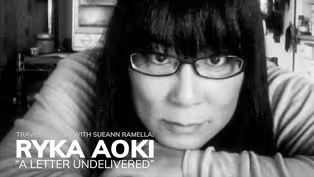
A Letter Undelivered by Ryka Aoki
Video has Closed Captions
Clip: 12/21/2021 | 5m 5s | Poet Ryka Aoki reads her poem "A Letter Undelivered" from her book Seasonal Velocities. (5m 5s)
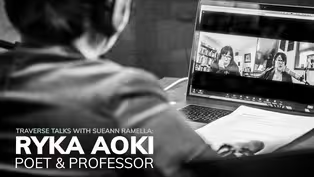
Poet Ryka Aoki - Conversation Highlights
Video has Closed Captions
Clip: 12/21/2021 | 3m 50s | Conversation highlights from Japanese American poet and professor Ryka Aoki. (3m 50s)
Providing Support for PBS.org
Learn Moreabout PBS online sponsorship













Support for PBS provided by:
Traverse Talks with Sueann Ramella is a local public television program presented by NWPB