
To The Point with Doni Miller
Police and Community Communication
Special | 26m 46sVideo has Closed Captions
Earl Mack and Doni discuss the dialogue between law enforcement and the communities they serve.
Earl Mack, president of the Toledo Buffalo Soldiers, discuss a recent town hall that brought police officers and community members together for a conversation about trust, understanding, and collaboration. He shares why open dialogue between law enforcement and the communities they serve is important and how conversations like these can help identify common ground and meaningful solutions.
Problems playing video? | Closed Captioning Feedback
Problems playing video? | Closed Captioning Feedback
To The Point with Doni Miller is a local public television program presented by WGTE
To The Point with Doni Miller
Police and Community Communication
Special | 26m 46sVideo has Closed Captions
Earl Mack, president of the Toledo Buffalo Soldiers, discuss a recent town hall that brought police officers and community members together for a conversation about trust, understanding, and collaboration. He shares why open dialogue between law enforcement and the communities they serve is important and how conversations like these can help identify common ground and meaningful solutions.
Problems playing video? | Closed Captioning Feedback
Where to Watch To The Point with Doni Miller
To The Point with Doni Miller is available to stream on pbs.org and the PBS app.
The views and opinions expressed into the points are those of the hos of the program and its guests.
They do not necessaril reflect the views or opinions of public media.
Today, on to the point.
The historic Buffalo Soldiers of Toledo and Northwest Ohio brought police officers and community members together for an important town hall conversation focused on trust understanding and collaboration.
As communities across the country seek stronger relationships between law enforcement and the people they serve.
The aim of this event was to create meaningful dialog and identify solutions that benefit everyone.
Commander and president of the organization, Earl Mak will share wh these conversations matter now more than ever.
Stay with us.
I'm Donnie Miller, and this is to the point.
Connect with us on our social media pages.
You know that.
You can email m at Donnie underscore Miller at and for this episode.
In any other additional extras, please go to.
To the point.
We are so lucky.
Today we have one of the preeminent social activists in Toledo, Ohio with us this today.
And that would be Mr.
Earl Mac, who is the commander and president of the Buffalo Soldiers of Northwest Ohio.
Is that correct?
To Buffalo Soldiers, correct.
Toledo.
Buffalo soldiers.
Well, thank you for being with us today.
You guys are always busy.
You're always busy.
But for folks who have no been able to keep up with you.
Why don't you tell us a little bit about the purpose of the Buffalo Soldiers?
Well, the first purpose is to represent that great history of the Buffalo Soldiers from 1866.
The cavalry and infantry, and what those soldiers did out of 60 regiments, six of those regiments after after the Civil War, were all black soldiers.
And they were detailed to help win the West first Border Patrol, first U.S.
marshals.
And you can imagine black soldiers being U.S.
marshals in the 1800s.
Yeah, it was a tough job.
First.
Patrol of of all the all the national parks, the career park and and and just from there, just done lots of community service.
And so what inspired you to start this organization?
Well, I'm ex-military, and I learned about them.
I was once the Ohio Homeland Security deputy director.
Yes.
And I learned about them during that period of time.
And I write motorcycles.
I know.
So so I was in Enfield, Connecticut one day and seeing some Buffalo soldiers on bikes there.
And I got to talk to them and they were from Ohio, and I just became very interested in it and went and done some research and came back and said, I would like to be par of this organization.
Here I am.
You do a number through through the Buffalo Soldiers.
You all do a number of community activities.
And, you know, for a number of issues, we're going to talk about one of the issues that I kno as a personal passion to you in just a moment.
But feeding veterans, for instance, I was lucky enough to work wit you on on one of those events.
It was wonderfully fulfilling and so necessary.
The feeling of the veterans is on Veterans Day, and we feed those shared in veterans because we seem to forget about them.
Yes.
And so that's a great program for us.
And one of our highlighted programs is what to do and stopped by police.
And we have a stage prop car that we use to put four kids in the car.
And, and we go through role playing.
And that's very interesting.
Yeah, it's very it's very fun for the kids and it's a learning experience as well as to what to do when you stop by the polic and then and then our Angel tree operation during Christmas time we last year we done over 400 single families of kids where our supporters will go ou and buy three of their wishes.
So kids give us three wishes and and the supporters buy one, two or all three of those wishes.
And we and we deliver those toys, you know, to them all the way to to our school operation programs where we talk about bullying in school, which is.
Huge, right?
Oh, yes.
And that our, our gun program, which is the Eddie Eagle program, it teaches kids to stop, don' touch runaway teller grown up.
If they see a firm and we and we do that with those grades, kindergarten through the fourth grade.
And you won't believe what how that affects those kids and how the kids affect us with all the firearms that they see out there.
It's amazing.
Right?
And so we try to do those programs.
That' at the heart of the community.
Why did you think this kind of event.
It's not your first time either.
As I understand it, this is more like your third, the third event that you've hosted.
Why do you think it's necessary?
Well, you know, the community needs to understand the police and the police need to understand the community, especially nowadays with a lot of retirements, a lot of our senior people are retiring out and a lot of being replaced by by younger officers, and they need to really know them first of of how you feel in order for me to service you as a community person.
And so we get into tha because there's so much conflict between, especially in Toledo now, between police and the community.
So it helps both sides to understand it's the two prone problem that we have.
And so we deal with it first by dealing with the community and having a forum.
Yeah, to bring them together to a conversation.
And the second phase of that is is a cultural competency for police officers.
There's nothing but police officers in phase.
And we talk about what makes you work.
How do you look at the community.
You know, what your biases are.
You know what you know.
Where you've been raised will affect how you please an area where you know nothing about.
And so I think those those two programs are very important to keep community police relations positive.
Yeah.
I want to talk about that cultural competency piece a little bit more in just a moment.
But but first, just some context, it feels like police and community relationships are worse than they've ever been.
That's what it feels like.
How did we get here?
What went wrong?
Well, I think some of that I believe though, because we have over this city, we have over 600 officers, 650 officers.
And if 1 or 2 of those officers does somethin that's against policy, against law towards the citizen, it seems like you take a brush and paint the whole police department that way because because they're connected to the police department.
So, so we, we, we try to deal with those with those single issues right now and we talk with the police chief and those those command officers that that's over those, you know, in a particular operation.
Because for us, I believe in secession and control.
Meaning if I'm a supervisor and you're my subordinate and I supervise you, that whatever you do falls on me as well.
Yeah, sure.
And so we we try to make sur that, that the police department understands in order to, to put those things in check.
We have to put those supervisors in check to, to make sure that they're doing the correct job that they're supposed to be doing.
But the biggest problem I see, though, we're getting younger and younger officers in.
I was just going to ask you about that.
Yes.
And they don't have th experience that we used to have.
And we're not we're not I don't believe that that we're training officers the way we used to train them because of budget crunches.
Yeah.
When I, when I talk to some.
Please, please.
Cheese.
You know the state they said, you know, Earl, it's hard now because of budgets.
And so they don't get the kind of trainings that they need.
They need those trainings and always say this to, to an officer because I've been a supervisor of officers for, for many years, is that if we can't change you or help you come to the realization that what you do psychologically affect that community and how you come on board with the baggage you have, if you can't, you know, be that kind of officer we need in that community then you had to follow policy.
I don't care what's in your heart.
Here's what the policy says.
And if you like this policy, then you need you need to be corrected on this policy and and discipline for that violation.
And does it the what we seem to see and and I would agre that sometimes it's really easy to take one even and and lay that on everybody.
That happens in a lot of different circumstances.
But what we do see when we watch these events on TV is an aggression toward citizens that seems to be, in some cases, unprovoked or provoked with only moderate reason for that.
Again, do you think it's the inexperience of the police officer?
Well, it's the inexperience and it's the baggage that they carry from from how they were raised.
So your cultural this is where your cultural competency program comes in.
Yeah.
Because a lot of times as police officers come up through, you know, through the ranks, if they carry that baggage with them, they think what they've heard Mom and dad say, they think of what they see on TV.
Yeah.
Is the realization in some of those communities in us not.
And so that's why competency is extremely important.
But it's also important for the citizen to understand too, because we don't give the citizen a pass as well, is that you need to raise your children to, to to to not violate laws.
And when a police when police officers approach them sometimes it' it's it's the saying of comply now complain later because you'r not going to win on the street.
And so how we do in talking with citizens, especially our young people is that comply.
Now even if you think that officer is wrong, comply keeping them to a record of it and then complain about it, go to the to your parents, to your school teacher, a principa and let them know what happened.
And let's deal with it that way.
Instead of having a confrontation on the stree because you're not going to win.
And do, are you hopeful that programs like your and this is an obvious question.
Programs like yours can bridge this divide because in fact I want you to think about this while we go to break.
You've got a huge divide here.
You've got inexperienced officers coming in.
You have an angr or what appears to be an angry or more resistan set of especially young folks.
And when they clash, there's going to be an opportunity for it not to go.
Well.
I want you to think about when we go to break, whether these programs really have an opportunity to make things better.
Okay, you stay with me.
We're going to go to break right now.
We will be back in just a few seconds.
To me, community means connecting to others.
I'm Donnie Miller and welcome to the point.
I love the FDA.
We're community.
Committed to education, discover new ideas, dive into exciting subject, and engage with the world around you.
I would send them personally a t shirt.
Crim doesn't pay in the old West End.
Pass it on.
That's how we cleaned up the neighborhood.
Vision loss for people is not the end.
It's a story.
It's the next chapter.
Public media invites you to get out and play day.
The 419 7 a.m.
on YouTube.
3 p.m.
on FM 91 and 6 p.m.
on connects.
It's the 419 powered by GT.
Wagt.
Where you come to watch, listen and learn.
Connect with us on our social media pages and you know that you can emai me at Don underscore Miller at.
And for this episode and other additional extras, please go to.
To the point we have Earl Mack with us.
In case you missed the first half of our show, we have Mac with us, who is the commander and president of the Buffalo Soldiers of Toledo in northwest Ohio.
We're talking about a series, actually, of conversation that the Buffalo Soldiers have started, and it's an ongoing program for the Buffalo Soldiers to have community and police better communicate with the hopes of making those relationships better, better relationships.
So is there obviously there's hope that these program are going to make a difference.
Do you see a difference happening?
This is your thir community forum on this issue.
Do you see a difference?
We do.
And in this being the 31, it's been, you know, years in between.
And so and so these kinds of progra programs are should be constant because you have new you have new players, you have new new police officers, you have new, you know, kids growing up into teenage hood and the and then into it into adulthood.
So these programs need to continue so that we can keep the respect of both the community towards the police and th police, towards the community.
Sure.
So when you're when you train in cultural competency, the idea is to make folks more comfortable with neighborhoods they might and people that they might have misconceptions about.
Is that is that correct?
Correct.
And it's mostly to to get in touch with your own feelings.
Okay.
How you've been raised and your biases, because those biases that you have, especially as a police officer, will affect how you police in that community.
Those perceptions you have of of that community can, can then play int how you police that community.
And we see that often here.
And so that culture competency again is to so those officers get in check with themselves and then and then lear how to treat a community, learn how to to treat those people that that you police.
So what do you what do you hea most often as the biggest myth that police have about community and then what community has about police?
Well the both of them have the same.
Sometimes a lot of times.
Really?
Right.
That police officers think that that when they go into a particular community that all are the same, you know, the bad guys are here and now the bad guys are everywhere, just like we just heard recently of this, of a police officer saying, you know, you live you live in a community like this.
And it's not my fault you live in this neighborhood, right?
Yeah, yeah, yeah.
And the same thing with wit the perception of the community, you know, we see things on TV happen and we see things in other communities happening with police officers that misuse your citizens.
And you think these officers do the same?
So there's a procession on both side that we have to keep in check.
And we tell the community, you know, get to learn that officer themselves.
Now, if they'r if they are the kind of officer that should not be in that community policing and they need additional training and help, then you make complaints, right?
Because the department can' do anything if they never hear, you know, how their officers are out there doing.
And sometimes people are telling us, oh, there's no use of complaining because nobody's going to do anything.
Yes it is you know, make those complaints because then we can go back and look how many complaints that this officer has had in any particular community.
And we can address that as well.
But, but, but just knowing some of the, some of the command officer in the top, officials of those police department didn't want their bad community.
They don't want their community against their police officers because it's dangerous for both of them.
Absolutely.
It's dangerous for peace officer to to to then have to deal with you, you know, in a in a strong hand that could cause you to lose your life.
And it's dangerou for for again for peace officer to deal with community.
Make them so upset til you can lose your life as well.
And I want to repeat this particular phrase that I've heard you say a lot over the years, and that is comply and complain later.
I know that makes people angry, and I know it's not what they want to do, but as we've seen, not doing that escalates.
Correct.
And and it doesn't end well.
Yeah.
Stockton.
Yeah.
We we have even adults that come to us and say, well why should we comply?
Right.
We think that that officer is wrong or what they're doing wrong and so forth and so on.
Well, it's because an officer carries something on his side that he has.
He may not have have the have that right to take that life, but he ha the ability to take that life.
And so and so we want them to, you know, to take a look at that.
Let's on both sides become especially the the community, the citizen.
Think about what you're doing.
If again if that officer is wrong then complain about it to where those complaints go whether it's internal affairs, whether you call the mayor's office, you know, whether you call the chief.
But the fight is not on the street.
Right.
That's a really, really good point.
I remember a long time ago and you will remember as well, when there were neighborhood, remember the neighborhood policing career?
I remember looking out my window and seeing two policemen walk down my block and feeling pretty good about that.
You know, feeling pretty good about that.
Do you think the removal of those kinds of programs has widened the gap between community and the police department?
Oh, I sure do.
There's an officer below that.
I just love this guy.
And I used to interact with him when he worked the street and he would walk a beat.
The community, the kids knew him.
Some of those officers that walked that, that beat, you could see them out playing basketball, basketball with the street, basketball in the street with the kids.
And that develops a positive relationship between that chil and that police officer, which if you develop a good relationship, positive relationship with someone, you're less likely to do somethin that's going to be against that, you're more likely to listen.
And so so I really miss those times that we had those officers that walk that beat because in the neighborhood got to know him to the, you know, they gave them their cell phone number.
Something happens.
You need to just call me, even if it's confidential, just call me.
Because we were able to take a lot of people off the stree because of confidential calls.
No kidding.
Yeah.
And so this is another way to build that connection, but it's not quite as good.
Yeah, not quite as goo in interaction with each other.
Always the best.
It's the best.
It's the best thing.
So we're asking polic to do an awful lot these days.
Absolutely.
Are we asking them to do too much?
Well, it's it's going to depend.
I can tell you this.
Police officers, especially nowadays because, you know, we're we're down in strength.
Even in Toledo, they run from call to call to call.
They see the worst of the worst.
They're human like us.
And that plays upon their psyche.
And that's why I believe wholeheartedly in psychological evaluation of police officers often.
Do you and I and I just said this on, on, on a show, you know, peace officers that that do good.
I would love to see funding to to take that whole family.
You have a contest to take the whole family and send them to a wife just to chill them out, you know, to let polic officer know that the community and we care about you as well and about your well-being.
A normal person, normal job, don't go through what police officers go through in dealing with behaviors.
Again, the attitude that they have to run into the fights, tha they have to run into and handle all the deaths in the stree that they see the car crashes.
A normal person do not have to deal with it.
That's a very good point.
I've not thought about that before.
Our police officers periodically evaluated well.
Well, yes, if they show signs, from my understanding with with the Toledo Police Department and they have a psychological officer that kind of watch those reports and watch that, they'll call them in and talk with them.
If they need additional help, then they will they will get them additional help.
So the the conversations that you have that you encourage community to have with police officers, what who's typically on the pane for on the police officer's side in your last several who have been on the panel?
Is it the police chief?
Well, it's someone higher up in the police department.
It could be.
The police chief is usually the mayor of somebody out of out of the mayor's office.
Someone from city council, a prosecutor.
Rather be the city prosecutor, county prosecutor, a judge and citizens, a community leader.
And so we all sit on the panel and we we talk and we answer those questions.
Amazing.
It's really good.
So people in the audience actually get to make their concerns to people who have to decision makers.
Absolutely.
People who can get things done, who can change things.
So if I'm a if if I'm a teenager and I'm sitting in that audience and I have seen my friends be roughed up, I have seen and police are carrying the additional burden o what goes on around the country.
So we're hearing lots of stories about ice.
And as far as many folks are concerned, Ice are policemen.
So you carry that burden as well.
So if I'm this kid sitting in an audience, why should I trust anything you say?
Well, and that's why it's very important for for police officers to have empathy.
You know, when they come upon the scene, because the citizens are watching it the children are watching that.
And just like me, as a as a seven year old boy in the Port Lawrence homes, I watched the police come an take my father out of the home.
And I was angry about police for a number of years until I started to learn what really happened.
So so so again, police officers have to have empathy and and if they don't have it, they need to develop it.
And that's why it's very important for, for those supervisors to, to make sure that they supervise what's going on out there in that they become supervisors, become accountable for those the police are under them for their actions.
And and then that child, the more programs like yours give people the opportunity to feel seen and the opportunity to feel heard by somebody that has great power over them and they don't know them.
So you intend to do more of these kinds of programs?
Most definitely.
You know, when when it's needed.
I have a great relationship with with Chief Tremblay.
I have a great relationship with ex-Chief Kroll, who is the safety director and with the and with the new chie that's coming on with positive.
And they all know that I love to eat.
So.
So when we have the conversation, we got to meet at a restaurant.
And that is so wonderful.
And what we had at this event, and we have it at all of our events, off the rails food truck comes in and feed everybody.
That's amazing.
You get everybody's attention then.
Thank you so much for being with us.
Buffalo soldiers are amazing.
What you do is amazing and it's all volunteer.
And I can't tell you how much we appreciate your presence in this community.
Thank you all for joining us.
So these are such important conversations.
I'm glad you spent this time with us and we will see you again next time.
On to the point.
The views and opinions expressed into the points are those of the hos of the program and its guests.
They do not necessaril reflect the views or opinions of public media.
To the point is supported in part by viewers like you.
Thank you.
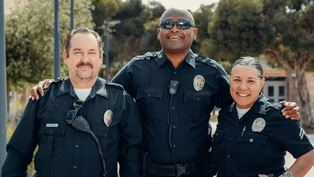
Police and Community Communication promo
Airs Friday, September 25th at 8:30 p.m. and repeats Sunday, September 27th at 11:00 a.m. (30s)
Providing Support for PBS.org
Learn Moreabout PBS online sponsorship New Episode
- News and Public Affairs

Top journalists deliver compelling original analysis of the hour's headlines.
 New Episode
- News and Public Affairs

FRONTLINE is investigative journalism that questions, explains and changes our world.
 New Episode
 New Episode
 New Episode
 New Episode
 New Episode
 New Episode
 New Episode
 New Episode
 New Episode
Support for PBS provided by:
To The Point with Doni Miller is a local public television program presented by WGTE