
Policing
Clip: Season 48 Episode 39 | 9m 50sVideo has Closed Captions
Policing | Episode 4839/Segment 1
Stephen Henderson interviews Detroit police department assistant chief Todd Bettison. Episode 4839/Segment 1
Problems playing video? | Closed Captioning Feedback
Problems playing video? | Closed Captioning Feedback
American Black Journal is a local public television program presented by Detroit PBS
Policing
Clip: Season 48 Episode 39 | 9m 50sVideo has Closed Captions
Stephen Henderson interviews Detroit police department assistant chief Todd Bettison. Episode 4839/Segment 1
Problems playing video? | Closed Captioning Feedback
Where to Watch American Black Journal
American Black Journal is available to stream on pbs.org and the PBS app.
Providing Support for PBS.org
Learn Moreabout PBS online sponsorshipSo I want to start with talking about police community relations.
And I think an interesting place to start is with something I saw this week on the news, a story about a man in Southwest Detroit being punched and kicked while on the ground by Detroit police officers in a video.
These kinds of things, when they happen, they remind us of the things that still need to be done, I think, to improve police community relations.
But they also remind me of how far things have come over time.
I mean this is a very different city than it used to be.
I want to give you a chance to put that in context, that kind of incident, what does that tell us about police community relations here in Detroit?
Well, I'm glad you started with that question, Stephen.
I had a chance to see the video and also had a chance to look at the body worn cameras of the officers and read the various reports.
So without going too far into it, because the young man is facing criminal charges, what I can tell you is this, that the snippet that you saw was taken, but it didn't show the totality.
And if you notice, the camera never faced the crowd.
It was a crowd of 25 to 30 folks out there.
The officers were driving, patrolling the area.
They saw this street party, saw individual in the street, the person in question.
And he had a Patron bottle or some type of liquor bottle in his hand in the street.
And a pistol was in his shorts with an extended clip.
So as a result, they stopped to investigate.
He didn't want to comply with their orders.
They ordered him to raise his hands.
He didn't want to raise his hands because he had on shorts.
When he did raise his hands, the pistol fell from his waist to the ground, with extended clip.
As they moved in to try to investigate further, he wouldn't comply.
Other folks in the crowd attempted to stop the investigation, and that's what led to the use of force.
That's what led to other individuals being arrested as well as they tried to interfere.
And like I say, force never looks pretty, but he was actively resisting and drugs were also found in the backpack, book bag, whatever.
And the subject also has a criminal record.
So I'm pretty sure that, you know, he definitely did not want to engage or go to jail, go back to jail, dealing with law enforcement.
Individuals, like I said at the scene actively, actively tried to stop that arrest.
So, I think one of the things that's hard for citizens like me or other people who are not police is to see that kind of conduct by police and never be able to come up with a reason for happening.
I mean, having somebody on the ground and punching and kicking that person, why is that part of the police repertoire, I think is one of the questions that comes up.
I mean, the idea of deescalating tense situations is what I think we think of when we think of what we have the police for.
That seems like the kind of thing that makes it worse.
So what I will say is this, that if you saw the entire video and with the body cam, which I'm so glad that we have.
And as a major department, we weren't the only departments where all of our officers are equipped with body worn camera.
What that'll show is the totality of everything that occurred in which you would see then is officers did deescalate.
They did give verbal orders, which is a form of deescalation.
They had a presence there, but as the crowd and the individuals refused to comply at that point, that's what ups the ante right there.
Also punches is a part of training as well, it's called hand ends.
And when a person is actively resisting to get control, you do get a chance or option to utilize that.
Also a taser was used.
It was an active scene where he was actively resisting.
So as soon as officers got him under control, he was quickly handcuffed.
And that's when the use of force stopped.
So, as I said, a little earlier, this is a different city than it was when I was a kid in the 70s and 80s.
The relationship between police and the citizens here is very different for a lot of reasons.
One of them is the federal consent decree that we had for several years in place.
I wonder what you make of where we are with police community relations in this moment though, where we see this continual protest against police brutality and systemic racism, and increasing conflict clashes between police and citizens who are protesting.
Is this making that whole effort to improve relations more challenging?
It's twofold.
You know, you have the national narrative, and of course what happens nationally, when you see incidents of excessive uses of force, everybody can see it on their cell phone.
So it definitely has an impact.
It makes you feel a certain way when you view it.
And folks will have a general tendency to generalize.
But the good thing is when you have a relationship with your community or where something does like that happen, as a result, you have advocates.
And as a result with our activist community, the advocates, the folks that we have built these trusting relationships with, they will actually come to the defense of the Detroit Police Department.
And during this whole thing that has occurred since the George Floyd incident, we've had local activists that have stood with us and have told other individuals that listen, we don't have those problems here.
And why don't you go to Warren?
Why don't you go to Harper Woods?
Why don't you go to Shelby Township?
Why don't you protest there?
Because that's where African-Americans in the city of Detroit is having an issue with, just to be bluntly.
And I've heard that from the activists that I have relationships with.
So it's not by accident that we didn't have looting, that we didn't have burning buildings or any other burnt structures.
Our community in the city of Detroit, still with the Detroit Police Department, and it's based off that relationship that we have with them to ensure that our city didn't burn.
So the return on investments for DPD, our relationship under Chief Craig of building those relationships pay dividends for the city of Detroit.
Last question, this has been a really violent summer here, and lots of people have been affected by that violence.
Lots of people have losses because of that, that violence.
Does that put an additional strain on police community relations?
And does it put more pressure on the department than we had before?
Does it change, I guess, the narrative around building that trust that was so important in police community interactions?
These are unprecedented times.
We're still in the midst of the COVID pandemic, which affected our department as well.
And at the same time, we have the protests that are going on nationally.
And as a result, major cities across the country has seen a sharp increase; Chicago, New York and Seattle, Portland, Oregon, they have seen violence surge.
And there's other cities that I haven't even named.
So Detroit is no exception.
But when you think about the pandemic, in February, March, you know, in March, April, we had 700 police officers that were quarantined at one time.
So you gotta think that's gonna have an impact on violent crime.
And other cities had issues like that as well.
Thank God, we were able to put things in plan and quickly get to a point where we were able to get our force back, back to low numbers of COVID.
But then right on the heels of the pandemic, with that, we went right into the, to the George Floyd incident and daily protest, where we're gonna have to deploy sometimes upwards of 200 police officers to deal with the large crowds.
Because at one point we were seeing crowds of a thousand downtown.
So that requires some maneuvering.
And as a result, you know, it really requires us to run a lot of overtime to ensure that we backbill and have officers in the neighborhood as well.
But these are unprecedented times and our community is under a lot of stress.
You know, they even call it like COVID brain.
So it's a lot of violence that we're seeing, just a lot of folks that are suffering from mental illness out there and it exacerbates their particular situation.
Yep, we're under a lot of pressure.
And I'm not just saying as a police department, we all are as a community, but I do believe that we'll get through it together.
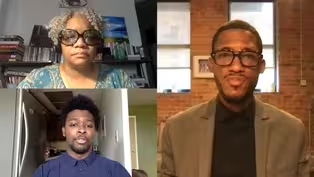
Video has Closed Captions
Clip: S48 Ep39 | 8m 16s | Community | Episode 4839/Segment 2 (8m 16s)
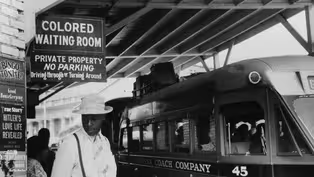
Video has Closed Captions
Clip: S48 Ep39 | 4m 30s | Driving While Black | Episode 4839/Segment 3 (4m 30s)
Providing Support for PBS.org
Learn Moreabout PBS online sponsorship New Episode
- News and Public Affairs

Top journalists deliver compelling original analysis of the hour's headlines.
 New Episode
- News and Public Affairs

Today's top journalists discuss Washington's current political events and public affairs.
 New Episode
 New Episode
 New Episode
 New Episode
 New Episode



 New Episode

Support for PBS provided by:
American Black Journal is a local public television program presented by Detroit PBS