
Political Science Trio | Almanac at the Fair 2026
Clip: Season 2026 Episode 50 | 7m 54sVideo has Closed Captions
Kathryn Pearson, Cindy Rugeley and Larry Jacobs discuss this week in national politics.
Kathryn Pearson, Cindy Rugeley and Larry Jacobs discuss this week in national politics.
Problems playing video? | Closed Captioning Feedback
Problems playing video? | Closed Captioning Feedback
Almanac is a local public television program presented by Minnesota PBS
Political Science Trio | Almanac at the Fair 2026
Clip: Season 2026 Episode 50 | 7m 54sVideo has Closed Captions
Kathryn Pearson, Cindy Rugeley and Larry Jacobs discuss this week in national politics.
Problems playing video? | Closed Captioning Feedback
Where to Watch Almanac
Almanac is available to stream on pbs.org and the PBS app.
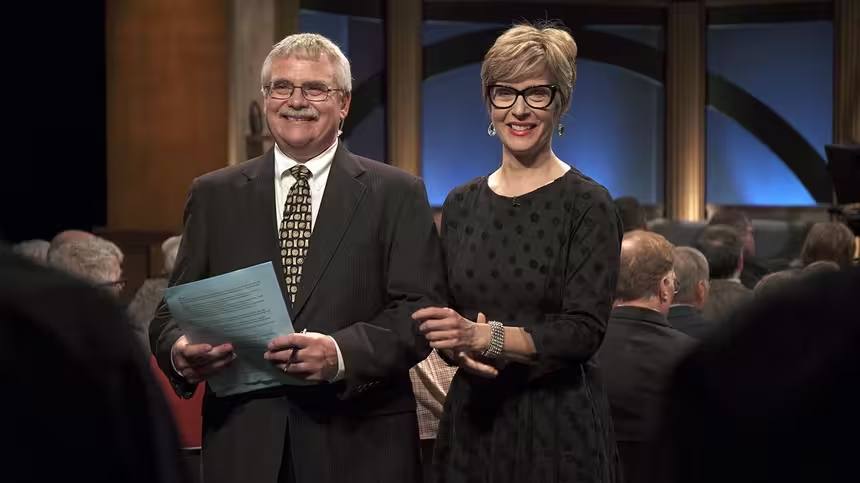
A Minnesota Institution
"Almanac" is a Minnesota institution that has occupied the 7:00 p.m. timeslot on Friday nights for more than 30 years. It is the longest-running primetime TV program ever in the region.Providing Support for PBS.org
Learn Moreabout PBS online sponsorshipOne more political conversation for you now.
Here to talk national politics, a trio of political scientists.
Cindy Rugeley made it right down.
I-35 to join us.
Heads up the political science department at UMD.
The University of Minnesota is Twin Cities campus, is where Professor Kathryn Pearson teaches politics.
Here too, Larry Jacobs.
He heads the center for politics and governance, part of the Huffrey School at the U of M. Professor Jacobs, I think all of us need a little bit of unscramble of where all of the voting and election activity is going on and what it means for Minnesota in November if anything.
Obviously, it's going to be a high turnout midterm election.
We saw that with the primary.
We've got some very competitive races, I think, the Governor race, the Senate race here.
That's going to drive turnout.
We're going to have a ton of money.
I mean, tens of millions of dollars are important here.
And don't even bother watching TV, because this could be all over and on the internet.
So we're going to be the center.
If you look at the US Senate, this could be the difference between Democrat and Republican majority.
What legal things are going to shake out over early voting, mail-in voting?
Or is that all going to be not available for this November?
Well, stay tuned.
I mean, yesterday a U.S.
district judge stopped for 14 days the implementation of President Trump's executive order to sort of federalize mail-in voting.
But I think this is likely that we would be going to be a Supreme Court.
And I don't think we would know in a timely fashion.
And so that is thinking it very challenging for secretaries of state nationwide, including some states that only have mail-in voting.
of mail-in voting, of course Minnesota uses mail-in voting, as do a lot of states, including those with Republican secretaries of states who are quite concerned.
How many of a mess could this be, Professor Ruzely?
You could be a big mess.
You know, I'm surprised it's been this chaotic.
I mean, the Constitution clearly assigns to states election responsibilities, and it is getting kind of late.
I think that's the Supreme Court what they said the other day was not that they weren't ruling on the merits of the case they were saying you just brought it to us too early.
So hopefully we'll get it resolved pretty quick but it is a mess right now and it is chaotic.
See what kind of an issue are the president's tariffs and trade war with Canada?
How might that play out as we head into the election, Larry Jacobs?
Well, obviously this is a big issue.
For Donald Trump and the Republicans, they need to mobilize Republicans.
And what's happening with tariffs and trade are hitting Republican areas.
You look in Minnesota, a lot of the agricultural areas are where we see a lot of Republicans.
Now, it doesn't mean those folks are in a vote Democrat.
I don't expect that.
But might they sit it out?
Yeah, that's a real possibility.
And when you start to look at the polls in terms of likely turnout models, Democrats have a real advantage.
So this may reinforce that advantage.
I'm wondering if there's any data on the candidate that spends the most money wins the most times.
Or is that not true?
So it gets very complicated because clearly the most competitive races draw the most And so the winners with the lowest vote margins actually have the most money spent in their races because all the money is spent on only a handful of races, probably 40 races at a 435 in the US House, maybe 9 or 10 in the US Senate, but taken together, money typically does help candidates.
If you have more money, you're better able to mobilize voters, get the word out.
But we've also seen that the candidate without the most money doesn't necessarily went.
Look at Minnesota's primary on the DFL side for the US Senate.
Angie Craig outspent Peggy Flanagan and lost by around 20 points.
Cindy Ruzely.
You know one of the interesting things about money is most the research has shown that it makes more difference for a challenger than it does for an incumbent because they have to buy the attention that that incumbent already has.
We've got open races here so it'll make a difference.
One of the things that was most interesting in my opinion about the primary dealt with the fact of the organizational effort by a lot of the groups and I think many of them were lined up behind you know a boutique governor flanagan and so organization matters particularly when you have some of these groups that are so active right now and promoting the democratic candidates but doesn't President Trump's pack sitting on 400 million to spread around his he sees fit - Absolutely, and the Republicans are very excited about that, along with some of the Supreme Court rulings, that are gonna allow the party and the candidates to now collaborate in ways they hadn't been allowed in the past.
The question with Donald Trump, as always, is how is he gonna do this?
Where is he gonna put the money?
Is he gonna be based on favoritism for those candidates?
He likes or is it gonna follow the advice of frankly the political professionals who say a dollar here is going to make a difference.
Go ahead.
I mean, the other dynamic here is that we know political science research and election results tell us that midterm elections, the party in the White House typically loses seats.
And the extent of that loss is very much contingent on the president's popularity, and Trump's popularity is hit record lows.
And so in some of these swing districts, that will really affect Republican candidates.
And so even increased spending, if it's with the support and sort of campaigning with Trump, won't necessarily be helpful.
- Professor Rugeley.
- One of the interesting things is Trump is saying he's going, the president's saying he's gonna start spinning the money on the campaign, but he wants it to focus on him, that he thinks when he's on the ballot, they win more often.
But as Catherine just pointed out, the incumbent president is always on the ballot in midterm elections.
- Larry Jacobs.
- Yeah, I think it's likely that the Democrats are gonna do well, but probably not as well as the Democrats think they will.
There are some real factors and forces here that I think are gonna temper how the Democrats do.
Obviously redistricting, it's a net gain of six seats.
Also when you look at the number of competitive seats for the House.
It's just a month, you know, three dozen.
And this is out of 435.
So there's just not that many seats that are actually up for grabs.
Then you get into the perception of some Democrats as ideologically extreme and that is going to be a tax on some democratic candidate.
So will the Democrats do as well?
As you might expect given how unpopular Donald Trump is?
Probably not.
Who's undecided still?
Probably no one.
Honestly midterm elections are about mobilization and turnout.
Typically turnout is about 20 points lower than it is in general elections And so both sides are really going to be trying to get their partisans out.
I mean, yes There are probably some swing voters and things like tariffs and the economy will matter I mean look at a case like Idaho.
Why would we even be talking about Idaho a solid red state?
But there's an independent party candidate who actually is you know Probably won't win but is actually in contention whereas we normally wouldn't see that dynamic about 30 seconds Final thoughts here from both of you Cindy Bruce Lee I think it's gonna be an interesting interesting race.
I mean right now the polls are gonna change just because of a whole lot of reasons dealing with how they screenpulls right now.
Are you Jacob's 20 seconds?
Well, you know, I think it's interesting you don't have any of the major candidates on this stage in the past you have.
So why won't the Republicans come up here?
And I think it's a deliberate strategy.
They want to maintain their image as being electable, which hasn't been the case in the past.
And I think they're fearful of questions you might ask about immigration enforcement or abortion that would split the coalition they need between the hard Republican and the independent.
I- And of course we have invitations to all the candidates.
I hear the bell ringing here.
We do.
Professors.
Birdchick | Almanac at the Fair 2026
Video has Closed Captions
Clip: S2026 Ep50 | 8m 30s | Sharon Stiteler previews fall migration patterns and takes audience questions. (8m 30s)
Kevin Kling essay | Almanac at the Fair 2026
Video has Closed Captions
Clip: S2026 Ep50 | 2m 58s | Kevin carries on his tradition of sharing one of his State Fair stories with us. (2m 58s)
Live Music | Almanac at the Fair 2026
Video has Closed Captions
Clip: S2026 Ep50 | 4m 52s | Kaomi Lee talks to Quillan and Kim Roe before the play a song for us. (4m 52s)
Reporter Duo | Almanac at the Fair 2026
Video has Closed Captions
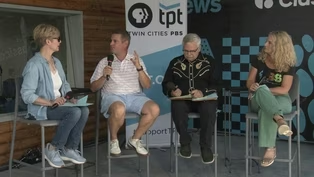
Clip: S2026 Ep50 | 5m 46s | Mary Lahammer and MPR’s Brian Bakst break down this week in Minnesota politics. (5m 46s)
Sports | Almanac at the Fair 2026
Video has Closed Captions
Clip: S2026 Ep50 | 5m 13s | 10K Takes’ Eric Nelson join us to talk Lynx, Vikings, and Twins. (5m 13s)
Video has Closed Captions
Clip: S2026 Ep50 | 2m 26s | Mary Lahammer speaks with the leading candidates for governor and U.S. Senate. (2m 26s)
Weather | Almanac at the Fair 2026
Video has Closed Captions
Clip: S2026 Ep50 | 5m 45s | Mark Seeley talks drought, wildfires, and what an El Niño will mean for winter. (5m 45s)
Providing Support for PBS.org
Learn Moreabout PBS online sponsorship New Episode
- News and Public Affairs

Top journalists deliver compelling original analysis of the hour's headlines.

- News and Public Affairs

FRONTLINE is investigative journalism that questions, explains and changes our world.
 New Episode
 New Episode
 New Episode
 New Episode
 New Episode
 New Episode
 New Episode
 New Episode

 New Episode
 New Episode
Support for PBS provided by:
Almanac is a local public television program presented by Minnesota PBS