Unspun
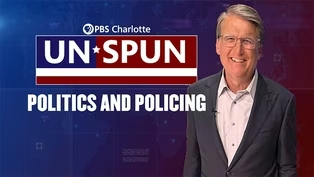
Politics and Policing | Unspun
Season 2 Episode 205 | 28m 12sVideo has Closed Captions
Charlotte is in the spotlight for crime—crisis or perception?
Over the past several months, Charlotte has found itself in the national spotlight; not for banking or growth, but for crime. Different neighborhoods, different circumstances; but collectively, high-profile cases quickly became political talking points. The real question: is Charlotte experiencing a crime crisis or a perception crisis?
Problems playing video? | Closed Captioning Feedback
Problems playing video? | Closed Captioning Feedback
Unspun is a local public television program presented by PBS Charlotte
Unspun
Politics and Policing | Unspun
Season 2 Episode 205 | 28m 12sVideo has Closed Captions
Over the past several months, Charlotte has found itself in the national spotlight; not for banking or growth, but for crime. Different neighborhoods, different circumstances; but collectively, high-profile cases quickly became political talking points. The real question: is Charlotte experiencing a crime crisis or a perception crisis?
Problems playing video? | Closed Captioning Feedback
How to Watch Unspun
Unspun is available to stream on pbs.org and the free PBS App, available on iPhone, Apple TV, Android TV, Android smartphones, Amazon Fire TV, Amazon Fire Tablet, Roku, Samsung Smart TV, and Vizio.
Providing Support for PBS.org
Learn Moreabout PBS online sponsorship(upbeat music) - [Announcer] This is a production of PBS Charlotte.
- Tonight on "Unspun," we try to separate politics from policing, and headlines from hard truths.
Because over the past several months, Charlotte has found itself in the national spotlight, not for banking or growth, but for crime.
- A deadly attack on a light rail train in Charlotte.
The story getting a lot of national attention after the really hard to watch surveillance video was released over the weekend.
- A purchase in a community park turned deadly within seconds.
We know a teenager is dead, another fighting for his life.
And we also have multiple arrests tonight.
The shocking part of it all?
The deal involved the selling of vape pens.
- CMPD has confirmed four arrests in connection to the deadly shooting of a four-year-old boy in Steele Creek.
Three of them have been charged with first degree murder.
- The incident happened yesterday morning on Cigar Court.
CMPD responded to that neighborhood after reports of a stolen vehicle, then learned shots had been fired into that home.
- Different neighborhoods, different circumstances, but collectively, high profile cases that quickly became political talking points.
The real question is Charlotte experiencing a crime crisis?
Or a perception crisis?
(upbeat music) In today's America, welcome to the spin game.
Believe me, I know, I'm Pat McCrory.
When I was governor and mayor, I played the spin game.
I was played by the spin game.
But aren't we all done being spun?
Let's take the spin out of the world we're in, here on "Unspun."
(upbeat music) Good evening, I'm Pat McCrory, and welcome to "Unspun," the show that tells you what public officials and community leaders are thinking, but not always saying.
Our guest tonight is Rodney Monroe, former Chief of the Charlotte-Mecklenburg Police Department.
Monroe led the CMPD for seven years, a period marked by real crime reductions, expanded community policing, and a stronger focus on technology and accountability.
In fact, during his tenure, Charlotte recorded its lowest homicide total on record.
He knows firsthand the complexity of policing a rapidly growing city where public perception, media spotlights, and real world incidences can sometimes seem at odds with the data.
Welcome.
Glad to have you here, chief.
- Good to be here.
- It's an honor.
You were chief in my last two years as mayor.
- Yes.
- And I really enjoyed working with you.
I think you were my fifth police chief during my 14 years as mayor.
- I remember our conversations about that.
The longest running mayor in Charlotte.
And to be given the opportunity to police the city of Charlotte.
Was greatly appreciative of that opportunity.
- And you kept Charlotte your home.
You didn't leave town after coming to Charlotte.
- After the first year and a half, we made the decision that however long this lasts, this was going to be our home, so... - Well, we're honored to have you still there, and I still consider you a friend.
And it's a real honor to have you here on "Unspun."
I'm kinda curious, when you came to Charlotte, we were still finding a pretty big crime rate at the time.
- Yeah.
- And your predecessors were initiating a lot of things with me and other council members, trying to have an impact, especially on the murder rate.
How have things changed from then to today?
- I think, there are a couple of different dynamics that I see on the outside looking in.
And as I continue to work with other police departments around the country.
And a lot of it has to, you have to get back to basics.
And I tell any police chief, any police department, you only have but so many officers on any police department.
Whether you're a 2,500 member police department such as Charlotte, or you're a 10,000 police department like a city like Chicago, you gotta get back to the community.
If you add the number of citizens that are representative of the city, and if you can get a large cadre of them pulling in the same direction as you, you exponentially increase your resources within the community in order to address problems.
- One thing you and I worked together on was going after career criminals.
- Yes.
- Those people, when I'd ride with the police, and I try to do it once a month.
- Yeah.
- During my whole tenure as mayor.
In fact, I rode with your successor at a certain time.
- Yeah.
- We were going after the career guys that, we knew their names.
We arrest them 20, 30, 40 times, whether it be for breaking into cars, or robberies or even murder.
And that was a big emphasis during your tenure was going after the career criminal.
What did you do specifically?
- Well, I'm always been a believer that one size doesn't fit all.
And that if you can be strategic, and technology plays a big role in that, where you can assess things from a data perspective to see who your prolific offenders are, where they're operating, how they're operating, where you can become more surgical on how you go about addressing those individuals and not affecting the entire community.
The old style of policing was if you had a problem with robberies or some other crime, you blanket the area with police officers, you stopped everybody that was moving in that neighborhood.
And then you got a lot of pushback.
Yeah, you may have picked up two or three different arrests, but you didn't get that primary individual that's really the linchpin in causing the problems in the community.
So when you can step back, analyze what's going on, who's doing what, focus on those individuals, explain to the public what you're doing, I think the support will come along with that to allow you to be a lot more successful.
- Gangs.
I'm a little concerned as an observer looking from the outside in, that gangs are starting to have a impact again on Charlotte.
And is what I see or what I hear true?
Later on, I'm gonna talk about the terrible shooting five years ago on Beatties Ford Road, where we had a mass shooting, and lots of witnesses, no arrest.
And that kinda signals to me are gangs around and are they intimidating people now?
Like they were doing, when I came as mayor in '95, we had Hidden Valley, for example.
Do you see the gangs coming back?
Or are they in a different form now than they were 20 years ago?
- They never left.
They never left.
If you remember when I first came to Charlotte, saying the word gang was a bad word.
People didn't want you talking about gang on TV.
- I never stopped.
- But they're there.
- Yeah.
- They're there.
And a variety of different levels.
You can have 10 people that live on the same block and they'll give themselves a name.
But our focus became more on the activity associated with gangs versus individuals within gangs.
So if you focused or if you had gangs that were selling drugs or committing robberies or burglaries, you go after their activity, and whoever may be a part of that, that's who you're going to bring into the fold.
But to say that we're gonna go after this gang, you can have 10 people that aren't really involved in any criminal activity other than standing on the street corner, but you wanna go after the activity that's associated with those events.
- Plus in the '90s, we did have some of the national gangs come to Charlotte.
The Bloods, the Crips.
- Yeah.
- Some of the international Latino gangs.
That's how I recall it.
And then maybe it's dispersed more into kids who went to high school together, or grew up together, forming their own little club.
- [Rodney] Yes.
- Of criminal activity at 13, 14, 15.
- It doesn't mean that they're not engaged in illegal activity.
But for the most part, most of them are just social groups that come together and they hang out, they go places together.
They may visit the mall and, but to the average citizen, you see a group of 10 or 15 individuals wearing the same colors, dressed the same way, you automatically look to associate them with gangs.
But instead of just looking at those 10 or 15 people, you look at the activities that they're engaged in.
And as a law enforcement officer, I can go after that activity.
I can't necessarily go after 10 or 15 people standing on the street corner, not doing anything.
- We used to do pretty strong enforcement for a brief period of time of teen curfews here in Charlotte.
You don't hear about it as much.
Is teen curfews still on the radar screen of law enforcement?
If we see a 13 or 14-year-old kid walking the streets during the day or at one o'clock in the morning?
- Well, I think we've gotten away from truancy enforcement as well as, but as far as curfews, I believe curfews shouldn't be a blanket thing.
- [Pat] Yeah.
- I think it should be very strategic as it relates to when and where you're looking to implement curfews so that you're not affecting the overall general juvenile population.
But if you look at juveniles today, they're becoming much more bolder in their activities.
So I don't know whether or not a curfew would be the answer, versus some other strategy.
- They're committing adult crimes.
- Yes.
- Earlier and earlier.
I'd be remiss not to ask you about two controversial issues, especially in Charlotte during the past several months.
One is the tragic killing of the Ukrainian person on the light rail line.
And second is some of the issues we're dealing with, just the overall crime perception, especially in downtown Charlotte, which it used to be back in the '90s, and we wanted to get rid of that.
What about the crime on light rail?
- Well, I think as Charlotte continues to grow, if you just take a look at the number of people that are moving to Charlotte, the Charlotte Police Department hasn't increased along with those numbers.
It's a little different than the fire department.
If you build out a new neighborhood with X number of houses and residents, you're going to get a new fire station and new firefighters.
That's not the same thing with policing.
We continue to stretch, stretch, stretch.
At one time, when I first came to Charlotte, the light rail had a contingency of CMPD police officers that were assigned.
- That's the way I designed it as mayor when we opened it up.
I wanted Charlotte-Mecklenburg police on our rails.
- Yes.
- Not a separate police department.
- Yes.
- Like we're doing now.
- Yes.
I believe that was effective.
But a lot of it has to do with growth.
If you're going to grow a city, then you have to not only develop the road, then other infrastructure associated with accommodating that number of people.
But you have to also look at your public safety needs as well.
And by the fact that it's becoming harder to recruit officers, you need a little more lead time than what you would normally need in order to bring those resources in the fold.
- Another issue that maybe wasn't around as much, it was more hidden during my tenure as mayor, is the homelessness, and mental health.
They were around when we were working together.
Under the bridges, in the woods, off of Wilkinson and Freedom and I-77 bridges.
Now they're laying in the middle of the sidewalk in front of restaurants, especially in the center city.
This is an issue that we're seeing in Portland and Seattle, started in San Francisco 20, 30 years ago.
What do we do as a police officer?
- Well, the thing about policing in the 21st century is, not every problem should be a police problem.
And that police may not be well-equipped to handle all of the social issues that plague a lot of our communities and such as homelessness.
Having a police officer arrest someone for panhandling, or some of the other minor offenses that they're involved in, serves no real purpose other than a momentary extraction of that person at that time.
- Which might make a difference to that restaurant owner.
- Yeah.
- Right there.
- Yep, but it also can make a worse problem too, because now, they're gonna come back, and then they're gonna come back angry because you've displaced all of their belongings and disposed of those type of things.
So now you have an angry person that hasn't been helped at all.
And when you mention about crime, I believe crime is down in Charlotte, but there's a perception that it's not.
And I always taught our officers that not only do you have to fight the numbers of crime, but you also have to fight the perception of crime as well.
People wanna feel safe.
- It works on both sides.
When a police officer's involved in something really bad that they may have done something, it sticks for a long time.
- Yeah.
- And then like the young woman killed on the light rail line, that sticks a long time.
- Yeah, yeah.
Those, I always tell police chiefs around the country, you're one incident away from losing your job.
- [Pat] Yeah.
- And it's how you not only manage that incident, but how you've managed things prior to that incident.
You have to develop goodwill within the community for them to know that you're trying to do the right thing, and what's in the best interest of the community.
But you're gonna always have those incidents where people are gonna look back and say, "Oh, how did this happen?"
Police officer didn't commit that crime.
You have some sick people out here, still walking down streets.
Mental health.
You talk about homeless, mental health is a big issue within law enforcement.
- Chief, I enjoyed working with you, and it's an honor that you kept Charlotte your home.
And you made a difference in this community too.
- Well I appreciate the opportunity.
- Appreciate it.
Thank you, chief.
- To be with you again.
- You're always chief to me, buddy.
- You're always mayor to me.
Even though you may have ascended to governor.
You're still my mayor.
- [Pat] Thank you very much.
- Thank you.
(upbeat music) - Okay, it's time for the "Unspun Top Five."
And this week's top five is the following.
The top five abandoned crime policies, especially enacted in cities throughout the past five to 10 years, in cities throughout the United States of America.
Some including right here in Charlotte.
Start out with number five.
Number five, teen curfews.
As you heard the police say, we really aren't focusing on teen curfews anymore.
Number four, cooperation between the federal and state government law enforcement.
Boy did we see that during the immigration controversy when federal authorities came into Charlotte region and in North Carolina.
Number three, enforcing truancy laws, drug offenses, and aggressive panhandling and loitering ordinances.
This is something that I focused on during my entire 14 years as mayor, and it worked.
But for some reason, we've gone away from those policies.
Number two, requiring sufficient bail to keep the career criminals in the state, or in the local county jail when they're arrested.
We really aren't requiring bail.
In fact, some cities aren't requiring bail whatsoever, much less sufficient bail.
And number one, limiting the prosecution of career criminals.
We again, are at that period of time in the United States history where we're rearresting the same people over and over and over again.
And that's unacceptable, especially to the victims of crime.
(upbeat music) Time now for "One-on-One."
Actually this time it's two on one, because I'm joined by two of my favorite people, Bo Thompson and Beth Troutman, the host of "Good Morning BT" on 107.9.
- Hi!
- It's great having my old friends back.
My old host and a much better co-host than I was with Bo Thompson.
- Oh, well thank you.
He tells me that all the time!
- [Pat] And we used to do our own TV show together a long time ago.
- We did, when I was at WCCB hosting "Fox News Rising."
They would bring you in, and we would debate one another behind podiums!
- And I think I won every debate.
Bo, you have some questions for me?
- That sounds very familiar, actually.
It's great to be back.
And it's deja vu, is what it is.
But I wanna, I heard you talking to the former chief and I think it's interesting, 'cause a lot of the times, when we did the radio show, you used to say, I remember when things were conceived in Charlotte, sometimes on a napkin, with leaders in Charlotte.
And then you had to see it go all the way to fruition.
And I think about the fact that you were talking to him about what, he was the fifth police chief during the time that you were mayor?
- [Pat] Yeah.
- And now you've been away from mayor, and there've been a number of police chiefs since.
But when you sit back and look at how things have changed in the communication chain, and just dealing with CMPD as a city leader, how has it changed?
- I think we're become separate where I've, for example, I've said on your radio show in the past, I don't like having separate police departments for the city of Charlotte.
One for the light rail line, and one for the rest of the city.
I think we ought to be one unit, whether it be at the airport, the light rail line, or throughout the city.
So we work together as a team, and don't become segregated regarding public safety.
That has changed.
Also, one thing I tried to do as mayor, and I did it as governor too, I rode with the police all the time, so I wouldn't lose touch with what they were actually hearing and seeing and feeling and that the pressures they were under.
And I would recommend that the new elected officials, a lot of new young people, like I was at one time, Beth.
- At one time.
- I used to be young.
I think it'd be really good for all the elected officials to ride with the police officers, a lot.
Not just one time and say you did it, but get to know 'em, and let them also trust you.
And I think that would help an awful lot in the city of Charlotte.
- Well, you just said it.
Police aren't working together necessarily as a team, and need to be.
That makes me think about what's going on in our country right now.
We don't see federal and state law enforcement working together as a team.
And it seems that everything is about butting heads, name-calling and blaming, rather than getting down to facts and figures, working together and finding solutions that work for everyone.
Because ultimately, it's about protecting all of us.
- Yeah.
And we got rid of the gangs out of a neighborhood like Hidden Valley back in the '90s because the city police department had such a great cooperation with the federal government.
And we used federal gun laws to get rid of the gang leaders.
And there's been a major TV special in the past about how we got rid of the gangs that had taken over a neighborhood in Charlotte.
Right now, as I talked to the police chief too about the gangs, I think the gangs, they never left completely, but I think we decreased their influence, and I'm afraid they're back.
And that's gonna take a collective effort between city, state and federal officials.
And I think we saw during the immigration crackdown just last month that there's this tension between the two.
And that tension's not good, regardless of where you stand on the issue.
- One thing that I have seen evolved, and I know you have, and even when we were doing the radio show, is the way that CMPD is covered, and the way news is gathered now, because when you think about what happens in the wake of a high profile crime, it used to be that there were three or four television radio stations that would come and cover that.
And you knew where to go and hear that.
Now if something happens, you have people with their phones, you have people that immediately post things on social media.
If you're a leader and if you're a chief, I can imagine, or I guess I probably can't imagine how much more complicated it is now in this information age that we live in to sort of make sense of all of that, and prioritize things and ignore things, or pay more attention to certain things.
- I think we saw that with the stabbing on the light rail line.
10 years ago if that had occurred during my tenure, we would've had time to think about how to respond, because the six o'clock news, or the morning newspaper.
- Yeah.
- We would've thought about how do we respond to this.
The response had to be immediate.
In some ways the city officials failed.
Because it was out on a telephone.
Tragic, tragic, violent killing, within a very short period of time.
And I don't think our transit officials and other elected officials were ready to respond in a way which hit the emotion of the moment.
And so politicians are now gonna have to be a lot more flexible.
Like you in radio too.
Same thing's happening.
- Yeah, well, and to Bo's point, and to elaborate on that, because of the fact that everyone has a phone, and because social media tends to dictate sometimes, the narrative of a story, and that narrative that someone's receiving might be dependent upon their algorithm.
And so perception can be incredibly different from fact.
And we live in an age now where I know that some people since 2016 call it the post-truth era, because people don't know where to go to find truth, to find facts.
They don't trust the even statistics anymore.
So how do you, especially if you were mayor now, how would you deal with perception versus reality, and then find a bridge in between the two?
- I'd probably have my own social platform and try to get on as many other platforms, both the liberal and conservative platforms, so I could have a voice, where before, I'd go on BT Morning Radio or NPR or wherever on all the channels.
But now you can't just do that.
And even radio is segregated by the listener now too.
And so are the TV markets.
And that's been gradually changing over the past 20 years and I think that's a great challenge for us as a country.
- We're trying to change that.
- Yeah, you are!
- Well and one of the things that I actually had a unique vantage point with you when we did the radio show, was to watch you react to leaders that had been in your same shoes, dealing with the tragedy, or dealing with a high profile crime.
And so I work around to the question for you now, from where you sit, and having seen those different vantage points.
When you watch leaders that come out after a crime or a big story that you know the mayor has to come out and say something about, and has to deal with the police chief about, best talking about perception versus reality.
There's also what happens in front of the camera, or the microphones and what you don't see behind the scenes.
And those are the things that used to tell us on the radio and now television, that I think are really invaluable.
- No doubt about it.
And it's very similar to morning radio.
You either have the instincts, or you don't.
It's not a learned trait.
And I think the politicians that we're gonna elect in the future have the instincts to either good at responding to crisis, or not good at responding crisis.
And if you're not good at it, you probably ought to hand off that responsibility to someone else, or have someone write a daggum good script for you in a very short period of time.
Like Bo had to do when I was on your show.
- Every day.
(all laughing) - So how's radio changing?
Covering the news, in the remaining 30 seconds?
How have you changed in covering politicians in crisis?
- Our goal, because we both love Charlotte, we were both born and raised in this area.
Our goal is to remind people about all of the things that we have in common, and to help people feel joyful and positive about their communities.
Because again, it's about perception.
- [Pat] Yeah.
- And if you go and talk to different parts of the community, they might see Charlotte a completely different way.
But if everybody can come to "Good Morning BT," they may feel something that's more positive.
- Well, y'all present good news and humor too.
And that's what I miss on your show, when I was interacting with Bo.
Y'all are still kept the humor, but are serious about the issue.
And I think that's the responsibility of all of us.
It's an honor to have y'all on One-on-Two.
- Yeah, well, we like to double up on you.
Gang up on you.
- [Pat] Thank y'all very much.
It's great to have you here, and it's fun.
- Thank you.
(upbeat music) - Over five years ago, Charlotte was the scene of a mass shooting.
Four people were killed, seven were wounded.
More than 100 shots fired during a Juneteenth celebration on a major west side corridor in West Charlotte.
And yet, despite the fact there were hundreds of witnesses, there have been no arrest.
What's even more disturbing, outside of close family members and friends of the victims, almost no one ever brings it up.
Not the mayor, not the city council, not the governor, not the police chief, not business leaders, not the NAACP.
And not even the media, except occasionally, on the yearly anniversary of this tragedy.
It's almost as if it never happened.
The victim's names are rarely repeated, barely remembered, which is striking, because after mass shootings elsewhere in this country, we usually know the names, we say the names, we honor the names.
So why hasn't this unsolved mass shooting, right here in Charlotte, received the attention these victims deserved?
Is it because of race?
Unlikely.
Given the makeup of today's political and public safety leadership.
Is it the lack of resources?
No.
Police still have dedicated investigators assigned to this case.
Is it fear?
Fear tied possibly to gang involvement, scaring witnesses into silence?
Well, that's my guess, and what I've heard from sources in the community.
And that should scare us all, because if gangs in Charlotte have enough influence to keep a mass shooting unsolved, to silence witnesses, stall justice, and erase public pressure, then this isn't just a cold case, it's a warning sign.
It tells us what happens when fear replaces accountability.
And it tells every would be criminal exactly how easy it is to wait out the clock.
Now is the time for leaders to speak up and confront this terrible crime, especially knowing that the shooters caught on video have never been found, and may very well have killed again, or could kill again.
This matters, because justice delayed doesn't just fail families, it weakens a city.
And it's time we stop letting this tragedy fade quietly into the background.
The families haven't forgotten, and neither should Charlotte.
Those responsible deserve to be arrested and given their day in court, for the victims, for their families, and for the future safety of the city.
Well, that's the truth as I see it, I'm Pat McCrory.
And thanks for watching "Unspun."
(upbeat music) (upbeat music continues) - [Announcer] A production of PBS Charlotte.
Politics and Policing Preview | Unspun
Preview: S2 Ep205 | 30s | Charlotte is in the spotlight for crime—crisis or perception? (30s)
Providing Support for PBS.org
Learn Moreabout PBS online sponsorship
- News and Public Affairs

Top journalists deliver compelling original analysis of the hour's headlines.

- News and Public Affairs

FRONTLINE is investigative journalism that questions, explains and changes our world.












Support for PBS provided by:
Unspun is a local public television program presented by PBS Charlotte