
Politics, Labor, Clean Energy, Crime
9/9/2022 | 26m 46sVideo has Closed Captions
Politics, Labor, Clean Energy, Crime
In this edition of CapitolView, a look at how growth in popularity for organized labor may sway a referendum on the November ballot; we explore how big picture issues like clean energy and crime are impacting the race for Illinois Governor. Join Host Jennifer Fuller as she talks with Mike Miletich and John Jackson.
Problems playing video? | Closed Captioning Feedback
Problems playing video? | Closed Captioning Feedback
CapitolView is a local public television program presented by WSIU
CapitolView is a production of WSIU Public Broadcasting.
Politics, Labor, Clean Energy, Crime
9/9/2022 | 26m 46sVideo has Closed Captions
In this edition of CapitolView, a look at how growth in popularity for organized labor may sway a referendum on the November ballot; we explore how big picture issues like clean energy and crime are impacting the race for Illinois Governor. Join Host Jennifer Fuller as she talks with Mike Miletich and John Jackson.
Problems playing video? | Closed Captioning Feedback
How to Watch CapitolView
CapitolView is available to stream on pbs.org and the free PBS App, available on iPhone, Apple TV, Android TV, Android smartphones, Amazon Fire TV, Amazon Fire Tablet, Roku, Samsung Smart TV, and Vizio.
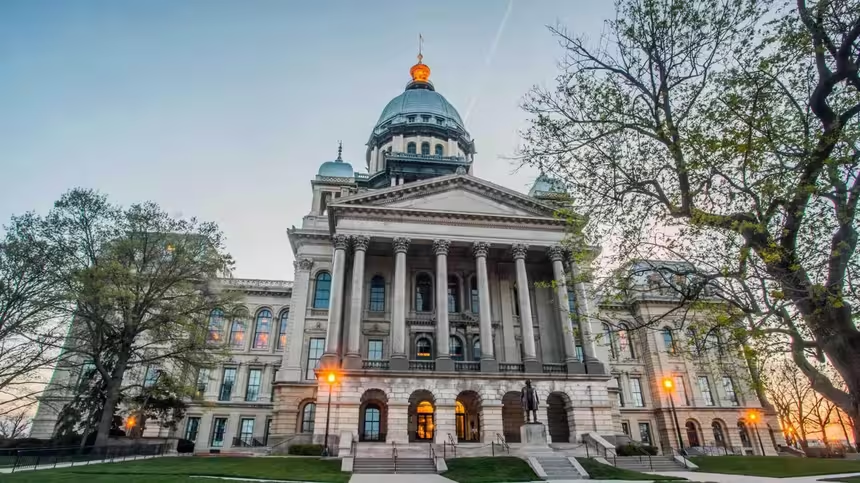
CapitolView
CapitolView is a weekly discussion of politics and government inside the Capitol, and around the state, with the Statehouse press corps. CapitolView is a production of WSIU Public Broadcasting.Providing Support for PBS.org
Learn Moreabout PBS online sponsorship(bright upbeat music) - Welcome to Capitol View, our weekly look at the happenings inside and outside the Illinois State Capitol.
I'm Jennifer Fuller.
Our guests this week are Mike Miletich of WGEM in Quincy, and John Jackson of the Paul Simon Public Policy Institute at SIU Carbondale.
Gentlemen, thanks for joining us.
- It's good to be here.
- It's good to be here.
Thank you.
- You know, it's just a few weeks now leading into the general election as the campaigns kind of kick into high gear after Labor Day.
A report out this week from the Illinois Economic Policy Institute and the Project for Middle Class Renewal at the (indistinct) have a new survey showing growth not just in union membership, but in support for unions in general.
John, what does this say to you just say eight weeks ahead of the general election?
- Well, things are looking up for the unions, both in Illinois and nationally.
I had read that Gallup Poll before this report came out and this report referenced it on the national scene.
And certainly in Illinois, things are in better shape than they once were in some markers that the report included.
Most of the growth and the stability for unions has been in the public sector, some growth in the private sector now, and places like Starbucks, Amazon, and so forth.
And I think young people and young employees particularly are really looking to the unions and are favorable to the unions.
Nevertheless, the unions are still about 10% of the workforce and that's compared to about 40% where they topped out generations ago.
So they still have some problems.
And those problems include most notably the Janus decision which came out of Illinois, which was prompted by Bruce Rauner.
And so there is a threat nationally still to the unions because of the U.S Supreme Court ruling about union dues and how they could be spent.
The unions are keenly aware of that.
And I think this is Governor Pritzker in the general assembly, trying to get out ahead of that if the administration in Washington were to change and it is their attempt to reassure unions in this state, at least.
- John, traditionally, the union vote was solidly for Democrats particularly here in Illinois.
Has that trend changed at all?
Or is that something still that the Democratic Party really counts on to get out the vote?
- Well, both the Democrats certainly count on it and the unions are huge part of the Democratic Coalition, but there's no doubt that what union members were people who went over and voted for Donald Trump.
Some of them certainly not nearly all of them and leadership is still mostly Democratic.
Nevertheless, there are cultural issues that overcome economic issues and that's what Democrats fear.
- This survey, the Gallup Survey that John referenced come out just weeks before the general election here in Illinois where there will be a ballot question for voters to decide whether or right to unionize should be a part of the state's constitution.
Mike, how do you think things are going there?
People haven't heard much about this issue leading up to the vote.
- I actually just reported on this on Labor Day and we got into the conversation of why this would be important for union members and kind of talking to people that aren't just part of the large labor leaders.
We talked to people that were on the ground indicator and talking about iron workers, firefighters, pipe fitters, and they all said that we want to have the opportunity to collectively organize and bargain, whatever needed.
The important thing that they want is they wanna have a voice when it comes to some of these larger organizations people could work for that say, okay we're gonna rule you from the top.
For example, they wanna be able to say that they wanna have higher wages or work less.
If they're having times where they say, you can't take days off after a certain amount of time.
Now there is some opposition to this as well, the Illinois Manufacturers' Association, and the Illinois Chamber of Commerce, of course, the Illinois Policy Institute is also against this.
They're putting information out there into the public, basically saying that this change would create a tax increase for Illinois but nobody else is really finding that because this would truly just be more of a symbolic change.
And if it was part of the constitution as what's going to be this question on your ballot it would make it so that it's less easy for a new administration in Washington DC or Illinois to drastically change unions.
- Do you think that this will become an issue similar to what we saw with the fair tax, just in a one election cycle ago where a lot of money got poured in for one side or the other and voters really in some cases were confused about what the issue actually was.
- I thought that at first, but the more that we've looked into this, it's been pretty interesting that almost all of the money is going towards the movement for the worker's right amendment.
You aren't seeing a lot of money being spent in opposition in regards to say no to this change.
I mean, 12 million already from donors going right towards the people that are fighting for this the labor organizations like the AFL-CIO, the Laborers Unions.
It seems that right now some of the larger groups, like I mentioned, the Manufacturers Organization and the Chamber of Commerce, are more focused on statewide races.
And honestly, some of the Supreme Court races instead of the question that's peering on the ballot.
They'd rather see long term victory there than have a possibility of losing out and spending a ton of money.
- Sure, one other report that we've seen over the last week or so comes from ProPublica, as well as Lee Enterprises Midwest and Capitol News, Illinois.
Molly Parker and Beth Hundsdorfer did an extensive investigation into allegations of mistreatment at the Choate Mental Health of rehabilitation center based in Anna, that's in Union County in far Southern Illinois.
John, this is something that's been going on for many years now.
People may be familiar with the fact that there have been arrests and there are cases moving through the court system.
But will this turn out to be similar in your mind to LaSalle or Quincy Veterans' Homes in the ways that they impacted statewide candidates?
- Well, that's a possibility.
I did note that Molly Parker was a part of that team and she undoubtedly knew that this is a long term problem.
It showed, it goes back two decades.
It includes back through the Rauner years.
And even back through the Pat Quinn here.
I think the report said there were 26 employees in total that had been arrested and charged with abuse and other kinds of not reporting correctly and that sort of thing.
So it's a long time making.
I thought the governor recognized that was problematic from a government viewpoint and a political viewpoint because he really tried to get out in front of it it seemed to me in that press conference.
He said that this is unacceptable.
And he even held out the possibility that shows would be closed now.
He did say pretty quickly now we don't have immediate plans for closing it but it's something that adds to the questions about efficient and proper administration somewhat comparable to the veteran songs.
And Republicans have tried to make the veteran's home administration an issue.
And I think that's fair.
It's also fair to throw in show now but nevertheless show in some ways is different.
I doubt that this will take off as a really single vote issue that moves many people.
It certainly imported in Union County but JB Pritzker's gone, you lose Union County anyway because it's Southern Illinois and they vote cultural issues down there.
So I doubt even in Union County, it's the number one boat mover.
- Mike, you primarily work out of Central and Western Illinois.
Is this story getting any traction in the Northern parts of the state?
- I honestly have seen a lot of politicians and other reporters sharing it so people will understand how tragic that situation was.
And honestly, props to Beth and Molly for doing that hard investigative work, because I look at it, is this close to what happened in the veteran's homes or even in the jails during COVID-19?
The thing is, it is a terrible situation that was happening but those were healthcare outbreaks.
We're talking about physical, mental and verbal abuse here.
And the state needs to address this quickly.
And as John mentioned, the governor's trying to get in front of it.
I'm curious to see how quickly something could be done.
If there were to be a closure, obviously there's not immediate plans, but I don't think it will become a larger story until there's that solution.
- Sure, suddenly something we'll certainly be keeping an eye on.
John, we've seen some talk in other states especially calling into question the administration of elections in many states, the secretary of state is in charge of the elections in that state.
Here in Illinois, we have an Illinois State Board of Elections that handles the administration of elections, county clerks, and in some cases municipal authorities handle the local level of actually having people come to a polling place and cast a ballot.
But there are starting to be some questions in some pockets here in Illinois about people calling into question the 2020 election as well as the possibility for issues in the 2022 election.
Is that sowing of doubt going to really impact this election do you think, and are any of those claims with merit?
- I wanna separate the national from the state in this case because nationally it's a big problem.
There's no doubt that what election deniers from the 2020 election are getting elected.
They're winning Republican primaries for all kinds of crucial positions like secretary of state.
They are getting into key places if they win the general election that have to do with the administration of the elections and have to do with what happens after the election is over.
I think it's a huge problem undermining our faith in the American electoral system.
I think it's different in Illinois to the extent that Illinois really has a good electoral system.
It is decentralized to the county clerks mostly.
Those county clerks do a great job of county clerks.
Democrat and Republican have been bipartisan and they've been professional for as long as I've lived in this state.
And they have, I think the trust of the people because so many people have volunteered to serve in election positions.
They go and do 14 or 15 hours for very little pay.
And they're good citizens for doing it.
Many of 'em are senior citizens and they know that Illinois elections are well run.
And they, I think are the backbone of the whole system.
And the Illinois State Board of Elections is an extraordinarily good, well run operation, very little depolarization and partisanship in the years that the administration has been in either hand in terms of what the state administration is doing.
So I think in Illinois, it's not a major problem yet now there are some pockets of this kind of national politics that's spilling over and it could become a problem.
I think Illinois right now though, still has a great deal of faith in the way our elections are run.
- I know in my own work and coverage I'm hearing from some county clerks in this area that are trying to kind of explain to people the process of how these elections are organized.
Mike, are you seeing some of the same kind of almost public service announcements or get out the information campaigns from the county clerks about how they do what they do and why it's so much more secure?
- I have.
And I think that it's almost a important PSA type of message that's going out to people specifically after former president, Trump inspired people across the country and a fringe amount here in Illinois to continue spreading the big lie of 2020.
And it could possibly spread into 2022, where now we have perfect example Darren Bailey's campaign for governor is actively trying to recruit people to be poll watchers and they have an election integrity officer that's part of their team who was also at the Capitol on January 6th.
So people have to think about who they're getting their information from.
And you could rely upon a county official who is in charge of your elections, like a county clerk or the State Board of Elections as compared to others that may be trying to get you to believe that national narrative.
But I agree with John that Illinois is in a much better place than other states in terms of election integrity.
- Changing gears a little bit.
The state announced for the first time this week some tax credits for electric vehicles.
It's part of what's known as the REV Act and they were awarded to a company in Decatur.
And Governor Pritzker and others are hoping that these incentives will inspire businesses and other organizations to move their fleet vehicles to a greener alternative electric vehicles, hybrids and things like that.
But critics continue to say that the infrastructure isn't there for electric vehicles or for even in some cases, other forms of energy.
And they also point out that Illinois has these vast reserves of fossil fuels in coal, natural gas and oil.
Mike, what's some of the controversy there.
Do you see it settling down or are there changes that you think can be made so that this comes to a closer to a middle ground?
- I think we're seeing two separate areas in the fact that we are seeing slow growth in electric vehicles here in the state.
Obviously, we already had Rivian Automotive and Tiger Electric, that Lion Electric that are already here in the states.
But this was the first of the announcements with the REV Act.
I see Decatur as a good opportunity for Central Illinois to get a boost from this.
The governor mentioned that this will create more jobs and specifically keep jobs here in the country that could have gone overseas easily.
The big challenge is going to be getting enough of these announcements in Central and Southern Illinois.
I think you're going to see a lot of the Rev investments happen in Chicago and the suburbs but you can't necessarily win over those hardworking families in Central and Southern Illinois, that down the road are going to be losing their jobs at coal plants and natural gas plants.
I remember talking to people at the Prairie State Coal Plant about losing their jobs and many were concerned because they thought they would do that for the rest of their lives.
Some people have been on the jobs for 10 years.
Others just started out and expected to retire in that role.
And to transition to electric vehicles, people said it could work and they support that idea but they wish that it was a better transition, more of a slower movement towards it because they feel that even the deadlines of 2030 having a million vehicles on the road which is the goal for Illinois, is too soon.
Some think that we're far from that right now.
I mean, if you look around, not many people driving in Springfield or even in Southern Illinois have electric vehicles I would imagine.
But it could change over the next few years.
And I think just getting the message out there to Southern Illinois investment for electric vehicle manufacturers, could help a little bit more and entice people to work at those manufacturing companies.
- John, you've lived in Southern Illinois for quite some time now.
Do you think that there's an opportunity there for people who have watched jobs disappear from the coal mines and from other fossil fuel related industries to pick up and be a part of an electric vehicle or a green energy picture?
- Well, clearly the governor hopes so and the governor's trying to make electric vehicles and clean energy, the centerpiece of his campaign on the environment front and on the manufacturing front.
As Mike just pointed out he's got Riblin and Bloomington-Normal and this new company indicator to point to as concrete examples.
And there are also tax incentives in both the federal and the state legislation that has been passed that encouraged this transition provide for job training, for transition and so forth.
And so that's the plan but there are problems getting from here to there.
You've gotta have places to plug in an electric vehicle now that law that passed in the federal law provides for that.
But it's still something that's got to be developed.
The infrastructure's got to be there.
It's not there on interstate highways yet although that's the plan.
And so the gap is getting from here to there as Mike was indicating.
And the gap is selling this to workers that might be displaced right now as down in Joplin, for example is closed that plant down there.
So it's going to be a tough sell.
And I think progressives and progressive leaders like Governor Pritzker make a mistake in not emphasizing that while all of this is great for the future, and we've got to have it for the survival of the planet, we've also got to have coal and natural gas as a part of the equation for the next several years.
And they ought to say, we need a multiple kind of solution.
And in this country and in this state nuclear energy is a part of that solution.
So they oughta talk that language of it's got to be a multiple choice solution.
- If clean energy is one of Governor Pritzker's key issues in this election, and we can certainly point to crime as one of the key issues in the Bailey campaign.
And Darren Bailey is continuing to outline his policies.
And as the election draws closer he included a plan to repeal the SAFE-T Act along with numerous other rollbacks on recent legislation those things like elimination of cash bail and other issues along that line.
Mike, how well does this play with voters?
And do you think that there's an appetite in the legislature and elsewhere to kind of modify those laws that were just recently passed?
- Well, I think it definitely depends on the voter.
Republicans are going to stand with Bailey and all the law enforcement who felt that they were wronged with the SAFE-T Act in terms of the elimination of cash bail, which contrary to popular belief does not take effect until January 1st.
It is not in effect.
And some of the changes for police training standards.
I think that the GOP movement and specifically the Bailey campaign is really taking the anti-SAFE-T Act as the top tier for their movement.
And a lot of the people that are supporting him say that we need someone that is willing to stand up for us and fight against the Democratic super majority.
The problem is, no matter who wins the election, people have to think realistically that no Democratic leader of either chamber is going to allow for a vote on a bill that would repeal the entire SAFE-T Act specifically the part about elimination of cash bail, and some of the police training.
There could be follow up bills as there have already been too, that we call the the trailer bills that go through and make some tweaks and changes.
I expect that to happen several times over the coming years.
But you're not going to see what many people have talked about repealing the SAFE-T Act.
Any of the bills that were filed to do that were locked in the house rules committee and that's likely where they will stay.
There have been talking points about let's have a special session to address this, to get rid of the SAFE-T Act.
That's never going to be a thing.
- Crime does resonate though across both political parties, major political parties.
John, I wonder when you look at the number of votes that each candidate is going to need and where they need to be able to pick them up, are the ideas that Darren Bailey is talking about going to resonate in the City of Chicago, in the suburbs, where there are issues with crime?
- Well, I think this is the Republican's number one issue and I think they will continue to pursue it both nationally and in the state.
I think it will resonate downstate.
You see all these downstate legislators railing every day on the news against the SAFE-T Act and against the no cash bail.
And they're really beating the drum.
It goes all the way back in American history to Richard Nixon's Law-and-Order campaign of 1968.
And there's nothing new under the political sun here.
It's always been a kind of thing that especially Republicans run on very effectively.
And as to the specifics of your question, that is the question I think the suburbs are the key to the election.
And the key answer here I'm not clear that this will resonate enough in the suburbs to make the difference.
I doubt that it will, frankly because I think there's so many other things that make the suburban voter skeptical toward Darren Bailey's campaign.
But nevertheless, I'm not surprised that this is the thing they're pushing very hard.
- Speaking of law enforcement, lots of law enforcement agencies joined with some child advocacy groups earlier this week to implore the state leadership to make sure that some of the opioid settlement money these dollars that are coming from court cases that were settled recently could go to early intervention programs for young children to keep them away from drugs in the first place.
Just a minute or so remaining, Mike, do you think that there's an opportunity there and what were some of the things that they're asking for?
- I think so.
This idea seemed to gain a lot of positive feedback this week, after law enforcement made that announcement.
And Illinois's already trying to make positive changes towards the opioid epidemic, trying to have more treatment centers and prevention efforts.
And that's been a key effort for the Pritzker administration.
But think about any governor's administration working directly with law enforcement to address opioids.
That could be groundbreaking for the state.
And obviously this has been happening for quite a few years and it's time to address it.
- Certainly, and with that, we're out of time I'd like to thank Mike Miletich and John Jackson for joining us.
I really appreciate you taking the time to join us here on Capitol View.
I'm Jennifer Fuller.
We'll catch you next time.
(bright upbeat music)

- News and Public Affairs

Top journalists deliver compelling original analysis of the hour's headlines.

- News and Public Affairs

FRONTLINE is investigative journalism that questions, explains and changes our world.












Support for PBS provided by:
CapitolView is a local public television program presented by WSIU
CapitolView is a production of WSIU Public Broadcasting.