
Politics of Supreme Court Nominations
Season 6 Episode 30 | 27m 8sVideo has Closed Captions
The U.S. and Utah Supreme Courts are both getting new justices. We examine the impact.
At both the state and federal level, the makeup of the Supreme Court is changing. Our panel discusses Gov. Cox’s choice to fill a Utah Supreme Court vacancy. Plus, the significance of Senators Lee and Romney splitting their votes on Pres. Biden’s nominee. Journalists Lisa Riley Roche, Glen Mills, and Ben Winslow join host Jason Perry on The Hinckley Report this Friday at 7:30 pm.
Problems playing video? | Closed Captioning Feedback
Problems playing video? | Closed Captioning Feedback
The Hinckley Report is a local public television program presented by PBS Utah
Funding for The Hinckley Report is made possible in part by Cleone Peterson Eccles Endowment Fund, AARP Utah, and Merit Medical.
Politics of Supreme Court Nominations
Season 6 Episode 30 | 27m 8sVideo has Closed Captions
At both the state and federal level, the makeup of the Supreme Court is changing. Our panel discusses Gov. Cox’s choice to fill a Utah Supreme Court vacancy. Plus, the significance of Senators Lee and Romney splitting their votes on Pres. Biden’s nominee. Journalists Lisa Riley Roche, Glen Mills, and Ben Winslow join host Jason Perry on The Hinckley Report this Friday at 7:30 pm.
Problems playing video? | Closed Captioning Feedback
How to Watch The Hinckley Report
The Hinckley Report is available to stream on pbs.org and the free PBS App, available on iPhone, Apple TV, Android TV, Android smartphones, Amazon Fire TV, Amazon Fire Tablet, Roku, Samsung Smart TV, and Vizio.
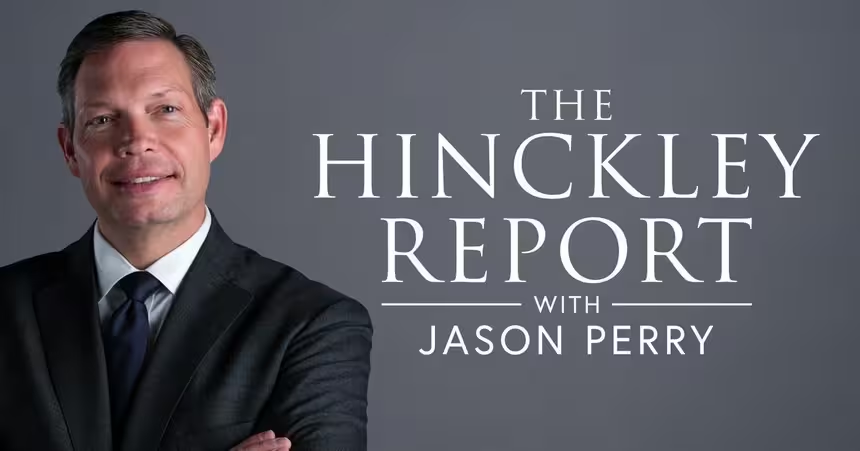
The Hinckley Report
Hosted by Jason Perry, each week’s guests feature Utah’s top journalists, lawmakers and policy experts.Providing Support for PBS.org
Learn Moreabout PBS online sponsorshipannouncer: Funding for "The Hinckley Report" is made possible in part by the Cleone Peterson Eccles Endowment Fund.
Jason Perry: Tonight on "The Hinckley Report."
Utah senators split their votes as a final decision is made on the next United States Supreme Court Justice.
Some candidates submit signatures to ensure their place on the primary ballot, while others leave their fate to the delegates at convention.
And new polling shows Utahns opinions on critical issues facing the state and country.
♪♪♪ ♪♪♪ ♪♪♪ Jason Perry: Good evening and welcome to the 200th episode of "The Hinckley Report."
I'm Jason Perry, Director of the Hinckley Institute of Politics.
Covering the week we have Lisa Riley Roche, reporter with the Deseret News, Glen Mills, anchor with ABC4 News, and Ben Winslow, reporter with Fox 13 News.
So glad to have you all with us this evening, we have a lot to get to.
I want to start with something happening in Washington D.C. that impacts the country though.
Lisa, start with you, we have a new Supreme Court Justice named, a United States Supreme Court Justice, Judge Ketanji Brown Jackson just had approval from our Senate.
Talk about first, without the politics, just the historic nature of this appointment.
Lisa Riley Roche: Well, here you have the first black woman justice poised to join the Supreme Court when Justice Breyer retires at the end of the term.
It was such an incredibly emotional moment for so many people to see themselves joining the court, the highest court in the land.
It was a moment for women, it was a moment for African Americans, it was a moment for so many people, and yet it was overshadowed to some degree by politics, and that's a little hard for a lot of people to see, I think.
Jason Perry: It's always interesting to see the politics in the Supreme Court nominees, and there certainly was that.
Glen, talk, let's start talkin' about that for a moment.
This was a very different reaction from our two senators from the state of Utah.
Glen Mills: Yeah, we've come to see that on a number of issues, especially the controversial ones, where Senators Lee and Romney split and go in different directions, somewhat reflective of what we see play out in the Utah GOP as a whole.
But it wasn't that long ago that Supreme Court Justice nominees would cruise through the Senate with maybe two or three senators voting against them, certainly within our lifetimes.
But we've seen a shift, no doubt, with Justice Thomas that got very contentious.
I remember when back in 2005 when President Bush nominated Harriet Meyer, remember that?
She was done almost immediately by the time he nominated her.
But in all fairness, I need to point out that was Republicans speaking out against her as well.
But we've just seen this partisan shift, and we only saw three Republicans vote in favor of Judge Jackson this confirmation.
Jason Perry: Ben, what do you make of that, and how does that play in the state?
We have Senator Romney, who voted for and, you know, talked about her qualifications.
He did acknowledge, probably going to have some rulings he doesn't agree with, but went towards her qualifications.
And we had Senator Lee who talked a little more about the judicial philosophy.
Ben Winslow: Well, to Glen's point, this kind of speaks to the divides even within Utah's Republican Party and how they view some of these things.
You know, the split, just you have certain groups that obviously had concerns with whether she should be on the bench there in the US Supreme Court, and then you had others who said, yeah, I may not agree with her rulings, like Senator Romney said, but she's qualified, she deserves to be there, let's put her there, and voting for it.
And I think that just kinda plays out, and what you're seeing is maybe even the polarization at play within our own state.
Glen Mills: One interesting point I wanna bring up real quick is she was up before the Senate just last year for the DC Circuit Court.
Senator Romney voted against her for the Circuit Court and for her in the Supreme Court.
I reached out to his team to try to get some insight on why that was, I haven't heard back from them as of recording, but I think it would be interesting to hear why he changed from no on the Circuit Court to yes on the Supreme Court.
Lisa Riley Roche: Senator Lindsey Graham of South Carolina did the opposite, right?
He voted for her for the Circuit Court and against her for the Supreme Court.
Glen Mills: And for what it's worth, Senator Leo was no both times.
But I believe Senator Lee, the first time she was up, 'cause this is her third time for confirmation, I believe he might have been a yes the first time.
Jason Perry: Ben, since you brought this up, I know you're talking to a lot of people in the state of Utah about this, these two very different approaches, how are they being perceived in Utah on the political side?
Utahns are gonna have a chance to vote for Mike Lee before they're gonna have a chance to vote for Mitt Romney if they do.
Ben Winslow: And it's gonna be fascinating to watch play out, because what you have is going into convention right now, of course, Senator Lee is beloved by the delegates.
We saw at the last state party convention, rock star treatment that he got, the cheers.
Senator Romney got booed.
But on the other hand, you also see in electorate general primaries and things, Mitt Romney did very well.
He was--a lot of people really liked him, very beloved in that respect, at least against his last opponent when it came to the results of the Republican primary.
So, you know, this is playing out here as well on a much smaller scale, obviously, compared to national politics, but it's still playing out.
Jason Perry: Lisa what's hanging in the balance?
We talk about politics of these picks, but there's some pretty big issues that are being decided right now by the current makeup of the United States Supreme Court, and some big ones will be coming down the road.
Lisa Riley Roche: There certainly are major issues coming up, and getting back to this this issue of the split that we saw over her nomination and how it was treated in the Senate, it's so interesting to me that most of the issues that were raised by the Republicans on the Senate Judiciary Committee seemed to have little if anything to do with what she would be doing in terms of dealing with some of these these major issues that are coming up.
You know, did she agree with a children's book that was in the library of a school she sat on the board of?
Could she define woman?
Could she talk about some specific things that might come before the court?
Well, a nominee doesn't do that because a nominee has to be able to look at issues with an open mind going forward, and that would certainly include the definition of woman for example, with transgender and LGBTQ issues continuing to head toward the court.
So, the fact that the Republicans based their whole attack on her nomination on things that largely had little if anything to do with those issues is very curious.
It just it--seems like we're getting more and more extreme in how we politicize these issues.
And something as important as the Supreme Court, it's astounding that we've gotten to this point.
Glen Mills: It's a show, the hearings are a show, and politicians are tryin' to score points with their base.
If you take a look at those questions that you just mentioned, they're all based on the hot issues of the day that are really driving people when it comes to politics right now, and they see that as an opportunity to say, look, I'm standing up for what you believe in here in the Supreme Court setting, when, and as you point out, really has nothing to do with what's going to happen on the bench.
Lisa Riley Roche: When does that base say--or how does that base grow though?
I mean, 'cause that's what politicians need to get elected, right?
Jason Perry: Let's talk about that base for a second, 'cause I want to ask you about the President Biden impact from this, Glen, since you brought that up as well.
'Cause Lisa is right, I'm gonna give you the Utah perspective, just the numbers from a poll that we did with the with the Deseret News recently, and President Biden has a 31% approval rating in the state of Utah, just over around 40% nationally.
Does this pick help him?
Does it help this base that Lisa is talking about?
Glen Mills: In the state of Utah or across the country?
Across the country, I think it might.
Here in the state of Utah, I'm not so sure that it will.
But when you talk about a president's approval rating, I still believe that most people are looking at economic issues and how they perceive presidential policies are impacting their pocketbook.
So, in the state of Utah, I don't see this nomination going through having much of an impact on his approval rating.
Jason Perry: Okay, let's talk about another Supreme Court pick, Ben.
Our own governor had a chance to nominate someone for the Utah Supreme Court, one already, and is going to have another opportunity.
Ben Winslow: Right, and this is an opportunity for a governor to shape the judiciary.
I should point out that Governor Cox's predecessor, Gary Herbert, appointed roughly 75% of the sitting judges in the state.
That's a huge impact on the judicial branch, and Governor Cox gets to appoint two Supreme Court Justices, Justice Dinos Himonas retired, Justice Thomas Lee is going to retire, so this is an opportunity for him to also shape the judiciary, because the Supreme Court, as we're seeing on a national stage with some of these big issues like Lisa mentioned, you also have local decisions, and there are some big ones that are coming up.
We've got a redistricting lawsuit that's no doubt gonna end up before the state Supreme Court.
They have decided important issues on transgender rights, they've decided issues on constitutional rights, they've interpreted legislative laws.
This is a big moment, and this is something why people should be paying attention to the Supreme Court and what these justices do, because even on a local level, they shape our lives, and the governor has a chance to put his imprint on, and, of course, he's gotta get through the Senate.
These nominees, the governor can appoint one, but it's the Senate that confirms them, and the hearings will be interesting to see if Judge Hagen's judicial philosophies, judicial temperament, things like that, the rulings in the past, if the Senate Confirmation Committee supports these things and if the Senate as a whole does.
I don't expect a lot of problems, in fact, I've been told not--no one really has any concerns or anything about this, but it's just another example of how these systems of government do work, and how they can have outsized influence on a lot of us.
Jason Perry: It's such a great point.
Glen Mills: And another example of how things are so different when you take a look at the national level versus the state level.
Jason Perry: Absolutely right.
Glen Mills: One other point I wanted to bring up on the national Supreme Court Real quick though is conservatives still have a strong grip.
When we talk about what's to come as far as the cases with abortion and other issues that the Supreme Court's going to be taking up, conservatives still have a strong grip on the court.
This move really doesn't change the political makeup of the court all that much.
Jason Perry: Let's get into just elections, because we talked about or set it up a little bit, but I want to get into that Senate race, the position held by Senator Mike Lee, because that is already getting pretty active here in the state of Utah.
As of this last week on the Republican side, Senator Mike Lee, Ally Isom, and Becky Edwards all got signatures.
So, Lisa, how does this play going forward, 'cause essentially all three of them, guaranteed a place on the primary ballot for the Republicans.
Lisa Riley Roche: Exactly, and what we're seeing is a real attempt to unseat Senator Mike Lee after two terms in the Senate here in Utah.
And we're seeing it at the primary level, obviously, with Becky Edwards and Ally Isom challenging him, and both of them going after more moderate voters, trying to pick up, perhaps, unaffiliated voters, and maybe even a few democrats.
But the real race is going to be in November, obviously.
And if Mike Lee, who polled very well for us in our Hinckley Deseret News poll recently, does win the primary, he'll face a really interesting general election, because not only will he have potentially Democrats, there's a whole nother issue there, but all those unaffiliated voters.
And remember, twice as many voters are unaffiliated as registered Democrat in Utah.
But he'll also have to deal with those Republicans who were unhappy enough with him to vote for one of his rivals in the primary, so there's a real opportunity for a coalition to be put together there and get behind the independent candidate Evan McMullin, who ran for president in 2016, and even got Mike Lee's vote.
Jason Perry: That's true.
Talk about how this is shaping up, Glen, because this is true.
So, this unaffiliated candidate, Evan McMullin, talk about Kael Weston, the Democratic candidate, but even this week we saw something interesting, this development when former President Donald Trump issued an endorsement of Senator Mike Lee.
Glen Mills: And Evan McMullin and his team were quick to point that out, because that's their strategy.
Is that, you know, they're offering this alternative to the Trump Republican, and so they were, you know, making sure to get that word out.
We haven't really heard from Senator Lee as to that endorsement at this time, so still kind of waiting to hear what he says about it, but Evan McMullin was quick to point it out.
Hey, the former president is endorsing Senator Lee.
Jason Perry: Uh-huh, do you think we'll hear more from Senator Lee about that endorsement or is that--Glen Mills: Hard to say.
It might help him, potentially, in the primary setting, and then not so much in the general, so I guess we'll just kinda have to wait and see whether he'll embrace that or not.
Lisa Riley Roche: It's not even clear it'd be helpful in the primary, right?
I mean, it would certainly be helpful at convention because those are those are the pro Trump voters, right?
But in the general, I mean, in the primary election, you have a lot more moderate Republicans.
I mean, clearly you've got candidates trying to take advantage of that, so.
Glen Mills: I think a general consensus in the primary is that with both Ally and Becky on the ticket, that really opens up the door for Senator Lee, because they are going to split that more moderate voter, the vote that you're talking about.
And I really expected to see some kinda deal worked out between those two to get one of them off the ticket, but obviously we didn't see that happen.
I know efforts were made to try to make that happen, but it didn't.
Ben Winslow: And then it all repeats itself again heading into a general election whoever survives the primary, and it's gonna be interesting to see if the Democrats actually do advance a candidate out of their party convention.
There has been discussion about not advancing a candidate, and we've seen, just as you see Republicans engage in their own party in-fighting, you see Democrats doing the exact same thing, and that's gonna be interesting, because we know that former Congressman Ben McAdams has been a vocal supporter of Evan McMullin, Mayor Jenny Wilson as well, and that's playing out.
Those are two big party names in the Democratic Party who are backing an independent candidate because they believe he has the better shot of winning or possibly defeating the incumbent should he advance to the general election.
So, it's going to be interesting to see how this all plays out and what happens when you--for whoever gets through the primary on the Republican side.
Jason Perry: What do you make of, while we're talking about these candidates, we talk about this endorsement from president--former president Trump, but while he made that endorsement, he also took the opportunity to take a shot at Evan McMullin and Mitt Romney.
Ben Winslow: The former president has been known to hold grudges, and it's clear he is still very upset with Senator Romney.
Evan McMullin, of course, was a presidential candidate the last go round, and--or, excuse me, against Donald Trump, and it was--he did okay in Utah.
I mean, did better than he was expected to.
Jason Perry: Yeah, yeah, true.
We'll watch this one play out a little more.
I want to get to our members of Congress, because we--they're all up for election, and it's so interesting, Lisa, 'cause I want to talk about their approach.
And you really can't talk anymore about position in Congress without talking about signatures and sort of the decisions our candidates have to make.
Do I get signatures, ensure my place on the primary ballot, or do I leave my fate to the hands of the delegates?
And we only had one member, current sitting member of our delegation in the House that got signatures, and that was Congressman Moore.
Lisa Riley Roche: I think the biggest surprise is that Congressman John Curtis did not gather signatures to guarantee a place on the ballot, because, remember, when he was elected initially to replace Jason Chaffetz in a special election, he did not do well at all at the special convention, right?
And he was far down the list of candidates that the delegates wanted to advance.
Now, clearly he's got a record to stand on, and I don't think he's done anything that would be seen as particularly offensive to delegates, to the more conservative base of the party, but there are some pretty conservative candidates, including Chris Herrod, a former state lawmaker, who was one of the people who did very well against him initially who's running again.
So, Curtis could be in a pretty dicey situation with the convention.
Glen Mills: Yeah, I'm kinda shocked that he didn't choose to gather signatures.
I would guess that he's taking a look at it, as you mentioned, that special election, I think he finished fifth that year.
He wouldn't have been on the ballot without signatures.
The following year, he did a little better with delegates, but still had a primary.
Then in 2020 he finally got through convention, and he did face Chris Herrod back then as well, and without a primary, so I think he's probably looking at it as, you know, I've made head ground with delegates.
Last time I didn't have to worry about it, so this time I'm putting my faith in them, but a lot of people are saying this may not be the year for him to do that.
Jason Perry: Yeah, go ahead Ben.
Ben Winslow: I mean, delegates, what we've seen at least in county party conventions, delegates are a little more conservative, on the conservative ideological spectrum, they're a little more on the the right leaning conservative, so there is a little bit of a sea change.
I don't know if that's gonna play out all the way to state convention, but it appears to be tracking that way.
What is also really interesting about this is you're seeing the signature caucus convention system playing out, and I'm going to be curious to see after this election cycle what the legislature does.
If they continue to allow this, or if they try to put a stop to it, and past efforts to try to put a stop to the signature gathering have not gone well for the legislature.
Glen Mills: One other note on that, Senator Lee, I think we'd probably all agree is the convention darling.
He gathers signatures.
That tells you a lot, and that's why I'm still looking at the Third race and just really surprised that Curtis didn't do that.
Jason Perry: Right before I leave this, Lisa, it's interesting so our viewers know, for a House race you need 7,000 signatures.
And as some of these members, as they're making that decision, say, I guess it's not that huge of a hurdle, but it's an expensive hurdle, and that's sometimes was playing into these calculations as well.
Lisa Riley Roche: Exactly, it does cost quite a bit of money to go out and gather signatures.
But if you want to get reelected, it seems like you would want to make every effort, and Glen's point is a very good one.
If it's good enough for Senator Mike Lee, who is arguably the most conservative member of the delegation, that should give cover to any other Republican.
Ben Winslow: At this point, you kinda wonder, shouldn't every campaign just budget it in that you gather signatures?
Just if you want to ensure a spot on the ballot, because that's what it's meant to do is guarantee you a spot on the primary ballot.
Jason Perry: Let's talk about the people who are--who can help guarantee if you don't have the signatures, these delegates.
Glen, I want to just get a comment from you on what's happening with these delegates, because we've had a couple of election cycles now where we talk about party raiding where you can kinda strategize in such a way, so, if I'm a Democrat, I'm--maybe I'm Jim Dabakis, as I recall, say, register as a Republican and pick the greatest one or the most conservative one.
Talk about how that's working this time post what we've seen in the past.
Glen Mills: So, in the race for Governor we have Jon Huntsman coming out and encouraging people to do that very thing, and we saw big movements in 2020 from Democrats and unaffiliated to the Republican Party.
We didn't see that this much this time.
Now, Representative Tusher, who ran that bill, came out with this statement saying that he believes what he did worked, but I don't think you can really compare the two years, because, one, I think 2020 was just a bigger draw with the race, and, two, this year the Democrats aren't necessarily focusing on the primary, as we've established in this show.
They're looking forward to the general election, the one race they want to make a difference in in the race for Senate.
They're focused more on the general than they are the primary.
Ben Winslow: There was also a sense, with the deadline moved up, people weren't necessarily paying too close of attention to the party switching deadline, and the way that the law is structured, it's still for if you are a registered in one party, whether it's Democrat, Constitution, whatever, if you want to vote in the closed Republican primary, you need to switch your party affiliation, and you can really switch your affiliation if you're a Republican and you wanted to become a Democrat, it works the same way.
But what it doesn't apply to is unaffiliated voters.
And that'll be interesting to see what happens, is how many people who are unaffiliated decide to affiliate before the June primary.
Jason Perry: Lisa, make this our last comment on this too, because you brought this up a moment ago as well, that March 31 deadline.
If you are affiliated, that's when you have a chance to change, but it really does not give us a full view at all about who might show up for these.
Lisa Riley Roche: To Ben's point exactly, we have twice as many unaffiliated voters in this state is we do Democrats, and I think that that new law actually creates a little bit of confusion.
I know I had to check that out before the show to make sure I understood it correctly, 'cause even reading the law--but you still have time if you're in unaffiliated voter to affiliate with a party, and in this state, the Republican primaries are closed, meaning you have to be an affiliated Republican to vote, but the Democrats are open.
So, if you're interested in voting in the Republican Party and are unaffiliated, you can do it right up to and including election day.
Jason Perry: We'll watch this one close, so many dynamics at play.
I want to talk about one more dynamic as we get ready to close here, because I see this being a major issue, certainly in the state of Utah, but on the national stage, and that issue is inflation.
It's getting so expensive for everything, and we've done some polling as we talk about the Deseret news, 93% of Utahns said they're concerned about it, but what's interesting, Ben, comment on this, is only 38% of Utahns said they saw their salary increase over this past year while costs continue to go up.
Ben Winslow: How much does this water cost again?
I mean, really.
No, it is, it's a big concern for everybody.
Look, we're all feeling it, because we all, you know, gotta go buy groceries, we all gotta buy, you know, things to get around, and costs are going up, and, yeah, wages or not.
And you're starting to see, that's why I think you're also seeing the little bit of the great resignation that is, of course, all over this state, and people are leaving because they're like, I can get a better gig somewhere else and make more money here.
Wages have to keep up with the inflation, or inflation's gotta come down.
It's--this is--this is--we're hitting this point, and people are feeling it, people are feeling it directly, and people do vote with their pocket books.
People vote strongly with their pocketbooks.
Glen Mills: I see that being probably the number one factor going into election.
Lisa Riley Roche: Well, the Ukrainian war kind of throws a little bit of a wrench into anyone that would want to use that to oust the current leadership, because it is affecting, obviously, gas prices in a big way, and I think gas prices are the one thing, that and housing, gas prices though are the one thing everyone uses every day and have really, really gone up.
But there is that that caveat that in some--at least some measure, it's due to the fact that the Ukrainian war has caused us to stop Russian oil imports and upset the markets.
Jason Perry: To that very question, it's interesting, 'cause we asked Utahns if they'd be willing to pay more money for their gas if it meant restricting oil and other things coming from the Soviet Union, and Utahns, Glen, said yes.
In our last 15 seconds.
Glen Mills: Yeah, they probably say yes, but still want the gas prices to come down, would be my guess.
But there's a sense of support for Ukraine in Utah, and I think that has a lot to do with driving that number.
Jason Perry: Absolutely right.
Thank you so much for your great analysis this evening, it's been exceptional.
And thank you for joining us as we mark the 200th episode of "The Hinckley Report."
We're so grateful for your viewership and your support as we've reached this historic milestone.
Thank you.
This show is also available as a podcast on PBSUtah.org/HinckleyReport or wherever you get your podcasts.
Thank you for being with us.
We'll see you next week.
♪♪♪ ♪♪♪ ♪♪♪

- News and Public Affairs

Top journalists deliver compelling original analysis of the hour's headlines.

- News and Public Affairs

FRONTLINE is investigative journalism that questions, explains and changes our world.












Support for PBS provided by:
The Hinckley Report is a local public television program presented by PBS Utah
Funding for The Hinckley Report is made possible in part by Cleone Peterson Eccles Endowment Fund, AARP Utah, and Merit Medical.