
Pontiaconnect
Clip: Season 48 Episode 51 | 10m 37sVideo has Closed Captions
Pontiac | Episode 4851/Segment 1
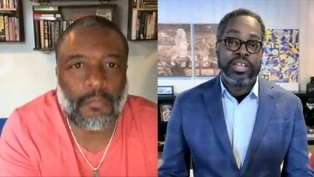
The city of Pontiac is using new technology to keep its residents informed during the covid-19 pandemic. The city has launched a free mobile app called “Pontiaconnect” that provides information such as Covid-19 hotspots, testing locations, pandemic guidelines, and other news. Stephen spoke with Pontiac mayor Deirdre Waterman about this new tool and how the city is doing on the economic front.
Problems playing video? | Closed Captioning Feedback
Problems playing video? | Closed Captioning Feedback
American Black Journal is a local public television program presented by Detroit PBS
Pontiaconnect
Clip: Season 48 Episode 51 | 10m 37sVideo has Closed Captions
The city of Pontiac is using new technology to keep its residents informed during the covid-19 pandemic. The city has launched a free mobile app called “Pontiaconnect” that provides information such as Covid-19 hotspots, testing locations, pandemic guidelines, and other news. Stephen spoke with Pontiac mayor Deirdre Waterman about this new tool and how the city is doing on the economic front.
Problems playing video? | Closed Captioning Feedback
How to Watch American Black Journal
American Black Journal is available to stream on pbs.org and the free PBS App, available on iPhone, Apple TV, Android TV, Android smartphones, Amazon Fire TV, Amazon Fire Tablet, Roku, Samsung Smart TV, LG TV, and Vizio.
Providing Support for PBS.org
Learn Moreabout PBS online sponsorshipSo you have a lot going on in Pontiac, and I wanna get to a lot of it during this interview.
But let's start with this new app PontiaConnect.
Tell us what that is, and how it's helping city residents.
Pontiac is the pilot site for something called a mobile engagement app, and that's an app, as you said, called PontiaConnect, and it was devised as another platform for social networking and distribution of information.
You know, communication is one of the currencies of our modern age, being able to communicate.
And so, particularly that was important for a couple reasons at this particular time.
Number one, with the advent of the COVID-19 and this pandemic we're having, it was important for us for the health and safety and information of our population to be able to get out good information.
And so, the app has particular designation as being able to get out resources, where testing sites are, questions people have, and in the era in which there's a lot of faulty information, we wanted to have a reliable source of good information for the safety and welfare.
And we know how much this has impacted communities, and it's disrupted everybody's life in one way or the other, but it's reality.
We're now beginning to finally see the end of the tunnel, now that we're being able to talk about people being vaccinated, because that's the way in which we can put 2020, and all the challenges of this year, in our rear view mirror very soon, as we're now gonna be talking about how we get this vaccination out into the general population.
So the PontiaConnect has all those features.
We were picked, as I said, as the pilot city to do this by a company called Kyyba, and they are a software company that specializes in global technology issues.
And so, they came to us, and said would we be willing to develop this with them, and we did.
So we have launched it, and this is an app that's available free.
People can download it from both the Google Play and the Apple Store.
So that is a way we're getting out information, as well as it has some COVID-19-related information including the more people who sign on, we have the heat maps, and it's actually a way that we'd introduce for contact tracing.
Yeah.
In addition to the fact that there are also platforms to just get out real information.
So we're able to communicate breaking news items, of which there are a number happening, also advisories and warnings, and just to kind of distill the current information of which people are being barraged by information from all sources, and we're able to get that, some of that out that's been tried, and trued, and tested, and comes out as a reliable resource.
So it's called PontiaConnect with one C in the middle.
That's available right now, and lots of people are signing on, and we're feeding it with good information, and reliable resources, and just good news.
Yeah.
In this era, in which good news is sometimes hard to come by.
It's been a tough year for good news, no question about it.
(Deirdre laughs) Let's talk about how Pontiac has fared during the pandemic.
We've talked a lot on our show about Detroit, and Southeast Michigan.
We've haven't heard specifically from you, or anyone else about what this has just been like, taking care of people, trying to keep people safe during the pandemic.
What have the last eight or nine months been like there?
Just like all other municipalities by the country, we have been under the siege of this pandemic.
So as an elected official, as the mayor of this proud city, which is an honor to serve, I realized my first responsibility is the safety and welfare and health of the population.
That's our first and foremost responsibility.
So while we had to keep the city rolling, and there's lots of stuff going on, so we didn't skip a beat on that, but we had to make sure that we took every occasion and opportunity to make sure that the health and safety was a priority.
So we did all the things we needed to do in terms of alerting people to how important testing was, set up test sites here in the city, in fact, we had some free test sites available just this last weekend, made sure people were aware of all the guidelines, gave out good information for that, made the safety of our staff, and we had declared an emergency of the city as far back as early March, in which we closed on our senior centers and our youth rec center.
I have since given guidelines, and changed the way we operate internally as the city to be able to continue to function, because we had so much going on, we couldn't miss a beat.
We still had to give all those services to our citizens.
We still had to make sure the streetlights were fixed, still had to make sure the streets were swept, and all those sorts of things.
So we had to have our staff still continue to operate for everything that citizens expected with the same quality, but under the new guidelines, and just observing all the principles we had to under this new COVID-19 mandate that we're under.
Yeah.
So, we have done that and kind of dancing forward, and still, it's like patting our heads and chewing gum at the same time.
And so, there was a certain art and technique and challenge to doing that, but I'm so happy to say that we've got a really dedicated staff of experienced professionals that I've recruited to come serve the city, and they had done that all well.
Even before this started, you know, Pontiac was changing pretty rapidly, I feel like, and there was a lot of economic investment that was starting to take hold, and really prevent, present opportunity to the residents there.
Catch us up on where you are with all of those things.
So yes, Pontiac is creating a new narrative about ourselves here, and people remembered Pontiac from the days in which we were pretty much a General Motors town.
So when General Motors kind of downsized and changed, so did Pontiac, as well as a number of other industrial cities, manufacturing cities along that I-75 Corridor.
So we likewise were affected by that, but you know, Pontiac people are resilient people.
We're very proud of our automotive heritage, but we also have moved forward into that post-industrial age with a strategic plan and a consensus-formed strategy of how we move forward and continue to build our economic development base.
And we have done that, and created a whole new narrative about the city of Pontiac.
One of those new narratives that people are becoming more familiar with as we talk about that is the fact that we are now claiming our rightful place as the county seat of Oakland County, one of the most prosperous counties in the nation, and whereas Pontiac used to be known as the hole in the donut, we're nobody's hole anymore.
We're very much a thriving metropolis, and we have certain unique capabilities, such as our downtown.
We're the only, one of the only cities in Oakland County that has a downtown that's thriving.
We have recently come up with a really good solution for a problem that I inherited from an attorney, the emergency manager, and that was our Phoenix Center, our amphitheater complex, which we, just now, the ink isn't even dry on the deal yet.
You know, we're still working out the final terms of that, but that, we're really happy to resolve that, because that's going to be a catalyst for investment and that whole opportunity zone that we've established in the center of the city is gonna open up that investment in our downtown, which is already drawing a lot of attention from investors.
So we're drawing kind of businesses to the city that Pontiac had never been the site of before, and they are thriving, and there have been testimony to what's going on with economic development in Pontiac.
So whereas some other cities, you know, will be impacted, as we all were, by somewhat of COVID-19, Pontiac now has a sort of cushion and insurance, in the fact that we've had companies that come in now, have seen that Pontiac is a good place to do business, and I'll name some that are kind of well-known around the dinner table, Amazon, for example, where we used to have the Silverdome, they took over that whole Silverdome site.
And they now have committed to doing a distribution center, which is already done.
It's known as The Hub, as well as they're in the process, in the area of completing a fulfillment center, and this is the first time anywhere in the United States that Amazon has put both a distribution center and a fulfillment center on the same site.
That's how much they liked being in Pontiac.
(Stephen laughs) In addition to that, we have a number of companies that have come to Pontiac and have thrived, we've, kind of come to Pontiac from their other places, such as United Shore, which is known because it's now going to NASDAQ.
It came to Pontiac with 2,500 employees, has now climbed to number one in the wholesale mortgage business, now going to NASDAQ, and from the 2,500 employees that they brought two years ago, they're now at 7,000, would have been at 10,000, had it not been for the pandemic.
But I hear from the owners and president just a few weeks ago that they foresee that they will be at 15,000 employees at the end of next year.
Wow.
So that's a sixfold increase in growth, and they've bought up additional properties, because Pontiac has been a good place for them to grow and thrive, and this is a good time to do business.
Right now in Pontiac, we have 40 new building projects.
Wow.
This is the most new building economic development we've had, I understand, since the early days of General Motors, so that's saying something.
So pandemic or not, Pontiac is still growing, and thriving, and creating a new narrative, and the people who've discovered that this is a good place to do business, a good place to invest, a good place to buy a home.
For example, our housing stock, we're working on increasing our housing stock.
The average time it takes to sell a home in Pontiac is, in most neighborhoods, is three days.
Wow, wow- Three days, okay?
So the word's getting out about Pontiac, and we're creating a new narrative.
I'm excited about that.
Video has Closed Captions
Clip: S48 Ep51 | 10m 8s | Mi Roundtable | Episode 4851/Segment 2 (10m 8s)
Providing Support for PBS.org
Learn Moreabout PBS online sponsorship New Episode
- News and Public Affairs

Top journalists deliver compelling original analysis of the hour's headlines.

- News and Public Affairs

Today's top journalists discuss Washington's current political events and public affairs.




 New Episode




 New Season
Support for PBS provided by:
American Black Journal is a local public television program presented by Detroit PBS