Positively Kansas
Positively Kansas Episode 1306
Season 13 Episode 6 | 27m 30sVideo has Closed Captions
Wichita’s most iconic landmark turns 50 years old.
Wichita’s most iconic landmark turns 50 years old. Also, see why a Valley Center boy and his dog make a great team. Plus, explore the joys of flying a kite in the brisk Kansas wind.
Problems playing video? | Closed Captioning Feedback
Problems playing video? | Closed Captioning Feedback
Positively Kansas is a local public television program presented by PBS Kansas Channel 8
Positively Kansas
Positively Kansas Episode 1306
Season 13 Episode 6 | 27m 30sVideo has Closed Captions
Wichita’s most iconic landmark turns 50 years old. Also, see why a Valley Center boy and his dog make a great team. Plus, explore the joys of flying a kite in the brisk Kansas wind.
Problems playing video? | Closed Captioning Feedback
How to Watch Positively Kansas
Positively Kansas is available to stream on pbs.org and the free PBS App, available on iPhone, Apple TV, Android TV, Android smartphones, Amazon Fire TV, Amazon Fire Tablet, Roku, Samsung Smart TV, and Vizio.
Providing Support for PBS.org
Learn Moreabout PBS online sponsorshipIt's time for Positively Kansas coming up.
Wichita's signature landmark reaches an historic milestone.
We look back at 50 years of the keeper of the Plains.
Also, in a windy state like Kansas, kite flying is a timeless way to relax and enjoy the outdoors.
We'll introduce you to Wichita's King of the kites.
Who's made this a lifelong pursuit.
Plus, learn about this boy and his dog and see their amazing talent in action.
Hello, I'm Sierra Scott.
Those are just some of the stories that are cued up and ready to roll.
30 minutes of information and inspiration starts right now on Positively Kansas.
50 years ago, it was something new to see and appreciate.
Along the shore where the Big and little r Kansas rivers converge.
In the years since Wichita was keeper of the Plains, statue has become the city's most recognized symbol and a true icon of the Midwest.
Chris Frank was there for the big birthday celebration.
The keeper of the plains prominently rising above the confluence of our two Arkansas rivers, has become an identifying symbol for the city and county in the past half century.
It is often referred to by locals simply as the keeper or just keeper for sure.
Keeper is the name the statue's designer, Francis Black Bear Bozeman, gave it in 1974 when it was dedicated.
Whereas the sculpture was created by Native American artist Black Bear Posen.
50 years later, Kansans turn out celebrating the iconic statue, reflecting on their own memories of keeper.
I think the keeper of the Plains is pretty special for a couple of reasons.
I have a lot of memories throughout the years of coming to visit this with my own family.
especially seeing the Ring of Fire light up.
but also, I just think it brings us back to, you know what started Wichita?
What are our foundations?
So I think it's important for us to remember we are here today at the confluence of the two Arkansas rivers, 50 years to the day when this iconic statue was first dedicated, first conceived as a way to cover up some unsightly equipment.
Kewanee now Evergy, asked Blackbear to design a statue to beautify this area.
Focusing on our native culture.
Roger's statement points to the backstory of how keeper came to being folks at Kansas Gas and Electric GE, and now Evergy had the corporate art idea to donate to the city.
Bob Reeves, a former KG&E vice president, explains, KG&E at that time had an active power plant just across the river east from where we stand right now.
And Elmer Hall, who was a vice president, and his responsibilities included that plant wanted something to help make the corner look better, where the rivers come together, and something that related to the history of the geography.
As Reeves says, on the river's east bank, the electric utility had a long standing power generating plant.
It now houses averages control center next to it.
Power distribution equipment is located.
At that time, this equipment wasn't hidden as well as it is now.
In the 1960s and 70s, the generating station and outdoor equipment were considered, well, unsightly.
And yes, the word ugly was also used to describe the area.
It was a period when Wichita was awakening to the potential of these riverbanks, to raising the city's downtown image, something that continues to this day.
The riverbank attractions and pedestrian walkways we take for granted now were dreams.
Then KG&E vice president Elmer Hall wanted to deflect attention away from this while also honoring Wichita's first residents, Native Americans.
So he decided to talk to Black Bear and that all then, over a period of about six years, led to the design and construction of the keeper.
it was 50 years ago today that it was originally dedicated, but it goes back about six more years to when the concept originated in Wichita State University historian Craig Miner later wrote, KG&E had another reason to promote a public work like this.
The utility was working on the plans to construct the Wolf Creek Nuclear Power Plant.
Utility executives knew there would be public opposition.
The hope was to buy some public goodwill before anti-nuclear protesters laid themselves down on the railroad tracks.
As the train carrying the nuclear reactor arrived at Wolf Creek, something I was on hand to witness and to report on in January 1979.
So that's the back story.
Black Bear Bozeman was already well known for his paintings capturing Native American culture.
Here's a portion of the documentary.
Keeper 150 PBS Kansas, produced in 2021, funded by Together Wichita.
These two over here are acrylics.
which is more oil based?
The living room of Doctor David Simmons home in Newton is lined with copies of the paintings.
His famous stepfather, Francis Black Bear Bozeman painter.
Basically, I've been the guardian of the copyright of all black bears, works for about 25 years now.
So who would know more about Black Bear Boseman's work than Simmons?
Yeah, no.
One black bear Bozeman was born near some in Oklahoma.
The Kiowa, Comanche, Native American moved to Wichita at age 19, in 1940 to work in Wichita's aircraft industry.
Simmons says his stepfather's interest in art started as a high school student in Anadarko, Oklahoma.
After school, he would do a little paintings, and sell them door to door for a dollar, dollar and a half.
When asked why, Bozeman would reply, have you ever tried to pick cotton?
That was the alternative.
So he was happy to make money?
Yeah, doing doing some art.
Bozeman gained worldwide fame as a Native American artist.
You can learn more about his life in the book Black Bear Bozeman Keeper of the Indian Spirit, written by Simmons.
Simmons says Black Bear Bozeman's idea was to try new things when producing artwork.
He didn't stick to the traditions of Plains Indian art, his stepson says.
But his idea, was always, to try things.
And and I think he would see this in that light.
Black bears health was declining at the time.
Cagney's Elmer Hall asked the artist to sketch ideas for a sculpture that happened just by happenstance.
I was with Elmer when he went to the hospital to see Black Bear, where he presented several sketches he'd made of potential, had maybe half a dozen different Indian themed ideas.
But this concept clearly stood out from the others he had, and he was enthusiastic about it.
Elmer was, and it kind of began from that hospital bed city, state community fund raising, including the help of the Quivira Council of Boy Scouts and the work of architectural metal products, help complete the funding and get the keeper installed.
In 1974.
Black Bear never sculpted before or after keeper.
His art was on canvases and paper, so to his credit, Black Bear didn't try to micromanage the work.
Once he turned it over to engineers and metal workers, there were some things the artist wanted, but was told they were either too complex for the builders or wouldn't stand up to Kansas winds.
Margaret Williams Norton authored keeper of the Plains, Black Bear, Bosons, Great Indian in Wichita, Norton writes, Black Bear requested no payment.
His payment was honor and a chance to donate a significant work to Wichita, Norton writes.
Black Bear single issue seems to have been the justness of, quote, putting the Indian back on the plains.
Black bear named the sculpture keeper, saying keeper was significant to his Kiowa ancestors.
In 2006 and 2007, the city of Wichita made major renovations, elevating the keeper with Kansas limestone building, the two walkway bridges, and more features, greatly enhancing the keeper's presence.
The keeper is definitely our most recognizable icon.
I think, everyone relates to it.
the placement of it is just beautiful in that river setting, because the keeper is a symbol that everyone in Wichita knows, and I think everyone in Wichita appreciates and everyone in Wichita, there's no downside to it.
The statue means different things to different people.
Mary Garcia has smaller keepers in her own yard.
She thinks of the keeper as watching over the city, for the river's come together and he's a keeper, kind of on the plains.
And it's like keeping with our safe.
Black bear signature work has been embraced by most Wichita over these five decades, and with this statue, as the artist Blackbear was fond of saying, I have put the Indian back on the plains.
This is Kris Frank for Positively Kansas.
You can learn more about The Keeper and see its profound influence on Wichita by watching the PBS Kansas documentary, keeper 150.
You'll find a link to it at kpts.org.
For thousands of years, people shared a special relationship with dogs at Valley Center.
Teenager and his dog have an athletic relationship that's propelled them to national prominence.
Jason Massingill shows us their bond.
speed, agility, ... sassiness?
So her sassiness is actually what we got her for.
We wanted her to be fast, confident, and sassy, and she showed that when she was a puppy.
Meet Onyx, a Shetland Sheepdog.
Onyx is Hayden Brown's canine partner and friend.
Now, she's not just a normal dog, she is one of the fastest dogs that I know.
Yeah.
Hayden Brown yeah, yeah.
A sophomore from Valley Center noticed that speed and has been training Onyx since she was eight weeks old.
when I started training her, I wanted her to be fast and confident in the ring, and it's been a long time in the making.
But we're there, Hayden Brown has been training dog since he was four years old, and has been training agility since he was eight.
yeah.
There is a lot of adrenaline for both the person and the dog at an agility competition.
The dogs are usually mile high and ready to run like a racehorse.
You put them on the start line.
They don't want to stay.
They want to go, of course, consist of 19 to 23 obstacles test speed and agility.
You have all kinds of jumps, tunnels and weave pulls.
A lot of times they'll have contact obstacles called an A-frame, dog walk and teeter totter, which is basically the equivalent of a seesaw for kids.
And Onyx loves to run them.
Her favorite thing to do is actually the falls.
Surprisingly, I've trained so much value into them that she, doesn't want to stop doing them and not only takes a talented dog to win agility competition, but also a brilliant strategist to navigate the terrain of a course.
I will have eight minutes to memorize them and five minutes till we start running dogs.
And then I have to remember the course that I've walked and how I'm going to handle it for the best for my dog.
It's fast and fun for you to be able to run with your dog, and it creates a relationship that a lot of people sometimes don't have.
Onyx seems to feel that way too.
So come in and bark at me and tell me that I messed up on a cross or something like that.
Hack is very intelligent.
She knows when I do something wrong and she's not afraid to tell me about it.
Go to say Hayden and Onyx are great team would be an understatement.
It has recently been announced by the American Kennel Club that the pair, along with 25 other handlers and their canine companions, are part of the 2024 USA Junior World Agility Team.
Didn't know what to say.
I was surprised and excited and, just honored to do it.
So with the bright future, Hayden trains with Onyx, excite for the next challenge.
Yes!
Good girl.
She has been a wonderful friend and partner doing this and I don't know what to say else about her.
She's an amazing dog.
This is Jason Massingill for Positively Kansas, Hayden and Onyx recently achieved their longtime goal of by qualifying for the Junior Open Agility World Championship in Belgium.
There are some things you can't do in Kansas, like surfing and mountain climbing, but flying a kite, this state was built for it.
Jim Gray shows us how a Wichita couple spreads the gospel of kite flying every chance they get.
For all the trial and error, death and destruction people endured trying to build flying machines not that long ago.
Kites have been known of and flown since the fifth century BC.
The Chinese had silk and bamboo readily available, and those made excellent materials for building kites.
In fact, it was a Chinese dragon kite that Mark Adams's parents saw flying over the San Francisco Bay in 1975.
That started his lifelong love of kites.
And they thought that I would be really intrigued with them and brought several of them home to me.
And I went out and flew them, like, right away and had never seen anything like it.
It just thrilled me that I could do something like that, but I probably never would have gotten involved if they didn't bring those kites for me to try.
Ever since, Adams has been piloting and preaching the joys of kites.
The generation after generation of Kansans, he organizes kite festivals like this one at Wichita's Champion Park.
So have your kids flown kites before their first time ever?
Yeah, the first time, you know, kind of brings the kids out of.
Yet no matter how Mark's wife Susan is right there with him and finds a lot of meaning and value in this kind of high flying fun.
This is a kind of like a rare connection nowadays, that you can have a father and his daughters out here.
I brought them.
Are spending time making something work?
Maybe it doesn't work right away.
So, you know, you get to kind of problem solve that.
You're the kids.
And I think it's really important also for, people to get away from their electronics and their four walls and get outside and just enjoy something that is, just you in nature.
Below the Adams's evaporated kite store is off and on through the years.
In 1979, Mark was featured in a Harrisburg's People story, and he demonstrated how it's possible to fly a kite indoors.
Not only are kites an outside sport, but an inside one as well.
This is an Indian fighter kite, and it's designed for speed, precision and maneuverable.
But it is outdoors, where the wind and sunshine make for a beautiful and peaceful flying experience that brings out the kid in all of us.
Now, can I up in Wichita for Positively Kansas, I'm Jim Gray.
Our human fascination with flight goes way back to the first time anybody ever saw a bird or a bug flying through the air.
In this week's Kansas Wild Edge Report, Mike Blair explains why one flying bug in particular does an important job, and it's fascinating to watch.
At the same time.
In the heat of summer, you can always count on plenty of bugs.
The air is full of flying midges, gnats and mosquitoes.
These can range from minor annoyances to reasons to stay indoors.
And if it weren't for nature's predators, it would be even worse.
Birds come to mind.
Some are fast and agile, able to snatch insects out of the air.
Homeowners sometimes put up nest boxes, hoping to attract birds like purple martins that may help control mosquitoes and other unwanted pest.
The birds have large energy requirements, and they usually prefer meals larger than a net sized snack.
So better hunters are needed for small prey.
And fortunately, there's a perfect prospect dragonflies.
Emerging from their underwater formative life stages, these deft fliers are the falcons of the insect world.
They can fly more than 30mph and maneuver with astonishing skill.
Their large compound eyes can see with excellent acuity in all directions at once, allowing them to hunt from purchase or on the wing.
Their most impressive displays occur in late summer, when some dragonfly species hunt in large packs.
This may be close to the ground or high above it.
At this time of year, tiny insects fill the air.
Though they are usually invisible to ground observers.
The dragonflies course this way and that, picking off victims in abrupt, darting motions.
They eat on the wing and they can consume huge numbers of mosquitoes and flying net.
Occasionally, mid swarms arise over vegetation to provide easy pickings for the dragonflies.
With fighter like attacks, the predators strafe these prey clusters relentlessly, eating huge numbers daily and unchallenged sorties.
These feeding frenzies, mostly unnoticed, are fascinating to watch.
Be on the lookout for summer dragonflies, Airshow specialists.
To keep the tiny flies of the world in check.
I'm Mike Blair for Positively Kansas.
Now to the underwater world of tropical fish.
This week, photojournalist Ogden Harry visited a group of Wichita aquarium enthusiasts.
See how they escape into their little aquatic worlds of motion and color.
All right.
I kind of like the sound of the water.
You can hear some of the water with the bubbles and the, the filter.
You can kind of hear it.
And so just listening to that in the silence, for me, it's very peaceful.
My stepdad had one in our house growing up.
And so seeing that just really made me want to get my own.
And then when I finally moved out and got married, you're able to get our own fish tank together.
I'd say I've named some of my fish after some family members fish.
Our first tank, we had five and then we slowly brought in more fish.
Over time I feed them all my fish.
A variety of diets.
I have flakes, I also have frozen.
So I have frozen brine shrimp.
I have blood worms.
I have this powder that I boil water and then I pour.
I mix it together and I pour them into these little heart molds.
and they get excited.
Any time you bring food, they kind of just do their own thing.
But as soon as they see me walk towards the tank, then they start to go crazy that they swim towards the glass.
It almost looks like they're looking at me.
I can watch their eyes and where it moves, so they can definitely see me and they know that I'm there.
You ever you ever go to the gas station and you watch the pump while you're pumping gas and you see it going backwards.
That's that's kind of like the fish hobby.
Yeah.
So when we first got our tank, we went to Exotic Pets to get our guppies and we ended up talking to the manager at the time, Carter, and he told us about this fish group.
Well, the group was actually started, in 2010.
And, I joined the group just as a member.
And, I got real excited and I invited a bunch of people over to my house, and, you know, we made food, we had drinks, and I think eight people showed up.
It was pretty terrible.
the group of small was really dedicated to cichlids, and it was only about 300 people at those events.
Like I really like that.
It's a place for everybody to get together.
They all have a common hobby and they get together, talk fish with each other, exchange stories or tips or, just kind of get to know one another and create friends.
And, you know, they're all into the same hobby.
And after the meeting, the founder came up to me and he said, do you want the group?
He goes, I'm tired of doing this.
Would you be interested in taking over?
And so I said, sure.
It just felt like there were other people who had this intense passion to, you know, love on these fish, take care of them, saw them more than just like a fish in a bowl.
So it's addicting.
Honestly, fish people are never happy with what they have.
Like they're never happy with.
They're only satisfied by their aquascape for so long until they have to change it.
I've been held captive by fish since the second grade.
My second grade teacher brought a, aquarium to school, and that was the kind that had the metal rims around it.
And the and the black slate bottoms.
And our job was to basically get our parents to take us shopping and even bring a plant or a fish.
I got connected to the group through my fiance, when we met, he had one fish tank and it was full of duckweed, which if you don't know what that is, it is a floating plant that just sits on top of the water, and it was covering the water so much that the water just looked green.
and so I told him I was like, no, you can't have any more fish tanks because you can't even take care of this one.
Why would you get another one?
And he was like, it's fine.
And it was a big old Oceana.
So we lifted up the canopy, we moved over the deck, and sure enough, the water was perfectly clear.
It was just all stacked on top of the water.
I had fish growing up, but, I actually got diagnosed with cancer three weeks after we met and after I got out of the hospital.
the hobby of fish keeping just really brought me a lot of peace and tranquility.
And so a lot of relaxation and, something to take my mind off of what I was going through at the time.
And, from there, we, I got him another tank, despite my, you know, objections to having another one.
I got another one for him.
Anyway, it's a very, very easy pet, in my opinion.
And they still have that personality as a dog, but kind of with a little bit less maintenance.
I put my hand in the tank and I pet them, and I play with them and like they and they like it, they come back for more.
Is it good for them?
Probably not.
But they like it.
I probably like it more than they do, though, you know, you don't.
You don't look at it and see an aquarium.
You look in there and you see another world.
I just like the aspect of building this little, like miniature environment.
One of the, one of my favorite tanks that I've ever done was an underwater bonsai.
And, I took azalea roots that look very similar to a bonsai when you turn them upside down and put moss on them and grew and grew a bonsai tree just from the moss, I was like, oh my gosh, there's more people out there like me.
We opened up the group to all different kinds of fish.
We opened it up to planted tanks and using CO2 and, you know, becoming a lot more technical than, just a cyclic group.
I know if I get a little stressed, the first thing I do is I head for my fish room.
It's just a fun hobby.
And they just bring me a lot of peace watching them swim around.
That's a wrap for this week.
PositivelyKansas@KPTS.ORG is our email address.
If you have a question, comment or story idea, I'm Sierra Scott.
Thanks for watching.
We'll see you again soon.
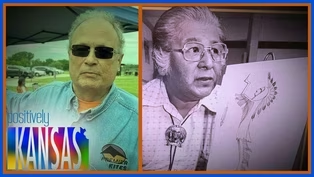
Preview: S13 Ep6 | 30s | Wichita’s most iconic landmark turns 50 years old. (30s)
Providing Support for PBS.org
Learn Moreabout PBS online sponsorship
- News and Public Affairs

Top journalists deliver compelling original analysis of the hour's headlines.

- News and Public Affairs

FRONTLINE is investigative journalism that questions, explains and changes our world.












Support for PBS provided by:
Positively Kansas is a local public television program presented by PBS Kansas Channel 8