Washington Grown
Potatoes by the Sea
Season 13 Episode 1309 | 26m 46sVideo has Closed Captions
In this episode we explore the fertile fields of Northwest Washington.
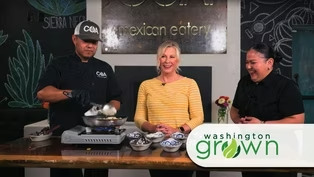
In Northwest Washington rich soil and coastal climates make it ideal for growing some of the state’s most versatile crops. At Ebe Farms, generations of innovation keep potato farming thriving, while the Organic Farm School and Snohomish Conservation District show how sustainability and habitat restoration strengthen local agriculture. We enjoy flavorful dishes at COA Mexican Eatery.
Problems playing video? | Closed Captioning Feedback
Problems playing video? | Closed Captioning Feedback
Washington Grown is a local public television program presented by KSPS PBS
Washington Grown
Potatoes by the Sea
Season 13 Episode 1309 | 26m 46sVideo has Closed Captions
In Northwest Washington rich soil and coastal climates make it ideal for growing some of the state’s most versatile crops. At Ebe Farms, generations of innovation keep potato farming thriving, while the Organic Farm School and Snohomish Conservation District show how sustainability and habitat restoration strengthen local agriculture. We enjoy flavorful dishes at COA Mexican Eatery.
Problems playing video? | Closed Captioning Feedback
How to Watch Washington Grown
Washington Grown is available to stream on pbs.org and the free PBS App, available on iPhone, Apple TV, Android TV, Android smartphones, Amazon Fire TV, Amazon Fire Tablet, Roku, Samsung Smart TV, and Vizio.
Providing Support for PBS.org
Learn Moreabout PBS online sponsorship- Washington Grown is made possible by funding from the Washington State Department of Agriculture and the USDA Specialty Crop Block Grant program.
- Hi everyone, I'm Kristi Gorenson, and welcome to "Washington Grown."
Potatoes are everyone's favorite, and here in Northwestern Washington, farmers are using some new techniques to grow them better than ever.
In this episode, we're taking a look at farming along the coast and on some of the islands in this region.
I'm learning about potato seed production at Ebe Farms.
- Starting in a few vials, we get to the point that commercial growers' planting several hundred acres.
- And I'm making a special potato dish at COA Mexican Eatery in Mount Vernon.
It's like a warm hug.
And Tomás is visiting Organic Farm School.
- Watching them grow food for their community, it's a point of passion.
- All this and more today on "Washington Grown."
[light music] Cooking with Kristi.
- Sweet Pete.
- Jiminy gee willikers.
- Watch my bangs.
Go big or go home.
- Ah, right in my eye.
You made me a believer.
Oh, I am making a mess.
- Oh, Val, I love you.
- Heaven on a plate.
That's yummy.
- We're gonna get a to-go cup for these.
- Yeah.
[Tomás laughs] - You keep talking, I'll keep eating.
[light music ends] In Mount Vernon, there's a special place that gives you a warm welcome like you're a member of the family.
That place is COA Mexican Eatery and Tequileria.
Here you'll find some fantastic cocktails, authentic Mexican dishes made with Skagit fresh produce, and faces full of smiles when they see you walk in the door.
- They know you and remember you and what's happening in your life, as well as serve you incredible food.
- After the first few times we've been here, they were already recognizing us.
- You feel like everyone that works here are friends and then all of a sudden you're a friend, and it feels like you're going into their kitchen and you're just eating with them.
- I like to make them feel welcome, make them feel love, like family.
They can just have a good conversation, come in and chill.
- Slow down.
- Slow down a little bit.
Yes.
- Yeah.
- Enjoy your time here.
- Viridiana Delgado is COA's owner.
With a team full of close friends and family, they don't just serve amazing dishes, but an experience of their own history with food.
- Everything that you get here, it's made with a lot of thought, making sure that you like it.
When you taste it, you like it.
- Yeah.
- It's our treat to you.
- I love that.
- The food is delicious always and you can tell the amount of care that's put into the ingredients and the food itself.
- It shows that they really support the community by using the locally food.
The quality of everything that they do is amazing.
- Don't miss later in the show when Viri, Chef Oscar, and I make a savory, traditional Mexican dish that features Washington potatoes.
So what are you looking for now for this to be ready?
[Oscar speaks Spanish] - He wants all the products to get to know them and heat it together.
- Everything needs to get to know each other.
- Exactly.
Love each other.
- They're having a little party in there.
- Yes.
[light music] - Have you ever been driving past the seemingly endless fields of crops in Washington and thought, "Where do all of these crops come from?"
I know I have.
Today, I'm in Whatcom County visiting Ebe Farms to try and find the answer to that question.
We're not in a potato field right now.
- No, this is kind of where things begin in our lab and greenhouse facility.
- Alright.
Well I'm excited to see what you got going on in there.
Greg Ebe is giving us a tour of a seed potato farm where they turn a small number of plants into thousands of seeds to be used across the West Coast.
The process can be incredibly delicate.
Before we begin, we must sterilize our shoes and don protective lab coats to protect the plants from potential disease and bacteria.
- Seed potatoes need to be disease-free, virus-free.
So we've sourced material and tissue culture just in test tubes and we're going to multiply that up into a crop that we can sell to commercial growers.
So in the lab, they're micro-propagating.
They're taking these microcuttings and spreading them to more of these jars.
They're grown in a media where different nutrients are available.
It's a really rapid way to multiply, but it's also a very clean way, which is really important when you're multiplying from just a few plants up to tens of thousands.
- Once Greg's team has multiplied the cuttings to the needed number, they move into the lab's greenhouse.
Here, the cuttings are planted in trays while being given a sterilized water and nutrient mixture.
This allows the plants to take root and begin producing minituber potatoes.
- Once those get to about quarter size, they'll harvest them.
Normally, the plant will produce about 20 to 30 of these.
The minituber will be the first field generation.
We'll plant that on the field next year - Okay.
- and we'll actually multiply to three generations before we send those to the commercial grower.
- And why is that?
- With each step out in the field, we get a multiplication of about tenfold.
Starting in with just a few vials in the lab, we get to the point that a commercial grower's planting several hundred acres.
- That's pretty amazing.
- Yeah, yeah.
- Yeah.
- It's pretty wild to think about.
- Once harvested, minitubers are rather tender and fragile.
They must undergo a drying process that helps thicken the skin, making them more durable for handling and planting.
Then, these minitubers are chilled and placed in storage until the following spring, when they finally are planted in Washington soil.
- This is the third field generation.
These will be harvested and then shipped to the commercial growers.
- So this is the final step in your process.
- Exactly.
- And these are what variety?
- It's called Ciklamen, originated in Europe and Hungary.
- Well, thank you so much.
It's been really fascinating.
Thank you.
- Oh, well thank you for coming.
It's one of my favorite things to talk about.
- Yes, well, I appreciate it.
[gentle music] [singers vocalizing] - Alright, ladies and gentlemen, Anna Lu and I, we're on the road and we decided, let's stop off and visit our good friend, Val.
- Hey!
Welcome!
- Thank you.
- So nice to have you over.
- We stopped by Val's house because you let us know that you actually have a little bit of a camping recipe, don't you?
- When I was little, I was a Camp Fire Girl, WoHeLo, that's right.
And we used to make these little hamburger packets or I think some people call them goulash - Today we're using ground beef, baby red potatoes, onions, carrots and celery, and some seasonings.
- Begin with ground beef on some foil.
[Val laughs] Then we add some carrots and onions.
Then it's time for the celery and baby reds.
After adding some salt and pepper... - And it looks like you got some garlic powder, - Got some garlic powder.
- So that's kinda nice.
- Once it's seasoned comes the fun part.
- Oh, so here we go.
I'm gonna wrap this up.
- Make a little packet.
- Thank you.
- There you go.
[Val and Tomás laugh] - Alright, we're gonna take these, and go throw 'em on the grill.
- Alright, in a minute.
- Here we go.
- And then after 20 minutes on the grill... - Alright, look at that.
Woo!
- Woo!
- Smells kind of good, huh?
- Yeah.
- Nice job, fam!
- Look at that.
Thank you.
- Okay, so let's take a bite.
Let's see what we got here.
- Alright, mm-hm.
A forkful.
Mm, mm.
- It's simple.
- Mm.
- Keep it simple.
- Mm-hm.
It's tasty, it's delicious.
It's a great hearty meal when you're out there camping.
And next time, Val, - Mm-hm?
- we'll pull you from home and we'll get you out on the trail with us.
- I'm looking forward to it.
- Alright.
Cheers, guys.
- Alright, cheers.
- Alright.
[Val and Tomás murmur] To learn how to make this recipe and many others, head on over to wagrown.com.
[light music] - The US Department of Agriculture says that a healthy diet of whole milk and potatoes is all the body needs to maintain itself.
How many calories in a six ounce potato?
We'll have the answer right after this break.
- Coming up, I'm making a special potato dish at COA Mexican Eatery.
It's like a warm hug.
Then I'm learning how a conservation district is managing water in the Skagit Valley.
- Really being able to think about how this place looks for future generations and how we can steward it to hand it off to them.
[light music continues] - A six ounce potato baked or boiled has approximately 110 calories and is packed with minerals and vitamins.
In fact, it has more potassium than a banana.
- We're back at COA Mexican Eatery and Tequileria in Mount Vernon.
Owner Viridiana Delgado is using her family's flavors and cultural history to create an unforgettable experience for her customers.
- The name of COA is a tool that helps scoop out the agave.
So coa is a big part of tequila.
We take a lot of pride in that and making sure that our margaritas are using good quality tequila, good quality food too.
It's our treat to you.
- Honestly, it's the best mole sauce I've ever had, and you know a good restaurant just by that.
- We actually travel 35 minutes to come here because it's so good and it's so fresh.
- You want good Mexican, you always come here.
- At the helm in the kitchen is Chef Oscar, whose dedication and passion for cooking has helped bring COA to where it is today.
- Oscar is awesome.
He's very passionate.
He loves cooking.
His food, the sauces, he made them better and better every day.
I am so lucky and proud of him at how much he grew, and we've grown with him together.
- Now it's time to join Chef Oscar in the kitchen, where we get to make papas con rajas y crema Oaxaqueña, a flavorful, creamy potato and poblano side dish.
So papas, potatoes, of course, - Potatoes.
- Washington-grown potatoes, we love it.
Alright, well, let's get started.
We start by adding our potatoes with some salt, pepper, and garlic powder to a buttered pan.
We're off to a good start.
That's gonna already taste delicious.
[Viri chuckles] When do you know that they're ready?
[Oscar speaks Spanish] - About five minutes, so when it's with a golden color.
- With the potatoes turning golden, we add our onions and let them cook slightly before adding the poblano peppers.
Once the poblanos and onions have cooked with the potatoes, we add our Oaxacan cream to the mixture.
- Crema Oaxaqueña is a little bit more salty, lime.
It's...more good.
[laughs] - More good?
I love that.
- I love it.
- More good.
- It gives such a good flavor to food and sauces, everything.
- So what are you looking for now for this to be ready?
[Oscar speaks Spanish] - He wants all the products to get to know them and heat it together.
- Everything needs to get to know each other.
- Exactly.
- That's perfect.
- And then heat up, love each other.
- They're having a little party in there.
- Yes.
- Now that all of our ingredients have gotten to know one another, this dish is ready to plate and for us to enjoy.
[light music] Oh yeah.
[Viri speaks Spanish] - It's creamy and salty.
The poblanos and the potatoes are just perfectly done.
What do you taste when you eat this?
[Oscar speaks Spanish] - The flavor, the salt, all the flavors together with all the condiments, it makes it very special.
- It is.
It's very special.
It's like a warm hug.
Gracias, Oscar.
Thank you so much.
- De nada.
- And thank you, Viri.
- Thank you, thanks.
- Yes, this is so delicious.
What a great way to highlight Washington grown potatoes and peppers and it's very delicious.
For more chef-inspired recipes for the home chef, visit us at wagrown.com.
- Over the years, I've come to realize that farms and farmers are the backbone of our great state, and farming is very challenging.
Now, if you didn't grow up on a farm, how would you even know how to start one?
Welcome to the Organic Farm School on Whidbey Island.
It's pretty much a Hogwarts for farming.
This nonprofit is training aspiring farmers in everything from soil, crop management, and even budgets.
- There's no average student.
We've had as young as 18 1/2 and as old as 55.
- Judy Feldman is the executive director, and her years of experience shows that farming goes a lot deeper than the dirt on the ground.
- The dirt and the soil is so beautifully complex, but I gotta tell you the rest of it's even more so.
You learn basic crop planning.
Then you learn, okay, how much fertility needs to go into that plan.
Here, you'll learn how to become certified organically.
You'll learn community interactions, how to really engage the people who are buying from you.
We'll prepare you to manage a small farm for someone else so that you can deepen your skill set, and then if you choose to start your own farm, you'll be ready for it.
So on Tuesdays and Thursdays, we harvest for a diversity of outlets.
We harvest for our local grocery store.
We harvest for our farm stand.
We harvest for our farmer's market.
That's really important for a beginning farmer to see how to diversify your marketing outlets.
- Well and how cool that the students' work is immediately given to the community.
- Absolutely.
They're getting that sense of value in the community, and they're also getting feedback.
"Oh, maybe next time we should harvest this lettuce a little earlier," or, "Oh, maybe I should taste it before I take it to market."
And that's why having a intimate program where the apprentice works directly with the farm manager, they're learning those skills by doing those things.
- Nice.
- They're learning the importance of the budget by paying attention to the budget.
They're learning the crop succession and when to stop planting lettuce 'cause it's too hot and start planting lettuce because it's cooling off again.
- I literally Googled organic farm school and this was the first thing that came up.
- It's literally the name.
- Yeah, exactly.
- Brooke Peterson is an apprentice here at the Organic Farm School.
From his time working in restaurants, his passion for food continued to grow, and enrolling in the school was the best way for him to start his journey toward having his own farm one day.
- I think it's the best of both worlds.
The pressure's kind of off of me, but I still get a lot of hands-on experience and I get to be a part of a lot of the decision-making processes.
But I still have a chance to make mistakes in a safe environment and to ask a lot of questions and to kind of go at my own speed.
I want to have my own business and I want to sell delicious and nutritious food to my community.
And I know as long as I'm farming, I'm gonna be happy.
- How does it make you feel when a crop of students comes in and then after seven months they leave?
What's that like?
- I feel like a proud mama.
Every time these folks graduate and go off and they become a farm owner, a farm manager.
I just stand a little taller.
I don't do the work.
I'm not a farmer.
I farm farmers, but I'm not a farmer.
But watching them grow food for people that they know, their community, people with faces and names, it's a point of passion.
- Well, if you keep teaching that passion and curiosity, I have wonderful hopes for the farmers of the future of Washington State.
- Well, thank you so much.
Can we sign you up?
- Thank you.
Let's do it.
- Okay.
[Tomás laughs] - Coming up, I'm learning how a conservation district is managing water in the Skagit Valley.
- Really being able to think about how this place looks for future generations and how we can steward it.
[light music] - If I said it once, I've said it a hundred times.
The Skagit Valley produces some amazing food, which means that if you're looking for something fresh and delicious, look no further.
Here in Anacortes, Adrift is serving up incredible meals featuring local seafood, meats, and produce.
Co-owner Nora Lamphiear knows that keeping things simple and fresh is the only way to go.
- When the ingredients are good, you just listen to it and let it tell its story.
Not too much fuss.
Just kind of get good ingredients and let the ingredients- - Just keep it simple.
- Yeah, yeah.
- Today we're trying one of their specialties, the veggie starts.
- In its inception, it was a healthy way to have breakfast, right?
You get your good vegetables.
You get some local potatoes.
So veggie starts is a good start to your day.
- Well, I'm gonna head back to the kitchen with Daniel and make some veggie starts.
- Okay.
Thank you, Tomás.
- Okay, so what does the veggie start comprise of?
- Well, today, it has cauliflower, carrots, green beans, zucchini, and peppers all from Well Fed Farms, along with the cabbage.
- Nice.
- Local Washington potatoes.
- Okay.
- Yukons, yep.
- Yukon Golds, right there.
- Yeah, we put some cheese on top of it - Oh gosh, okay.
- and then we throw it in the oven.
- I didn't know you were putting cheese on it.
Even better now.
And then we're just gonna slide this right here on the plate?
- Oh yeah.
If you do it right, it'll just slide right out.
- Oh man.
Look at that.
Look at the colors behind that.
It's so beautiful.
[light music] Mm.
You're really letting the fresh veggies kind of speak for themselves.
- Yeah, just a little salt, pepper, and garlic.
- It's always more fun sharing delicious food with a good friend.
And look who's here.
Check this out.
- Perfectly cooked.
- Right.
- It's fresh, so good.
- And I love the fact they didn't overcook the veggies.
- Right.
- It's as fresh as it can get.
- It is.
- Well, our adventures continue and we need to hit the road.
But if you're in Anacortes, swing by Adrift and tell them "Washington Grown" sent you.
- As the climate changes, everyone is learning to adapt to overcome new challenges to keep our environment safe and healthy.
But not every challenge looks the same.
In Eastern Washington, low water supply can cause issues for crops, fish, and wildfire risk.
But on the west side of the state, problems range from both too much and too little water.
Today, I'm talking with Kristin Marshall of the Snohomish Conservation District.
Together with partners, she's working to solve a major issue caused by climate change.
- On the west side of the Cascades, we have an interesting problem.
We have a lot of water in the winter that we have to manage.
And then in the summer, our summers are actually becoming increasingly drier and our summer dry season is actually extending.
We expect to get the same amount of water, but we're getting it in bigger events, so more water at the same time that is potentially going to overwhelm existing drainage and flood protection infrastructure that's been in place, in some cases, since the '50s.
Drainage Improvement District 7 is located just west of Stanwood, Washington.
It's a very small but very important agricultural area in Snohomish County.
There is a sea dike that DD7 maintains that is actually the main flood protection for the entire city of Stanwood and it also protects hundreds of acres of really important commercial farmland.
On top of that, there's freshwater streams that flow into ditches and ditch streams, and those ditches are undersized for the amount of stormwater that's heading down.
So then we have this coastal squeeze effect happening at DD7 where we have more water coming off hill, more fresh water, and then we have sea water from Puget Sound pushing up against that aging dike.
- With the help of the Snohomish Conservation District, Drainage District 7, Stillaguamish Tribe, and the City of Stanwood are working with local farmers to replace the aging dike, working together to solve a problem that impacts everyone in the region.
- We're facing a lot of the same challenges, and there are just so many opportunities for us to work together to find better, stronger solutions that are gonna serve all of our communities here.
You see it in agriculture.
We have farmers who are really working with tribes and understand that they're all just working to support their families, support their culture.
That's just an incredibly inspiring way to work together.
So that's what excites me about working with the partners I do, really being able to think about how this place looks for future generations and how we can steward it to hand it off to them in the future.
[dramatic music] - Washington is a powerhouse in the potato industry, ranking second in the nation for production and contributing billions of dollars to the state's economy each year.
In fact, the Columbia Basin is the most productive potato-growing region in the world, with yields per acre that are double the national average.
Washington's success with spuds is no accident.
It's all thanks to the state's rich history of potato-growing that spans more than 200 years.
Historians say potatoes first came to the state in 1792 when Spanish explorer Salvador Fidalgo established a fort near present day Neah Bay and planted a garden.
The Spanish settlements on Neah Bay?
They didn't last, but the potatoes did.
When other European settlers first arrived in Washington in the 1840s, potatoes quickly became a staple crop.
They provided nutrients and were easy to grow, store, and prepare.
- Anybody that did a lot of labor, and almost everybody at that time had to do a lot of labor to get their daily bread, would value potatoes as a source of energy.
- People who settled in the Columbia Basin in the late 19th century recognized the area's agricultural potential.
It had rich soil and a long, sunny growing season.
But farming there was difficult due to the lack of rainfall and irrigation.
The Grand Coulee Dam ultimately made water available to much of the Columbia Basin, and by the early 1950s, irrigation water flowed throughout the region.
Most potatoes grown in the Columbia Basin were Russet Burbanks, which were often considered too large for restaurants to use.
But Russet Burbanks handled processing and freezing well, making them perfect for frozen French fries and tater tots.
The Columbia Basin's Russets helped transform the French fry industry.
The JR Simplot Company developed the first commercially successful frozen fries in the 1940s.
By 1967, Simplot had convinced McDonald's CEO Ray Kroc that the burger chain should rely on his fries.
The company became a major supplier of McDonald's fries, a distinction it still holds today.
Many of those fries are made from the Columbia Basin's Russet Burbanks, and Simplot operates large processing plants in the region.
Washington's Skagit Valley also offered perfect growing conditions to early settlers.
But the river delta flooded often.
In the late 1800s, settlers built a dike and drainage system to control flood waters.
The Skagit became one of the most productive growing areas in the world, and some of those original farm families still produce potatoes there today.
Washington's potato harvest and its processing capacity have continued to rise over the years.
Today, potato growers in Washington harvest around 160,000 acres annually, yielding more than 30 tons per acre on average.
Washington is also a leading potato exporter.
The state produces around 20% of all US potatoes, which are shipped places throughout the country and sent overseas.
In fact, frozen French fries are the top food export in Washington.
Washington farmers continue to embrace new technology and keep up with the latest research.
- What's so great about the potato, especially here in Washington State, is literally how much nutrition it provides.
And you can literally grow more nutrition with an acre of potatoes than any other crop.
And particularly here in Washington State, we can grow more potatoes on an acre of ground than anywhere else in the world.
We have gotten so good at producing potatoes here because of our environment that we grow in, that clean, fresh water that we use, the sunshine, the long summer days, the frost-free growing season that we have, a very long one, allows us just to grow a great crop.
It makes us very sustainable.
So I think that's really why our potatoes become so popular, is 'cause we can offer that consistent nutrition at a great, affordable price.
Walk into a grocery store, I mean, how, I mean, you can literally buy a 10 pound bag of potatoes and get so much nutrition.
- All of Washington potato growers take tremendous pride in the high standards they've set for themselves, and they'll continue feeding the world for years to come.
- Northwestern Washington is a pretty special place where farming and natural resources benefit us all.
That's it for this episode of "Washington Grown" We'll see you next time.
Video has Closed Captions
Preview: S13 Ep1309 | 30s | The fertile fields of NW Washington, ideal for growing some of the state's most versatile crops. (30s)
Providing Support for PBS.org
Learn Moreabout PBS online sponsorship
- Food
Christopher Kimball’s Milk Street Television
Transform home cooking with the editors of Christopher Kimball’s Milk Street Magazine.




Support for PBS provided by:
Washington Grown is a local public television program presented by KSPS PBS