Unspun
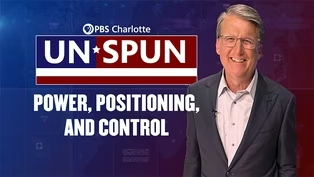
Power, Positioning, and Control | Unspun
Season 2 Episode 204 | 27m 31sVideo has Closed Captions
Pat McCrory talks about the NC race that could help decide which party controls the US Senate.
Unspun looks at the NC race that could help decide which party controls the US Senate: the 2026 Senate showdown between former Governor Roy Cooper and Republican Michael Whatley. We’ll look at what’s really at stake, who’s playing offense, who’s playing defense, and what this race tells us about 2026 and beyond. Plus, we count down the top five divisions inside the Democratic party right now.
Problems playing video? | Closed Captioning Feedback
Problems playing video? | Closed Captioning Feedback
Unspun is a local public television program presented by PBS Charlotte
Unspun
Power, Positioning, and Control | Unspun
Season 2 Episode 204 | 27m 31sVideo has Closed Captions
Unspun looks at the NC race that could help decide which party controls the US Senate: the 2026 Senate showdown between former Governor Roy Cooper and Republican Michael Whatley. We’ll look at what’s really at stake, who’s playing offense, who’s playing defense, and what this race tells us about 2026 and beyond. Plus, we count down the top five divisions inside the Democratic party right now.
Problems playing video? | Closed Captioning Feedback
How to Watch Unspun
Unspun is available to stream on pbs.org and the free PBS App, available on iPhone, Apple TV, Android TV, Android smartphones, Amazon Fire TV, Amazon Fire Tablet, Roku, Samsung Smart TV, and Vizio.
Providing Support for PBS.org
Learn Moreabout PBS online sponsorship(bright music) - [Announcer] This is a production of PBS Charlotte.
- Tonight on "Unspun," power, positioning and who gets control of what comes next.
We're talking about the North Carolina race that could help decide which party controls the US Senate.
The 2026 Senate showdown between former governor Roy Cooper and presumed Republican nominee, Michael Whatley.
We'll look at what's really at stake, who's playing offense, who's playing defense, and what this race tells us about 2026 and beyond.
Plus, I'll count down the top five divisions inside the Democratic Party right now.
In today's America, welcome to the spin game.
Believe me, I know I'm Pat McCrory.
When I was governor and mayor, I played the spin game.
I was played by the spin game.
But aren't we all done being spun?
Let's take the spin out of the world we're in, here on "Unspun."
Good evening, I'm Pat McCrory and welcome to "Unspun," where we break down the politics you see and the power struggles you don't.
Former North Carolina Governor Roy Cooper is no stranger to North Carolina ballots, serving as Attorney General for 16 years, and then two terms as governor.
His opponent is expected to be Michael Whatley, a close ally of Donald Trump, serving as Chair of the North Carolina GOP.
Then as Chair of the Republican National Committee.
Joining me now as a man who has seen how these races really work from the war rooms, not the press releases.
He has decades of experience shaping political messages and knows what wins and what doesn't.
Welcome Paul Shumaker, founder of Capital Communications.
Paul, great to have you on the show.
- Great to be here, Governor, appreciate the opportunity.
- Great to have you back, actually.
We've got a big race, US Senate race.
First we have a primary, a Republican primary in March, no Democratic primary for Roy Cooper, but a Republican primary for Michael Whatley.
How do you see that primary going at this point in time?
- Well, right now Whatley is considered the presumptive nominee because he's got the Trump endorsement.
The real question is going to be does the average Republican primary voter, are they aware of that?
Do they know Michael Whatley?
We have basically someone who's been a former state party chairman, been former Republican National Committee Chair, but the reality is probably 75, 80% of Republican court primary voters probably have no hard opinions of any of the candidates running right now.
So he has to run a campaign in the primary to get his awareness up.
And voter turnout's gonna be another critical factor.
In low voter turnout elections, anything can can happen.
- And tell, tell us about his two opponents or the two major opponents in the Republican primary.
- Well, you got two former Congressional candidates.
You got Don Brown who ran, I think in the eighth district in 2024, who's an attorney and who has a strong social media presence.
And then you got Michelle Morrow, who's running past congressional races and from Eastern North Carolina.
Both of them have come from strong Republican congressional districts.
So they have a level of awareness where they have run in the past, but neither have any great statewide awareness.
The question is that, you know, how focused will the Whatley campaign be on building that level of awareness for himself, and also in building the turnout operation?
I look at primaries is opportunities, and what the Whatley campaign needs to be doing is looking at this as a trial run for the general election, testing different parts of their campaigns, see what works, what doesn't work.
But turnouts gonna be critical, not just in the primaries, but turnouts will be critical in the general election in November.
- But Whatley has one thing that is very valuable in a Republican primary, and that's the endorsement of President Donald Trump.
Do you see the endorsement of Whatley having the same impact that it had on Ted Budd against me in a US Senate race?
- The answer to that is it will have an impact on the positive side.
There's a big difference in this dynamics of this race and that is that you were able to engage in a competitive race, so there were millions of dollars spent against you.
There are no money being spent against anyone here.
All the money's gonna be spent for someone.
And the one advantage on top of the Trump endorsement, Whatley will have a huge money advantage.
It will take resources away from the general election.
But in these US Senate races, this is not a North Carolina US Senate race.
This is a national US Senate race, so there will be third party players in the state for Michael Whatley helping boost his ID between now and the March primaries.
- In the meantime, Roy Cooper's getting a free ride, and the people know his name extremely well.
He has positive name ID, he has a lot of experience traveling the state and the nation raising money.
I assume right now you don't see much of him.
He's raising money, right?
- Right, he's raising money, and Roy Cooper's doing what Roy Cooper needs to do right now.
He's keeping his head down.
He the one candidate who has the luxury of planning for November today.
He knows what the outcome is going to be as far as what happens in March.
And so he can be focused on the November election, and right now he doesn't have to be spending a lot of resources.
So he's gonna garner that and save that after the past because campaign costs continue to rise, and the rising cost is on advertising rates.
They go up, they get more and more competitive.
This is gonna be the top US Senate race in the country most likely.
And so it's gonna be the most expensive.
It may eclipse 750 to $800 million.
- And right now it's an advantage, Roy Cooper being ahead in the polls in a perceived general election between Whatley and Cooper, that helps you raise money also throughout the nation.
People like to pick the winner early with money.
- Right, and the challenge for Michael Whatley after the March primary against Roy Cooper is going to be able to show he has to make this race competitive and he has to make the race competitive early on.
If we go into Labor Day and the race is not within the margins, everybody gets poll crazy, so to speak.
Everybody's looking at the polls and if the national sentiment is this race is not within the margins, then the money starts to go other places.
We don't know exactly what the environment's gonna look like come October, November, but this race has to be within the margins and has to be competitive on multiple fronts by the time we turn Labor Day.
And that's gonna be the challenge for Whatley between March and end of August.
- What's Trump's role in helping or hurting Whatley in both the primary and general election?
I mean, he's got to come to North Carolina, I assume, to give Whatley a name ID.
Do you agree with that?
- Well, the first thing is the big help that Trump brings to the table is on the money side.
He keeps all the other money out against Whatley on the Republican side, and he puts a lot of money into the coffers for that.
The question of is he an advantage or a liability in the November election, that's all going to depend on how the voters feel about the economy.
This is right now, is this election's gonna turn on the economy.
The president was elected on the theme on the belief that he was going to fix the economy, and how voters feel about the economy is going to determine the outcome.
Midterm elections are about anger management failed expectations.
The expectation was that Donald Trump is gonna fix our economy.
If that feeling is not there, then the anger's going to be he hasn't done it and they're gonna wanna change.
So we'll have to wait and see on that, still early on.
- Most people don't realize that Michael Whatley's campaign manager is Chris LaCivitas, who was my campaign manager in my reelection bid for governor against Roy Cooper, which we lost the closest race in North Carolina history gubernatorial wise, what does LaCivitas bring to the race for Whatley?
- Well, he brings the Trump organization, obviously, and you can make the argument that Michael Whatley brought that on his own accord, but North Carolina becomes a must win state for the Trump organization, because Michael Whatley is a product of that organization and they have laid that gauntlet down so it becomes a must win equation here.
That's what he brings to the table from that standpoint.
- And I don't think I mentioned also that LaCivitas was Trump's winning presidential campaign manager.
- Oh yeah, I mean, look, here's the reality is that on the Republican side and the Democratic side, be it Roy Cooper or be it Michael Whatley, they've got very seasoned professionals in place.
They know what they're doing.
One of the things that the Trump campaign did extremely well was they went outside traditional media avenues and maximized digital advertising, maximized social engagers on multiple fronts.
It's a new ball game as it relates to that, and they're probably the best at that that we have seen.
The Harris campaign did not do that at a national level.
The one thing that the Democrats have going for them is that Roy Cooper basically is a institutional candidate.
He has a brand identity, and you're trying to change that brand identity as much of a challenge in itself as it is in trying to win the race.
At the end of the day, the question's gonna be, is the president a plus positive, with that determines on the economy, or is he not gonna be as much of a positive because of the economy?
Right now he has more to say about this.
And clearly if you look at the statements in the last 14 days, he's very much aware of the need to get his arms around the economy between now and the November elections.
- So where will Chris LaCivitas and Whatley attack Cooper on?
Where are Cooper's weaknesses that bring down his positives and raises and negatives?
- Most likely they're gonna go after social conservative type issues.
They're gonna go after the gender identity type issues.
They may go somewhat after, you know, when Roy Cooper was Attorney General and also as governor, we had a huge state backlog, problems that relate to rape kits and the testing of all that.
They'll probably go after hurricane recovery, and at the same time we're in the midst of hurricane recovery, Helene, it did not happen on the Trump administration's watch, but the Trump administration's responsible for the recovery now because of the federal government's role there.
But they're gonna go after him on multiple fronts from that standpoint.
They will be interesting to see how the economic world of this plays out, because Roy Cooper has eight years as governor.
He has eight years of job growth in North Carolina, and so he has a good strong record on the economic fronts for them to run on, and so it's gonna be hard for them to come after him economically, so they have to go the social issue path.
- The social issue, which impacted my race in a negative back in 2016, might help Whatley now.
How times have changed.
- It may or it may not, because quite frankly, the reality is is that social issues play well when the economy is good.
The one thing that I'm seeing in the numbers today, and it should be concerning for all Republicans, not just US Senate candidates, but down ballot and state legislative, even down to county commissioner races and all of that, is that when we had a 2008 crash in August going into that presidential cycle when Barack Obama won, the economy we had an economic crash.
And the economy was the number one issue with all voters, at least for the next four years.
In fact, in going into 2010, we didn't have a single survey where over half the voters cited the economy as their number one issue.
Right now, the economy is the number one issue is dominant with over half the voters, and it overrides everything.
And so it has to be fixed and addressed or the social issue path is not gonna be a winning for math.
- So where does Cooper go after Whatley?
What's their strategy?
- It's gonna depend on the approval ratings of the President and how voters feel about the President at that point in time.
The real questions going to be, does Michael Whatley need to build separation from Donald Trump at any point in time?
North Carolina is a state where 39% of our voters are unaffiliated.
We're at parity now.
Republicans outnumber Democrats by like 2,500.
So you know, we have no more crossover party voting.
Whatley gets 95% of Republican vote.
Cooper will get 95% of the Democratic party vote.
The question's going to be those unaffiliateds who are motivated to turn out.
Are they motivated to turn out because they like what's taking place with the economy?
They want to keep it moving, or are they motivated to turn out because we're mad at what's happening with the economy and they wanna make a change or they wanna send somebody a message.
- In the remaining 20 seconds, there are gonna be a lot of negative ads, I assume.
Will the negative ads stick on both candidates?
- Absolutely.
They always stick, and in fact, American politics is not about who rises the fastest, it's about who sinks the slowest.
- That's a great way to end it or a sad way to end on how politics moves today.
Paul, thank you very much for being on "Unspun."
- Great, Governor, appreciate the opportunity.
Thank you.
(upbeat music) - Alright, now it's time for the Top Five countdown and tonight's Top Five countdown are the Democratic Party divisions, the top five Democratic party divisions.
In a past week we did the Republican divisions and now we talk about the top five Democratic divisions.
Number five, tariffs.
You know, until Trump was for tariffs, Democrats used to be for tariffs.
Now the Democratic party is divided on tariffs.
Number four, the transgender social issue.
You know, that was a big issue for Democrats 10 years ago.
Now public opinion has changed, especially regarding the locker rooms and women's sports.
Some Democrats want to talk about it.
Other Democrats wanna avoid the issue altogether.
Number three, the Israeli Gaza situation right now has deeply divided the Democrats, some pro-Israel, some against Israel, some in between trying to play both sides.
Number two, tax incentives.
You know, governors and mayors actually love tax incentives for rich corporations.
National Democrats don't like tax incentives for the rich.
That's coming to a conflict now when we have some former governors running for the US Senate, it's gonna be interested now the media and the candidates handle that issue.
And number one, socialism.
We got a new Democratic mayor from New York who calls himself a socialist.
What will the National Democrats say about that?
(upbeat music) Time now for "Unspun" One-on-One?
Joining me now is Steve Harrison, WFAE's Politics and Government reporter.
His work has appeared in the "Charlotte Observer," the "Washington Post," and "Sports Illustrated."
Steve, it's great having you here.
- Thanks for having me on.
- And thanks a lot.
So this is the part I hated as governor and mayor is having you guys like you interview me, but I wanna give you that chance and we'll have a good conversation.
- Sounds good.
I mean, I guess, you know, the big issue of course is the senate race coming up this fall, it'll be one of the most important in the nation, may set fundraising records for the most expensive race ever.
Let's go back and talk about what you see as the differences between this race and the Ted Budd Cheri Beasley race in 2022.
You and I were talking just before we started the segment, you said you were surprised that Democrats in that race didn't spend the money, national Democrats didn't spend the money for Cheri Beasley.
Clearly that won't be a problem this time, but going back to that race, do you think that would've made a difference?
- Absolutely.
I think North Carolina was definitely in play for the Democrats.
They had momentum.
Cheri Beasley was a bright, articulate, good candidate, would've been the first female African American center in the state of North Carolina.
And yet the National Democratic Party walked away from North Carolina.
Now, some of that was strategic.
In order to get the Senate majority, they decided to put their money in Arizona and Nevada and North Carolina got pushed the side.
And in some ways the Republican candidate Ted Bud got a free ride.
And that's one reason when I ran in the primary against Ted Bud, and I didn't get the endorsement of that time, Donald Trump, the primary was gonna be the race for the US Senate, 'cause we kind of got signals that the Democrats were not gonna fight in the purple state of North Carolina.
Now this purple state is the number one priority of the National Democrats.
- Yeah, I mean I think there'll be no question the money will be here in the fall.
I think going back to that race, I mean this is an interesting debate that I've had with a lot of Democrats in that Beasley race is, was it a situation where the party, it was a total strategic move to put their money elsewhere?
Or were they just not impressed with with Beasley's campaign?
I mean, she wasn't a great retail politician.
There was a great resume, absolutely great resume.
But did she excite people enough and is that why they moved on?
- I think more of it was national strategy, where to put the money.
Now there is no loyalty in national politics among either party.
They're gonna put their big money where they know the money will work.
They had more confidence in Arizona than North Carolina.
Maybe some of it was the candidate.
You know, it's kind of interesting, North Carolina Democratic politics tends to favor with the exception of I think Beverly Purdue and maybe Kay Hagan, they tend to go after the traditional white male lawyer, going all the way back to Jim Hunt, Easley Cooper, and now the current governor.
And that trend has worked extremely well for the Democrats in North Carolina, despite what the national party demographics are.
North Carolina Democrat demographics have not been very diverse among that party in North Carolina.
- No, I think absolutely.
And then going back, we're gonna move ahead, but going back to that 2022 race, that sentiment, there was a sentiment among Democrats to move away from the white male lawyer.
Jeff Jackson bowed outta that race.
Perhaps he might've won.
Okay, let's shift forward to the current race.
I said earlier, this may break records for the amount of money spent.
It seems to me though, you get to a point of diminishing returns, you hit 300, 400 million, you're watching football in the fall.
I don't know how decisive money's gonna be when you get to a certain level of spending.
- I anticipate the most negative campaign we'll ever see in US Senate race history, probably comparable to the Jim Hunt who recently passed away and Jesse Helm's race.
I think Whatley's main chance to win is gonna go heavy negative toward Roy Cooper.
He's never had a negative campaign run against him.
I did not run a negative campaign against him when he was Attorney General.
Very few negative ads.
I assume Whatley's gonna attack him possibly on the social issue of transgender restrooms and locker rooms in women's sports.
Maybe also the hurricane response on three different hurricanes, and maybe COVID response where he kind of got a free ride according to many Republicans.
Will the independents be swayed by that over the current brand that Roy Cooper has?
- So here's my question on COVID.
It COVID is of still a very important issue I know among the Republican base.
And they do feel like that Roy Cooper was heavy handed, draconian in his shutdowns.
I'm not sure, that's gonna be six years ago.
I'm not sure if that plays, but what about this wildcard, the murder on Charlotte's light rail, the horrifying images, you know, you look on social media that really energized conservatives.
Do you think that is gonna be an unexpected opportunity for the Republicans of Michael Whatley?
- Roy Cooper, he has a incredible talent of staying away from divisive issues like that.
He will separate himself from the new mayor of New York, the mayor of Seattle, other controversial mayors in the Democratic party and probably even Newsom.
I doubt you'll see Newsom here in North Carolina campaigning on behalf of Cooper, not because of Newsom.
Cooper doesn't want a California liberal here.
He wants to keep that reputation whether deserved or not, of being a moderate.
And that's one of his great strengths.
Believe me, I saw it.
We had nothing to run against him during his 16 years of Attorney General.
He was rather bland, and he made me the one on my heels, which is a great talent of his political operatives.
He doesn't get his hands dirty at all.
He lets his political operatives do the dirty work.
I'm kind of saying that as a political compliment and also as an insult.
- Sure absolutely.
Well, okay, so let's talk about how do you think the campaigns- - That's a talent.
- Are gonna be run in terms of the engagement with voters, engagement with the press.
Republican candidates in this state, well, even nationally, for a long time they have bypassed the media.
They bypassed the newspapers.
They bypass, I think TV still has a role, but public radio, newspapers, they are bypassed.
Do you think that Roy Cooper's gonna take a similar strategy and just stay at 30,000 feet?
- I think he'll do what Ted Budd did.
And he's been both are very successful in staying on a very simple message, attack the opponent, or let other people attack the opponent and stay out of the way and let the polls work for themselves.
And he'll be watching the polls, especially of Trump, whether to use Trump as a partner or a foe.
He actually used them as a partner when I ran against him, he ran ads almost close to being pro-Trump when I ran against him.
And if that got him 2% of the vote, that's 10,000 votes or less than 1% of the vote, which won the campaign for him.
His campaign strategists are very, very good.
- I think that's gonna be a fascinating thing is Trump has a lot of vulnerabilities on some key issues, of course, including the economy.
But for Roy Cooper, I think it'll be an interesting decision.
How close do they go negative on Trump as opposed to the issues, because of course Trump has won this state three times.
I think that's gonna be- - The other issue is they tend to play class warfare.
You know, we gotta quit giving tax breaks for the rich, Trump's tax breaks for the rich.
Cooper plays that very well.
If I were Whatley, I'd come back and say, wait a minute, you gave tax breaks the whole time you were governor for eight years to major industry, huge tax breaks.
So there's a little contradiction, but it may be too confusing.
And Whatley, Trump probably thought Whatley had greater name ID than he actually does.
You know, being National Chairman, a North Carolina Chairman, most people have no idea.
- I don't think anyone cares.
- But I think the Trump people assumed he had greater name ID than he does now.
- And you see that in the polls with Cooper ahead by six, seven or eight points.
Yeah, he's at 47%, 48%.
And Whatley, you know, at 39, 40, 41.
I don't think that's necessarily an indictment against Michael Whatley.
I just don't think people have any idea who he is right now.
- He's gotta get out and spend money right now and get out on the campaign trail and get some free publicity on a very focused message.
I haven't seen it yet.
It's still way early, but the time will run out very quickly.
And will he get attacked in the primary by the other two strong candidates?
- I watched last year when Whatley entered the race, I watched closely his speech to enter the race.
He must have mentioned President Trump, I mean it was like every 40 seconds, okay.
Does he have at all the ability, if Trump's approver ratings slide even more, does he have the ability at all to pivot and even put any distance between himself?
Or is it just ride or die?
- That may be the $100 million question.
Steve, it's great to have you on One on One.
- Thank you so much.
- Very much.
(upbeat music) You know, there's a disturbing trend taking hold in big time political races across the country and right here in North Carolina.
The problem is this, retail politics is dying.
The old days where candidates were accessible to the media, when opponents wanted to debate as often as possible, when campaigns released detailed position papers.
And most importantly, when candidates traveled the state, shook hands and answered unscripted questions from everyday voters.
Well, those days are almost gone.
In the current North Carolina US Senate race the two leading candidates are spending most of their time on the phone or behind closed doors raising money.
Money not just for their campaigns, but for their Super PACs.
So where does that money come from?
Every special interest group that needs help in Washington, that's where it's gonna come from.
And where are the fundraisers held?
Everywhere, but mainly in DC, New York City, California, Aspen, Colorado, Florida, and yes, even Cashiers, North Carolina where a lot of rich people live.
They're happening in beautiful mansions, on large yachts and inside luxury hotels.
I know this game because I played it.
So if you're looking for either Michael Whatley or Roy Cooper this winter, you may have a better chance of spotting them at the airport than at a barbecue restaurant in North Carolina.
And that tells you a lot about modern politics, who it built for, and who it's drifting away from.
And here's why that matters.
When candidates stop campaigning with voters and start campaigning only with donors, the conversation changes.
Questions from everyday people get replaced by talking points for big checks, and policy starts to follow the money instead of the voters.
That's when elections become less about listening and more about buying time, access and influence.
Well, that's the truth as I see it.
I'm Pat McCrory.
I hope you'll join us next week on "Unspun," where we'll tell you what politicians are thinking but not saying.
Goodnight, folks.
(upbeat music) (upbeat music continues) - [Announcer] A production of PBS Charlotte.
Power, Positioning, and Control Preview | Unspun
Preview: S2 Ep204 | 30s | Pat McCrory talks about the NC race that could help decide which party controls the US Senate. (30s)
Providing Support for PBS.org
Learn Moreabout PBS online sponsorship
- News and Public Affairs

Top journalists deliver compelling original analysis of the hour's headlines.

- News and Public Affairs

FRONTLINE is investigative journalism that questions, explains and changes our world.












Support for PBS provided by:
Unspun is a local public television program presented by PBS Charlotte