Continuing the Conversation
Practicing for Death: Integrating Mind and Body
Episode 14 | 26m 46sVideo has Closed Captions
Explore how physical presence and pain can prepare us for the certainty of death.
Through the writings of the 13th-century Japanese author Dogen and the 16th-century French author Montaigne—explore how physical presence and pain can take us out of our minds and into a practice that prepares us for the vicissitudes of life and the certainty of death through an integration of mind, body, and soul.
Problems playing video? | Closed Captioning Feedback
Problems playing video? | Closed Captioning Feedback
Continuing the Conversation is a local public television program presented by NMPBS
Continuing the Conversation
Practicing for Death: Integrating Mind and Body
Episode 14 | 26m 46sVideo has Closed Captions
Through the writings of the 13th-century Japanese author Dogen and the 16th-century French author Montaigne—explore how physical presence and pain can take us out of our minds and into a practice that prepares us for the vicissitudes of life and the certainty of death through an integration of mind, body, and soul.
Problems playing video? | Closed Captioning Feedback
How to Watch Continuing the Conversation
Continuing the Conversation is available to stream on pbs.org and the free PBS App, available on iPhone, Apple TV, Android TV, Android smartphones, Amazon Fire TV, Amazon Fire Tablet, Roku, Samsung Smart TV, and Vizio.
Providing Support for PBS.org
Learn Moreabout PBS online sponsorship(bright piano music) - Welcome, Claudia.
- Thank you.
- Thanks for joining me on Sunday afternoon.
- My pleasure.
- We've been talking for many years off and on about practice.
But the idea of practice and the practice of practice, 'cause we have our various practices, the college has a practice.
And so I thought today might be a very good opportunity to talk about practice as it emerges in two of the greatest thinkers that we study on campus, Montaigne, 16th century Frenchmen, and Dogen, the 13th century Japanese philosopher, both of whom wrote essays- - Mm-hmm.
- Right?
Both of whom had their versions of practice for ordinary life.
And both of whom raised many questions about the relation of practice to ordinary life.
And it's not an idea that we get to talk about a lot or idea that we do talk about in normal life because most people think they don't have a practice, you know, namely some deliberate set of activities that they do with some kind of purpose and intensity and consciousness, right?
Well, it is a culture that we have in say, martial arts, or in yoga, spiritual traditions, in Christian traditions, we have the idea of practice.
- Yeah.
Mm-hmm.
- So I wonder if we could just start with Montaigne and we both landed on this unusual and less well-known essay by Montaigne in Book Six, called "On Practice."
- Yeah.
- Which in French, it's (Krishnan speaks in French), exercises, exercisation.
Would you like to introduce us to it?
- Yes.
Thank you for pointing me to it, I loved this essay.
He starts right away by talking about practice in relationship with our awareness of our mortality.
So he starts right away by saying, "But in dying, which is the greatest work we have to do, practice can give us no assistance at all.
A man may by custom fortify himself against pain, shame, necessity, and such like accidents.
But as to death, we can experiment it but once and are all apprentices when we come to it."
And so I really loved how he just like landed there, which has to do, I think, with the inevitable emotions that arise when we reflect upon the possibility that we would cease to be.
But then I thought it was really quite amusing that he then goes on for quite a number of pages to talk about this possibility that we might actually be able to practice for dying.
And I also love how that orients the question against the Western philosophical tradition, because that Socrates of course famously says, "Philosophy is a training for death."
So immediately he says, "You can only do it once, so you can't actually have a trial run.
But there's a lot you can do to think about relationships to mortality."
And I'd like to talk about some of those today.
I also thought it was quite lovely that he ends the essay with a return to Socrates, who he calls the, I believe "The greatest sage, he's the only sage," right?
He's the only one who actually kind of put his money where his mouth was in terms of being willing to stake it all.
- Yeah.
- And face death.
I got quite a lot out of this.
And I'd also like to talk as we go about, he tells personal stories, but he also works in these Latin quotations from various classical Roman authors.
He works in some Dante, so he's doing something with the Western literary tradition that seems to have something to do with orienting oneself around temporality and mortality.
- Yeah.
That's part of the tradition he belongs to, right?
I'm glad you brought up the general arc of this essay because it's fascinating how he starts in the first paragraph, with describing how great it is that we can, as he quotes it, "Exercise and form our soul by experience to the way we want it to go," namely one good way of describing what practice might be, you know?
- Mm.
- But then as you say, immediately in paragraph two, he jumps straight in and says, "But for dying practice cannot help us," right?
And then he has about seven pages where he unpacks an anecdote from his life where one of his servants riding a big horse bowls him and his horse over- - He's thrown from his horse.
- He's thrown from the horse, and the horse is knocked down too.
The horse is on top of him maybe.
And so he said, "This is the only time he's ever lost consciousness."
- Mm.
Mm-hmm.
- So he then wrestles with that, you know, so we go into quite some detail about that story.
- Mm.
- And then he comes back to practice.
- Well, and he makes it so personal.
He says, "I spend my time working on myself."
And then he has a critique of why the Western tradition has been so hesitant to allow self to emerge as a kind of crux of practice.
Because it's perceived as vanity to focus on self.
And so I think he also illustrates something that I hope we can talk about later, which is, this is not metaphysics, this is not self as looked upon from the high, lofty metaphysical heights of a kind of Contherian or Hegelian kind of perspective.
This is, "No, this is me, and I'm gonna have to face my death with equanimity, hopefully."
I love how he's like, "Hopefully," right?
Like you can never quite know.
But he's trying to return us to this process of ruminating on what it means to be mortal, what it means to be given one life to live, what it means for things to matter.
I think he does a great job with that.
- Yeah.
Mm-hmm.
- Yeah.
- Yeah.
What are you thinking when he says that?
- I guess I'm thinking about a kind of vanity that maybe the metaphysical tradition is not aware of in itself.
That if you purport to a kind of lofty reason, which can somehow sweep away all of our emotional or repetitive responses to things, then maybe there's a kind of vanity in that, that you've reduced who you are.
And I love Montaigne, he's like, "I have all of that.
I had a lot of emotion when I woke up, when I regained consciousness after that accident."
He talks about his wife and he's kind of invoking kind of this restoration to consciousness.
Yeah.
- Mm-hmm.
- And I think there is, you know, he says, "Oh, we've turned it into kind of vanity to talk about ourselves, but it's the most important thing we have."
- Yeah.
Yeah.
- And that leads me into why I personally practice the martial arts.
You can't get it through daily life, right?
You can't get it through, am I hungry?
I need to get something to eat.
You can't get it through the sort of utilitarian forms of tending to the needs of the body.
You have to seek for something that goes beyond utility.
- Mm-hmm.
- Something that looks at life from a kind of vantage point of it could throw anything at me, right?
- Mm-hmm.
- It could bring me great illness.
It could take in death the ones I love the most, right?
And there's, how do you practice for the vicissitudes of being embodied, of being who we are.
- Mm-hmm, so there's a kind of practice that most people do usually without knowing it in everyday life of, as you say, the ordinary things.
- Mm.
- Practice of hygiene, right, practice good health practices, good culinary practice, good social practices.
- Mm.
- But you're suggesting that it's very different from what Montaigne is describing here, namely a kind of practice that attempts to engage the most important moments of life that we can't necessarily predict, right?
The ones that unsettle you completely.
Yeah.
- Yeah.
And how do we face those moments?
We can face them by escaping into distracting thoughts.
But I think that at the heart of practice is facing those moments with a kind of acceptance, with a kind of fullness of consciousness.
And that I think maybe bridges the Eastern tradition and the Western tradition.
Who's the Frenchman who talks about how we wanna get in our carriage and race off to the country, right?
And then we race back to the city?
Pascal, right?
- Pascal, right.
- It's in the "Pensees," that we wanna race around and distract ourselves so that we don't have to feel the full weight.
I think this notion of practice has something to do with looking straight at it without flinching.
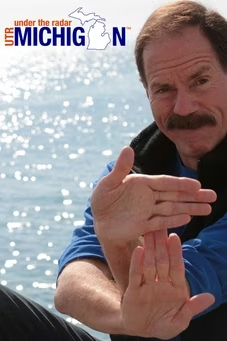
I mean, I'm thinking of my martial arts practice, as you know, I do the Japanese martial art of aikido.
I have a fifth degree black belt.
- Right.
- It's been a long journey.
- 30 years, right?
- It's been 30 years.
A long journey of hitting the mat hard in the cold of winter and sweating hard in the heat of summer.
And you have to keep asking yourself, "Why would I go back to the dojo?
Why would I continue to go back?
Why would I put myself in the throes of discomfort when I could turn on the air conditioning and order the fish tacos?"
- Mm-hmm.
- But we begin to undo, I think, the inevitability of utilitarian thinking.
We begin to unearth a more raw willingness to contemplate pain and discomfort.
- So I wonder, before we go further into this, could you describe for the viewers who might not know what exactly aikido is, how it differs from the others, and what goes on in the dojo?
So when you say you go there for the discomfort, what do you mean by that?
- Hmm.
Yeah, so we walk into the dojo and you have to bow to the Kamiza, to the Japanese notion of the sacred shrine.
- And you're in your uniform?
- Not yet.
- Not yet?
Okay.
- Not yet, but there's this kind of liminal, and I wanted to talk about this today, this notion of liminal spaces.
- Yes.
Okay.
- Right?
You walk across the threshold and the cares of the day, all of the thinking that you've done at St John's College, right, where you've been like teaching Comte, and you've been talking about Aristotle, all of the cares of the day, you have to realize I left those on the shoe rack when I took off my shoes and I crossed into the dojo and I did my bow.
And I've entered into, I think what we would call a sacred space.
A space that has been carved out of daily life where something else is going to happen.
And I think one thing I like about the Japanese martial art of aikido is that it's up to you to discover what that something else is.
So aikido, it's the most recent of the Japanese martial arts.
It was invented in Japan after World War II by Morihei Ueshiba, who very consciously felt that humanity needed to address its violence problem.
And so he came up with this idea that you could design a martial art around the concept of love, around the concepts of ai.
Ai is the Japanese syllable for a kind of, maybe agape would be a commensurate?
- Yeah, yeah.
In Chinese too, ai is love.
- Love and then ki, which is the energy that flows through us, the energy of the universe.
And so with aikido, it's pretty unique among the martial arts in that you can practice it at full power without anybody getting hurt.
- And do is do, the way.
- Do is the way- - So it's like- - The path- - The way of loving energy or the way of love and energy.
- Yeah, and for me do is just that you go in and practice wondering what the path is.
And some days it's like, "I hate this.
I'm gonna quit at the end of the session, I'm gonna go to sensei and tell him I quit."
And some days it's unbelievable recognition that there's an interface of consciousness that you don't encounter in daily life.
- Mm-hmm, so that's when you bow, right?
At the beginning.
So the liminal space that I always taught, the way I understood it in my practice is that it's similar.
You bow all the preoccupations of daily life, your frustrations, your sadness, your anger drop off your shoulders, - Or they should.
- Or they should.
They should.
That's what you're trying to do.
So you can go in there clean because you're going to practice some dangerous stuff, right?
And you don't want any of that stuff to fuzz you up or interfere.
- Right, right, right.
- And at the end you bow all of what you've just practiced off.
- Yeah.
Can I tell you a story actually?
- Yes.
- 'Cause we do iaido as well at the dojo, the art of the sword.
And we started up again after the pandemic a year ago.
It was in April of 2021.
And I have this little lightweight practice sword.
It doesn't even have a sharp edge.
And I started with that.
And the very first time I drew the scythe out of the scabbard, I hurt my elbow.
And it was like this constant wrestling, like, "Am I really gonna do this again at this stage in my life?"
And I finally worked myself up.
I have a live sword, a Japanese blade, very sharp, very heavy.
I finally worked myself up, I'll take it to the dojo.
10 minutes.
I take the other one too, 10 minutes.
10 minutes, "Okay, I'm gonna cash it in," I traded them out.
And then 20 minutes, 30 minutes, slowly developing the strength to be able to practice 'cause it's very heavy on the right elbow and the right shoulder.
But I realized that I was in an antagonistic relationship with this sword.
I saw it as an adversary.
It was something I had to wrestle with.
And if I could do it for 20 minutes, it was a victory.
And I finally realized it's the adversarial that's my enemy.
So I sat down with the sword, I bowed to the sword and I said out loud, I said, "I respect you."
And I bowed to the sword and everything changed that day.
And now I take out that sword, every Saturday I take it out, I bow to the sword, I say, "I respect you.
You are a worthy warrior."
- Mm-hmm.
So you're not entering clenched and embattled and- - Oh- - Yeah, self-sabotaging?
- Yeah.
I saw it as an adversary.
- Yeah.
- Yeah.
- Okay.
So then what?
So you go into the dojo, and then what happens?
What happens in aikido?
- Oh, well, who knows?
I mean, it's different every day.
I mean, some days you're running a tape in your mind from something you're clinging onto from your work, from your personal life, and you never get past that.
You're just running the tape the whole time that you're practicing.
- Mm-hmm.
- And sometimes some amazing thing happens where you can drop all of that and have an insight.
I mean, we can talk about this later, but just the now, what is the now and how does the now work?
- Uh-huh, but in the dojo to an observer, it looks as if there's a series of simulated attacks where one person attacks and is then thrown to the ground or taken into a joint lock.
- Right.
- Or something like that.
- Right.
- Right?
- There are the techniques.
And then because aikido focuses so much on love, we spend a lot of time thinking about the art of ukemi, ukemi being the art of being able to fall to the mat safely, without injury.
- Mm-hmm.
- So even receiving the technique in aikido is a practice.
In some ways more interesting.
- More interesting, yeah.
- The technique is the technique.
I mean, obviously there are technical aspects to it, and we need to think about, is it, you know, are you trying to raise the chin?
Are you trying to cut across the eyes?
What are you trying actually to do with the strike or with the movement?
But in receiving the technique, you really can't be distracted because you're gonna hit the mat and you're probably gonna hit it pretty hard.
And there's only kind of a few ways that that could happen without injury.
So I think that's what drew me to aikido, was the art of ukemi, the art of taking the fall.
And that, I think, relates to what we said about life.
Life is gonna throw a lot of attacks at you.
Can you take the fall?
- Yeah.
Somebody with whom I trained judo a long time ago told me about ukemi.
So if I'm receiving the fall in a test, fall in such a way as to make your friend look really good.
- Mm.
That's beautiful.
(Krishnan and Claudia laugh) That's beautiful.
Yeah.
And I think a lot of people come into the dojo and watch, and at the end of their watch, they're like, "It doesn't look all that hard."
And you're like, "Oh, yeah."
- Oh, yeah.
- That's the perfect response.
You just made me feel really good.
- Yeah.
(Krishnan and Claudia laugh) So just to go back to Montaigne, now you're helping me see something.
This whole essay is built on a fall, right?
And in a way, the whole essay is about ukemi.
- Mm.
Right.
- In a deep way.
And I can't help thinking about what you said concerning the Socratic tradition early on, that Socrates is the one who first made the injunction that to philosophize is to learn how to die or to study how to die, or to practice how to die, right?
And Montaigne himself has an essay in Book One on that very theme, to philosophize is to learn how to die.
And in that tradition, the work or the practice is mainly cerebral, right?
You're trying to understand death.
You're trying to see how your soul is not the same as your body.
You're trying to wean your soul away from the body, from this world of flux, by philosophizing, by thinking through what it might be.
So the practice, at least in Plato's "Phaedo," and to some extent with Montaigne, you know, early on in Montaigne, is to face death constantly in your mind so that it's not alien to you.
It's like you're making sword your friend in a way.
But you do it, at least with Socrates and Montaigne, and the Stoics for sure, you're befriending it, making it your benefactor, you know, as it were.
But here there's a kind of turn, you know, so when he says that "Death is something you can't practice for," it's as if he says that way of practice, the cerebral thinking, the ordinary thinking that isn't faced with something physical.
- Right.
- Right?
Is not really practicing for death because death when it comes is going to be unexpected.
- Right.
- Unpredictable.
- Mm-hmm.
- And physical.
- Right.
- Right?
It's going to be a fall in some way.
- Mm.
- Yeah.
- Yeah.
No, I think that's right.
And I think that's kind of why I brought up that as this notion of the essay, that literally is like an attempt, right?
- Attempt, yeah.
- Right?
That this is not metaphysics.
This is not retreating into thought constructs.
I think that's very important because I'm not convinced that death should come to mind, right?
LeViness has that whole essay on whether God should come to mind.
No, God should come to heart.
And I think death also should come to heart.
And this kind of response to it, I think does justice to that turn from, "Well, let me engage in reason, let me engage in syllogistic reason," right?
Kind of does this sort of self-consistent reason and just allows himself to wander into those places of fear, of weakness, of feeling that the, I love how he describes just like waking up like a broken body, right?
- Yeah.
- When he comes back after the fall off the horse, is he wakes up, he comes back to consciousness, but he's a broken body and he begins to start to process our brokenness, and that appeals I think at a practice level of- - Yeah.
- Yeah.
- Yeah, and he says he wouldn't have remembered what happened if it were not for the onlookers.
- Mm-hmm.
Right.
- Right?
- And we can all relate to that experience and like kind of being knocked unconscious and being confused, and his wife and the people who witnessed it, they kind of tell him.
Yeah, what what do you make of that?
I guess that aspect of having to be told- - Yeah?
- What happened to you.
- Yeah, 'cause what we're reading then in this story is not even Montaigne's memory of it.
It's a reconstruction, like kind of like a composite memory.
- Oh yeah.
Reaching into the collective.
- Yeah, reaching into collective, which he then reimagines and writes down, right?
So there's a funny way that the blank in memory, the loss of consciousness, is itself a kind of death, right?
For a moment there's a blank in my existence and I need the help of all these people to piece it together.
- Mm.
Yes.
- And, you know, so this just emphasizes what you said earlier, in that the metaphysical tendency is really to pretend that there's some spot outside change, or outside experience that you can stand on and where you don't change and it doesn't change.
And you can look down objectively, and everything that's happening and that it's always there.
And that's a kind of pretense, 'cause we can't in fact find it, you know?
And so this fall from the horse is really kind of temporarily the loss of his existence.
- Mm, that giving oneself over to the importance of the congregation, I'm thinking now of religious.
I'm thinking now not of Montaigne, and not yet of Eastern practices.
But of maybe things from the Judeo-Christian tradition or the Muslims are about to go into Ramadan.
This period where you give yourself over to hunger and thirst during the day in order, not in order, but then going to feast with the community at night.
And just having read Genesis in sophomore seminar earlier this year, this notion that one doesn't know where the meal is going to come from.
One has to give oneself over to this kind of faith that God will provide and there will be a meal.
But this is very foreign, I think, to us at this stage in our kind of utilitarian socioeconomic ethic.
(bright piano music) (bright piano music continues) (bright music)













Support for PBS provided by:
Continuing the Conversation is a local public television program presented by NMPBS