
Prediction Markets 101
Clip: Season 8 Episode 31 | 8m 15sVideo has Closed Captions
The popularity of prediction markets is on the rise.
The popularity of prediction markets is on the rise, along with the concerns Nevada gaming officials have about them. But what are prediction markets? Amber Renee Dixon explains.
Problems playing video? | Closed Captioning Feedback
Problems playing video? | Closed Captioning Feedback
Nevada Week is a local public television program presented by Vegas PBS
Prediction Markets 101
Clip: Season 8 Episode 31 | 8m 15sVideo has Closed Captions
The popularity of prediction markets is on the rise, along with the concerns Nevada gaming officials have about them. But what are prediction markets? Amber Renee Dixon explains.
Problems playing video? | Closed Captioning Feedback
How to Watch Nevada Week
Nevada Week is available to stream on pbs.org and the free PBS App, available on iPhone, Apple TV, Android TV, Android smartphones, Amazon Fire TV, Amazon Fire Tablet, Roku, Samsung Smart TV, and Vizio.
Providing Support for PBS.org
Learn Moreabout PBS online sponsorshipbegin with prediction markets, also known as event contracts.
They're available on trading platforms like Cal Shi and Pali Market.
And states like Nevada have an issue with how they are regulated.
Here's how they work.
Prediction markets are like the stock market and sports betting combined.
People buy contracts based on what they think the outcome of an event will be.
And as you can see on this app, these events can be sports.
They can also be the weather, the economy, elections.
For example, this event asks Will Nancy Pelosi resign her office before the midterms?
If you think the answer is yes, you would buy a yes contract for $0.22.
I'll put in my one contract there.
This app charges a two cent fee each contract pays out $1.
And so if Nancy Pelosi does resign before the 2026 midterms, you would get a $1 payout, which includes the $0.24 you already paid and a $0.76 profit.
If Nancy Pelosi does not resign, the older contract expires and you lose your money.
But you can also make money before there's an outcome, like a stock price.
The value of a contract can rise or fall as new information becomes available and people change their expectations.
So you could sell your contract at a higher price than what you paid, and walk in a profit before the event even happens.
So who should regulate these contracts?
The prediction market industry favors federal oversight, arguing these contracts are financial derivatives, more like trades.
Well, several states, including Nevada, say when they're based on sports, they're more like sports betting and should fall under state and tribal gaming regulators.
Here to expand on that and the role prediction markets are playing in the evolution of sports betting are a barbell.
Executive director of the UL, the International Gaming Institute, professional sports bettor Steve Cizik and Stephanie Goodman, executive director of the doctor Robert Hunter International Problem Gambling Center.
Thank you all for joining Nevada Week.
So I want to start with the hot topic of prediction markets.
And Brett, actually, that came out of your mouth.
That is the hottest topic within your industry right now.
Why?
This is the newest thing.
We are constantly seeing innovation and evolution of what can be done with betting.
And this is a really interesting one because it's not just an evolution of what gambling can be, it's an evolution of financial markets.
And as a result, we're seeing a lot of very public discourse on whether or not this is gambling, what it means for states in the U.S.
that have very strict laws around licensure for gambling, and then also what it means that a federal level here in the United States and how these different markets can be regulated, We don't know yet if they're going to be determined to be federal level financial markets.
And then even within that, there's a lot of different niche areas that we could discuss around the subjects and the assets that underlie the financial products.
That is a prediction market.
You brought up states, Nevada is currently fighting these prediction markets, claiming this is gambling, and if it's happening in our state, we should be regulating it.
You brought up what will this mean for gamblers?
And so for that, Steve, what do prediction markets mean for gamblers right now.
They mean I get to purchase things cheaper.
All right I'm a mercenary.
I'm betting on the Super Bowl.
I don't want to play -110.
A local casino has a -105 special.
Now, all of a sudden, if I can hit 51.4% instead of losing, I'm winning at -105.
Well, guess what?
A lot of these prediction markets have pricing as low as -1 or 2.
So it's I'm I do believe it's gambling.
I'm I don't have a law degree.
So I can't say how they're getting around this, but it's basically I'm making the same wager at a cheaper price.
So from my perspective I love prediction markets.
You are paying the bookmaker less.
This is not a bookmaker, but in this example I'm getting the same product for less without the but without the regulation and the safeguards.
Okay, Stephanie, your thoughts?
Well, I think that prediction markets are predatory, especially when you consider that they are they're talking to 18 year olds and there's zero protections surrounding it.
And they're very bold in marketing these individuals.
And, you know, you could be an 18 year old and you have a Robinhood account.
And then all of a sudden it comes up, who's going to, you know, win the BCS game?
I mean, these sorts of things are it's it's not okay.
And I think my issue is, you know, I'm all about free markets.
I think that's great.
But this is gambling.
You can word sell it as much as you want.
It's gambling.
And the fact of the matter is, there's zero protections surrounding it, and that's not okay.
And when you look at the number of, of, 18 to 30 year olds, I think 10% of 18 to 30 year old males have, display behavior that shows that maybe they have a gambling issue, and then 26 of those people could, at 26% of those individuals, actually, they think might have a gambling problem.
So when we're looking at what we're doing to our youth right now, I think it's unacceptable.
It's huge that the prediction markets allow entry at 18 years old in most states, whereas sports betting typically happens when you turn 21 years old.
That earlier introduction, what kind of impact does that make?
Cannot make?
This is what I think.
I think we have a whole generation of individuals, especially males, that have been playing video games.
Loot boxes are a form of gambling.
They're going to put money in.
They're going to see, they're going to get that skin that they want.
So that's a form of gambling.
So we've kind of been just just, you know, teaching these loot boxes are you put money in as a, as an adolescent, you're playing, Fortnite and you put money in as an adolescent.
And you, you get you get this loot box and suddenly you're going to decide if you if you get the skin that you want or not, you're going to continue putting money at at your parents money until you get the skin that you want.
So there's this whole, this whole concept that they've been that they've been raised with.
And then you move on to the fact that here they are at 18 and they're going to start working with prediction markets.
It's not acceptable.
We do not teach gambling addiction to our youth.
Right.
So they're going to learn about alcohol.
They're going to learn about drugs.
They're going to learn about health.
They're going to learn about all kinds of things in the K through 12 system.
I think We need to teach people that gambling actually is an addiction.
It's a legitimate addiction.
It's a DSM five addiction, like alcohol and drugs.
And so for us, I feel like we really need to do a better job at the awareness piece.
When we're when we're talking to our youth, who is responsible for that awareness, creating that material and putting it out there, or do you want to add anything about video games?
Because I know that's a hot topic, right?
And something about prediction markets here.
I talked about innovation.
Prediction markets themselves are not a new product.
This is a financial product.
It's a derivatives market.
We've had futures markets for umpteen years umpteen centuries I mean centuries it goes political races, political races.
But also the idea that you have an underlying asset and you're buying a position about what will happen to that asset in the future.
So this concept of prediction markets, one of the major ways that has driven its growth has not been politics has not been physical product, but it has been sports.
And prediction markets right now are 90 to 95% sport in terms of their volume.
And so when we talk about the various things that we've been discussing over the last, what, 5 to 10 minutes or so, a lot of the surrounds, that concept of sport and whether or not sport is something that should be considered a betting product versus or versus a financial products, we're not necessarily talking about, you know, like pork bellies or wheat or the weather.
We're really particularly focusing on sport, which has for such a long time been the purview of the states.
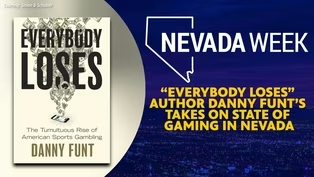
“Everybody Loses” Author Danny Funt’s Takes on State of Gaming in Nevada
Video has Closed Captions
Clip: S8 Ep31 | 7m 23s | Sports journalist Danny Funt shares what he learned about gaming in Nevada while writing his book. (7m 23s)
Sports Betting News, Ethics, and Problem Gambling
Video has Closed Captions
Clip: S8 Ep31 | 16m 49s | Prediction market regulation, combatting problem gambling, and betting scandals are the topics. (16m 49s)
Providing Support for PBS.org
Learn Moreabout PBS online sponsorship
- News and Public Affairs

Top journalists deliver compelling original analysis of the hour's headlines.

- News and Public Affairs

FRONTLINE is investigative journalism that questions, explains and changes our world.












Support for PBS provided by:
Nevada Week is a local public television program presented by Vegas PBS