
Preserving Appalachian History
Clip: Season 2 Episode 43 | 3m 47sVideo has Closed Captions
Media Burn & Appalshop digitize historic tapes.
Media Burn & Appalshop digitize historic tapes.
Problems playing video? | Closed Captioning Feedback
Problems playing video? | Closed Captioning Feedback
Kentucky Edition is a local public television program presented by KET
Preserving Appalachian History
Clip: Season 2 Episode 43 | 3m 47sVideo has Closed Captions
Media Burn & Appalshop digitize historic tapes.
Problems playing video? | Closed Captioning Feedback
How to Watch Kentucky Edition
Kentucky Edition is available to stream on pbs.org and the free PBS App, available on iPhone, Apple TV, Android TV, Android smartphones, Amazon Fire TV, Amazon Fire Tablet, Roku, Samsung Smart TV, and Vizio.
Providing Support for PBS.org
Learn Moreabout PBS online sponsorshipAppalachia is a region rich with creativity, but their stories don't always make it out of the mountains.
Digitizing videotapes is one way to keep history alive, and media Baron Archive has partnered with Apple Shop to recover 34 videos from 1970s Appalachia.
They give us a unique glimpse into life way back then.
The work of digitizing videotapes is very cost.
It's very costly, it's very labor expensive, and it requires equipment that almost no one has anymore.
We thought it would be a great way to we wanted to share our resources.
Apple Shop was one of our first choices just because of the extraordinary work they've been doing for the past 50 years.
You never really know what's on a tape.
So one of the tapes that we highlighted that was one of our favorites had all these amazing bluegrass performances.
But the tape was labeled Girl Scouts.
And the first 5 minutes of the tape are just that Girl Scout troop meeting.
That's the type of thing that's really exciting for us, is that happens constantly where tapes are mislabeled or things are taped over and it's like you don't know what you're going to find until you digitize them.
I don't believe if God could look down upon this earth that he was made, that he'd be displeased with it.
Conducted, went on our knees, turn these mountains down.
There are tapes that deal with destruction that strip mining brought to local communities and efforts to hold companies accountable for that type of destruction.
Through there is this really, really fantastic tape called Burn, Burn, Burn.
And it was made by a group of kids who basically created a little like a funny experimental film about their house burning down and pretended to burn their house down.
And it is just a joy.
And I think that one is then my favorite.
Hey.
I got an idea.
The type of tape that this was produced on is called Half Inch Open Reel Videotape.
And it was a technical marvel because it was the first time that portable videotape equipment was available to the public.
They weren't meant to be sort of permanent.
They weren't meant to be an archival medium.
They're very fragile.
And at this point, many of them are suffering a lot of damage.
One of those is called Sticky Shag, which is basically the tapes are just basically sort of flaking off.
Once it degrades, it's totally gone.
So some things that we do to remediate that is we bake the tapes, which basically involves sort of pulling humidity out to try to stop that process of sticky shot in particular with Apple Sharps collection.
Many of the tapes were very moldy and you can't transfer tapes that have mold.
And so the process of removing the mold is very labor intensive.
And it's really just sort of hand cleaning every little bit of it to get that modok so that we can transfer it.
So we've been working for about 20 years to preserve exactly this type of material, community based work that was generally rarely seen like outside of local context at the time that was created.
And we realize that this has really created a big gap in our understanding of American history that there are all these voices whose work was only seen locally and never made it into the bigger picture.
And so one of those communities that has been definitely less heard is than rural America.
Well, I think that moving images just give us this incredible insight into the way people live, the way they talk, what's important to them.
That's as close as we can get to, like going back in time and being in a place and talking to people and watching events happen in real time.
Video has Closed Captions
Clip: S2 Ep43 | 39s | Churchill Downs set to reopen in September with no track changes. (39s)
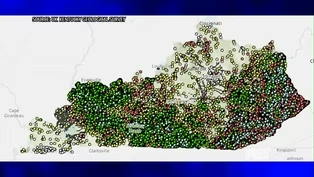
Video has Closed Captions
Clip: S2 Ep43 | 4m 42s | Taking care of Kentucky's orphaned oil and gas wells. (4m 42s)

Ed. Commissioner Stepping Down
Video has Closed Captions
Clip: S2 Ep43 | 2m 32s | Kentucky Education Commissioner Jason Glass is stepping down. (2m 32s)
Officer Nicholas Wilt Going Home
Video has Closed Captions
Clip: S2 Ep43 | 27s | Nicholas Wilt discharged from a rehab center three months after he was shot in the head. (27s)
One-On-One With Mayor Alan Keck (Part 2)
Video has Closed Captions
Clip: S2 Ep43 | 3m 57s | Mayor Alan Keck sits down with Renee Shaw to reflect on his gubernatorial run. (3m 57s)

Video has Closed Captions
Clip: S2 Ep43 | 5m 52s | Louisville Metro Police Department's new chief Jacqueline Gwinn-Villaroel. (5m 52s)
Report: Crafts Not Backing Trump
Video has Closed Captions
Clip: S2 Ep43 | 43s | Report shows Crafts are donating to other GOP Presidential candidates instead of Trump. (43s)
This Week In Kentucky History (July 31, 2023)
Video has Closed Captions
Clip: S2 Ep43 | 1m 37s | This Week In Kentucky History (July 31, 2023). (1m 37s)
Providing Support for PBS.org
Learn Moreabout PBS online sponsorship
- News and Public Affairs

Top journalists deliver compelling original analysis of the hour's headlines.

- News and Public Affairs

FRONTLINE is investigative journalism that questions, explains and changes our world.












Support for PBS provided by:
Kentucky Edition is a local public television program presented by KET