Preserving the Ponce
Preserving the Ponce
6/16/2026 | 26m 13sVideo has Closed Captions
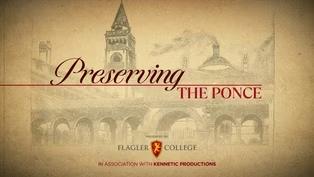
The history & restoration of Ponce de Leon Hall at Flagler College in St. Augustine, Florida.
Preserving the Ponce details the history, architectural significance, and multi-million dollar restoration of Ponce de Leon Hall (originally built in 1888) at Flagler College in St. Augustine, Florida. It highlights Henry Flagler's legacy, and the monumental effort to maintain historical accuracy for students. 2026 Suncoast Emmy® Award Nominee
Problems playing video? | Closed Captioning Feedback
Problems playing video? | Closed Captioning Feedback
Preserving the Ponce is a local public television program presented by Jax PBS
Preserving the Ponce
Preserving the Ponce
6/16/2026 | 26m 13sVideo has Closed Captions
Preserving the Ponce details the history, architectural significance, and multi-million dollar restoration of Ponce de Leon Hall (originally built in 1888) at Flagler College in St. Augustine, Florida. It highlights Henry Flagler's legacy, and the monumental effort to maintain historical accuracy for students. 2026 Suncoast Emmy® Award Nominee
Problems playing video? | Closed Captioning Feedback
Where to Watch Preserving the Ponce
Preserving the Ponce is available to stream on pbs.org and the PBS app.
Providing Support for PBS.org
Learn Moreabout PBS online sponsorshipHere on Florida's Atlantic coast lie Saint Augustine, the nation's oldest city, founded centuries before the modern age.
Its narrow streets and weathered stone tell a story of empires, explorers and endurance.
Spanish, British and American histories converge here, layered one upon another like pages in a living book.
But in the late 19th century, a new chapter was written, one shaped not by conquest but by vision.
That vision belonged to Henry Flagler, industrialist, railroad builder and co-founder of Standard Oil.
Having mastered the machinery of modern America.
Flagler turned his attention south, believing Florida's future could be built quite literally from the ground up.
He chose Saint Augustine for its history, its climate, and its promise.
And here, in 1888, he raised a building unlike anything the region had ever seen.
The Hotel Ponce de Leon, monumental in scale, modern in design and built to last.
Henry Flaggers wealth was unimaginable in today's time.
He and Rockefeller had combined 3 or 4% of the country's gross domestic product.
And so when he did something, he went all in.
Saint Augustine was a pitiful little town then, but he saw something in the town.
He said, this is one of the oldest towns in America.
We need a grand hotel down here.
Flagler is coming off of Standard Oil wells, and he's also catering to a clientele that have plenty of money to spend.
These Americans want luxury.
They want palatial spaces that may remind them of Europe, where the aristocracy has existed in previous eras.
The.
He knew Thomas, Hastings and John career.
Two great architects who had just gotten back from Beaux-Arts had Paris Flagler engaged these two men and said, I want you to build me the finest hotel you can.
He really went out on a limb when he chose the architects because they were not very well known.
I think what he was saying was, I want something extraordinary.
I just want something that will put my hotels ahead of everybody else's.
This was built during the growing age of tourism in the United States.
It was the first poured concrete walled building in the United States.
This building actually had electricity before the white House did.
Thomas Edison installed the electricity here.
Career in Hastings to set a standard.
There were over 200 Louis Tiffany stained glass windows throughout the hotel.
There were mural paintings all over.
There were just a collection of marvelous paintings throughout the whole hotel.
It was almost an art gallery.
Every level of detail is at the finest of whatever trade that you're dealing with.
The concrete work was new and innovative.
The brickwork, the terracotta, the embellishment and some of the detailing, wood carvings and wood paneling, finest furnitures and source of materials from all over the world, and bringing them together in a uniquely American style.
Pass Hall, which of course is the center of the porcelain hotel, turned Saint Augustine into a different place than it was before.
It really brought in people from a different wealth level who were well-to-do.
They were not the typical visitors.
Prior to that.
There were very few hotels that aspired to be artistic in the sense that the spaces were dramatic.
The architectural ideas behind the buildings were complex and interesting.
But he never built anything like the Porcelain Hotel.
That was his first hotel, and he really well, I think he peaked and he couldn't do any better after that.
(MUSIC) About a year ago we began looking for other uses for this plant.
Anything to use of this hotel would have to reflect well on him and on the present management of the company.
Whatever became of this hotel had to be good for Saint Augustine and the community.
And it's a great pleasure that I announce today the sale of the Ponce de Leon Hotel to a group of well-known educators headed by Doctor Roy Carlson, for the purpose of becoming a private, non-denominational, four year liberal arts college for women to be named Flagler College.
Well, it was the building that Henry Flagler built.
His hotel was reopened as a college.
That was the beginning and were Flagler College.
The first five years David was on the ship.
After that, there was a long period of stable housing coverage.
We had to sell buildings.
You had to repair buildings, share the good buildings in there, make it look like a college.
1978 we were listed on the National Register for Historic Places.
So when I got back to campus the next day, I called one of our faculty members in and I said, why aren't we a National Historic Landmark?
And we began the process.
We did that because we thought that the centerpiece of our campus merited that kind of distinction.
I think the historical nature of it is so important that you can actually have a tangible evidence that Flagler came through here, that he built this, that he bought these craftsmen and built this beautiful building.
It's a somewhat cliche, but it's true to know where you're going.
You have to know from where you came.
And showing the style of architecture, showing the way.
The people live, showing what artistic beauty was important to them, helps inform us in our current generation about the past and borrowing some of those ideas from the past to incorporate and new things.
(MUSIC) We had a water leak July the 4th of 2022, a sprinkler that went off and it did massive flooding on a portion of one of the wings.
And it allowed us to get behind the walls and realize that we really needed to gut it.
Once we had this flood, our commitment to rebuilding it, there wasn't an option.
It makes me realize what a committed board and what a committed community we have here.
The timing was critical.
Our people here at the college knew that the structure was in danger, and if we didn't act quickly, we were going to lose.
Parts of the structure.
Our structural engineer called it divine intervention to have that fire suppression water leak occur, because it allowed us to go in, and the college was able to get the money together to do the restoration of the East Wing.
And we really then got to see how grand this place was.
Everything had to be exposed, the structure needed to be evaluated.
We would have a plan going in.
But then as you uncovered things that were additional items to be addressed, those structural issues, the cast iron pipes, the copper, there were some structural items that were really overstressed and could be an issue.
The Hvac system just really wasn't performing real well.
The air quality wasn't great.
Bathrooms were in front of windows.
You had humidity problems.
You had a lot of things to be addressed.
This building is the centerpiece of our college.
There was never a question on whether it would be renovated or not.
It was just where do we get the money?
For.
I met with the leaders in the House, Speaker Renner and in the Senate, Kathleen Barcelona, and then with the governor, and explained what happened.
We didn't know how much, but we said for this to get fixed.
This is a statewide issue.
This building is the most prominent building in Saint Augustine.
Saint Augustine is the oldest city not just in Florida, but in the country.
And everybody understood.
The Historical Commission wants to see a match, and we agreed that we would raise the money, match the state dollars.
But the price tag was enormous.
Public private partnerships are extremely important in a project like this.
So the state wants to ensure, since they're using taxpayer dollars, that there is buy in from the local community, that the local community cares as well.
And so this is one of those examples of investing private dollars to complete a project like this.
I think they recognized that.
They would lose.
Something as a major city if they didn't protect what they had, because you can't build it back.
You know, once it's gone, it's gone.
(MUSIC) This is the Punchbowl Lobby rotunda.
We've done quite a bit of work in the space.
I think the biggest challenge and here was our schedule.
Just because, like, they constantly do tours in here.
And then during the school year, it's like kids.
They live here.
We had three months over summer to basically come in, tear down all this plaster rerun everything, and then put the plaster back.
Just working above all of this artwork is terrifying.
There's a lot of pressure because there is stuff in this building that we could not replicate today.
The craftmanship back then was so much different than it is today.
We can take any sort of trim piece, 3D printer or have somebody make it, but it's not that original.
Wood.
There definitely is a lot of pressure to just preserve what's here.
If we can salvage it, if it's not been damaged, whether it's just dry rot, termites, whatever, anything that we can salvage.
There's a little bit of pressure to keep that historic nature to this building.
Forget alligators and pythons.
It's the termites that really you have to worry about.
A lot of the woodwork in the rotunda is oak.
The termites love it.
A lot of times you don't know that there's termite damage there because they eat from behind and the surface will be like paper.
So we go in and figure out what areas need repair, treat them, fill them, and then wood grain to match.
We're stirring all the the glaze trim work, all of the wood work going back to the historic original wall color.
We found all of these by taking scrapings, and then I sent off the paint samples to Colonial Williamsburg to get them analyzed under the microscope.
These are by an artist named Hagerty.
He's an Italian artist.
These were part of the original design of this room.
We've had to, in some cases, remove the canvas and repair the plaster behind.
And then we adhere the canvas with a conservation grade glue, which we inject with a syringe and then iron down.
So we have original fireplaces, original tile.
We have 94 rooms on the west.
There's probably 70 some odd fireplaces over there.
There was a fireplace in every room.
Some of them, when they started doing the demolition, were behind walls and we didn't realize that were there.
I had a company come in and take out the ones that were visible, and they took the mantle and the woodwork off the fireplace to center out the strip and reworked them, and then replaced them, the ones that were behind walls.
We stripped clean, patched, repaired back with original paint colors.
After we did the paint sampling.
Yeah, smart.
This is a beautiful example of a restored fireplace.
The mantel.
You notice the brush marks in it.
That's because it was done that way intentionally.
Anyway, if you look at this, one is particularly beautiful.
I love this interior as sort of a basket weave look.
They use that pertain to a lot of the fireplaces, and you'll see the tile here.
Some of the tiled building is actually Tiffany, which makes it very, very special.
We done our job.
Someone comes here from 130 years ago.
Won't know we were living here.
And that's the magic restoration.
Architecture is an art, but with a caveat in the sense that it's a public art.
Everybody has to see it.
Every building has to be properly designed to be used by human beings.
I think in the current age, we've kind of forgotten.
The design challenge that was posed to the faces system for this project was to implement a solution that had no impact on the architectural or historic elements in the building.
We had to distribute the air without penetrating any of the original plaster affecting any of the original woodwork, and maintaining a completely open site picture to where none of.
Our air distribution was visible to the naked eye.
We provided air distribution on the third floor of the building, and coordinated with the architect and the general contractor to disguise our air distribution as architectural features to the bill, as woodwork.
The system that was installed here for the last 25 years was approximately 80 of these residential systems, and they were littered all throughout the building.
We removed all of those air handlers from floors, which eliminated all the need for all those mechanical rooms, and instead put a very small, complete package.
Air conditioning systems above the ceiling.
Serve service way.
The original chandelier that hung in here was removed in 1891, and in 1893 Flagler would end up putting this plaster lines to light the floor up a little better for people, because once he removed the chandelier, it was probably pretty dark in here.
The chandelier was made out of 24 different castings that were originally crafted here in Saint Augustine.
Were built and designed to mimic exactly what's hanging in here at the time.
One of the most interesting things to me as a painter is, there are a lot of signatures that we've found from other painters who have done restoration over the years.
Over one of the door frames, we found a signature from 1919 from a painter from Scotland.
There are signatures in the rotunda from 1960.
In 1990s, when we were restoring the exterior of the building, we found a signature in a cell in the coquina from 1886, which is super neat to me because those are my people.
Those are the craftspeople that do what I do.
That part is very special to me.
Found a booth just here.
And a wall.
My first question to my superintendent was like, there's no bones in it, right?
And he was like, no, we're good.
I'm like, all right.
So that was cool.
There's a painted on signature in the second floor rotunda, and it's Thomas Edison.
Thomas Edison's signature was fantastic.
Some of the the metal beams came from the firm that, did the Statue of Liberty in New York.
The inside.
And they still got the stamp of that company on there.
Next time somebody comes to renovate, we've left a couple plaques behind some of the walls.
We're proud of what we did.
Henry Flagler really tried to bring beauty to a space that everybody could enjoy.
It's such a treasure.
The people who worked on that building are some of our best artists.
Designers are craftsmen throughout the country now.
It's a lot of the buildings from that time period have been torn down, especially in the 1940s, 1950s when that was out of style.
Things were modern and wide and square shaped.
Nobody wanted decorative, colorful buildings like this.
Luckily, it was saved from being torn down.
And we all have that as a sort of a treasure of that time period.
But it's also mixed with the modern use of the kids today, which is special.
Marriage.
The folks who are doing this can inspire other young people to go into these trades, because we're going to need them.
We have to have people in construction who can restore buildings like this.
Not everybody does it to this extent.
Not everybody has the faith that hiring these artisans and giving them, the full rein to do it, their way.
You got to believe in these people.
And when you believe in them, spectacular things happen.
The Urban Land Institute has a phrase that call a sense of place.
They apply to buildings and developments, etc.
and that's really what the ponce has, is the sense of place, the place you go in.
You want to sing, you want to pray, you want to think.
Henry Flagler built the Ponce de Leon Hotel, but he really was built in a college, and it's really birthed quite a special place.
When I saw it the first time, it was moving day, and everyone was kind of running around and all over the place, and I walked up through the breezeway and into the rotunda.
And when you walk in for the first time and you see all the design and the artwork and stuff, it's it's beautiful.
It kind of takes your breath away for a second.
The students get to go to school in an artwork.
I almost feel sometimes that the history comes in through your pores, which doesn't sound very scholarly or academic, but it's almost like you absorb it by being around it and you start to get a feeling for it, for the students and the faculty.
Some of the experience is probably something that's not intellectual, but more at the gut level or the sensory level.
A lot of people actually start crying when they see it for the first time, especially the parents of students who want to come here.
They are just in all of the beauty, looking around and seeing detail, especially in the rotunda with the beautiful gold ceiling.
It definitely made me realize how lucky I was to live here.
I was talking with a girl about her experience at Flagler.
She said, you know, Flagler made me better than I thought I was capable of becoming.
And it really just said so much in terms of who we are, what we are, what we do, why we do it.
I think it's incredibly important because people are living here, they're learning here, they're enjoying this physical space the same way that people over 100 years ago did.
The biggest problem we have in art history is we're always teaching reproductions of work, not the original.
I think it's an extraordinarily special right to, like, be able to be in front of an original painting.
The actual architecture you're talking about in class, rather than it's behind a screen, constantly.
Thinking about sort of esthetics in the 19th century.
This has got to be one of just a few places in the U.S.
where you could go and sort of experience that firsthand.
I think for those that don't appreciate the history of Flagler College, they should take the time to just sit in one spot and look around.
That's all it takes is just a moment of time and acknowledge the beauty of what was created.
So long ago, and how lucky we are to be able to attend such a place.
The parents are coming in and what they see is this beautiful building and the beautiful craftsmanship and the beautiful stained glass.
It's kind of like when you're a kid and there's something special in this beautiful music.
That music stays with you for your life.
The pond stays with them.
Esteemed guests and friends at Flagler College.
It is truly an honor to be with you this evening as we celebrate a defining moment of our college's history.
The restoration.
Renewal of Punch Hall.
Your generosity, your belief in our mission, and your dedication to Flagler College are shaping not just buildings and programs, but a new future for the college at large.
We are dangerously close to losing that ceiling.
Forever.
Which is why we call that water break a blessing.
Some say Henry Flagler may have been trying to tell us something.
We have the entirety of the pants reflective of its reputation.
Students now exclaim with wonder when they walk into the hallways for the first time.
The project wasn't really about just preserving the past.
It was about investing in the future, investing in our students, investing in the City of Saint Augustine, investing in the cultural fabric of the state of Florida.
The climate memory has always been more than just a building.
It's where we find connection, community and belonging.
It's where we grow.
I'm forever grateful for the role it played in my story, and I'm filled with joy knowing that future generations of saints will get to experience this place, to another world.
(MUSIC) When you think about spending $100 million plus, those numbers are just staggering.
I don't know that anybody could understand and appreciate what that means to this institution, what it means to this community, what it means to Flagler College and its future going forward.
The buildings have sold.
I say good morning to every morning when I come in.
I say goodnight to her at night.
She's a good building.
I thank her for letting me be here.
I tell her all the time.
Will make a new frame.
Not only does it tell the story of Florida, but it really it tells a part of the story of America.
We want people to come here and see the history of America, the history of travel, of railroads, of tourism.
A lot of it ties directly to this unique place in Saint Augustine.
If you don't use buildings, people don't care about them.
It's hard to get people to care about preserving them if they can't use them.
If it just becomes something to look at, like a statue.
Hunt is special because it's alive, and every inch of that building is being used by someone from the basement to the solarium.
I love that energy.
There.
What would have happened if the president and the Board of Trustees had not said, we're going to fix this?
I cannot even imagine in my wildest dreams how this building might be used otherwise.
Everybody that you talked to in Saint Augustine sees the building as the heart of downtown.
Everybody's so proud of it.
It's a very personal building to them.
Schoolchildren 75 years from now have got to be able to come here and marvel at this and see what real craftsmanship is.
This building is 100 and 2030 years old.
We're sure anybody builds anything the last 100 years.
They don't build like this anymore.
And it really is amazing to think this was done by hand when you really get down to it.
So it was special at the time.
It opened in 1888.
It still is today.
The parts in Flagler College, they're the heart and soul of Saint Augustine.
And if it was not here, I think there would be a tremendous void.
And I don't know how.
You would feel it.
(MUSIC)
Video has Closed Captions
"Preserving the Ponce" details the history, of Ponce de Leon Hall in St. Augustine, Fl. (1m 3s)
Providing Support for PBS.org
Learn Moreabout PBS online sponsorship














Support for PBS provided by:
Preserving the Ponce is a local public television program presented by Jax PBS