Pressing Matters
Pressing Matters | Hunger Crisis
Clip: Season 3 | 9m 54sVideo has Closed Captions
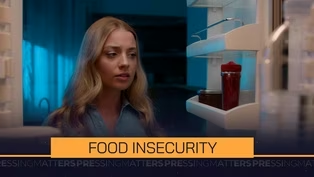
Pressing Matters examines the hunger crisis in Michigan
Food insecurity is a crisis across the state, affecting one in six adults, and one in five children. That's more than a million and a half people in Michigan.
Problems playing video? | Closed Captioning Feedback
Problems playing video? | Closed Captioning Feedback
Pressing Matters is a local public television program presented by WCMU
Pressing Matters
Pressing Matters | Hunger Crisis
Clip: Season 3 | 9m 54sVideo has Closed Captions
Food insecurity is a crisis across the state, affecting one in six adults, and one in five children. That's more than a million and a half people in Michigan.
Problems playing video? | Closed Captioning Feedback
How to Watch Pressing Matters
Pressing Matters is available to stream on pbs.org and the free PBS App, available on iPhone, Apple TV, Android TV, Android smartphones, Amazon Fire TV, Amazon Fire Tablet, Roku, Samsung Smart TV, and Vizio.
Providing Support for PBS.org
Learn Moreabout PBS online sponsorship- It looks like a lot when we go through the warehouse, you'll see racks of pallets of different products.
You'll see a huge freezer and cooler, and when you look at that food that's in our warehouse, it's roughly about a month worth of food.
We turn our warehouse inventory roughly 12 times a year, so it looks like a huge amount, but that's how much we basically distribute every month.
- [Stefanie] Food insecurity is not just about the feeling of hunger.
It means not having reliable access to enough affordable and nutritious food.
Ken Estelle is the CEO of Feeding America West Michigan.
He says, it doesn't always mean someone goes without eating, and it often means making tough decisions.
- I get a chance to talk to folks that are coming and you get to know some of them and they make choices, and some of them are really hard choices, and that's what really hits you is like, okay, they're choosing between, "do I get groceries?"
or "do I pay my rent, or house payment, or utilities, "or medical bills, prescriptions," things like that.
- [Stefanie] Feeding America West Michigan is part of a network of food banks serving 40 of Michigan's 83 counties and the entire Upper Peninsula.
Food banks like this move massive amounts of food, which comes from a mix of sources, donations from grocery stores, food companies, farmers, and federal programs that purchase food directly from producers and when needed, they can also buy items at a reduced cost.
- We have a fleet of trucks that make sure that food is picked up and delivered to where it needs to go.
We have about 35 trucks.
Half of them are tractor trailer rigs.
Last year, overall, we distributed 32 million pounds of food.
We're on track for about the same this year.
It looks like we're coming in right around that same amount, so that's around 26 million to 27 million meals worth of food throughout the year to those, you know, four to 600,000 households - [Stefanie] In nearly every community, it's become increasingly difficult for people to find equitable access to food while needs spike during the pandemic, today's demand is even greater.
- What we've seen over the past several years is that a continual step in need based on reduction in elimination of some of those pandemic related benefits.
- [Stefanie] For many families, food assistance through snap, the Supplemental Nutrition Assistance Program, formally known as food stamps, has been a critical lifeline, but pandemic era benefit increases have ended, and federal rules have changed, which now require many adults to work, train, or volunteer a certain number of hours each month in order to qualify.
At the same time, food prices remain high, meaning many families are getting less help, even as they need more of it.
- In most cases, I just hear, you know, I have the same amount of money I had two years ago, but everything costs more.
- [Stefanie] In communities across the state.
Organizations of all sizes are making it their mission to help keep people fed.
Traverse City based Project Feed the Kids began during the pandemic when founder Tiffany McQueer realized while children were getting meals during the school week, weekends were a different story.
- The buses were running and the schools were putting food on porches of all the families, and I said, wow, that's fantastic that the school is stepping up and still feeding children during COVID.
I said, but I wonder who's feeding the kids on the weekends?
And my husband looked at me and he goes, well, we are.
- [Stefanie] The couple owns J&S Hamburg South Airport, which serves as home base for the nonprofit.
Tiffany says her motivation to help came from watching her mother struggle to put food on the table when she was a child, and also challenges of her own as a young adult.
- I know what it's like to be judged and questioned through all the different chapters of my life, and I wanted to be able to be the person that helped people with no questions.
I just wanted to be the person that I needed when I was a kid.
- [Stefanie] In their first week Project Feed the Kids, packed 81 meals the next 500.
Today through donations, fundraising, and the help of an army of volunteers, they distribute around 4,000 free meals each week, which are placed in easily accessible coolers at eight locations throughout the region.
- And it's just great to know that, in at least a small way, we're making sure some of these kids get some meals.
- Often people think of Traverse City as this tourist rich, all this stuff, and that is the case for some, but definitely not the majority.
There's so many families fighting food insecurity.
There's no way we would go through 4,000 meals if there wasn't a hunger crisis in our communities here.
It is always busy.
There's never any meals left over.
I would say as a whole, there's always going to be food insecurity.
We're always going to need to fight hunger.
We pack on Thursdays, we're typically outta meals by about Saturday night.
Probably the hardest part for me is knowing that there's so many kids that are in need, that there's so many families fighting the same fight that I fought when I was a kid and being in the shoes of those families knowing what it's like, that is the hardest part.
- [Stefanie] Food Hugs is a West Michigan-based nonprofit that delivers surprise home-cooked meals and groceries to help people going through difficult moments, including food insecurity, illness, grief, or financial hardship.
The organization was founded by chef and restaurant owner, Jenna Arcidiacono, is built around the idea that food can provide both nutrition and emotional relief.
- One less thing you have to think about when you're struggling.
- [Stefanie] And Jenna says the need and the response has continued to grow.
- Once they announced that SNAP benefits were maybe not going to get given or completely cut, I couldn't bear to think of people not being able to eat.
So, I just made this food pantry right in the front door of the restaurant.
You don't have to fill out paperwork, you can just come in and grab what you need and leave.
There was a couple that came in and said, we saw your video and we haven't eaten for two days, so our kids could eat.
Sometimes people put food at their back burner, but we all need nutrition and food to survive.
I think food should just this general human right.
No one should have to worry about that.
- [Stefanie] From bigger cities like Grand Rapids to this small but mighty operation in Isabella County.
Cathy Fourtier, owner of The Barn Door, bar and restaurant, knew she had to take action.
- With the SNAP benefits being cut, I put word out on my business page on my personal page and just let everybody know, bring non-perishables, here's my Venmo, I'll do the shopping for you.
This is what needs to happen so that we can at least give out some meals for people until, and that's all I had to do.
- [Stefanie] Cathy and her crew have been making a difference in their community in many ways by offering free community dinners, food drives and more.
- We've been filling the little pantries around town also, and then we've given out over 1300 meals since the 1st of November.
We're planning on 100 bags for Thanksgiving, it'll probably be more than 100, but I wanna say 100 to be safe.
- [Stefanie] While many associate food insecurity with families or the elderly, it's a growing reality on college campuses.
Here at Central Michigan University, officials say as many as one in three students may be experiencing hunger, which is where the student food pantry offers a little extra help.
- The only algebra requirement is that you're a student.
We don't check income, we don't check financial aid status.
We don't check Pell Grant status.
We quite literally just check if you're registered for classes.
It's the only thing that really matters to us to use the pantry, and then we also will encourage people to bring their friends.
- [Stefanie] The pantry is open five days a week.
Along with food, it also has hygiene products and other supplies.
Students can sign up online at cmich.edu or they can simply just show up during pantry hours with their valid student ID.
Donations come in from local organizations and community partnerships.
The pantry helps feed students of all backgrounds and education levels.
- People tend to do things better when they're fed well, both just like cognitively and emotionally, and so not only the fact that we can provide food to students who are food insecure and help them in that moment.
We also believe, and I especially, believe just the very fact that we exist on campus is very helpful because students don't necessarily have to worry about, even if they're not currently experiencing financial needs or food insecurity, they know that if those things do happen, like, we are here and we're here for them, if they have that moment of need.
- [Stefanie] It is clear that hunger is no longer confined to any one type of community.
For many, it doesn't take much for that need to become personal.
- Food insecurity is in every neighborhood.
I could be here getting food with just one or two major life events.
- [Stefanie] For the people responding on the ground, the goal is simple and urgent.
- Getting people fed.
That's all.
That's it.
That's it.
Just making sure that nobody goes hungry like food is a necessity.
- [Stefanie] And for those working directly with people who are facing food insecurity, how that help is offered matters.
- We just want to take care of families.
We want families to come here, feel comfortable, no questions asked.

Pressing Matters | WCMU in 2026 and Beyond
Video has Closed Captions
Clip: S3 | 9m 15s | Pressing Matters examines the future of WCMU Public Media (9m 15s)

Pressing Matters | Managing Menopause
Video has Closed Captions
Clip: S3 | 6m 38s | Pressing Matters examine menopause. (6m 38s)
 Now Playing
Pressing Matters | Hunger Crisis
Video has Closed Captions
Clip: S3 | 9m 54s | Pressing Matters examines the hunger crisis in Michigan (9m 54s)
Providing Support for PBS.org
Learn Moreabout PBS online sponsorship
- News and Public Affairs

Top journalists deliver compelling original analysis of the hour's headlines.

- News and Public Affairs

FRONTLINE is investigative journalism that questions, explains and changes our world.












Support for PBS provided by:
Pressing Matters is a local public television program presented by WCMU