
Pride
Season 1 Episode 110 | 26m 46sVideo has Closed Captions
This month Flatland takes some time to celebrate our inclusive spaces in Kansas City.
This month Flatland takes some time to celebrate our inclusive spaces in Kansas City, how far our community has come in the fight for LGBTQIA rights and what is still needed to make our region a place for everyone.
Problems playing video? | Closed Captioning Feedback
Problems playing video? | Closed Captioning Feedback
Flatland in Focus is a local public television program presented by Kansas City PBS
Local Support Provided by AARP Kansas City and the Health Forward Foundation
Pride
Season 1 Episode 110 | 26m 46sVideo has Closed Captions
This month Flatland takes some time to celebrate our inclusive spaces in Kansas City, how far our community has come in the fight for LGBTQIA rights and what is still needed to make our region a place for everyone.
Problems playing video? | Closed Captioning Feedback
How to Watch Flatland in Focus
Flatland in Focus is available to stream on pbs.org and the free PBS App, available on iPhone, Apple TV, Android TV, Android smartphones, Amazon Fire TV, Amazon Fire Tablet, Roku, Samsung Smart TV, and Vizio.
More to Explore
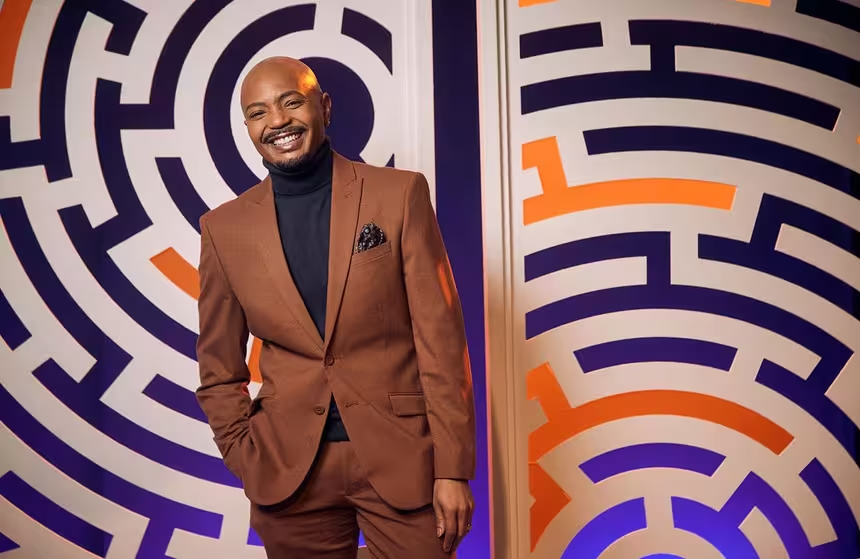
Meet host D. Rashaan Gilmore and read stories related to the topics featured each month on Flatland in Focus.Providing Support for PBS.org
Learn Moreabout PBS online sponsorship- [Announcer] "Flatland" is brought to you in part through the generous support of AARP and the Health Forward Foundation.
- Hi, I'm D. Rashaan Gilmore, and welcome to "Flatland."
Every month, as you know, we dig into one issue that's raising questions, causing tensions, or has gone curiously unexplored in our area.
And for this episode, we'll be talking about inclusive spaces for the LGBTQIA community in Kansas City.
(gentle music) Spaces where the LGBTQ community can be themselves mean so much to so many in Kansas City.
Personally, as a queer man myself and leader of a nonprofit serving the queer community, I know this to be true all too well.
Let's take some time, however, to celebrate how far our city has come in the fight for inclusion, highlight spaces that encourage us to express ourselves authentically, and discuss how we can move forward so that our region is a welcoming place for all identities.
(gentle guitar music) - The opportunity to celebrate spaces gives people the chance to come together and just recognize, first of all, how far they've come and, secondly, that these spaces do exist for this community, and there was a time when they didn't.
Until GLAMA got started, nobody was collecting this stuff in an organized way and, therefore, these stories weren't being preserved, and they weren't being told and passed down.
When the histories of marginalized communities are incorporated in the institutions that collect those histories, they disappear.
It's been my experience that students love working with this stuff because it's stories they don't know.
It's history they don't know.
It's not a regurgitation of the history they've been taught.
These are advertisements from some of the Black newspapers in Kansas City in the 1930s.
Each of these clubs in and around the 18th and Vine District feature a female-impersonating event.
What that tells us is, first of all, female impersonation was popular enough that they featured it weekly.
What it also tells us in terms of spaces, safe spaces for a gender nonconforming community, is that these spaces existed.
Then by the mid-'60s, we see the formation of Kansas City's first gay and lesbian advocacy group, the Phoenix Society for Individual Freedom, and these are some of their newsletters.
Bars have been so popular for so long in this community is because you can go in.
You didn't have to be a member of a club.
You didn't have to be a member of a church.
You didn't have to endanger yourself when it was dangerous to be an LGBT person by identifying yourself.
- If you weren't welcome in your family 'cause you were trans, or you were gay, or you were different, you would go out to the bars, and that would be your family.
You would meet those people, and you would have your house mother and your house sisters, and sometimes actually live with them.
And they would take care of you and protect you from the world, and that was your safe space.
So we're like, well, if Kansas City were to have that kind of energy, it would be the Fountain Haus.
And tonight, we are doing Boozical Mondays.
We're gonna have a bunch of drag queens here performing.
- [Performer] I have two sets of the biggest tits in the show.
- To save it.
- And I'm the biggest boob.
(patrons cheering) ♪ You just smile at me ♪ - [Ryan] And I think that everyone has an idea of what a gay bar is or what it has been in the past.
And I think in this day and age, it's kind of reinventing what it can be.
- My name is Wayne.
I'm the founder and co-organizer of Palace Parties, and this is our first attempt at doing an art gallery.
Oh my God.
- [Woman] Trade?
- Yeah.
- Trade-sies?
Trade-sies.
- Thank you.
I made this in, I think 2017, and it's a 13-foot long weaving with goose feathers and yarn.
And it's really cool for me personally because this is like my first queer art show, and I only just came out like three years ago, so, yay.
- [Wayne] I think there are a lot of really interesting queer spaces in Kansas City, but I kind of wanted to add to that, more of like a creative, artistic kind of environment where it's not always centered around buying drinks.
It's more centered around entertainment and like performance art and fashion.
- I think just the way that everyone that is in this community that is a creative expresses themselves so beautifully and vividly through their work and through their hands, and I think for other queer people to see how that representation of themselves in this space, I think is incredibly important.
- [Wayne] But there's also still like, so many other queer people in the city that don't have those connections or maybe like haven't been able to have access to those connections.
Some of them might not feel comfortable going to bars.
We wanna give those people a queer home.
(gentle upbeat music) - The fitness industry is a very scary, excluding place, and it was keeping a lot of folks who really needed to be in a healthy, safe, inspired environment from even walking in the front door.
And so I decided to open a gym space that took all of those things that were fear-based and kind of flipped them on their head.
And so Momentum, which is trans men's workout group, is really a byproduct of that intention.
- My second life sort of began here at the City Gym.
I was at a point in my life where I couldn't continue on as the person that I was at that time.
It really brought me to a place of both personal acceptance and just acceptance as a whole of like what I can contribute to society.
It's hard for someone like me because I'm also sober, being able to like, exercise.
Community is difficult to find sometimes.
Working out here and being with other groups of trans people, trans men, gives you so much hope and also community.
- And I think we have a bigger job now because we're looking at our rights that are possibly gonna go away.
And so we're married, and if the kid that is eight right now can't get married in the future because somebody's gonna take those rights away that we were granted, we have to be most vocal now and be proud and fight for it.
- In my lifetime, I have experienced having beer bottles thrown at me on the street.
I've been spat upon.
I was fired from a job for being gay.
I was kicked out of an apartment for being gay.
That's one of the things that concerns me about this political pendulum that's swinging further and further to the right and seemingly faster.
- The root of our disagreement is in my right to exist, and that's what you're doing with this legislation.
- We have anti-trans legislation all over the place.
Young adults that are just coming into their own identity, those kind of things cause people to have self-doubt, think about self-harm.
It causes other people to feel emblazoned to cause harm to other people.
- Kansas City is one of the top five cities for murders of black trans women.
We still live in those times as a community where folks are still killing people just because they don't agree with their lifestyles or understand.
Not having a safe haven for LGBTQ folks led me to founding Our Spot KC and fast forward to now, founding Lion House KC, which is our housing program.
This is where the magic happens/ All the floors combine up here.
And this is our dining and living area.
Our kitchen is over here.
They can come out here and go for walks, trampolines out here.
They feed the chickens and have some fellowship and build community.
So we have emergency housing beds, and then we have our programmatic beds that are year round.
Say, for LGBTQ, myself having lived experience in being homeless, I start seeing clients who are friends who were in need still and still not having any resources that were supportive and affirming of who they are.
We still need these services.
People are still practicing religious-based homophobia and transphobia.
And these are mega shelters in our cities.
- Again, Kansas City needs more safe spaces, brave spaces, and what I mean by brave spaces is it's safe enough for me to be brave enough to go in.
You feel like you belong at the table.
Belonging is that extra step.
- It would be amazing to really see deep intersectionality in those spaces where trans folks, non-binary people, people of color, cis folks, white folks, all feel like they can be there together.
And that's not something that comes from just saying it.
It comes from a real commitment to doing the work, and it comes from a commitment to confront, especially for white folks and cis folks, our own discomfort.
- There are no real Black queer-centered spaces here.
I always talk about the seven pillars of inclusion.
One of those big, big, big pillars is humility, recognizing that you don't have all the answers.
It's also important to be mindful about those people who are in the corners of the room that belong in that circle, but don't necessarily fit completely in those parameters.
A lot of those really niche stories get erased.
Be willing to stand in those differences and celebrate those differences.
There's no time to hide.
There's no time to sort of mute ourselves, mute our experiences, just because our lives are on the line at this point.
They've been on the line for a very long time.
- Pride means rebellion.
It's about being able to reclaim agency.
- It's a protest.
It's a fight for your life.
It is a fight for your identity, the ability to be as out or as not out as you wanna be.
- I wanna live in a world where my 13-yeah-old self just continued to evolve and grow and be this big version of herself and felt like they could stay in Kansas City, and they could invest in this town, and they could stay connected to their communities, and stay connected to their schools.
- We have so many artists, so many creatives, so many makers that are willing to change, literally, the cityscape that we live in.
We are ready to blast off into the future.
(air swooshes) - And welcome back for the discussion portion of today's program.
With us in studio today is Alex Salazar, board member of Transformations KC, Kiki Uchawi, the drag queen hypnotist and program director at Missie B's, and Stuart Hinds of the Gay and Lesbian Archive of Kansas City.
Stuart, the history of Pride in Kansas City is a very storied and, indeed, colorful one.
What are some of your most prominent memories of being a gay man coming up and coming out in Kansas City?
You know, Kiki, you're a performer, and you hit the stage.
What does it mean to you as a performer and as a Black queer performer to be able to take the stage at Pride in Kansas City?
- You know, it was definitely very full circle for me.
I experienced my first Pride in Kansas City maybe 10 years ago or so.
And getting to host Pride, getting to be a part of it, getting to perform at Pride and also seeing younger people that were my age in the audience kind of having that moment for the first time where they were seeing the community and seeing the involvement and seeing the support, I definitely got a little emotional a few times.
And it's also just very, It's very nice.
I feel like sometimes we as entertainers, because we work in clubs, and we work in different events like that, that it's fun to have just community moments that we can all kind of ground each other and realize that we're all people in it for the same thing.
- Kiki mentioned about being a young person in that space.
Transformations plays a really critical role in what I think of as the safety net for LGBTQI individuals.
What does a space like a Pride or the programming that Transformations provides mean to the community of young people who are coming up, like Stewart did, like Kiki did, like I did, quite frankly?
- Well, I will say that Transformations actually primarily serves trans women of color in this day and age.
We did previously serve a vast host of youth, but we continue to affirm and validate all trans youth.
We really felt as a group that it was a group that was getting forgotten and left behind.
So when we care and love and affirm trans girls of color, then that really, at the end of the day, makes us all very safe.
As you know, black trans women are the highest risks for violence in our community.
So we made an effort about a year ago, a concerted effort to go inward as a group and become fiercely anti-racist, first of all and foremost, and secondly, just to reevaluate our approach in community and as a whole as we start to see all of these anti-trans laws come about throughout the Midwest and down in Florida.
And we really wanna make a concerted effort to make some noise and get women and girls of color of the trans experience to understand that you're loved, you're valued.
And we want 'em to come to our Liberation Camp that's gonna happen later this year.
- In terms of place and space for trans women, particularly for trans black women, but also for youth, have we come as far as we need to as a community?
I mean, you can look back, but I'm gonna ask you to kind of project forward and tell us, are we on the right track here?
- Well, I think we're on the right track.
What tends to happen is sort of an ebb and flow of safety and security within our relationship to the more mainstream community.
And some of the things that Alex was talking about in terms of having to go to these places and see a presence because of the hateful legislation that's being passed is history repeating itself.
- Yeah.
- And that was one of the things about the 1989 Pride Festival, was that we were trying to make a presence.
We were trying to be in people's faces because it was another ugly time.
I firmly believe there's still a need for these spaces and celebrations because, as we make progress, people are trying to erase that progress through legislation, through the prohibition of saying the word gay or teaching gay history or allowing trans people to exist.
So it's a constant struggle, and it's one that requires these kinds of spaces.
- Alex, what are your thoughts on that?
- I do think that it's very important for these types of events to continue to occur mainly because we need to continue to be visible for our young people.
That's first and foremost.
And the best way to reach that youth that is still closeted, we'll just say, or hidden, maybe they're still scared, they don't feel like there's anybody else like them out there, is to be as loud and proud and out as possible.
It's not possible for everybody.
I'll be the first one to admit it.
I lived very closeted for much of my young life.
And then when I transitioned, I gained some privilege pretty rapidly because I was educated.
So I was able to transition in the shadows.
I didn't have to be looking for a job.
I didn't have to be doing those type of things.
I work remote.
What's important now is that now I'm established, I can be visible and I can say, hey, you're not alone.
You're never gonna be alone again.
And it does get better.
It gets easier.
Well, I take that back.
It doesn't get easier, but your life will get better.
We'll just say that.
- Hear, hear.
Kiki, you occupy sort of a unique space in not only queer culture but also in popular culture as drag has sort of gotten sort of mainstream acceptance thanks to shows like "RuPaul's Drag Race" and other things of that nature.
But you have a few intersections here where you live as black, queer, drag queen, I mean, and on and on.
Do you feel that the arc Dr. King talked about, the arc of the moral universe is long, but it bends towards justice.
Do you feel like you're seeing it been towards justice in this country for queer people like yourself?
- You know, I would say to answer the question directly, do I see it bending, yes.
Do I think that we're done?
Do I think that we're close?
I would say no.
I have good friends of mine who are drag queens and that are experiencing things this week.
I have a friend of mine who has a small child, her and her husband, who are experiencing homophobia yesterday in Overland Park, Kansas.
So I think there's a long way to go, and I think especially when it comes to drag, people think that because there's "Drag Race" and there are these things that maybe make drag more accessible, there's a lot of subcultures and things in that that are not.
Drag kings, for instance, do not have a voice, people that do alt drag, people that do things that are maybe not what's seen on television.
And people are still needing to make room for those things.
So I think that's very important, and I also think that you also have this younger generation that is finding themselves.
That's always kind of been the job, I think, that drag does in our community, is it allows people to find themselves.
It allows people to express themselves.
Many, many trans people throughout our country sometimes start their transition through drag.
And so I think more drag spaces, more affirming spaces for different sexualities, different people, different types of things.
I think we know one thing, and we see one thing, but that doesn't mean that we're affirming for everyone.
- So is it safe to say that, it's 2022, there's been a lot of progress.
We have shows like, I mentioned "RuPaul's Drag Race."
We've got "Pose."
We've got "Legendary," "Queer as Folk."
I mean, there's all these things.
I think for a lot of people, and I've heard this feedback personally, well, quit shoving that in our face.
Be queer, be gay, be trans, but keep it over there.
And I see some reactions from both, from Kiki and from Alex.
Alex, what are your thoughts on that?
- So my opinion is that, yeah, people are always gonna be upset when you're in their face, but we've had people in our faces forever.
I heard something very profound from another black trans man a while back that really struck home, and it's this.
And I just wanna say this to the youth that are listening, that don't be scared about the laws because we were here before the laws, and we'll be here after the laws.
And that is the one thing that is very true.
- There are a lot of spaces that have opened up in Kansas City recently for our community.
And I'm just curious if it sort of matches what we had before, or are we still playing a bit of catch-up in terms of the need for those spaces?
- One of the main differences between now and 20 or 30 years ago is that more mainstream places are welcoming.
They're not necessarily targeted towards LGBTQIA communities, but they are welcoming of those communities.
And that wasn't the case 30 years ago.
The spaces tended to be specifically for those communities.
It was a bookstore, or it was a community center, or it was a bar or maybe one or two restaurants that you knew about.
There's a wider, I don't wanna say acceptance, but a wider openness to a wider variety of patrons and users.
- Ultimately, we're all bonded in our queerness first and foremost, no matter what that looks like, no matter what that is.
And we have, we as queer people, have always made strides when we are unified.
That's just how that's always worked.
And it's not going to get any better unless we continue to do the same thing.
- Let me push back on that just a little bit and not to be controversial or adversarial, but I think that there are a lot of people who feel like while that language is important and true on a certain level, they feel left out of that context.
And I think in our community sometimes we forget that we can be unified without always agreeing on everything, and we can move forward in that way.
And so I'm just curious if you feel like we are doing that work well, of coming together through understanding and agreeing to disagree because I feel like sometimes we leave out groups like our trans siblings and- - Yeah.
- [Rashaan] And people of color just writ large.
- Yeah, no, I don't think that we're doing a great job at all.
I think that there's a lot that we can do, but I think that ultimately that should be the goal.
That should be what we're saying.
That should be what we're pushing for.
It's okay if me and you might never express the same hobbies or the same fashions or for circle in the same groups.
But if we both understand that there is work to do for our trans people, there is work to do for our lesbian communities, there is work to do for, there is work to do, and just acknowledging that and acknowledging that that is the brunt that we all share, even if that is not your community.
- I think that's well said, and I wanna ask you, Alex, for young trans persons who are in this community, and they're searching for spaces to find acceptance, where can they go?
- So I do know that the Center of Inclusion, the last time I heard, was having in sessions again for trans and queer youth.
I do believe also that there is a group happening up at the YRC Resiliency Center, Youth Resiliency Center.
That's ran also by, I believe, a trans individual.
I think that's a broad spectrum.
Unfortunately we lost our biggest purveyor, KCAVP, who was the host of Passages.
I would love to see some actions happening back at JUCO.
I think JUCO had a group as well.
We really feel like Kansas City offers a lot of in person or actions that can assist youth.
From Transformations' perspective, we're not gonna come back in service in Kansas City.
We're gonna bring our focus, like I said once before, to those communities in the Ozark region, Southern regions that are targeted by the hate laws coming out.
- Yeah, frankly often left out, too, to be completely honest.
And, Stuart, in the 30 seconds or so that we have remaining in this discussion, I'd like to ask you to do a little bit of heavy lifting here.
If there is a message that you could give to our community and maybe even to those who are allied with our community about where we are and where we're going and what it takes to get there, what, from your heart, from your mind, from your own soul, could you say to them?
- Well, I think that the thing to remember about the community was like Kiki was saying, it's the unity part of community and how we all need to remember that we do share the same queerness.
And that's the base.
Recognizing that we have that commonality between us, I think is critical.
And I think it's critical for our allies and our supporters to also recognize that commonality within this very, very diverse community who is trying to effect change for as many pockets of, as many of the colors of the rainbow as possible.
- Very well said.
And that's where we wrap up today's conversation for this episode of "Flatland."
That's been Alex Salazar, board member of Transformations Kansas City, Kiki Uchawi, the drag queen hypnotist, and Stuart Hinds from the Gay and Lesbian Archive of Kansas City.
Thank you for joining us and be sure to check out flatlandshow.org for more coverage on the LGBTQIA community in our region.
And also submit your CuriousKC question for the next month's topic.
This has been "Flatland" I'm D. Rashaan Gilmore, and as always, thank you for the pleasure of your time, and Happy Pride.
- [Announcer] "Flatland" is brought to you in part through the generous support of AARP and the Health Forward Foundation.
(gentle music)

- News and Public Affairs

Top journalists deliver compelling original analysis of the hour's headlines.

- News and Public Affairs

FRONTLINE is investigative journalism that questions, explains and changes our world.












Support for PBS provided by:
Flatland in Focus is a local public television program presented by Kansas City PBS
Local Support Provided by AARP Kansas City and the Health Forward Foundation