
Primary Election, Hastings Street, African World Festival
Season 6 Episode 49 | 26m 46sVideo has Closed Captions
The Michigan primary election, 'Hastings Street' musical, and the African World Festival
Who will voters choose to represent each political party in the 2022 Michigan primary election? One Detroit’s Stephen Henderson and Nolan Finley debate the potential outcomes. Then, go behind the scenes of the Plowshares Theatre's new musical “Hastings Street,” about Detroit’s Black Bottom neighborhood. Plus, the Charles H. Wright Museum’s 39th annual African World Festival at Hart Plaza.
Problems playing video? | Closed Captioning Feedback
Problems playing video? | Closed Captioning Feedback
One Detroit is a local public television program presented by Detroit PBS
Primary Election, Hastings Street, African World Festival
Season 6 Episode 49 | 26m 46sVideo has Closed Captions
Who will voters choose to represent each political party in the 2022 Michigan primary election? One Detroit’s Stephen Henderson and Nolan Finley debate the potential outcomes. Then, go behind the scenes of the Plowshares Theatre's new musical “Hastings Street,” about Detroit’s Black Bottom neighborhood. Plus, the Charles H. Wright Museum’s 39th annual African World Festival at Hart Plaza.
Problems playing video? | Closed Captioning Feedback
How to Watch One Detroit
One Detroit is available to stream on pbs.org and the free PBS App, available on iPhone, Apple TV, Android TV, Android smartphones, Amazon Fire TV, Amazon Fire Tablet, Roku, Samsung Smart TV, and Vizio.
Providing Support for PBS.org
Learn Moreabout PBS online sponsorship- [Narrator] Just ahead on One Detroit.
the August 2 primary is just days away.
Nolan Finley and Steven Henderson debate the possible outcomes in the heated Michigan congressional races.
Also the Plowshares Theatre Company debuts a new musical about life in Detroit's historic Black Bottom community.
Plus the African World Festival's return to the Detroit Riverfront.
And a performance by local hip hop artist Frankie P. It's all coming up next on One Detroit.
- From Delta faucets to Behr paint, Masco Corporation is proud to deliver products that enhance the way consumers all over the world experience and enjoy their living spaces.
Masco, serving Michigan communities since 1929.
- Support for this program is provided by the Cynthia and Edsel Ford Fund for Journalism at Detroit Public TV, The Kresge foundation.
- The DTE Foundation is a proud sponsor of Detroit Public TV.
Among the state's largest foundations, committed to Michigan-focused giving, we support organizations that are doing exceptional work in our state.
Visit DTEFoundation.com to learn more.
- Nissan Foundation and viewers like you.
(calm techno music) - [Narrator] Coming up on this week's One Detroit, the Plowshares Theatre Company premieres a new jazz musical about Detroit's Black Bottom neighborhood.
We'll hear from the co-creators of "Hastings Street" and the theatre's artistic director.
Plus the Charles H. Wright Museum's 39th African World Festival returned to its original location at Hart Plaza this year.
We'll take you to the Detroit tradition that celebrates all things African.
Also ahead, the intricate rhyming skills of Detroit hip hop artist, Frankie P., from her appearance on Detroit Performs: Live from Marygrove.
But first up, the much talked about Michigan congressional races.
There are 13 seats that have to be filled, instead of 14, as a result of the state's newly drawn districts.
When voters go to the polls for the August 2 primary or cast their absentee ballots, they may have to select from a crowded field of candidates in their district.
One Detroit contributors, Nolan Finley and Steven Henderson sat down to discuss what's at stake in the heated congressional races.
(slow techno music) - All right, Nolan, it's next week, the August 2 primary, where we'll make big decisions in Congress and in the state house.
And there are a couple barn burners still really raging out there.
Let's start with the 13th congressional district, which is the new district, one of the new districts, in the city of Detroit.
Nine candidates, Shri Thanedar, Portia Roberson, Adam Hollier, Sherry Gay-Dagnogo, Sharon McPhail.
I mean, - Yeah.
there are lots of big names in that one.
- There's a lot of big names which, you know, gives an advantage to Shari Thanedar, the state representative, who's spending $5 million of his own money to go to Congress.
And the polls show that's paying off, that he is the front runner in that race followed rather closely by Portia Roberson and Adam Hollier, who are making a good run for that.
But the significant of this race is that it's the best chance or perhaps the only chance to send a African American Democrat to Congress and to get an African American congressional representative from Detroit.
It's been a long time since Detroit did not have- - 1955. yeah, 1955 was when - 19... Yeah, 1955 was when- - Right, since Detroit has been without- - Charlie Diggs was elected.
- Yeah.
Well, I mean, that's a pretty remarkable shift, but if things play out the way they appear to be playing out, that will be the case.
And the only, maybe, Michigan's delegation either has no African American members or a Republican in John James, who's running in the 10th district, no guarantee he'll win there.
- Yeah, I mean, well, the problem is that actually has nothing to do with the way that district is drawn.
It's the number of African Americans from the city who decided they wanted to take a shot at it.
- Right.
- They will clearly outpoll Shri Thanedar on election day, together.
But individually they may not be able to come up with the votes.
- But let's move over to the 11th district where you have two incumbent Congress members running against each other in Haley Stevens and Andy Levin.
You look on the paper and you say ah, two Democrats, two progressives, but they're really quite different.
I mean, Andy Levin aspires to be a member of the Squad.
Haley Stevens describes herself as a pro-business Democrat.
Now, neither one of 'em are moderates.
But if you look at that district, it would seem that someone who comes from a business point of view and a more moderate, slightly more moderate point of view would have the edge there.
And I think that's what the polls are suggesting in Haley Stevens.
- I think, the truth is that neither of them really represents the way that district was drawn.
And I think what you could see is one of them win it this term.
But in two years, face a really stiff challenge from somebody who would not have gotten in it this year, because you had two incumbents in the race, but I'm surprised at how ugly this race has gotten.
- When you put two incumbents together, it always gets ugly.
It always gets nasty, 'cause they both - Crabs in a barrel.
Are desperately trying to hold on to these jobs.
I've seen it play out this way, any time it's happened in Michigan, but let's go all the way over to the third district in the Grand Rapids area where Democrats are spending a lot of money to promote a Trump-backed candidate in John Gibbs, who's making a primary challenge to Peter Meijer.
And they've done this in other places in the country, trying to get the Trump candidate on the ballot in hopes that he'll be easier to beat in the general election.
Sort of a sleazy move, but politics is a sleazy business.
- It's kind of par for the course, but here there's a little bit of an individual miscalculation in that district.
You know, I mean, Peter Meijer Yeah, he is a Republican, but you certainly would favor him if you were a Democrat over the primary opponent that he has.
And there's no guarantee that the Democrats who, even though they're gonna have a good candidate, can win that district.
It's not really drawn too much to their favor.
I think over time, maybe they hope that, because it's a more centralized district than the one that they had before that maybe they can, but I don't think this is the year to be playing that game.
- Now, I think Peter Meijer will keep this seat.
I think once he's through the primary, Republicans will flood that district with money because it's district like these that are key to winning the majority.
We had an interesting piece last week in the Detroit News about the redistricting commission itself and the chairman of the commission saying, look, I was pressured by our attorneys to the number of black voters in these districts that she didn't wanna get accused of packing, but in doing so, made it a lot harder in both legislative races and congressional races to get Black candidates elected, particularly around the city of Detroit.
- What you have are districts that try to create common communities of interest across municipal and community boundaries.
That's always a risk, but it's a smart risk.
And one of the reasons that it makes sense is the number of African Americans who have moved out of the city and now live, especially in suburbs.
If you look at all of those districts, they have enough African Americans in them, according to the numbers, 40% and above is really what you're looking at, to be able to elect an African American.
The question is whether they will elect African Americans from the city or eventually whether they will turn to African Americans from the suburbs.
I always say that the most instructive example here is the district that Brenda Lawrence now represents, which went away.
But the idea that she, as an African American from Southfield, was able to beat African Americans in some cases from the city for that seat is, it's a harbinger of the future in this region.
- It's been decades since we haven't had a black Senator from Detroit in the state Senate.
I don't think this is a good outcome of that whole redistricting effort.
- Yeah, it's not a good outcome.
It is a logical outcome of the shifting demographics.
And again, this is the first election under this map.
I think elections three through five really are the ones that tell you what you really have.
I don't think it is a bad map.
I think it is a map that has a bad transition potentially that comes with it.
But we'll see it a few days.
- Well, let's get out and vote Tuesday, state.
- Yes, everybody go out and vote or you can sit at home and vote now, if you wanna vote absentee, no reason absentee voting.
One of the wonderful changes we've made here in Michigan.
- [Narrator] Detroit's historic Black Bottom community is the setting for a new jazz musical presented by the Plowshares Theatre Company.
The production of "Hastings Street" runs through July 31 at the Music Hall Center for the Performing Arts.
When Detroit's Marcus Green dropped in for a rehearsal and a conversation with the show's co-creators, jazz trumpeter Kris Johnson and actor and singer John Sloan III, along with Plowshare's artistic director, Gary Anderson.
(slow techno music) - For "Hastings Street", we knew that it was gonna be set very specifically in '49 and '50, in Detroit, in Black Bottom and Paradise Valley.
And so what does that do then to the music that is inherent to that time period?
if somebody's walking into a bar in Black Bottom in 1950, what are they gonna be hearing?
- [Kris] Right.
- [John] Right?
And so there's that aspect to it.
Then there's also, I think, some music that isn't necessarily anachronistic to the time period, but that draws a similar contrast that is really speaking to, well, where is a person?
One of the main characters, Renita, has a song called Towers.
What is going through her head?
What is she feeling at this moment?
And how do we express that through music?
- I think, right now, we have this opportunity to be at a major stage and what I consider to be a very important city from an artistic and historic standpoint, and to be able to be working with Plowshares Theatre and the history that they've really carved out for themselves here in the city of Detroit is really significant.
Gary Anderson's been a long time collaborator of mine, and I'm really proud to be working with him, really proud of what he's put together in both commissioning us to put this piece together, as well as this production that we're about to see.
- We were all working on another project that was supposed to be Detroit related that wasn't really Detroit related and it fell apart.
And I think it fell apart for a legitimate reason.
It wasn't gonna focus the attention on something that was gonna celebrate Detroit.
And so I decided that working with them has shown me that they had some talent and the best thing to do is to seek some funding so that we could get them commissioned to create a work that was gonna focus on, really an untold story in Detroit.
And that is the conditions that occurred during the raising of the Black Bottom.
- For me, having family constantly talking about Black Bottom.
- Right.
My grandmother used to tell stories about how they would take pennies and coins and put them on or tack them to the bottom of their shoes and go out and dance in the streets, standing outside, listening to music.
And that neighborhood doesn't exist anymore, like the city that we grew up in was very different from the city that our grandparents and aunts and uncles and family grew up in.
And when, there's a difference, I think, between hearing your family talk about a story and then actually doing research and investigating that story more thoroughly.
And for me, I think it was the idea that this street that could have had however many businesses, stores, shops, homes, families, is now a couple blocks.
You know what I'm saying?
- [Kris] Right.
That to me was a great microcosm in understanding what happened to a whole community.
- [Kris] And I think even, you know, being in a room like this, where we're able to see so much history and so much detail that has been preserved, but then we're talking about an area where it's really the lack of having access to that resource, having access to that visual reference of what this would've looked like and what this would've been had it still existed now is a large part of what has informed this piece.
Because now we're really thinking about what could have this legacy have been.
If this had continued, how it would've shaped the music, how it would've shaped the culture, the infrastructure of business, how it would've really have changed the Black community in the city of Detroit, had those neighborhoods not been destroyed.
- Hastings Street was a cultural entertainment hub for black folks.
Everything that you think about when you talk about Broadway, or you talk about Woodward Avenue here, that was Hastings Street.
- Right.
- The stories that happened in Detroit are just as valid as the stories that happen in New York.
The people that live in this city, that have lived in this city, this community, are just as influential, if not, if I dare say so myself, more so sometimes when you start talking about their history, manufacturing sectors, and the birth of the middle class and everything that came out of this city and this geography and this people and that their stories deserve to be told, but their stories deserve to be cherished.
- [Kris] I want people to walk away feeling proud of the history of our city and also feeling proud of the musical influence that African Americans have had on the world of music.
- [John] Yeah.
'Cause we have everything represented here.
Every piece you could ask for, whether we're talking about jazz, whether we're talking about blues, or even talking about the influence that we've had on the music referred to as classical music, or even the influence that was had on the history of musical theatre.
If you really think about it, Black American music has shaped the face of what popular music is across the world.
- We also need to look at that one of the elements that this play talks about is coming together, the importance of people, of a community unifying to work on large challenges.
I get choked up about that, 'cause it means a lot.
We, Plowshares, has instituted this policy of what we call harambee, it's a Kenyan principle.
In Swahili, harambee means all pulled together, which shows you the importance of nobody does anything alone and others have to be invested and see the benefit of being engaged.
And one of the messages of this story is that even though this community was fractured and displaced, the key to us moving things forward in Detroit is by coming together, having a common interest and a common goal.
And I think that's the main thing that I could get across.
The idea of this story being used to convey that message to the people who see it, hopefully, hopefully, might spark some people to see that as a solution for our current situation.
- [Narrator] The Charles H. Wright Museum's African World Festival celebrated its 30th anniversary this year with a return to the location where it all started, Detroit's Hart Plaza.
More than 100 art, clothing, and food vendors joined musicians, storytellers, and other performers to offer visitors a wide ranging African experience.
One Detroit contributor, AJ Walker, paid a visit to the Riverfront for this popular Detroit tradition.
(slow techno music) - [AJ] It was a journey through African culture by way of Detroit, the 39th annual African World Festival.
The festival was put on by the Charles H. Wright Museum of African American History.
Vendors from around the country and patrons from around Detroit and the Midwest packed Hart Plaza.
Njia Kai, festival director, helped put it all together, something she says takes a lot of planning.
- We do our very best to make this as wonderful an event and as full of variety and to pull from the full African world because there's so many traditions, so much different music, and presentations and culture and technology, and there's just a lot to pull from.
And so we have a sampling here that we hope our community will come and enjoy and acquaint themselves with the variety and the deep richness, really, of the African culture.
- [AJ] It's been years since the African World Festival was held at Hart Plaza.
- The last time we were here was 2011.
So it's been quite a while since we were down on the river and we're happy to return.
We were happy at the Wright Museum and on the grounds and streets around the museum.
But of course this is a venue made for this type of event.
And as we continued to grow around the museum, it was time to make a move.
- Oh, I love it here.
I know it was down by the Afro-American Museum and all there, that was nice.
But here it's more, more festival.
- I like this downtown better.
- [AJ] What do you think about the selection in terms of all the African art, different things that it offered?
- Oh, it's a great variety here.
- [AJ] So what brought you out here today?
- The festival is the one that brought me out here.
I do this every year at the Wright Museum, but this is the first time doing it here at the Hart Plaza.
That's what brought me over here.
- Originally from Liberia, Dauda Beretay traveled from his home in Columbus, Ohio to sell some of his African art collection here.
- Yeah, the price on these, auction, 25,000 for that.
- [AJ] 25,000?
You think you'll sell something like that?
That's a lot of money.
- For the right person that come will like it.
Of course I will.
- The African World Fest had a variety of vendors for those who were looking to purchase high-end African art to those who wanted a small piece of African culture.
- Yeah.
I got some African attires from Ghana, from Gambia, and we have some African shea butter for dry skin, blemishes, and we have African handmade fans from Ghana, that's the one right there.
You're looking at it.
You know, different stuff mostly for women.
- [AJ] And of course, there was plenty of food.
He's cooking up here.
- Cooking some jerk chicken and a curry chicken.
- What do you think about this food selection they have here?
- Outstanding.
It smells awesome.
- After checking out the food, we checked out more art vendors and patrons like Katie Homant, who stopped by from Farmington Hills.
- It's been very welcoming, very open, a lot of diversity here, so I think that's great.
And of course the vendors, Donald Calloway's been a great friend, and I think that his displays are some of the best.
- Detroit artist, Donald Calloway, selling his unique artwork.
- It's part of a series I call "Rediscovery."
I'm taking objects, rediscovering them, and transforming to art.
The base of this is of a chair and parts of furniture and children's toys and put it all together and make the faces.
- [AJ] I see you ladies are out here showcasing some local offerings.
- We have Jafra Cosmetics, an international cosmetic company and we have fragrances, body care.
Skincare is what we specialize in actually.
We call it Royal Jelly for the skin.
Nature's perfect food.
- From African music... (rapid drum music) to blues (jazzy trumpet music) and gospel performances, people were able to take a break from checking out what vendors had to offer to be entertained.
- This is actually my very first festival.
I'm enjoying it a lot.
I like all the different foods.
I especially like the earrings.
- It's good.
It's good for everybody to be able to get out and mix and mingle.
And it's just outstanding.
- We appreciate the Wright Museum and all of the sponsors who support the museum and this festival so that we can continue to have this annual gathering that pulls people together like family.
- [Narrator] That will do it for this week's One Detroit.
Thanks for watching.
To close tonight's show, here's one of Detroit's premier lyricists, Frankie P., backed by the Aisha Ellis Trio.
From their appearance on Detroit Performs: Live from Marygrove.
♪ Listen, holler if you hear me, maybe I'm not loud enough, ♪ ♪ Read between the lines if you think about it hard enough.
♪ ♪ Disconnect, 'cause homie, you not charging up.
♪ ♪ I'm not a threat, they told me I'm not smart enough.
♪ ♪ See this my art, baby, this is where I start, baby, ♪ ♪ Come from the heart, baby, go and play your part, baby.
♪ ♪ I'm gon play a part and get far from the scene, ♪ ♪ Too much is going on, if you know what I mean.
♪ ♪ See, on me, I might fade away, fade to the back, ♪ ♪ Playing in the shadows, I might fade in the black ♪ ♪ I'm kind of faded to not blast in the past, ♪ ♪ See, I got an old soul, I need vinyls and cassettes.
♪ ♪ And you living with regrets, and you feeling kind of dense ♪ ♪ Company I keep is myself and four cats ♪ ♪ See I'ma mess around and the neglect all my friends, ♪ ♪ I'm gonna mess around and be alone in the end ♪ ♪ See, I'ma go, ghost, and disappear from homies ♪ ♪ And I'ma tune it all out till I can't hear the homies ♪ ♪ And I'ma fade on way, go on by ♪ ♪ And I'ma go on home.
♪ ♪ And I won't say I'ma go, ghost, and disappear from homies.
♪ ♪ And I'ma tune it all out till I can't hear the homies ♪ ♪ And I'ma fade on way, go on by ♪ ♪ I'ma go on home, and I won't say bye ♪ ♪ Look, sustain me, sustain me, get me in the G concentrate ♪ ♪ Hard enough to fill your inner cheek ♪ ♪ Expectations running low now, people getting dirty, man, ♪ ♪ These, ha, they low down ♪ ♪ Won't at least slow down, getting kind of fast.
♪ ♪ Separate yourself, girl, you more than just a piece of- ♪ ♪ Who told you things that you've never said before ♪ ♪ I mean, who told you things that you've never ♪ ♪ thought before?
♪ ♪ I mean, hol' up, hol' up, walk there ♪ ♪ Really?
I got you ♪ ♪ Speak up for yourself and tell 'em what that mouth do ♪ ♪ Tell 'em what you 'bout to do, ♪ ♪ but never what you doing ♪ ♪ Best left not saying it 'til you done what you doing ♪ ♪ I mean, who said this just can't be done.
♪ ♪ I mean, who came up with the fact you'll never ♪ ♪ be the one or you'll never have some fun ♪ ♪ or homie, you just a sellout ♪ ♪ You ain't talking positive to homie, ♪ ♪ You can get out, huh?
♪ ♪ I'm done saying stuff that ain't related to my dreams.
♪ ♪ I'm done saying stuff that I ain't never really mean, ♪ ♪ but who am I impressing?
♪ ♪ I know what I want now, I'm done second guessing ♪ ♪ I'm done holding back on behalf of other folks.
♪ ♪ Not doing what needs to be done.
♪ ♪ See, I'ma mess around and neglect all my friends.
♪ ♪ I'ma mess around and be alone in the end ♪ ♪ See, I'ma go, ghost, and disappear from homies ♪ ♪ and I'ma tune it all out till I can't hear the homies ♪ ♪ and I'ma fade on way, go on by.
♪ ♪ And I'ma go on home.
♪ ♪ And I won't say I'ma go, ghost, and disappear from homies ♪ ♪ and I'ma tune it all out til I can't hear the homies ♪ ♪ And I'ma fade on way, go on by.
♪ ♪ And I'ma go on home, I won't say bye.
♪ ♪ Look ♪ ♪ See, fade on way, I won't say bye ♪ ♪ Fade on way, I won't say bye, look ♪ - You know how sometimes people just mad 'cause you just you?
Like this.
♪ Looking back, they just mad 'cause they not me ♪ ♪ Looking back, they just mad 'cause they not me ♪ ♪ See, looking back, they just mad 'cause they not me ♪ ♪ Looking back, huh?
♪ ♪ I get lost in my mind, I've been weak for some time ♪ ♪ I've been out of the loop, I've been slow on the grind ♪ ♪ It's been minimum wage and every week getting paid ♪ ♪ And getting back from the job, I've been sleep every day.
♪ ♪ Grandma tried to tell me, maybe I'm too selfish ♪ ♪ Maybe you don't like me, maybe I'm too helpful ♪ ♪ Maybe I'm too anxious, busy seeking sanctum ♪ ♪ Probably just too loud, hush, I really need a tranquil ♪ ♪ Really need to focus, that's why I need the reset ♪ ♪ And selective on the homies, don't mess with the rejects ♪ ♪ It won't last forever, I guarantee as Keith Sweat ♪ ♪ What I gotta do to make it last, though I see that ♪ ♪ I'm too weird for half of you, weaving to comprehend ♪ ♪ Used to mask it all, 'cause you want me to pretend ♪ - From Delta faucets to Behr paint, Masco Corporation is proud to deliver products that enhance the way consumers all over the world experience and enjoy their living spaces.
Masco, serving Michigan communities since 1929.
- Support for this program is provided by the Cynthia and Edsel Fund for Journalism and Detroit Public TV.
The Kresge Foundation.
- The DTE Foundation is a proud sponsor of Detroit Public TV.
Among the state's largest foundations, committed to Michigan-focused giving, we support organizations that are doing exceptional work in our state.
Visit DTEFoundation.com to learn more.
- Nissan Foundation and viewers like you.
(quiet electronic music) (bright piano music)
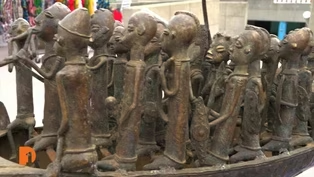
African World Festival Celebrates 39th Year at Hart Plaza
Video has Closed Captions
Clip: S6 Ep49 | 5m 3s | The 39th annual African World Festival returns to its roots in Detroit's Hart Plaza. (5m 3s)
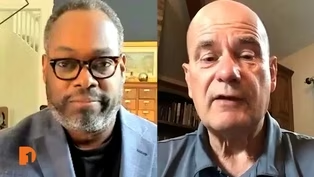
More Candidates, Fewer Districts in 2022 Michigan Primary
Video has Closed Captions
Clip: S6 Ep49 | 7m 29s | Stephen & Nolan debate the outcomes of the 2022 Michigan primary congressional election. (7m 29s)
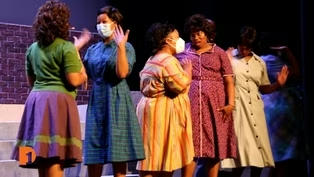
Plowshares Theatre Presents New 'Hastings Street' Musical
Video has Closed Captions
Clip: S6 Ep49 | 6m 14s | The Plowshares Theatre premieres its new “Hastings Street” musical, set in 1949 Detroit. (6m 14s)
Providing Support for PBS.org
Learn Moreabout PBS online sponsorship
- News and Public Affairs

Top journalists deliver compelling original analysis of the hour's headlines.

- News and Public Affairs

FRONTLINE is investigative journalism that questions, explains and changes our world.












Support for PBS provided by:
One Detroit is a local public television program presented by Detroit PBS