This Is Minnesota Orchestra
Principal Timpani Erich Rieppel
Clip: Season 8 Episode 4 | 10m 24sVideo has Closed Captions
Minnesota Orchestra Principal Timpani Erich Rieppel prepares for a powerful concerto.
The timpani are set center stage as Principal Timpani Erich Rieppel prepares for his performance of Andy Akiho’s Timpani Concerto. A defining moment in his youth propelled Erich to pursue percussion and eventually the timpani. Erich and his father reminisce about family and Erich's principal position with the Minnesota Orchestra. Credits: Cosmic Coffee; Whitey's Old Town Saloon; Karsten Moran.
Problems playing video? | Closed Captioning Feedback
Problems playing video? | Closed Captioning Feedback
This Is Minnesota Orchestra is a local public television program presented by Minnesota PBS
This Is Minnesota Orchestra
Principal Timpani Erich Rieppel
Clip: Season 8 Episode 4 | 10m 24sVideo has Closed Captions
The timpani are set center stage as Principal Timpani Erich Rieppel prepares for his performance of Andy Akiho’s Timpani Concerto. A defining moment in his youth propelled Erich to pursue percussion and eventually the timpani. Erich and his father reminisce about family and Erich's principal position with the Minnesota Orchestra. Credits: Cosmic Coffee; Whitey's Old Town Saloon; Karsten Moran.
Problems playing video? | Closed Captioning Feedback
Where to Watch This Is Minnesota Orchestra
This Is Minnesota Orchestra is available to stream on pbs.org and the PBS app.
Providing Support for PBS.org
Learn Moreabout PBS online sponsorshipThe timpani sound powerful, with a lot of personality.
It can be mysterious, quiet, and it can be absolutely, terrifyingly earthshaking.
I'm Erich Rieppel and I'm principal timpani of the Minnesota Orchestra.
I'm preparing the Andy Akiho timpani concerto co-commissioned with my brother from Houston, Leonardo Soto.
This has been the project I've been focusing on for well over a year.
Way before a note was written by Andy.
The music is super intense, quasi minimalistic, and dramatic in its trajectory.
It really feels like a live action film.
Timpani just is such a unique sound.
It's acoustically the most challenged instrument.
It reacts severely differently in different environments, in different halls, different flooring where it's placed in the orchestra, what type of timpani, what type of heads.
It really is quite a technique to get the right sound and just have the endurance, strength, flexibility.
Just that alone takes many years to develop.
So these instruments are made out of copper bowls.
These are made near Amsterdam, at the Adams factory, which I've been to.
It's amazing.
I use a lot of different mallets to get many colors, articulations, dictions, expressive effects.
We need a wide variety to get the whole color spectrum.
So here I have carbon fiber and lots of wool felts.
So really heavy dark sound.
That compared to hickory handles and shammy felts on top.
Would use this for Mozart maybe.
So score study is absolutely crucial for us.
And then you make a decision on what kind of mallets are going to be best for that moment.
So it's really an instrument about each moment.
So the bigger drums will have lower notes.
They're all about an octave.
This one's like E to E-flat-ish.
How I change pitches here is this wild mechanism that was developed in the late 19th century, and I controlled with my feet.
If you pull it down, you tighten the head and raise the pitch.
And that's a separate technique.
Getting used to pedaling.
Timpani has a lot of repertoire going back to the 1600s.
We play Beethoven, the Tchaikovsky symphonies, Mozart symphonies, Haydn symphonies.
Jean Sibelius is one of the great composers for my instrument.
No one quite compares to his soloistic type of writing for timpani.
I grew up in Eden Prairie, and then we moved out to Marshall, three hours west of here, where my dad got a job as a professor of music at Southwest Minnesota State University.
He teaches piano, conducts the orchestra, teaches music theory, teaches music history.
My mom was a harpsichordist, grew up in Panama with engineers and government workers as her family so that she chose classical music with a specific emphasis in Baroque, which is like the esthetically ornamented style.
That's super punk rock to me.
Yeah, I never understood That your mother, who was the short, petite South American, was dead set that you play hockey, and the big lug who actually was born in Minnesota, was absolutely opposed to it.
She loved exotic things, and Minnesota was super exotic to her.
Both your parents were keyboard players.
Why drums and not piano?
He asked a bit ruefully.
Drums felt rebellious and active.
You're such a team player.
And that's why you were a great hockey player.
And there was a great team of percussionists at the high school and great, great teacher.
Yes.
Other than hockey, that was another team thing in Marshall that was kind of spectacular.
That is definitely the most spectacular thing that there was a great percussion program led by Chad Przymus my first teacher.
So grateful for him.
There was such a culture of excellency in that marching band percussion.
Around the age of 17, I had this life changing trip to Vienna.
I remember when I had a sabbatical from Southwest State Marshall.
We took you along to Vienna and said, go explore.
And you started falling in love with it.
And we started going to concerts.
And you must have heard at least 15 different orchestras.
During that time, probably, I think you heard Vienna Philharmonic, Vienna Symphony, Bayerischen Rundfunks Munich Phil.
Berlin Staatskapelle with Barenboim doing Nights in the Gardens of Spain.
Mahler's sixth, Mahler's ninth, Shostakovich ten.
All these huge pieces I heard in one little span.
And that just changed the game for me.
That just gave me all the fuel I needed for years to practice like a crazy person and seek out lessons with great teachers.
And I got into Indiana University, studied with John Tafoya, who was my main teacher.
He played in the National Symphony.
I gained so much from working with him.
Really, the whole package at Indiana was perfect for me.
I went there for undergraduate, masters.
Took a bunch of auditions, and got into the New World Symphony in Miami under Michael Tilson Thomas.
Another great influence.
To even be in the presence of such a mind was such an inspiration.
I kept auditioning, you know, each year there were like 2 to 4 at the most across the continent.
My first year there were two auditions at the end of the year, and my mom had passed right before those two auditions.
so I was a wreck.
And then 2017, the Minnesota Orchestra held auditions.
And I got to final round and was cut.
So I had completely shut the door that this would be a possibility at all.
But then somehow they gave me an opportunity to have a trial here where you play timpani specific excerpts.
But with the orchestra in addition to the repertoire you're playing.
It's a fairly intense trial.
After the last concert, Osmo called me.
He was like, Erich.
I was like, yes, who is this?
He's like, It's Osmo.
Good news.
We want to work with you.
It's not finished yet, though.
You know, you got to go through tenure, you know, so it's not quite over yet when you get the gig.
Your mother loved you fiercely.
I think she would have been insufferable backstage with you at the Minnesota Orchestra.
Preening all the time.
What do you think your mother is thinking about your success from on high?
She might have coordinated the whole thing.
Yes.
I don't doubt it for a second.
[Jazz music] The breadth of human expression is so beautifully described in music.
All sorts of genres Jazz, to me, is creative freedom.
The Jam is at Whitey's Old Town Saloon in Northeast Minneapolis.
It's so great.
A bunch of artists of all types show up to that thing, and I just love the scene.
When you improvise in jazz, you're learning just that skill improvising, which leads to composition, which leads to creative thinking in other fields, other mediums.
I love playing with different groups for the uniqueness of each group, but as a timpanist, I've played a lot of memorable performances.
The Carnegie Hall one was important.
Andre Watts was super giving in his collaboration with me.
The end of the Emperor Concerto is a duet between timpani and piano.
He said it's the best it ever went.
That really affected me, whether it was true or not.
But then The New York Times called me out in their review.
It said, and the timpanist jousted mightily with Mr.
Watts in the finale.
Music has this special effect in how it connects from the ear into the brain to the hearts, and to our collective humanity to find it a beautiful life to pursue.
You become a better person, more curious, more empathetic throughout the process.
Video has Closed Captions
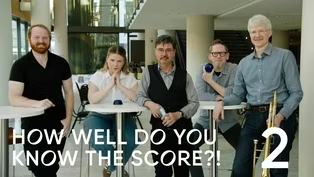
Clip: S8 Ep4 | 9m 45s | Violinist Michael Sutton hosts Minnesota Orchestra’s quiz show Know the Score Episode 2. (9m 45s)
Providing Support for PBS.org
Learn Moreabout PBS online sponsorship New Episode
- Arts and Music

Innovative musicians from every genre perform live in the longest-running music series.

- Arts and Music
The Best of the Joy of Painting with Bob Ross
A pop icon, Bob Ross offers soothing words of wisdom as he paints captivating landscapes.
 New Season







 New Episode
 New Episode
Support for PBS provided by:
This Is Minnesota Orchestra is a local public television program presented by Minnesota PBS