
Pritzker Military Museum & Library
Season 12 Episode 5 | 26m 48sVideo has Closed Captions
Military history comes to life as we visit Pritzker Military Museum & Library in Somers.
Visit Pritzker Military Museum & Library in Somers, a striking facility featuring thousands of artifacts, rotating exhibits and programs that deepen our understanding of military history. Then, follow a veteran tracing his family’s legacy of service, a comedian taking the stage in Brookfield and a music festival in the Driftless Area.
Problems playing video? | Closed Captioning Feedback
Problems playing video? | Closed Captioning Feedback
Wisconsin Life is a local public television program presented by PBS Wisconsin
Funding for Wisconsin Life is provided by the Wooden Nickel Fund, Mary and Lowell Peterson, A.C.V. and Mary Elston Family, Leon Price & Lily Postel, Stanley J. Cottrill Fund, UW...
Pritzker Military Museum & Library
Season 12 Episode 5 | 26m 48sVideo has Closed Captions
Visit Pritzker Military Museum & Library in Somers, a striking facility featuring thousands of artifacts, rotating exhibits and programs that deepen our understanding of military history. Then, follow a veteran tracing his family’s legacy of service, a comedian taking the stage in Brookfield and a music festival in the Driftless Area.
Problems playing video? | Closed Captioning Feedback
How to Watch Wisconsin Life
Wisconsin Life is available to stream on pbs.org and the free PBS App, available on iPhone, Apple TV, Android TV, Android smartphones, Amazon Fire TV, Amazon Fire Tablet, Roku, Samsung Smart TV, and Vizio.
Providing Support for PBS.org
Learn Moreabout PBS online sponsorship- Announcer: The following program is a PBS Wisconsin original production.
- Angela Fitzgerald: Coming up on Wisconsin Life: [gavel banging] Meet a veteran in Kenosha tracing his family's history of service.
- Are you ready for your headliner tonight?
- Angela: A seasoned comedian takes the stage in Brookfield.
[audience laughs] A teacher building robots on Washington Island.
And the organizers of a music festival bringing music in the heart of the Driftless.
- You made it!
Yeah!
- Angela: That's all ahead on Wisconsin Life.
[bright music] - Announcer: Funding for Wisconsin Life is provided by: the Wooden Nickel Fund, Mary and Lowell Peterson, the A.C.V.
and Mary Elston Family, the Stanley J. Cottrill Fund, UW Health, donors to the Focus Fund for Wisconsin Programs, and Friends of PBS Wisconsin.
[trumpet fanfare] - Hello, and welcome to Wisconsin Life.
I'm Angela Fitzgerald.
We are at Pritzker Military Museum and Library, a nonprofit dedicated to preserving military history in a new state-of-the-art facility.
Just off I-94 in Somers in Kenosha County, the museum and research library recently made Wisconsin its home after 20 years in downtown Chicago.
[rousing marching band music] Founded in 2003 by Jennifer Pritzker, a retired colonel in the Illinois Army National Guard, the museum has amassed thousands of items in its collection, all housed within this architectural marvel.
The building's design was inspired by a Higgins boat, the amphibious WWII vehicles that landed on the shores of Normandy on D-Day.
Inside, the building's designed with bright exposed beams and floor-to-ceiling glass designed to let light in while protecting the art from harmful UV light.
Creating a beautiful space for visitors to participate in programming, learn about their collections, or browse through rotating exhibits.
It's all part of their work to "ignite a passion for understanding and preserving our military heritage."
We'll dive deeper into all the happenings at the museum and the library, but first, let's head out around our state.
But first, we join a veteran in Kenosha who's checking out his own family's history in the service.
[stately military music] - Michael Hellquist: I knew I wanted to be military from a young age.
I served in Operation Iraqi Freedom.
- Angela: Michael Hellquist grew up in a military family, along with a sense of honor and tradition.
- My grandfather is probably my biggest inspiration.
How's it going, Gramps?
- George Swenson: Just wonderful.
- Michael: It actually started with the American Legion.
I was a kid, and any time he'd have a Legion meeting to go to, a function, I'd go with.
- George: What?
- Michael: You're the longest-serving legionnaire in the state of Wisconsin.
- You're kidding.
I didn't know that.
[gavel banging] - Angela: Grandfather and grandson still share time together at the American Legion in Kenosha.
- Michael: So this is probably one of my favorite pictures of my grandpa.
That was just this past Army Navy game.
- Angela: Michael is on a mission to piece together his family's history in the armed forces.
- Robert Hellquist: You know, I got that hat.
- Yeah, I'd like to put it on display at some point.
- Yeah.
- Angela: On this day, he shares the collection of military memorabilia with his dad.
- Michael: Grandpa's original dog tag from Korea.
Your dog tag and then my dog tag.
You got my uncle, Les, and cousin, Verle.
He was in Korea and Vietnam.
- Angela: During the pandemic, Michael started tracing his family's story.
- I think on his mother's side, how far back he got.
'Cause he got back into the 1700s.
- Michael: There's eight generations of military in my family that I've been able to trace from the Revolutionary War until Iraq and Afghanistan.
- Angela: This Iraq War veteran has made some fascinating discoveries that make his family unique.
- Every story is unbelievable.
James Buchanan, the 15th president of the United States, is my fourth or fifth great-uncle.
He's not the greatest president in the world, considered the father of the American Civil War, but it's exciting for me to be able to trace that lineage, that I am related to a U.S.
president.
To my knowledge, I have three relatives that fought in the Revolutionary War.
Like General Samuel Sloan from the Massachusetts militia.
He was also at the Battle of Ticonderoga.
He's my sixth great-grandfather, so that is great, great, great, great, great, great-grandfather.
...To England.
I'm sure we have relatives that fought for the English.
I don't have links on them yet.
Key word is "yet."
I will find them.
- Angela: Now, it is Grandpa George who is finding inspiration from Michael.
- Michael: ...My tattoo.
This is my grandfather's Aunt Madeline.
She was a nurse in the nurse corps for World War II.
- That boy has done tremendous work in getting all this stuff together.
- So this is what I've been able to come up with for your dad, is his Certificate of Military Service.
He served from March of 1918 until January of 1919.
- And I'm very proud of what he's put together, y'know.
I practically raised that boy.
[voice breaks] Can't help it.
I'm proud of him with what he has turned out to be.
He's as good as gold.
So I'm very proud of you.
- I'm proud of you too, Grandpa.
[chuckles] Well, there's nobody like him.
- You got that right.
[Michael laughs] - Angela: One veteran sharing his story has resulted in nearly 1,000 new family stories.
- Michael: It was daunting, but I have 997 people on my ancestry family tree right now.
- Yeah, it's amazing.
I can't believe some of the things he's got over there.
From his grandmother's side, his mother's side, and my side.
Proud of you, son.
- Michael: Thank you.
So... - Yeah.
- Angela: The quest to find more stories continues, and Michael's military pride will be preserved for generations to come.
- Michael: I don't know why, what drives me.
I think it's my passion because I'm a veteran, my grandfather's a veteran, my father's a veteran.
I'm very proud of my family.
What's your serial number, Grandpa?
- 1392117.
- Michael: It's a humbling experience, it's exciting.
It's cool to just be able to say I have all of this history in my family.
[rousing music] - Angela: Now, we're off to explore more as we ferry to Washington Island to meet a teacher putting their school's STEM program on the map.
[whistling] - Miranda Dahlke: I say I'm from Wisconsin, but then when we dig deeper, I just have to say I'm in the middle of Lake Michigan.
[laughs] [upbeat music] I'm Miranda Dahlke, and I teach science exclusively, essentially, here on Washington Island.
As well as a STEM elective for middle school.
- Tim Verboomen: There's six miles of water between us and the mainland, and the ferry operations just make it impossible for our students to attend school anywhere else other than here.
- So obviously, when we look at our data... You're in the same building, just over 60 kids from 4K through 12.
All the kids pretty much know each other, so we like to say they end up acting like a family.
And I have little visitors.
- I'm a little, I'm a big kid.
[Miranda laughs] - Your seatbelt is stuck.
[students laugh] - What I try to do with the different programs that we do and bringing in all these different activities is I try to give them a realistic idea of other careers that aren't just owning a business or being part of a family business up here.
- I was the structural engineer.
- I was the electrical engineer.
- I was the mechanical engineer.
- Miranda: Totally awesome if you wanna go run your family's business.
We need that, obviously.
But my goal is to try to connect anything that we do extra or bonus or anything that they're getting involved in, if I can tie it to a career or potential idea of, like, you could do this for a living.
- And she's fantastic with that.
So whether it's SeaPerch or the Samsung Solve for Tomorrow or the robotics stuff that we're doing here, we've got a STEM rotational.
The opportunities that brings our students, especially, like, some of those things are all water related, and being here on the island, it's just a really cool connection.
- Miranda: The reason why the robotics program, I think, is so successful with our students is because the kids take so much ownership of it.
- Xander Weilbaker: This is where we get to practice the agility of our ROVs.
- Miranda: So their ROVs might have to pick up, lift, unlock, you know, drag, do a bunch of different tasks.
But they, every year, have to design their ROV to do that the best.
We've competed within the county, gone to regionals, and then we have sent teams to internationals, and they're there to win.
Like, that is the whole purpose of it.
[upbeat music] We are a force to be reckoned with.
We have heard people whispering about Washington Island.
- Jaylyn Nickchen: For internationals, you go to Maryland to compete internationally against a bunch of kids from different parts of the world.
[upbeat music] - Allison Bennett: I actually have friends that are from New Zealand that I met there, and there's people from China and a bunch of places all over the world.
- Producer: So, what do you tell them about where you're from?
- We kinda say that we're from a small island.
Usually, they think it's tropical or something.
- Jaylyn: And then you say, there's a little island, there's actually, like, several little islands.
There's one that's called Washington Island.
I'm from nowhere, but it's a wonderful place with a wonderful community.
- When I was a kid, I used to say I wanted to be a bunch of different things, but the past few years, I've stuck with wanting to be a marine biologist.
- I'm interested in going into robotic engineering, and that's definitely influenced by being able to do SeaPerch, which Mrs.
Dahlke allowed us to do.
So I have to thank her for letting me be able to experience something like that.
- Isaac Weilbaker: I kinda put her as, like, a fun teacher.
- I know people around the world.
Their science teachers are probably really cool, but Mrs.
Dahlke brings so many opportunities and fun stuff for us to learn.
- Ashlynn DeJardin: So many opportunities for us students and this school to continue growing.
She really is passionate about it.
- Like, they don't just need to read from a science textbook.
I want them to actually engage with nature or solder something together.
[laughs] [bell rings] If I am not that way, how can I expect my students to be that way?
[indistinct conversation] - I'm at the Pritzker Military Museum and Library near Kenosha, learning about their efforts to be recognized as a hub for military history in the Midwest.
[rousing marching band music] I met with Rachel Marcella, Manager of Programs and Events, to discover what visitors can expect when they arrive here.
- Rachel Marcella: So as soon as they come in, you are right in our exhibit space.
So they kinda just get the whole experience.
We have over 40,000 artifacts in our own collection that we'll put on display.
We're not just a museum, we're also the library.
So the library has 60,000 books.
We usually have a couple exhibits that are rotating through.
Right now, we have an exhibit highlighting women of color who have served.
- Angela: I love that because I think we all maybe have an idea in mind when we think of who represents the armed services, the armed forces that you all are like, "Yes, and these other individuals also represent."
And so I appreciate the intentionality that you all take with uplifting those stories that aren't often heard.
- We, as a country, have gone through so much and we will continue to go through so much.
And it's so easy to think that, like, I am just living my piece in it, but all of us as a community are interwoven, and it really helps strengthen the ties, I think, between the community.
[rousing marching band music] - Angela: To explore that military history, I met up with Dustin DePue, Director of Museum Collections, who showed me a few items found in archives here, starting with trench art.
- Dustin DePue: Trench art kind of became popularized during World War I, as there was millions of artillery shells littering the battlefields, and so soldiers had a lot of time on their hands.
They would often fashion it into little art pieces, use those to try to sell or trade.
This is a piece that's been sort of turned into, like, a vase of some kind.
It is from a French 75-millimeter artillery shell casing.
It says "Verdun 1918."
Now, Verdun is a city in northeastern France, and it was the site of the longest battle in World War I. So a lot of times, a piece like this would've been made after the war to commemorate that battle.
- Well, and that's interesting, because you don't often think about the materials that are literally left behind after battles and what happens to them, other than they just become waste.
- That's right.
- So the fact that they're being repurposed.
- Yeah, exactly.
I have another item from World War I. We've got a little bit of a theme going today.
What we have here is what is called a Brodie helmet.
It's sometimes called a Doughboy helmet as well.
This helmet was worn by Samuel Rigoulot, who was in the 3rd Infantry division and was present in what's called the Second Battle of the Marne.
It was an incredibly important and decisive battle in World War I. He was the victim of a chemical warfare attack, and was forced off the front lines and had to convalesce with a French family until he sort of healed up.
He did survive.
- And I'm assuming his family donated this.
- That's correct, yes.
Yeah, so this is a real piece of history here.
The last thing I have is a lot more simple.
It is a mess kit, so it's an American mess kit.
So our Doughboys, as we call them, when they were going overseas, you know, they would have this kit with them, and this is an instance of, you can see some etching in there.
- So someone personalized their mess kit.
- Dustin: Exactly.
You can see the Eiffel Tower on there.
You can see a bald eagle.
- Angela: From equipment used on the battlefield to art found in the trenches, Pritzker Military Museum has a treasure trove of military history to explore.
Let's switch gears and cue the laughter as we join in on the joke with a comedian taking the stage in Brookfield.
[upbeat music] It's nearly showtime at the Improv.
- We can't wait!
- Angela: Tonight's headliner is Chastity Washington.
She is marking a milestone: 30 years in stand-up comedy.
- This is a long time coming, you know, so... - Angela: Chastity didn't expect comedy to become a lifelong avocation.
Freshman year at UW-Parkside, Chastity and a sorority sister saw a notice for the student talent show during homecoming.
- I remember contemplating it, and she's like, "I already signed you up, whatever.
Just, you're gonna do it."
You know, I was like, "Oh, my God!"
You know, so, I wasn't seeking it out.
It found me.
- Hello, Chas!
- Hi!
- Angela: Her sorority sisters still come out to cheer her on.
- I don't have enough words to have that type of support for your life.
- Angela: Chastity also gets support from her fraternity of fellow comedians.
They call me Auntie, [laughs] but I like to see people grow.
- And are you ready for your headliner tonight?
- Angela: Finally, it's showtime.
- Host: Make a ton of noise for Chastity Washington!
[audience cheers] [upbeat music] - Angela: The greatest influence on Chastity's comedy over the years has been her day job.
- This is what teachers look like when we off, you hear me?
How ya doing, y'all all right?
- Angela: During most of her long career, when not on stage, Chastity has been in schools, teaching phy ed and drama.
An experience that has given her plenty of material over the years.
- Right, like now at some schools, if it's under 32 degrees, the littles can't go outside, which is ridiculous to many of us.
'Cause we went outside, it was nothing degrees.
[audience laughs] You lost skin, eyes, fingers, toes.
Somebody would bury you, you'd be almost dead!
- Angela: Some of Chastity's best material comes from kids just being themselves.
- "Miss Washington, can you help them?
"We doing the activities portion.
"We doing the color wheel.
Could you help them?"
So we doing the color wheel, and I asked them, I said, "If you mix yellow and blue, what do you get?"
And one of boys raised his hand real fast.
I said, "You."
He said, "I wanna be a firefighter."
[audience laughs] True story.
That's what makes it fun.
That's the beauty of kids, you know what I mean?
- Angela: Chastity herself was a Milwaukee kid, whose extended family helped raise her, especially her grandparents.
- Like, the house always, you know, smell like bakery and mothballs.
[audience laughs] Oh, I love my grandparents.
They was married 65 years, right?
[audience applauds] They're wonderful.
[laughs] Wonderful.
Consistent.
It gave me a different appreciation and respect for family in general.
- Angela: Chastity's extended family makes for another source of her relatable material, and some outrageous stories as well.
- And you ever find out something about a family member you didn't know?
Like, we was sitting around talking about my auntie.
We was talking about, "Oh, she was wonderful.
Maybe she did this, maybe she did that."
And they was like, "Yeah, but what about that time she stabbed Frank?"
Stabbed Frank?
[audience laughs] Absolutely true story, exactly how it happened.
[laughs] I thank you guys so much.
[audience cheers] And friends and family, thank you.
- Angela: She ends the night marking 30 years of making people laugh.
[audience cheers] [friends exclaim] Surrounded by fans and friends, new and old.
- All: Yay!
- That was awesome to see, yes.
It's just very fulfilling.
You just grateful that, like, people enjoy what you doing.
- We love you so much, honey.
- Chastity: That is wonderful to me.
One for the record books, you know?
Mm-hmm.
- Angela: Get your dancing shoes for our last story.
We move and groove to Yuba, where the hills of the Driftless are alive with the sound of music.
For most any traveler, reaching the Driftless Music Gardens will come at the end of a long trip.
- Crickett Lochner: Come on down!
You made it!
Where you driving in from?
You are literally being taken to the middle of nowhere and then beyond.
[laughs] They drove, like, eight hours.
- Angela: After that long journey, chances are Crickett Lochner will be there with a warm welcome.
Hello!
- Driver: Hello!
- Crickett: We love sharing the space with people that appreciate it.
You made it!
Yeah!
- Angela: Thousands make it each year to set up tents and camp out, stroll the grounds, and listen to live music at one of the summer festivals held at the Gardens.
- Crickett: Peace, love, music, community.
Why not enjoy music, middle of nowhere, and good weather?
- Angela: Crickett's greetings are meant to make guests feel at home.
- Jilly, hurry, hurry up!
- [laughs] Sorry!
- What's up, buddy?
[exclaims] - Angela: Because it's Crickett's home that she's welcoming people to.
The Music Gardens occupy the farm where she grew up.
Land that's been in her family since the 1850s.
She lives in her childhood home where her father also grew up.
- Sherry Wallace: This will take it on to the sixth generation now, with Crickett.
- Angela: Crickett's not alone on the farm.
Husband Tim might like it there even more than his wife.
- Tim Lochner: I couldn't be prouder to have married into this family.
I tell people people all the time that I married into the hippie dream out here.
I'm growing vegetables, I'm throwing music, I'm hanging out with my father-in-law who looks just like Willie Nelson.
[Sherry laughs] - Just got out of the fields.
My husband, he's in a band.
[high-energy music] - Angela: Tim's group, the People Brothers Band, had played and put on music festivals.
That experience opened the couple's eyes to the family farm's potential.
- When we moved out here, we kind of started dreaming of having music over in this nook, or music over in that nook.
Hence the Driftless Music Gardens.
- Angela: Driftless for the region's topography.
- Crickett: The glaciers never came through to readjust the landscape.
- Angela: And Driftless for the vibe the land inspires.
- And that's the same with here.
It just flows.
The Driftless, it just, you flow.
[drumsticks clack rhythmically] - Angela: The number of music lovers flowing to the Gardens has grown steadily since 2016.
But this season marks a new stage for the venture.
Literally, a new stage to keep the shows going on.
- Crickett: Every ounce of energy that we had went into building that stage.
Love, sweat, and tears.
- Angela: But they didn't do it alone.
The community they'd built built it with them.
- Once we got the project rolling, we had to start making a lot of phone calls and calling in a lot of favors, and have friends over.
And it was kind of like an old-fashioned barn raising.
- Crickett: I think at one time, we had 50 people out here just, like, hammering away.
- Angela: Even the farmland offered up its own contribution.
- Crickett: The inside of the stage that you see is the pine from the land.
And so, it is a huge, proud moment and love that we share with the land.
All my team members that shared a hand in building the stage, the first show that we all saw, it just brought tears of joy.
- Angela: It's a new landmark on a landscape that's been home to six generations of Crickett's family.
But for all that's changed, the life they live today may not be so different.
- We're out here farming music now instead of growing corn or raising cows.
There's some striking similarities to what we do.
Everything is dependent on the weather.
And if it's a great weekend, we could have a good crop.
If it's gonna rain all weekend, we're in trouble.
So no different than a lot of my neighbors.
- Angela: But what they grow here now feeds the soul.
- Crickett: Why did I come back here?
Because it's where my bliss is, where I feel home.
It calms me, balances me, gets me rooted.
To be able to offer that to so many others is a huge gift.
- We've patrolled Pritzker Military Museum and Library, checking out their collections and exhibits while meeting folks from around our state.
For more, visit WisconsinLife.org.
Link up with us on social media or by emailing stories@wisconsinlife.org.
I'm Angela Fitzgerald, and this is our Wisconsin Life.
It's not goodbye.
It's see you later.
[gentle music] - Announcer: Funding for Wisconsin Life is provided by: the Wooden Nickel Fund, Mary and Lowell Peterson, the A.C.V.
and Mary Elston Family, the Stanley J. Cottrill Fund, UW Health, donors to the Focus Fund for Wisconsin Programs, and Friends of PBS Wisconsin.
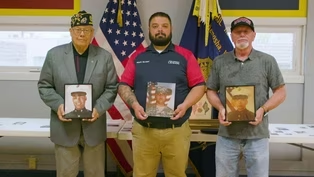
Preserving the family military legacy
Video has Closed Captions
Clip: S12 Ep5 | 5m 4s | Michael Hellquist uncovers his family's eight generations of military service. (5m 4s)
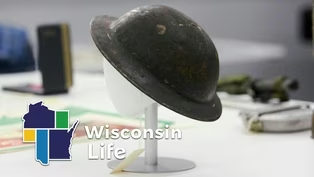
Preview: Pritzker Military Museum & Library
Preview: S12 Ep5 | 30s | Military history comes to life as we visit Pritzker Military Museum & Library in Somers. (30s)

What kind of art was in the trenches during WWI?
Video has Closed Captions
Clip: S12 Ep5 | 3m 49s | The museum holds 60,000 books and 40,000 artifacts on military history. (3m 49s)
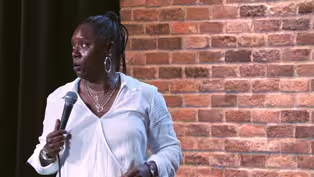
Milwaukee's 'Comedy Auntie' marks three decades on stage
Video has Closed Captions
Clip: S12 Ep5 | 4m 5s | Stand-up comic Chastity Washington gets plenty of material from her day job as a teacher. (4m 5s)
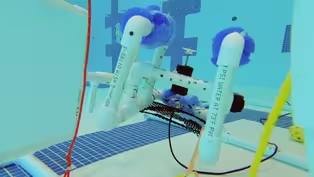
The robots being built on Washington Island
Video has Closed Captions
Clip: S12 Ep5 | 4m 44s | Science teacher Miranda Dahlke helps put Washington Island STEM program on the map. (4m 44s)
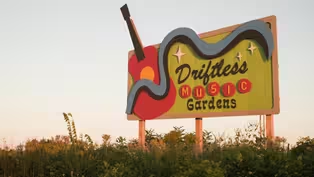
A modern-day barn raising brings music to Driftless Music Gardens
Video has Closed Captions
Clip: S12 Ep5 | 4m 27s | A farm-turned-venue fosters a vibrant music scene with the help of its local community. (4m 27s)
Providing Support for PBS.org
Learn Moreabout PBS online sponsorship













Support for PBS provided by:
Wisconsin Life is a local public television program presented by PBS Wisconsin
Funding for Wisconsin Life is provided by the Wooden Nickel Fund, Mary and Lowell Peterson, A.C.V. and Mary Elston Family, Leon Price & Lily Postel, Stanley J. Cottrill Fund, UW...