
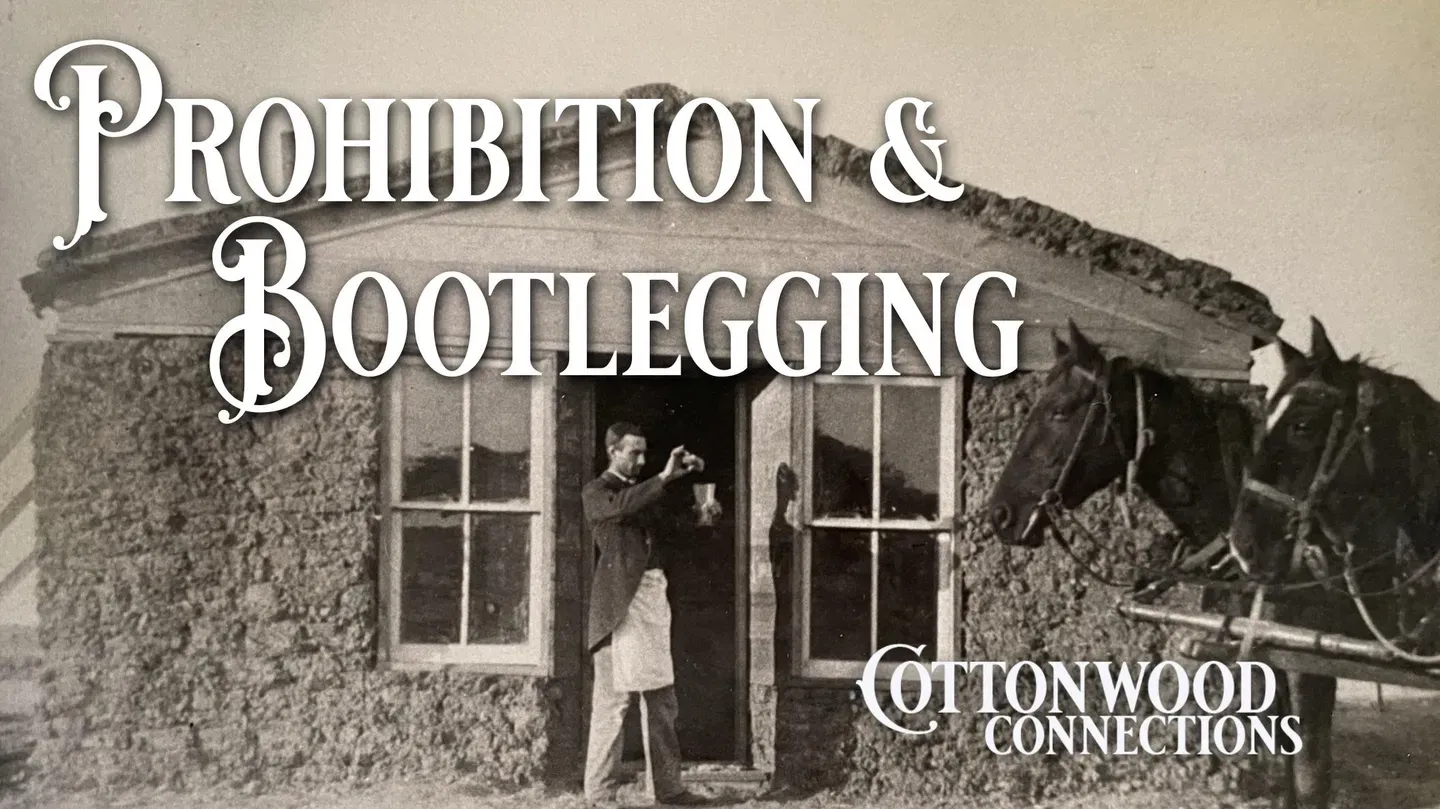
Cottonwood Connection
Prohibition and The Bootleggers
Season 8 Episode 5 | 24m 52sVideo has Closed Captions
Kansas stayed dry for decades, but liquor still flowed through High Plains communities.
Kansas was on the front lines of efforts to bring about prohibition, and held out as a dry state longer than many, but that didn’t stop the flow of the strong stuff into the communities of the High Plains.
Problems playing video? | Closed Captioning Feedback
Problems playing video? | Closed Captioning Feedback
Cottonwood Connection is a local public television program presented by Smoky Hills PBS
Cottonwood Connection
Prohibition and The Bootleggers
Season 8 Episode 5 | 24m 52sVideo has Closed Captions
Kansas was on the front lines of efforts to bring about prohibition, and held out as a dry state longer than many, but that didn’t stop the flow of the strong stuff into the communities of the High Plains.
Problems playing video? | Closed Captioning Feedback
Where to Watch Cottonwood Connection
Cottonwood Connection is available to stream on pbs.org and the PBS app.
The 18th Amendment to the U.S.
Constitution and resulting prohibition on alcohol led to iconic images of the 1920s with speakeasies, gangsters, and lawmen.
But the Temperance Movement and its bootlegging counterpart had deep roots in Kansas.
We are in the courtroom of the Sheridan County Courthouse to talk about prohibition and bootlegging.
Prohibition has always been an extensive thing in Kansas.
And in bootlegging, the derivation of bootlegging allegedly came from wearing high-topped old boots and keeping the bottle in your boots.
So it was in your bootleg.
So it was hidden, kind of illegal stuff that you didn't want to show.
So that's where the term "bootlegger" came from.
And prohibition, it's been a really controversial thing in Kansas.
I know the first prohibition demonstration on record that I found was in 1857 in Lawrence.
There was a group of women.
They went through Lawrence and tried to confiscate all the whiskey in Lawrence.
And so that was Kansas' territorial days.
But today, Tony Haffner was in law enforcement here and also a judge in Sheridan County.
Most of what I know is stories that I've been told.
But just for background, Kansas was one of the first states that adopted prohibition in 1881 and one of the last to end prohibition in 1948.
But everybody's heard about Carry Nation, but Drusilla Wilson and the governor, St.
John, were the two people that really pushed prohibition in Kansas.
Drusilla Wilson, from what I've understood in 1879, 1880, traveled over 3,000 miles in Kansas having meetings and get-togethers and gathering signatures to get prohibition on the ballot, which it passed in 1880 and went into effect 1881.
And Kansas was well known through the entire time for being very lax in enforcement of prohibition, even though we were one of the oldest to have it.
For example, while I was magistrate judge, I went through all of the county court records.
There were bootleggers, well-known bootleggers, according to stories.
And I found one case of a guy that got charged with what they called, the bootleggers I'm talking about weren't, they didn't run stills.
They were in the late 30s after prohibition, federal prohibition ended.
Nebraska became wet.
You could buy alcohol in Nebraska.
You couldn't in Kansas.
And these guys were going to Nebraska, buying it and bringing it back and selling it here.
Legal whiskey in Nebraska, illegal in Kansas.
And at one time, from the stories, emphasized stories, the sheriff's office was across the hall over here.
And on the south side of the courthouse, there was a bootlegger there.
There was a bootlegger across the street to the east.
And there was a bootlegger over here under the water tower.
And the sheriff could look out any window up here and see all three of them.
And none of those that I could find were ever charged with selling whiskey.
Carry Nation is well-known because she was, well, Drusilla Wilson was a peaceful protester.
Kerry Nation was a violent protester.
Carry Nation became famous in the early 1900s because she was mad that Kansas was not enforcing the prohibition laws.
My name is Ginger Goering and I'm the director of the Stockade Museum in Medicine Lodge.
And I also manage the Carry Nation home for the city.
It is actually a national historic monument.
Well, actually, Carry Nation has national significance.
In fact, I think it's international to tell the truth.
She was pretty well-known around Europe as well as the United States and Canada.
She had moved here in actually 1889.
And she lived here until 1903.
And when she got to this place, she had already been involved with the Women's Christian Temperance Union in Texas.
Interestingly enough, they had a very active chapter here in Medicine Lodge, Kansas, which was still very active when I moved here in the 1970s.
Susanna Salter, who was the mayor of Argonia, Kansas, the only... In fact, she was the first woman mayor of the country of the United States.
I mean, she was in Argonia, Kansas, and she was very into prohibition.
She was ahead of Carry Nation in that time she came here to our area in the early 1880s.
And when Carry came here, they had just kind of started with the Women's Christian Temperance Union here, but it was active.
And they were able to have a chaplain that would visit people in the jail and that would find out what was going on with families.
And they would also make a very concerted effort to have the men that were working in the mines around and in the fields around to come home and give their paychecks to their families rather than take them to the brothels and the bars.
And that was definitely a thing that Kerry was very, very adamant about, was taking care of families.
She was very content to be here with her projects here, with her WCTU home defenders here, with the project that she had trying to get people to leave the bars.
And I mean, that was a stage show in itself.
And she had a group of women.
They would go stand in front of the bars and they'd sing hymns and recite Bible verses.
Yes, there was prohibition in Kansas.
Yeah, there was.
They still had bars.
They sure did, because you know, nobody would really enforce prohibition.
When Carry made her first raid, it was to Kiowa, Kansas, which is about 22 miles from here as the row flies.
She started collecting sticks and rocks and bricks.
And she loaded up a wagon and she had someone drive her to Kiowa.
Took them two days to get there.
She had already telegraphed some of her acquaintances from Kiowa that were also rampant members of the WCTU.
There were 13 little saloons in Kiowa.
She annihilated three of them pretty well.
She went through and smashed and broke bottles and rolled kegs out and emptied them.
And just, it was a mess.
And the sheriff came and he said, "Kerry, you can't do this."
She said, "Well, why not?"
And she said, "Because you just can't.
You don't own these places and you can't just come in here and make a mess."
And she said, "Well," she said, "You know, you won't give me a vote.
I used a rock and I want this stopped now."
And he said, "Well, if you will leave town, I will make sure that these people are gone from here, that these saloons are closed down in two weeks."
And so they were.
After she returned to town, she learned that the sheriff down there actually owned, he had interest in all of the bars in that town.
And that was largely why that he would not arrest her and that he would not just say, "Hey, get out of here.
We don't want you here."
He couldn't because it was against the law and he knew it.
She came back, but of course by that time she was quite a noted figure in the nation and across the world because everybody had seen it.
It had gone across the wires and they knew what she'd done in Kiowa.
That was June 1st of 1900.
And she went to a lot of little towns around Kansas in this area.
She went to towns around Salina.
She was in Enterprise, Kansas.
She tore up a bar there and got arrested.
She was probably arrested 47, 48 different times in her life.
She lived in Topeka for a while and she was kind of frequently in and out of jail in Topeka as well, a lot actually.
She traveled around and did kind of speaking from the back of a train and whenever she would go someplace, why crowds would go to see her and sometimes they would heckle her and other times they were very receptive.
I don't know whether you've ever seen the little pins that they sell that they used to sell for her.
They were little hatchet pins with little gold pins with mother of pearl hatchets on them.
Her home defenders put those together and they would sell those for her bail and her travel money.
This hatchet was used by Carrie Nation.
She named her hatchets.
She called them Faith Hope or Charity.
Those were her three favorites.
She didn't use a hatchet until she went to Wichita.
That was the first time she ever used a hatchet.
She did that when she went into the Carrie Hotel on Douglas in Wichita and it was in December of 1900.
She was rather horrified that there was this mirror that had come to the hotel that had an etching of a nude in it and it was in the bar just right downstairs as you walk into the hotel.
She called some home defenders together and two people traveled from here and they met up with several ladies in Wichita.
They actually spent the night there before and kind of cased the place out and decided what they were going to do with it.
She used a hatchet for that.
David Nation was the one that gave her the idea about the hatchet because she had been picking up rocks and sticks and bricks and taking those with her when she would go smashing.
And you know, honestly, that was heavy.
And he said, "Carrie, you could easily hide a hatchet in your skirt."
And she thought that was just pretty clever.
So that's how she came into hatchets to begin with was from a recommendation from the Reverend Nation.
This is the release that Carrie used to transport rocks in and her hatchet sometimes.
And first she used to transport music in it to the church in her Bible.
She did go in though and smash that up and then was arrested in Wichita and jailed for about six weeks.
After she got out of jail, she was seen again on the streets of Wichita smashing windows in drugstores because they had alcohol in them and they had cocaine in them.
And she just was, yeah, she was bound and determined.
Those things just didn't need to exist.
She made a huge impact in Kansas and across the country.
And I think eventually after she left Medicine Lodge, she made an impact across the world.
She was very involved in the amendments.
She was involved in the legislation.
She wrote lots of letters and she also wrote magazine articles and she had little publications.
She had one she called the Hatchet, but she had the Smasher's Mail, which was another magazine that she did.
And these went all over the country and she had a large following.
And I think a lot of people knew that what she was saying was needed to be paid attention to.
She went all over the country to rallies and she went all over speaking to politicians.
The governor would have her in when she would go to Topeka.
Carrie would talk to them about what she'd seen and how we needed to help our families.
And we needed to help these people get past their addiction to alcohol.
Well, the home defenders, Carrie felt, needed to be able to provide support for people who were impacted by alcohol in their families.
They needed to be able to show them a better way to help them establish a home.
She would encourage women to work.
She would encourage women to do what they could to keep their kids safe.
And honestly, I know she felt the influence of alcohol was just a very, very destructive force on families.
The 18th Amendment to the U.S.
Constitution was ratified, establishing a nationwide prohibition of alcoholic beverages in January of 1919.
And actually that was not repealed until 1933.
Carry Nation died in 1911 and she only worked so far, but she never actually saw the government come in and support these things like she had hoped they would.
Her final day out in public, she was speaking in January and someone hit her with a rock.
And it basically knocked her down.
And at that point in time, you know, she says, "I have done all I could."
And that was about the last thing she ever said.
And she died six months later.
Her brother and her nephew moved her to Levenworth and she died in Levenworth so she was close to family when she died.
We do have somebody that made an impact in the country.
She was notorious.
She was also right on in many respects.
And I think our community has come to respect her for what she did and for what she accomplished.
She was just a nice old lady that had a mission.
and that believed in what she stood for.
The work of Nation and others in the temperance efforts may have moved the country to a national prohibition amendment, but it also inspired a response, the growth of a black market industry.
1925, a raid in Northwestern Kansas had resulted in 35 arrests and confiscation of six automobiles, 16 stills, 7,000 gallons of mash, and 250 gallons of whiskey.
Apparently, despite all that Kansas and federal laws had done in relation to liquor sales, there was no way to stop people with a thirst from trying to quench.
Selden had bootleggers, every little town had them.
As I said, the sheriff's office, he could look out on this third floor, he could look out any of the windows and see the three that I've been told about were the most common.
I know there were more than that.
My uncle talked about when he worked for the county before they were married.
On Friday nights, they'd get done with work, he'd stop by the bootlegger, and he'd buy a pint or two of whiskey and go over to the doctor's office, which was up on top of the state bank.
And that's where the young single guys and people got together and had their drink on Friday evenings after work.
And everybody knew it.
In the 30s, the late 30s, after Nebraska became wet, in 34, farmers would go to Nebraska and load grain.
My uncles, older uncles, my father would have only been 10 years old, but he rode with them.
They would go to McCook.
First thing they'd do is go to the liquor store, buy two cases of whiskey, put them in the bottom of the truck, go to the elevator, load corn on top of it, and bring it home.
I know Alan Neal, who was a good historian, a businessman in Hoxie, and he had an office and stuff on Main Street.
And anyway, they were rebuilding the building.
He said when they did that, they found a basement under the building that they weren't sure about.
Because between the ground floor and the ceiling of the basement was about 18 inches to 2 feet thick and full of sod.
And he said so that they found an entryway on, I believe, on the east side.
And it was a blind pig, is what the term was.
And this was like a speakeasy, where you serve the illegal booze.
So there was a blind pig there, too.
Although prohibition was there, a drugstore could buy a case of, or a keg of brandy for medicinal purposes and mix it.
But that's the deal when the big patent medicine came through in the late 19th century and that a lot of patent medicines had a lot of alcohol in them.
I have a bottle that I found in a little house that we had across the street.
It's molded into the glass, Dr.
Pierce's favorite prescription.
After the internet became available, I looked that up.
And Dr.
Pierce's favorite prescription was about 80% alcohol.
They had it for cancer, cholera, diphtheria.
I mean, it was a catch-all for everything.
Stills were common.
I mean, it was home brew everywhere else.
I mean, it's been going on for hundreds of years.
Most of the moonshine that was illicit alcohol was made out of corn.
And I know there's a case about three miles west of Studley, bootlegger, and he was using the seed from cane, a grain sorghum.
He had quite a deal worked up because he had hogs in his farmyard.
And the hogs used to be housed instead of in big structures as we see today in little A-frame buildings.
He had the still in one of these A-frame hog houses, and what were they, probably eight feet long maybe at the most?
Six foot by four foot probably, and four feet high, five feet high.
And the still was in there.
And so the mash that was left over after the distilling was right there for the hogs to eat.
The story is that he had it in there, and the revenuers or the people trying to police the stills didn't want to walk into the hog lot because it was nasty, and the sows are mean if they have little pigs.
And so it was fairly well protected so he didn't get caught.
And then kind of in the same area, about a mile south of there, there was a still in the dugout.
Because one story is that there were deputies out there looking for it, and I know when I was substitute teaching in Hoxie High School, I thought, "Well, I know the kids.
I know their dad.
I know their granddad.
I know their great granddad."
And this was in a history class, and I thought, "Should I or should I not say that your two granddads, one of them was a bootlegger and the other one was a deputy sheriff.
Your granddad turned in your granddad."
But Kansas was very lenient on the stills and the alcohol.
Everybody had them.
And although, as Tony said, the prohibition started in 1880 .
It was a fact in 1881, there were saloons everywhere.
Studley had a saloon ran by an Englishman by the name of Frank Brandrum, who was a bootlegger also.
Nobody enforced it.
Yeah, they didn't enforce it, and that's what really made a lot of people mad that had pressed for the prohibition all the way through that nothing was enforced.
Well, just like 1881 prohibition, we were supposedly went dry, but the cattle drives were still coming through Dodge City until 85, so we know the saloons just from watching Gunsmoke.
We know that the saloons were open in Dodge City the entire time, and prohibition went into effect in 81.
Four years before Dodge City, the cattle kind of slowed down.
And most of the enforcement, it was the revenuers or the feds, were more involved in forcing alcohol production.
And 3-2 beer became legal in Kansas in 1937, even though but alcohol, they could not sell they couldn't sell alcohol or liquor store type, anything over 3-2 until 48 in Kansas.
And then some counties did not allow it.
It was kind of up to individual counties.
The last county in Kansas that was dry, and when they say dry, they're meaning no liquor by the drink.
They had liquor stores, but they couldn't sell liquor by the drink in a restaurant or anything like that was Wallace County, and that was changed in November of last year, November election in 2025.
Wallace County voted to allow liquor by the drink.
They were the last county in Kansas to become technically wet, even though to this day, from what I found, there are still three towns in Kansas that do not allow alcohol to be sold inside the city limits.
But in the 70s, they did not, especially when Vern Miller was the Attorney General, they did not allow airplanes, trains, or buses to sell alcohol when they were crossing Kansas.
I remember when I was in the Army flying one time from Denver across, and when we got, they said, you know, we had no sales until we get to the east side of Kansas.
Actually, when the state allowed 3.2 beer in 1937, they established 18 as the legal age for 3.2 beer, and then they changed that.
They raised the drinking age to 21 in 1985 when the nation, national thing, got all crazy about it.
But yet, when Don and I were kids, Kansas, you had to be 21 to buy whiskey, 18 to buy 3.2 beer.
And yet, when I went into the Army, I could buy anything that was available, and you come home on leave, and you couldn't buy it.
So, you know, the liquor laws across the nation, it just depends on where you're standing at that moment in time.
Tony talking about when he was in the service and stuff, part of the stuff is the soldiers were coming back after World War II.
Well, they'd been to other countries where they could drink.
Everything was legal.
And so, them being veterans, they respected them a lot, and they put the pressure on it.
So that's where the Prohibition law didn't go out in Kansas until 1948.
Kansas Constitution Article 15.
Yeah, 15 or what.
What was banning this stuff?
The first truck load of legal liquor arrived in Kansas on July 8, 1949.
Yeah, like I said, Kansas was very lax.
Like I said, they were known for being lax.
It's like any law that people don't agree with.
When you've got half the population that doesn't agree with it, it's hard to enforce.
And any time there is a demand, somebody's going to provide a supply.
[music]












Support for PBS provided by:
Cottonwood Connection is a local public television program presented by Smoky Hills PBS