
Protecting Southern Nevada’s Animals
Season 5 Episode 27 | 26m 46sVideo has Closed Captions
An update from The Animal Foundation and a look at Clark County’s new ban on pet sales.
The Animal Foundation has been under scrutiny after reports of poor conditions at the animal shelter and an outbreak of illness among its dogs. We talk to the CEO about efforts to make improvements. Plus, Clark County recently enacted a ban on the sale of popular pets at pet stores. It’s an effort to stop puppy mills and overpopulation in animal shelters.
Problems playing video? | Closed Captioning Feedback
Problems playing video? | Closed Captioning Feedback
Nevada Week is a local public television program presented by Vegas PBS
Protecting Southern Nevada’s Animals
Season 5 Episode 27 | 26m 46sVideo has Closed Captions
The Animal Foundation has been under scrutiny after reports of poor conditions at the animal shelter and an outbreak of illness among its dogs. We talk to the CEO about efforts to make improvements. Plus, Clark County recently enacted a ban on the sale of popular pets at pet stores. It’s an effort to stop puppy mills and overpopulation in animal shelters.
Problems playing video? | Closed Captioning Feedback
How to Watch Nevada Week
Nevada Week is available to stream on pbs.org and the free PBS App, available on iPhone, Apple TV, Android TV, Android smartphones, Amazon Fire TV, Amazon Fire Tablet, Roku, Samsung Smart TV, and Vizio.
Providing Support for PBS.org
Learn Moreabout PBS online sponsorshipThis week on Nevada Week , Clark County bans the sale of certain animals at pet stores while the City of Las Vegas looks into opening its own animal shelter.
♪♪♪ Support for Nevada Week is provided by Senator William H. Hernstadt.
-Welcome to Nevada Week .
I'm Amber Renee Dixon.
Overcrowding at animal shelters is part of why Clark County banned the retail sale of dogs, cats, rabbits and potbellied pigs.
We'll explore that ban ahead.
But first, an interview with Hilarie Grey, CEO of Nevada's largest animal shelter, The Animal Foundation.
In September, several of her employees walked off the job alleging poor working conditions.
And in October, the foundation temporarily suspended the intake of stray or owner-surrendered dogs due to an outbreak of a respiratory illness known as canine pneumovirus.
Hilarie, how would you assess the past three or so months for The Animal Foundation?
(Hilarie Grey) You know, it's been a really challenging period.
A lot of things coming to a head and to our attention, but I'm really first and foremost really proud of how our team has risen to meet those challenges and some of the things that we've learned and have been able to really institute as a result.
-And when you talk about what you've learned, what would that entail?
-Well, you know, first and foremost, shelter overpopulation is a problem across the country.
It's not unique to The Animal Foundation.
It's not unique to Las Vegas.
It's a really challenging time for shelters and rescues.
And, you know, we saw that over the summer, that our population in the shelter became very high.
And we got outside of what we refer to as our "capacity for care," where you look at what our staff capacity is, what our facility and what our resources can handle.
And you want to make sure that you're giving the best care to every animal that comes in and you're not stretched so thin that you're not doing that and you're burning out staff and you're not being fair to the animals.
So we actually did what turned out to be a fantastic thing, and we have foster programs year round.
But we asked for the community's help in getting fosters out into homes, and that was really successful, and made sure that as some other things came down the pike that we weren't so overpopulated that we couldn't cope.
-Your intake situation.
What is it, and how does it impact overpopulation?
-"Managed intake" is kind of a key phrase that you hear from a lot of folks and experts in the animal welfare community to help make sure that communities are in tune with their most humane resources and aren't using the shelter or animal control as a default.
It's a little bit new from the traditional model of years past, which is, Okay, there's a lost pet, it goes to the pound.
You know, we're not a pound or a shelter, and we want to make sure that we have the resources to take the best care of the animals that need us the most.
So the ones that are really abandoned, maybe their family pased, you know, they're injured or dangerous, or ones that really need our care to be on their best pathway.
In Las Vegas, there aren't packs of stray dogs wandering the streets like in some countries.
What you have for the most part are lost pets.
And so it's kind of reframing that discussion with people.
When you find a lost dog or cat in your neighborhood, chances are it belongs to a neighbor.
And so it's a better deal for that person who is lost and frantically looking for their pet, and for that pet, for you to spend just a little time trying to find the owner, if that's canvassing the neighborhood, if that's putting a photo on Nextdoor, and even working with, you know, they're now "Animal Protection Services," as opposed to "Animal Control."
And part of that is those officers scanning for microchips, returning pets in the field so that we're not just getting lost pets in the shelter and diminishing their chances of being returned home.
-So what would it look like if I saw a stray dog out and about and I called Animal Protection Services today?
What would happen?
-Well, I mean, I can't speak for their individual procedures, but there are, like I say, there are a few different categories that we're talking about.
Like if you find a dog wandering around in your neighborhood, you may even recognize that dog and go, Okay, I think that belongs to somebody on this block.
But if it's a dog that's abandoned or, you know, running down the highway, those are the exceptions.
And you do, you want to call Animal Protection Services.
And it's important for the folks watching this to know that even when we had a disease outbreak in the shelter, we never stopped taking animals in true emergency.
-Was managed intake a result of the canine pneumovirus?
-You know, we had been-- We had moved to an appointment system for owner surrenders that we have been already experimenting with for several months that had been really successful.
And the great thing on that front is that that also, when you make an appointment, Oh, I'm having some trouble, and I think that I might need to surrender my dog or cat, that gives us a chance to kind of mobilize our troops, get some more information.
Why is that?
Do you maybe just need a little bit of veterinary care or food or resources?
You know, maybe your landlord is starting to charge pet rent, and we have programs that can help with that.
So to be able to have people thinking about that and giving us information in advance has been really helpful.
And so now also on the lost pet side, or the found pet side I guess I should say, we've gone to an appointment-based system, which is, you know, flexible.
Again, based on what's the capacity of the shelter, what's our capacity for care.
And that also does let us take in true emergencies.
And keep in mind, too, that we don't just get animals coming to our lobby from the public, we get them from three municipalities from Animal Protection Services.
So what we've asked our partners and the community to do is make sure that they're bringing us the animals in the greatest need.
And in any case, where we as a community can help get lost pets home, that's what we want you to do.
-And what did you learn from the pneumovirus?
-You know, number one thing is we have a fantastic team on our veterinary services, on our animal welfare and behavior side.
They really pulled together, and as a result of kind of an incident, command system that they set up starting with our chief veterinarian, they were able to detect, test, quarantine, and make sure that everybody was kept healthy and that we didn't see, you know, more spread of the disease.
All of the dogs in our care were watched, were treated, provided extra enrichment while we were in disease protocols.
And we're very happy that we were able to see the pneumovirus cleared in about a month, which was not the case for a lot of other shelters across the country that have also dealt with it.
So very, very proud of that and the way our team mobilized.
I also learned that our electronic system that we have for managing our kennels and our space helped with contact tracing.
Which if you remember from COVID, contact tracing was a big thing, right?
So we could actually track which dogs had been in which places, which had been in playgroup or encountered each other so that we knew which ones we needed to watch for popping symptoms as things went along.
-When I brought up the past three or so months within that timeline, in addition to the pneumovirus, was the City of Las Vegas notifying The Animal Foundation that it was in violation of its contract with the city.
And that was after Councilwoman Seaman made a surprise visit here and described the conditions as "unsanitary."
What is your response to that allegation?
-You know, we did respond to that in kind, and we are inspected.
And they're surprise inspections all the time by all three municipalities.
And our team does a great job of keeping conditions safe and healthy.
We felt like that was a calculated time and place, and we've addressed it.
-And now the City is conducting an audit of The Animal Foundation.
Your thoughts on that?
-You know, we really value our partnerships with all three municipalities, and we have contract relationships where financial audits are a part of that.
So we're happy to work with them and to, you know, discuss anything that, you know, they might be interested in.
-What do you think they will find as a result of that audit?
-You know, our finances, we are audited by outside firms.
We're listed in Charity Navigator and GuideStar , and our financials are very good.
-Might it be possible that they find the foundation could use more money?
-You know, it's interesting that you bring that up.
The contracts are sort of long standing and have been renegotiated at intervals.
But with the same kind of supply chain and cost issues and staffing issues that, not just in animal welfare, but everybody has experienced, you know, over the past few years, we have found that the cost of care that's supposed to be covered in the contract-- which are the statutory hold days that the cities or the county are responsible for.
So if an animal comes in and is on a three-day hold, it's those three days of care that that's supposed to pay for-- that it really hasn't been keeping up with our actual costs.
We've been subsidizing for quite a while.
-And on another topic, the ban on pet stores selling popular animals like dogs and cats that Clark County recently voted to enact, The Animal Foundation supports it.
In what ways would it support your efforts?
-The reality is, we talked about shelter overcrowding, there are plenty of animals that are in need of good homes.
And we think that directing people to adopt and letting them know that they can find, even if they're looking for a special breed of dog or cat, they all come through the shelter.
We did an analysis preparing for that ordinance hearing to look at how many of the top 10 breeds that you see listed that people seek out and buy have we had in the shelter, and we've had a lot of French Bulldogs, Yorkies, purebred Labradors.
Like you can really find whoever you need.
We have a lot of great rescue partners, too, where there are breed-specific rescues.
If Beagles are your jam, you know, there's a really great Beagle rescue in town.
There's a Golden Retriever rescue.
So there are lots of places where you can find the animal of your choice and do the right thing by giving someone who might not have one right now a loving home.
-Let's expand now on the ban.
In December, the Clark County Commission voted unanimously to prohibit the sale of dogs, cats, rabbits, or potbellied pigs by retailers in unincorporated Clark County.
These retailers, or pet stores, will have one year to continue selling those animals.
And after that, stores found in violation will face a minimum fine of $500.
Joining us to talk more about the ban is Michael Naft.
He is the Clark County Commissioner who introduced the ordinance.
Commissioner, thank you for joining us.
(Michael Naft) It's good to be with you.
Thank you.
-What was it that made you go, Hey, pet stores should not be selling these animals.
-I think anyone who has spent some time looking into puppy mills will feel the way that I feel.
It really is inhumane and just-- You have these innocent victims who need someone to stand up for them.
And while we at the local level have little authority on what we can do about puppy mills, we can do something about their pipeline.
And the fact is pet stores are getting their pets, getting their dogs and cats, dogs primarily, from puppy mills.
And the treatment that they're going through that they're-- The horrible conditions is just devastating and heartbreaking.
So if there's something that we could do about it, I sure felt compelled to do that.
-And we'll get to the pet stores' response on what you just said in a bit.
But Clark County now joins Reno, Mesquite, and North Las Vegas, which all have similar pet store bans in place.
The City of Las Vegas does not.
It did have a ban it was set to impose back in 2018, but repealed it before it could go into effect.
Here is a clip from the City Council meeting in which that ban was repealed, Mayor Carolyn Goodman explaining why she was supporting the repeal.
(Mayor Carolyn Goodman) It solves nothing.
And putting two-- All this is gonna do, come January 6, is close down two shops.
That's all.
It's gonna solve nothing because anybody who wants to go buy a puppy from a puppy mill will just go online and go buy it.
Or for those that exist in this state-- and I was told there are no puppy mills in this state.
I don't believe it-- and they'll just go find one.
And we are doing and showing no leadership here.
-Commissioner, your response to that argument?
-Well, I think time has proven my good friend, Mayor Goodman, wrong in this matter.
And that's because as you just heard, there were two at the time that the City passed this ordinance in 2017.
That-- Later that year, the entire state of California went through a pet store prohibition.
And that took effect in 2019.
And since then, we have seen right here in our community the proliferation of pet stores every single month since that happened.
So while it might not have been as devastating of a problem back then at the time of that clip in 2017, it has only become worse.
And I think had they kept this policy in place, we wouldn't-- we wouldn't be here today.
-And at that meeting, Mayor Goodman did say the City of Las Vegas would resolve this issue of puppy mills and become an example as to how to bring about real change.
We did invite her on the show.
She declined to discuss what has been done in the five years since that repeal, and the City of Las Vegas did confirm that no new bills have come forward to try and address the issue of puppy mills.
We also asked several pet store owners who are set to be impacted by this ban to come on the show.
We could not find anyone willing to do so, but a few did speak at the Clark County Commission meetings.
Here is one.
Let's take a listen now.
(Speaker) I would love for us to sit down, run the numbers.
Let's see if these animals at our Animal Foundation, local rescues, are part of our animals.
Are we the problem?
We're open for debate.
We're open for working together, but an outright ban is-- You're gonna-- You're gonna affect 20-plus stores for Clark County, over 200 employees.
-All right.
So a few issues were brought up there.
First, you believe pet stores are leading to animal overcrowding at shelters?
How can you tell this?
-I do believe that; I think we know that.
I think if you speak to any, either municipal shelter, The Animal Foundation-- I know you heard from Miss Grey-- or if you speak to the others here in our community, you can just-- you just know it.
They can get the facts directly from the source and from someone who's not standing to economically benefit.
The other thing I would say is I'm certainly open to having the-- you heard him call it debate, but conversation.
I've met with nearly anyone, well, anyone who on this topic had an input or an interest and discussed it.
And at the end of the day, you can't really compromise on welfare of animals when we know there is something that we can do.
You heard the mayor say, This isn't leadership.
Well, she's kind of right.
This isn't leadership, because 400 communities across this country have already enacted such ordinances, multiple states since the time that we passed this, the entire state of New York has already adopted it.
So-- And that includes, as you mentioned, our sister cities in Reno, North Las Vegas, Mesquite, and here in the community.
So Clark County wasn't leading on this; we're following a policy that we know has been effective and works in other communities.
-So you mentioned California's ban.
And Clark County during this process did reach out to some of the jurisdictions in California where animal control officers also run the animal shelters and asked, Since the ordinance went into effect, have you seen less animals being brought in?
And the answer was no.
So why do you think it's going to work here if it's not working there?
-Well, I think if you look at the current state of events everywhere across our country as a result of the pandemic, the economic consequences, transitions that have been happening, people moving from community to community, you've seen surrenders go up.
So I think that just speaks to why this is even more important right now, not why we have to walk away from it.
I think it's, you just can't wait for this problem to get any worse.
And that's what's happened since the time that the City repealed it.
The worst thing you could do for businesses is to give them false hope of success and having them continue to open up month after month, when you know that what they're doing is not right, doesn't match the values of this community.
And it's hurting taxpayers who, at the end of the day, fund places like The Animal Foundation and other municipal shelters.
-So that's how you would justify the business impact here, taking away these people's source of income?
-Well, look, nothing is harder than that.
But what I want to make clear is we are not shutting down one business in this community.
We have 89,000 business licensees.
There are 12 who operate in this space, all of which are invited to amp up what they're doing with their business, things like grooming, pet grooming, things like retail sale and pet supplies, which are successful elsewhere.
You have entire large companies that everybody's heard of who don't-- don't deal in this space, but serve the $2 billion industry of pet supplies and grooming and sales and to take it one step further, because I would never want to see a policy that I enact negatively impact a business.
We also moved forward with the Business Impact Grant program to help these businesses, these 12 licensees, transition their, their staff, their employees into how they can move from pet sales into other relevant businesses, how we can help them transition their physical space, whether it's through TNI or other improvements to the physical space.
They can apply for these grants to help them make the transition, because I want to make sure that not one of these guys go out of business because of a policy that we put in place.
-Before we run out of time, one more argument against the ban.
Take a listen.
-I believe in the power of choice.
Banning pet stores affects my freedom to choose.
Slogans such as "Adopt, don't shop" is a manipulation tactic that affects my freedom.
While being qualified like most people, I was denied at a shelter because I work.
They said that I won't have enough time for a pet.
This ban will force me and others to go through backyard breeders, which are unregulated.
-First off, the freedom of choice argument.
How would you respond?
-No doubt people should be able to operate in a way that, that they want.
However, not when it comes at the life of helpless animals.
And that's what I believe this is.
This is really the pet store-- pet puppy mill to pet store ordinance because we have to do something to prevent the puppy mills from getting their animals out, and this is one way to do it.
-And pet stores would say, We don't get our pets from puppy mills, we get them from breeders regulated by the USDA.
Is that regulation sufficient?
-That's simply untrue because the code of ethics for the breeders nationally does not allow them to sell to pet stores.
So we know that there are no humane breeders that are selling to pet stores.
-And last question.
Backyard breeders, that would be the next step, correct?
Where do you even start?
-Well, it is really important to recognize that this is not going to solve every problem that we have under the sun.
I think this is a policy that's going to help our shelters, it's going to help taxpayers who are funding those shelters, but it's not going to solve everything.
We do need to look closer at backyard breeding.
This, particularly in our community, is something that has just exploded in the last decade, and we need to take a closer look at it.
And I certainly invite all of those stakeholders who we heard from today and those we haven't to reach out and let me know how we can move a policy that benefits everybody forward.
-Commissioner Michael Naft, thank you for your time.
-Thank you.
-On January 4, the Las Vegas City Council discussed what it would take to part ways with The Animal Foundation and open an animal shelter of its own.
City Manager Jorge Cervantes estimated it would cost $35 million to construct a new facility and 6 million a year to run it.
He said in the past 12 years, the City has paid The Animal Foundation about $2.3 million a year for its services, and added that the City would still have to make a $2.5 million bond payment.
The council took no action.
And right now at The Animal Foundation and at Nevada SPCA, there are dozens of dogs and cats ready to be adopted.
Maria Silva joins us now.
And Maria, there are several ways that people can make a difference in the lives of these animals (Maria Silva) Yeah Amber, as we both know, pets bring us great joy, but with that joy comes great responsibility.
Now, if you are considering adopting a pet or maybe you can't adopt right now but still want to help these adorable dogs and cats, fostering might just be the way to go.
(Amy Lee) We call them our "happiness heroes," because they really are.
They bring so much happiness to the animal and, you know, the animal brings happiness to the foster.
-If you are ready to become a happiness hero, Nevada SPCA wants you.
-Fostering is such a great way for somebody who can't commit to adopting to provide that animal some enrichment outside of the shelter.
-Amy Lee with NSPCA says that enrichment outside of the shelter includes more exercise and mental stimulation.
These pets also get the chance to experience a sense of normalcy.
[dog barking] -You can sign up for a weekend sleepover or an extended staycation.
-That really does help us get a better gauge on how that animal is in the home and outside of the shelter.
We have little food court cards that we send them home with so they can kind of fill it out and let us know, Hey, this dog, you know, is great with this, likes this, doesn't like that.
But it's a really, really wonderful way to get them out of the shelter.
-And SPCA also makes sure you are well prepared for the task at hand.
-So a lot of animals that have specific needs; for instance, this one needs some medication.
So we'll definitely send you home with medication.
We'll send you home with food and any and everything that that animal needs, instructions, the report card, little stuffy toys.
We'll set you up with everything just to make sure that that animal is comfortable and that you don't have to go out and purchase anything on your own.
-So if you're not quite ready to do a staycation, how about a day trip?
And that's super easy.
You just sign up online, get here, and you get paired with a cutie like this one.
Punkin, are you ready for our day trip?
Do you want to go walk?
All right.
Vamanos, let's go.
♪♪♪ -Good girl, Punkin.
All right, during your day trip, do not forget to take plenty of video and photos and post them.
Become a hashtag happiness hero.
All right.
By the way, Punkin, already a social media superstar.
Ready, Punkin?
[camera shutter] -Cheese.
-We share those photos to social media and say, you know, such and such has gone on a great hike up to Mount Charleston and had a great time.
Just so people can see like, Hey, this is what it could be like if I decide to bring this animal home with me and make it a permanent family member.
-There are requirements in place to make sure these adorable pets, searching for their forever homes, are paired with the right happiness hero.
-So you do have to complete a foster application online.
It's really simple.
You just have to be 18.
But we'll get that application in.
And if you're looking to do a day trip, we have animals.
Dogs that are eligible have been here a little bit longer than what we typically would like.
So if they've been here a little bit longer than two weeks, you can come in and do the day trip.
We've had people take them to the park and just go enjoy the day at the park, take them out for a pup-acino.
Just take them around for walks, or you could just go home with that animal and just play with them in the yard.
-And you never know, you might just end up becoming a "foster fail."
No worries.
Being called a foster fail is a good thing.
-Foster fail, yeah.
So it's kind of a fun little play, but it's kind of what's known as the foster fail.
So your plan was just to keep this animal for a short period of time, and you end up failing and you keep that animal forever.
♪♪♪ -Maybe our next trip, we go to Red Rock.
How about that?
-All right, so quick update on Punkin: I did not get the chance to take Punkin on that field trip to Red Rock because, Amber, I am so happy to report that Punkin actually went on one of those foster field trips and was adopted.
-So it was a foster fail?
-Yes, it was a foster fail.
Isn't that amazing?
-That title of failure in that particular circumstance is the best kind of failure you could be.
-And I admit, I am a foster fail.
I adopted my Husky that way, YukiYu.
-Oh, say hello to YukiYu.
-Hi, YukiYu.
-So you mentioned in the package that you have to be 18 to foster, but families with children are encouraged to also sign up.
-And it's encouraged, highly recommended because how many parents-- I know I've heard from parents who say okay, they want a dog, but not necessarily.
We talk about that responsibility.
A lot of time, this would be a great way to take the dog home, see how the child does with the dog, and that responsibility of having to go outside and take the dog for a walk or take the dog out to do its business.
And a lot of times the parents end up with that responsibility.
So it's a good way to see, make sure it's a good fit.
-Maria, thank you so much.
And thank you for joining us for Nevada Week .
For any of the resources discussed here including links to The Animal Foundation and Nevada SPCA, go to our website, vegaspbs.org/nevadaweek.
♪♪♪
Video has Closed Captions
Clip: S5 Ep27 | 10m 34s | We talk with The Animal Foundation CEO Hiliarie Grey about improvements at the shelter. (10m 34s)
Video has Closed Captions
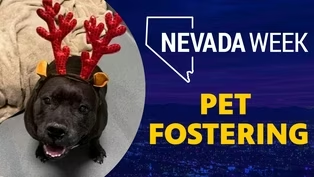
Clip: S5 Ep27 | 4m 59s | Animal shelters offer pet fostering as a way to get animals out of shelters. (4m 59s)
Video has Closed Captions
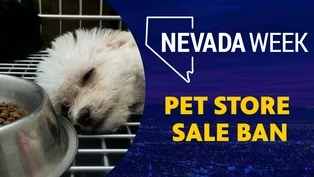
Clip: S5 Ep27 | 10m 30s | Clark County Commissioner Michael Naft explains the new ban on pet sales at pet stores. (10m 30s)
Providing Support for PBS.org
Learn Moreabout PBS online sponsorship
- News and Public Affairs

Top journalists deliver compelling original analysis of the hour's headlines.

- News and Public Affairs

FRONTLINE is investigative journalism that questions, explains and changes our world.












Support for PBS provided by:
Nevada Week is a local public television program presented by Vegas PBS