
Psilocybin Research Bill Passes
Season 6 Episode 2 | 26m 46sVideo has Closed Captions
A look at the extreme heat, and then a discussion on Psilocybin research.
Are extreme heat waves here to stay? Amber Renee Dixon visits the Desert Research Institute to find out more. Then a panel discusses a bill recently passed that will allow Psilocybin research in Nevada. Can it make a difference for people suffering from PTSD?
Problems playing video? | Closed Captioning Feedback
Problems playing video? | Closed Captioning Feedback
Nevada Week is a local public television program presented by Vegas PBS
Psilocybin Research Bill Passes
Season 6 Episode 2 | 26m 46sVideo has Closed Captions
Are extreme heat waves here to stay? Amber Renee Dixon visits the Desert Research Institute to find out more. Then a panel discusses a bill recently passed that will allow Psilocybin research in Nevada. Can it make a difference for people suffering from PTSD?
Problems playing video? | Closed Captioning Feedback
How to Watch Nevada Week
Nevada Week is available to stream on pbs.org and the free PBS App, available on iPhone, Apple TV, Android TV, Android smartphones, Amazon Fire TV, Amazon Fire Tablet, Roku, Samsung Smart TV, and Vizio.
Providing Support for PBS.org
Learn Moreabout PBS online sponsorshipCan psychedelic medicines help solve Nevada's mental health crisis?
That's this week on Nevada Week.
♪♪♪ Support for Nevada Week is provided by Senator William H. Hernstadt.
-Welcome to Nevada Week.
I'm Amber Renee Dixon.
A new law in Nevada requires the State to study psilocybin, or magic mushrooms, as a potential treatment for post-traumatic stress disorder, depression, and more.
Ahead, you'll meet a local veteran who says using the hallucinogen changed his life.
But first, that extreme heat we've had... Expect future heat waves to only increase in severity, says Erick Bandala, Assistant Research Professor at Desert Research Institute.
(Erick Bandala) We did some analysis in the past, and we found that the extreme heat, and particularly the heat waves in Las Vegas, are getting stronger, more frequent, and getting worse every time.
At least this is the trend for the last, let's say, 20 years or so.
-Is this something that people living in Southern Nevada should just accept as commonplace and get used to?
-I'm afraid that this is it.
The cover with more paved places around are creating something that is called an urban heat island, which is getting worse and worse.
And the urban heat island is a phenomenon that collect the heat during the day and release it back into nighttime.
So something that we have also find is that not just the high temps during the day are going higher, but the gap between the high and the low temp is getting closer.
So we have warmer nights every year, and it's getting hotter and hotter during the nighttime, where we were supposed to have some release.
-When you think about extreme heat in Southern Nevada, what concerns you the most?
-Well, there are many concerns.
One of them is, for example, in agreement with our findings, the number of heat-related deaths have been increasing significantly and constantly for the at least 15 years.
So to give you an example, in 2007, which is the first year that we got these data for analysis, there were about 20 heat-related deaths.
Last year, there were over 250.
So now this is a big concern because it's the people's life that we are losing here.
But beside that we have observed also an increase on the number of, for example, outdoor workers affected by that.
And in a very recent project funded by the John Ben Snow Trust, we found that not only outdoor workers, but also indoor workers has been increasingly affected by extreme heat, which was something that amazed us.
I was not expecting that to happen.
-How so?
-For example, people working in places where there's heat around, like kitchens, dry cleans, are being affected by the heat outside, but also because they they-- it's hot in there, and they have no access to, for example, ventilation or air conditioners that double the effect on them.
So they are reporting or complaining about these kinds of hard working situations.
And we got this information from Nevada OSHA, where they said-- I mean, they report that this is increasing in time as well.
-Your study that explored the impact of summertime heat waves on people who work outdoors, what stood out to you from it?
-You know, I would say that the main thing that surprised me was the-- the increase of number of female outdoor workers being affected by extreme heat.
Now, we were not able to figure out whether that was just because more and more female workers are jumping into outdoor works or jobs or whether it was a physiological issue depending on the gender.
So anyway, I thought that was interesting because guidelines are usually produced in thinking on the average person, which probably looks a lot like me, you know?
Middle-aged, this tall, this weight.
But that take me to think that probably the guidelines or even regulation had to be gender considering because it's not the same, the effect that may have in someone like me that if it is female with different, you know, condition and physical characteristics.
-What else may not be understood about extreme heat?
-We found like the number of heat-related deaths for people under the influence of substances has increased also like crazy.
For example, people under the influence of alcohol or methamphetamines, cocaine has gone like rocket high in the last 10 years.
So I suppose that the kind of thing that we all need to know is that if you are using any of these substances, it's probably not the best idea, go and expose yourself to the extreme heat.
-The Southern Nevada Health District says those most at risk for heat-related illness are older adults, the very young, and those with chronic medical conditions or mental illness.
However, anyone doing strenuous physical activity in hotter weather can be affected.
We move now to our main topic, the use of psilocybin, also known as magic mushrooms, in mental health treatment.
The State will start studying that, thanks to the passage of Senate Bill 242.
Joining us to discuss the need for this research and what it could lead to are State Senator Rochelle Nguyen, the sponsor of SB 242; also UNLV Neuroscientists Rochelle and Dustin Hines, a husband and wife team researching psilocybin; and Bruno Moya, a veteran and co-founder of the Nevada Coalition for Psychedelic Medicines.
Everyone, welcome to Nevada Week.
Thank you for taking the time.
-Bruno, I want to start with you.
You are a Marine Corps veteran of the Iraq War.
First off, thank you for your service.
(Bruno Moya) It's a privilege.
Thank you.
-Second, you told me that you have used psilocybin to treat your PTSD.
How has it impacted you?
-It was transformative.
I was somebody that grew up on the Mexican-American border on the Mexican side.
So drugs have some-- have always been something that I've feared, essentially, just growing up in that area.
So it's something that when I turned about 35, 36, I took a leap of faith and went over to a friend's house.
And they invited me.
They were like, Hey, we're gonna do this thing, this thing we call a ceremony.
We're gonna, you know, a bunch of combat veterans, and we think you'd be great for this.
I think you need it.
Look, I'm a little too old for a slumber party, but I'll try it out.
And the next morning I remember coming home, and my wife looked at me and she's like, What did you do?
You look a lot different.
You're behaving differently.
At the time, I'd been married, I was married about 12 years.
And I've told my wife at the time, a handful of times that I loved her, you know, and it was this, that type of relationship that I had coming out of the military coming home from war, what I've seen, what I've witnessed, and also growing up, you know, the way that I was raised.
And that changed for me at that-- in one night.
You know, now every single night I tell her I love her.
I hug my kids.
I play with them.
I'm not this Marine that's always talking, you know, knife handing them, telling them what they're doing wrong and everything.
It's, it's transformed my relationship with myself and with my family and my community.
-Rochelle, when someone experiences trauma like Bruno has, what does it do to their brain?
(Rochelle Hines) Well, our brains are amazing at adapting to the circumstances that we're exposed to.
And we need this capacity.
But unfortunately, if we're exposed to trauma, our brain gets prepared for being on high alert all the time.
And so our brains have this capacity by making change or having plasticity.
That's what we call it in neuroscience.
So plasticity is just the way that the brain changes in response to our circumstances.
And when persons are exposed to trauma, they start to have plasticity in the pathways that prepare them to be on high alert all the time.
And then they might lose connections in other parts of the brain that helped to suppress those feelings to help bring us back to calm, to help us regulate ourselves.
You know, when threat subsides.
And so it's really that capacity of the brain that's so critical, but it's also extremely sensitive when we're exposed to things that are dangerous to us.
-And Dustin, what does psilocybin do to the brain?
(Dustin Hines) Well, the first thing to say is that psilocybin is what's called a prodrug.
What a prodrug is, is something that you ingest and then it changes throughout your metabolism.
So when you take in psilocybin, magic mushrooms, it changes into something called psilocyn.
And psilocyn is largely the psychoactive compound that then binds to serotonergic receptors.
There's all kinds of crazy different scientific names for the different receptors.
And in this case, it's called the 5-HT, which stands for serotonin 2A receptor.
And so it binds to this receptor.
And then all throughout your brain, you get these connections that you hadn't had before.
This is kind of what Rochelle was talking about.
You can tune into those fear centers in your brain.
You have kind of like a critical period opening up where all your brain is interconnected at one time.
-Senator, we opened the show asking whether psychedelic medicines can help solve Nevada's mental health crisis?
What do you think?
(Senator Rochelle Nguyen) What we're doing now is not solving our crisis.
And when you read about the, like, research that's out there and you read about what the Hines are talking about in their research and what they've done, when you talk to people like Bruno who have-- you can see, feel, touch, like a real life person that's been affected by these medicines.
It's hard for me.
It was hard for me as a legislator to unsee that.
And so that's part of the reason in my motivation in bringing this bill was I saw the change.
I read about the change.
I, you know, did my research.
I talked to people.
And, you know, our state deserves to have other solutions and be able to research that.
So this is a very, like, impactful first step to coming up with those solutions to solve our mental health crisis not only in our state, but also around the country.
-Bruno, the smiling calm presence that you have, this was not you prior to psilocybin use?
-I don't think so.
My wife will tell you that it was not, and my kids will too.
It completely has changed the way that I, that I take in things.
So it allowed me to see things about myself in such a way that it forced me to say, okay, am I going to change this behavior that I'm always at, these triggers that I'm always at, or am I going to stay the same?
And the answer was easy.
It allowed me to see, okay, you know, you're behaving in such a way.
You're treating your family and yourself in such a way.
It's up to you to change it.
And after that, I did the work.
You know, I was exposed to some of the things that I've, that I'm forced to see within myself.
Then I had to do the work to be able to get past those and to heal myself in such a way.
-Dustin, is that typical of the experience?
There's an introspective experience?
What's happening in the brain?
-Absolutely, there is.
One of the words we use is that the psychedelics or psychoplastogens cause behavioral flexibility.
So you can kind of get into new patterns.
What's amazing about Bruno and others, though, and that's really important-- -And who are "others" that are-- -There's lots of veterans doing this.
There's lots of people kind of behind the scenes for depression, taking these compounds right now, people that have what's called treatment resistant depression.
I hate that word.
-Why?
-Well, there's a lot of stigma around it.
Most of our drugs that we treat depression with now are about 15 to 20% effective.
So that means 80% of people aren't getting treated by the drugs.
That doesn't mean-- -We're talking about Prozac-- -Yeah.
- --the Zolofs?
-It doesn't mean people are deficient; it means our medicines are deficient.
So what's unique about Bruno, I think, and what's important to know is you've heard him say, We take the psychedelics, and he did the work.
We're in a culture where you want to pop a pill and it's over.
But you know, it shows you where your patterns are maybe maladaptive, and now you can deal with them.
-And Bruno, we had talked about that off camera, the need for therapy prior to the use of this and after.
Why is that so crucial, and what type of therapy?
-Absolutely, yeah.
So it's very important to, first of all, if you are wanting to experience this, the importance of having to do this with somebody that knows what they're doing.
A therapist of some kind or somebody that has the experience and training, and then just that talk therapy that you do a couple of times prior, first of all is the rapport, right?
You're developing a rapport with somebody that's going to give you a substance and then take care of you while you're under the substance and make sure that you're not driving or calling your mom or your wife or anything like that.
Where you're at in life as well, you know, and you explore those things.
And then once you're in that experience, those things might come out.
And so that individual that you did the therapy with is going to be able to at least help navigate those things, maybe not drive the wheel or drive the car of the experience, but allow you to express those things.
And then post is when you come, come back to real life, I guess.
And then you're attempting to integrate your experience by talking about it, by making changes, coping mechanisms, or maybe just, You know what?
I think this is the last day I'm gonna drink.
So this is the last time I'm going to drink.
-Senator, is that what you're after, the monitored use of psilocybin?
Or would you also like people to be able to use this in their own homes?
And I ask that because the original bill you introduced had a decriminalization aspect to it for possession of a certain amount of psilocybin mushrooms.
-I think-- I think it's two points.
I think it's really important.
I think Bruno hit the nail on the head.
This isn't a solution.
It is not a pill.
It's not a one-time thing that is going to fix you.
I think it's really important to listen to the people that are trained, the people that have experienced this, the people that understand this.
I think that's why you're seeing that.
I think the very first day of the Nevada Psychiatric Association Conference in February is dedicated to psychedelic medicines and their use and their future use in psychiatric care.
I think that's the traditional medical industry is also looking at this saying, Hey, we need to see how we're going to incorporate this into our talk therapy, how we are going to train our physicians and our psychologists and our psychiatrists and people that are going through these things.
When you look at Oregon, I think it's important to see what they're doing.
They have like a training process for people, that as they're opening up their centers, as a part of their ballot initiative that passed, to give that training so people are not just doing this on their own.
But also when you look at some of those other, like, locations, people are utilizing these medicines already.
And criminalizing people that are trying to figure out and receive mental health treatment I don't think is the right direction.
So that was my intent in decriminalizing the possession of this for mental health treatment.
I think getting away from the stigma that-- and you see that still a lot not only with mental health treatment, seeking it even in a traditional sense, it's still like stigmatized.
You know, when people think about it, and when you talk to certain, like, more conservative partners that haven't had these experience, haven't talked to people like Bruno, they think it's like EDC or Burning Man, like, all the weekend long.
And that's what we're talking about.
And in this case-- -And that's what Metro Police testified during the hearing on this when there was that decriminalization aspect, that it would be a threat to public safety.
What would your response to that be?
-I don't think that's evidence-based.
And I think that's why this study group-- I'm glad that we're incorporating law enforcement into that study in working group as a part of the bill.
Because I think once they talk to the people and they have the evidence, they see the evidence and see the research and they see that information and they even pull their own statistics.
I think at one point they testified there were 19 arrests for mushrooms or psilocybin.
-In one year?
-In one year.
And I know as a criminal defense attorney, there's probably thousands of arrests for DUI, alcohol, drunk and disorderly conduct-- -Impaired driving-- -Impaired driving-- - --was one of their arguments.
- --cannabis, fentanyl.
We have all those things.
And so to lump all of them into one group, I think is dangerous.
But I think this will be a start to having a more evidence-based conversation about how we should treat psilocybin in our state.
-What are the dangers of psilocybin, Rochelle?
-So I would say that more research is needed to understand people with preexisting mental health conditions.
You know, something like bipolar or schizophrenia may put you at higher risk for having an adverse event.
But really, again, you know, looking at the evidence, looking at the data, studies have been done of over 9,000 people who have used psilocybin, and the adverse event rate is something like 0.06%.
That's extremely small.
That's much smaller than most of the pharmaceuticals that people access to, you know, take care of their diabetes or, you know, birth control pills for example.
-Really?
-So, overall, the adverse event rate is very, very low.
That being said, people who do experience adverse events, it can be stressful, traumatic.
It can cause them to have erratic behavior.
And I think that's why it becomes sensationalized is because, you know, even though there are very, very few adverse events that occur, you know, people that do have those negative experiences, they tend to be extreme.
And again, that's why support and being with somebody that you trust and being in sort of this, maybe more healthcare controlled setting might be really important for people.
-What about an age restriction?
Is there an age you think someone should be?
You're looking at Dustin.
-This is a big focus right now.
This is a big question that we're trying to answer.
And so I'll be quiet right away here because it's kind of Rochelle's area with development.
But we don't know is the answer to that.
We could just say forever that we shouldn't give kids this.
That's probably a good idea.
But there's developmental disorders we think this could have hope for if we can get that critical period when things are wiring up and maybe open them up with psychedelics and maybe we could help.
But-- -That's in the future?
-That's in the future.
-Yeah, far in the future.
Because there's a lot of interaction.
You know, the brain is changing a lot when we're developing.
And so, you know, using something also that changes the brain dramatically, there's a potential to have quite a bit of conflict or problem there.
But again, we really need to understand these substances more.
And that's why we feel so compelled in, in doing the research.
-And if you look at other compounds, our culture has this very taboo idea about kids and drugs.
If you look at kids and cannabis, you would say, That's a terrible idea.
But probably the number one compound now to treat infantile epilepsy is CBD, a drug called Epidiolex.
So we're open to the data and where it takes us.
Again, I think we need more data to understand that question.
It's a very important question.
-I think it's also important to see when you look at the research being done in this area, it's not only just PTSD or substance abuse disorders.
You know, there's research on how these substances can repair brain injury in stroke patients.
And so there's a lot of research that's going out there.
In fact, in Carson City at Carson Tahoe, they are looking at partnering with Stanford University to do some trial and clinical trials and studies with the use of these psychedelic medications in that, like, hospital trial setting.
So the opportunity for what these medicines can do is kind of limitless at this point.
And the research is so new.
-Bruno, because this is illegal-- or did you want to add something?
-I just wanted to also to say one other thing that I think in my experience, in my travels has been very, very important.
And that's the fact that when we're talking about veterans or first responders, police officers, you know, they experience trauma in a very primal setting, traumas can be very primal.
Like going overseas, going to the desert, like Iraq, Afghanistan, these areas, and then asking them to go, come back and talk about their experiences in talk therapy in like a clinical setting, there's limits to that.
And some of these experiences with psychedelics can actually be outside in the wilderness in a safe setting as well.
-And where are you currently using psilocybin?
Because it is illegal in the U.S., a Schedule 1 drug.
So where are you going to do this?
-For somebody that, like myself that I'm, I'm doing it as a training for myself, right?
So I have to go overseas.
I'm going to Mexico, I'm going to Colombia, Ecuador, these places where I'm sitting with indigenous communities and also teachers that have academic background.
And we're talking about these substances, how to properly administer them, the dosage, all of these things that we're talking about, but then also doing them in the middle of the jungle.
And that can be very scary.
But when you're talking about somebody that experienced trauma at war, and then you're doing something like this, that--like you're liberating yourself from, you know, these things that consistently live in your head--in a nonclinical setting, can also be extremely beneficial.
-As you told me, you're not alone.
There are other veterans who are traveling these long distances to use psilocybin mushrooms.
We are running out of time, but, Senator, I want to know, this working group, what do you hope comes out of it, and when may Nevada legalize psilocybin mushrooms?
It's already legal in Oregon and Colorado.
-I look forward to this interim between the legislative sessions.
We only meet every other year, so that gives us a good 18 months to have this working group get together, come up with actual recommendations.
I know that myself along with several other legislators are already reserving bill draft requests, our BDRs, for the upcoming session on what this transition, what this will look like, what it will look like as mental health, what it will look like in the decriminalization space, what it will look like in the regulation space.
So I anticipate that in 2025, you'll see a lot of bipartisan legislation that will come from this working study group from Senate Bill 242.
-Which passed with bipartisan support.
-It did.
It was signed by the Governor.
And it's going to be housed in that executive branch agency.
And I think that is telling of the work that we'll be able to do together to come up with some real solutions and a path forward.
-Real quick.
Do you think legalization will be via the legislature or a vote of Nevadans?
-It could go either way.
You know, I think we're in a really good position to have that research base.
When you look at the way cannabis kind of like went through that ballot initiative, it left legislators kind of scrambling to implement the will of the people.
And I think we know what the will of the people is, is in this case, and we can implement that short of a ballot initiative.
-Thank you all for your time.
And thank you for watching.
For any of the resources discussed on this show, go to our website, vegaspbs.org/nevadaweek.
And I will see you next week on Nevada Week.
♪♪♪

Video has Closed Captions
Clip: S6 Ep2 | 5m 47s | A look at the major temperature spike in Las Vegas and the extreme heat wave. (5m 47s)
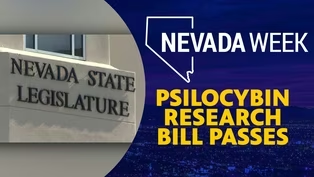
Psilocybin Research Bill Passes
Video has Closed Captions
Clip: S6 Ep2 | 19m 30s | Our panel discusses psilocybin, its effects, and how it can contribute to PTSD research. (19m 30s)
Providing Support for PBS.org
Learn Moreabout PBS online sponsorship
- News and Public Affairs

Top journalists deliver compelling original analysis of the hour's headlines.

- News and Public Affairs

FRONTLINE is investigative journalism that questions, explains and changes our world.












Support for PBS provided by:
Nevada Week is a local public television program presented by Vegas PBS