VPM News Focal Point
Public Safety | December 08, 2022
Season 1 Episode 19 | 26m 46sVideo has Closed Captions
Policing in Virginia since BLM protests; Prison deaths in Virginia; Community policing
Policing in Virginia since the Black Lives Matter movement; Prison deaths in Virginia – an investigation; Community policing programs that work.
Problems playing video? | Closed Captioning Feedback
Problems playing video? | Closed Captioning Feedback
VPM News Focal Point is a local public television program presented by VPM
The Estate of Mrs. Ann Lee Saunders Brown & Dominion Energy
VPM News Focal Point
Public Safety | December 08, 2022
Season 1 Episode 19 | 26m 46sVideo has Closed Captions
Policing in Virginia since the Black Lives Matter movement; Prison deaths in Virginia – an investigation; Community policing programs that work.
Problems playing video? | Closed Captioning Feedback
How to Watch VPM News Focal Point
VPM News Focal Point is available to stream on pbs.org and the free PBS App, available on iPhone, Apple TV, Android TV, Android smartphones, Amazon Fire TV, Amazon Fire Tablet, Roku, Samsung Smart TV, and Vizio.
Providing Support for PBS.org
Learn Moreabout PBS online sponsorshipANGIE MILES: In this episode of VPM News Focal Point, we'll talk about public safety.
How is Virginia keeping the peace and safeguarding its citizens?
From calls to end police brutality, and even defund the police in 2020, to how policing looks today.
With an unflinching look at issues of life and death in Virginia's prison system and an introduction to some crime fighting ex-offenders who are committed to ending gun violence in their city.
You're watching VPM News Focal Point.
Production funding for VPM News Focal Point is provided by Dominion Energy, dedicated to reliably delivering clean and renewable energy throughout Virginia.
Dominion Energy, Actions Speak Louder.
The estate of Mrs. Ann Lee Saunders Brown.
And by... ♪ ♪ ANGIE MILES: Welcome to VPM News Focal Point, I'm Angie Miles.
We all want to feel safe when we are in our homes and when we venture out.
What keeps us secure, collectively?
We'll start with a look at policing in today's Virginia.
The Associated Press reports that states are struggling with pushback on a wave of police reforms passed after the murder of George Floyd in 2020.
Virginia passed the Marcus-David Peters Act named after a black man killed by Richmond police while he was experiencing a mental health crisis.
The Marcus Alert helped create a relationship between 9-1-1 and regional behavioral health call centers.
That law was recently changed to allow Virginia localities with populations of 40,000 and under to opt out.
Five pilot programs went into effect last year including one at Rappahannock Rapidan Community Services.
They're urging other localities to see the benefits of the Marcus Alert.
JIM LAGRAFFE: We say all the time here with all of our jurisdictions, law enforcement should not be in the behavioral health field, right?
And so our goal is to support them to allow people who do work behavioral health to help those people on-site where they are.
ANGIE MILES: When we talked with people of Virginia about safety, some mentioned being pro law enforcement, but interestingly when asked what was most important for making communities safe and crime free, their answers went beyond policing.
CARTER JONES: I think values, okay.
If there's no values and those values have to be taught at home.
Two, I think community, the community development of children, I think that's important and the third thing, I think it is parenting.
NINA GREEN: I think maybe if we could all work as a community even and have programs that would unite us, I think that that would be a good way.
AARON THOMPSON: I believe the biggest and best way to keep our community safe is to know our neighbors.
I'm living in Cottage Grove Apartments and I've made my rounds to know who my neighbors are, introduce myself, and that's the best way.
We need to stop being behind her own walls, get off the computer, get outside, and start talking to people.
ANGIE MILES: Everyone we asked also shared a belief that good policing has to be about building relationships within communities and not just showing up when there is a crisis or demonstration.
In 2020, in response to the police killing of George Floyd, more than 15 million Americans took to the streets to protest.
Thousands of Virginians also marched that year to demand changes in policing.
Pointing to the killing of Marcus-David Peters by a Richmond police officer.
Multimedia journalist, Adrienne McGibbon takes a look at efforts to improve policing in Virginia, since that time.
>>Black lives matter.
Black lives matter.
ADRIENNE MCGIBBON: In Richmond.
people gathered for months at the Robert E. Lee statue on Monument Avenue, renaming the area Marcus-David Peter Circle to honor the Virginia man shot and killed by police during a mental health crisis in 2018.
His sister, Princess Blanding, an educator turned activist, worked with lawmakers to reform policing PRINCESS BLANDING: They reached out to me and other people who they felt were community leaders and said, "Let's talk," because now, yeah, we need to have this conversation about police reform.
ADRIENNE MCGIBBON: Reform efforts were intended to improve law enforcement's response to emergency calls related to mental health.
PRINCESS BLANDING: In many of our communities, especially the Black communities, we don't trust the police.
When we see time and time again from George Floyd to Breonna Taylor to Tamir Rice to Marcus-David Peters to my other brother who was recently killed by a police officer, and you tell me to trust the police.
How and why?
ADRIENNE MCGIBBON: New Jersey police shot and killed 19-year-old Joshua Mathis in January.
The incident is under investigation as Blanding mourns the loss of a second sibling.
Prior to Mathis death, Blanding's reform efforts in Virginia led to the passage of legislation in 2020 called the Marcus Alert System.
PRINCESS BLANDING: The original version of the Marcus Alert called for us to create community care teams, right?
Which had a mental health professional, a peer recovery specialist, somebody who has that lived experience with mental health, right?
And a police officer standing in back, right?
ADRIENNE MCGIBBON: Blanding who ran for Governor of Virginia in 2021 continues advocating for change calling for civilian review boards and removing protections that shield officers from civil lawsuits.
She also supports Governor Youngkin's calls for additional mental health service funding.
PRINCESS BLANDING: Invest it in those proactive measures, invest it in those professionals who can be the correct responders to the early signs of a mental health crisis.
ADRIENNE MCGIBBON: In Chesterfield County, the police department isn't waiting for legislative reforms.
It's been working on improving community care for decades.
>>You guys been doing good?
>>Yeah.
JEFFERY KATZ: My expectation is that when a member of our department engage with a member of the public, we treat that person like they are the most important person in our world.
ADRIENNE MCGIBBON: Police Chief Jeffrey Katz says the way to build trust is to focus on building relationships.
JEFFERY KATZ: It's important for people to see us as partners and as advocates as opposed to, you know, an occupying force.
ADRIENNE MCGIBBON: Officer Justin Abshire has been with the Chesterfield Police Department for several years.
JUSTIN ABSHIRE: In community engagement, our goal is to address those underlying problems and see if we can't reduce the crime or the call volume in certain areas by working with the community to do outside-the-box problem solving.
ADRIENNE MCGIBBON: Chesterfield's Community Engagement Unit is tasked with developing relationships and helping to figure out ways to address chronic issues like food insecurity, unemployment or homelessness.
JEFFERY KATZ: Because there's so many negative messages out there about police, it's incumbent upon us to make sure that we engage as many people as possible before they need help, so that they feel comfortable and safe reaching out to us so that we can provide them assistance in their time of need.
ADRIENNE MCGIBBON: Katz says police and mental health professionals should be working together.
JEFFERY KATZ: And when somebody calls that is in crisis, our interaction with them should be as minimal as possible.
We should be able to be with them, take them to a resource center and get them treatment as fast as possible.
That is not happening right now and that's something that needs to be changed.
ADRIENNE MCGIBBON: The chief acknowledges there are successful co-response models in the country and says they're worth exploring, but warns that recent reforms may not be the answer.
JEFFERY KATZ: The reflexive reform efforts of the last couple of years have not made our community safer and I think it's important that we go back to the drawing board and we evaluate from an informed perspective how we can all work together to improve our criminal justice system to enhance public safety.
ANGIE MILES: Chief Katz speaks to law enforcement leaders from around the world about the importance of building trust within a community.
He says his department in Chesterfield County is still a work in progress.
He hopes other jurisdictions will implement similar community engagement efforts.
VPM News Focal Point is interested in the points of view of Virginians.
To hear more from your Virginia neighbors, and to share your own thoughts and story ideas, find us online at vpm.org/focalpoint.
ANGIE MILES: One of the most volatile topics in public safety relates to solitary confinement in Virginia prisons.
Prisoner rights advocates have been pushing for years to end a practice, which the Virginia Department of Corrections says technically does not exist in our state.
What they describe instead as restorative housing is the subject of a new report mandated this year by the General Assembly and published on December 1st.
The Virginia Coalition on Solitary Confinement was also assigned as a partner to study the Restorative Housing Program and determine how to safely curb use of the practice.
But the coalition pulled out of the research and issued its own report, citing a refusal by corrections officials to allow outside oversight of the research.
In fact, they say the lack of oversight of daily prison practices can mean life or death for the incarcerated and can impact all of us when prisoners are released into society.
An advisory for you, the story includes material that may be difficult to watch.
(birds chirping) ANGIE MILES: In the hours before daybreak on January 3rd.
PRISON NURSE: This is Red Onion State Prison.
We have an offender who is in full cardiac arrest.
ANGIE MILES: At Virginia's Red Onion Prison.
PRISON NURSE: We're doing CPR right now.
911 OPERATOR: How old is he?
PRISON NURSE: We found him.
Oh God, I don't even know 'cause I've been too busy doing CPR.
ANGIE MILES: Anwar Phillips was dead.
PRISON NURSE: Nothing.
Nothing.
He's stiff as a board, so.
VERNETTA PHILLIPS: I was at work and his father called me.
It took him six hours to call me because he said he did not know how to articulate the words that our son was dead.
ANGIE MILES: But what happened to Anwar?
The 36 year old was confined to a wheelchair.
He was isolated in a singular cell in a maximum security prison where inmates are checked every 40 minutes or less, but where Phillips had likely died hours before the 911 call.
NATASHA WHITE: You hear the nurse screaming, "He's stiff as a board," but you do not hear the nurse talking about the rope that they found tied around his neck.
She claimed he was in cardiac arrest.
He was cold.
He had been dead for so long.
ANGIE MILES: Natasha White is director of community engagement for Interfaith Action for Human Rights.
She's been trying to get answers in the death of Anwar Phillips.
NATASHA WHITE: He was killed in a solitary confinement cell that you cannot get in without a key.
You have to make that make sense.
It doesn't.
And now they are charging another young man for his death.
Well, how did he get out of his locked cell to get in somebody else's locked cell and kill them?
ANGIE MILES: The cause of death now listed as strangulation, was reportedly delivered by a handmade rope.
The named suspect, William Pettigrew, an inmate, who like Phillips, was serving time for murder, locked in a solitary cell at Red Onion.
Anwar Phillips' mother, who preferred being interviewed off camera, is not convinced the story of his death makes sense.
VERNETTA PHILLIPS: Solitary confinement should have been the safest place in the world for him.
What I want is the truth.
My child is dead.
I deserve the truth.
ANGIE MILES: According to data provided by the Virginia Department of Corrections, Anwar Phillips is among more than a dozen inmates murdered in Virginia State-run prisons in just over a decade.
Recent homicides include 63-year-old Mark Grethen, and 47-year-old Gregory Pierce in 2021.
Also 62-year-old Charles Mitchell, just days after Anwar Phillips.
But in the last decade, hundreds of prisoners have been seriously injured or died of a wide range of causes including hepatitis and COVID-19.
Examples include several who died at Lawrenceville, and three women at the Fluvanna Correctional Center in 2019.
Two of the three had recently filed lawsuits against DOC for alleged medical negligence.
Virginia Corrections administrators often cite legal constraints and privacy issues as reasons they can't divulge certain information.
But prison rights advocates say that in Virginia and nationally, many departments lack outside oversight and consequently, transparency.
This can make it difficult to know how many people are dying in prison or from what causes.
Suicide appears to be the leading cause of death in both jails and state-run prisons.
It is on the rise and so is drug use.
PHIL WILAYTO: You got a big problem in jails, and prisons in Virginia with drug overdoses.
We're getting a lot of letters from prisoners asking us to focus some attention on this.
One prisoner suggested that prisoners should be taught to perform CPR, because they're often the ones who are right there when a crisis happens.
ANGIE MILES: Phil Wilayto is publisher and editor of "The Virginia Defender," which keeps track of injuries and deaths of individuals in state custody.
PHIL WILAYTO: Out of the 40 facilities, there are three, Nottoway, Augusta and Buckingham that have no air conditioning.
Now, this past summer, you know, we hit a hundred degrees several times, and in these buildings, it'll be another 10 degrees above that.
There was one case in Nottaway this summer where a man passed away and the prisoner said it was due to the heat, although the administration said it was due to other causes.
And I don't think an investigation ever went any further than that.
ANGIE MILES: Virginia's Department of Corrections has sat for an interview with "Focal Point" in the past, but declined to do so for this report.
Some of the information on prison deaths came to VPM from a Freedom of Information Act request of corrections officials.
Although VPM is still waiting for answers to most of our questions.
Among the data provided by the department, are numbers that show prisoner deaths and serious injuries much lower than in adjoining states.
Despite this relative success, Wilayto and White agree that most Americans have a hands-off approach to the way prisons operate.
That translates to thousands of those behind bars being written off rather than rehabilitated.
NATASHA WHITE: People that are incarcerated are automatically dehumanized as soon as you put handcuffs on them and they start calling you inmate, that people just don't care.
And they fail to realize that this is the most inhumane practice in the world.
PHIL WILAYTO: It's a closed system.
And if a prisoner is and does speak out and does file a lot of grievances or has some mental issues and is acting up and gets targeted as a troublemaker and gets, you know, picked on, there's very little recourse for them or for their family.
So outside oversight is a crying demand of prisoners and something that we're trying to promote.
ANGIE MILES: Prisoners do speak out.
Anwar Phillips wrote to prison officials and outside advocates outlining grievances against correctional officers, many of whom he called corrupt or racist.
And at least one, Phillips claimed, said he would only leave prison in a body bag, which in reality, he did.
PHIL WILAYTO: So that brings you to another issue is guard brutality.
Now, you know, not all guards are bad.
Not all guards are sadistic, but when you have them, you have almost no recourse.
ANGIE MILES: And who is guarding Virginia's prisoners?
The National Bureau of Labor Statistics says, "A high school diploma and an absence of felony convictions are the primary requirements to be a state prison guard."
Like most industries, there are persistent staffing shortages, presumably adding to the workload and the stress of working with offenders who can sometimes be violent.
Research and experience show the work conditions can fuel corruption for some.
When visitation was halted during the pandemic, DOC data shows that positive prisoner drug tests actually increased.
Raising the question of who is bringing drugs into state prisons?
In the past decade, numerous corrections officers have been charged with crimes ranging from having sex with inmates to smuggling drugs or other contraband into state facilities.
In the DOC's own reporting, more employees report feeling unsafe because of their colleagues' behavior, than because of the inmates themselves.
NATASHA WHITE: Prisons should be run by trauma-informed care staff, licensed social workers, licensed nurses, psychiatrists.
Those are the type of people that should run the jail.
The people with the badge should just be opening the doors, because clearly they don't have it in them to help or truly rehabilitate somebody else.
Also, I know plenty of correction officers that start in the Department of Corrections, normal and loving just like us, but the wear and tear of the trauma that happens in prison, it affects everybody involved.
How do you stand in the lion's den and not get bit?
ANGIE MILES: White and Wilayto speak about the letters that pour in from prisoners who claim mistreatment, feeling unsafe and believing their lives are in danger.
When asked how people convicted of crimes can be more reliable than the professionals who manage them, White offers this.
NATASHA WHITE: They have the most to lose.
They are going nowhere.
They are writing about the people that give them food, about the people that lock their door, and about the people that have the power to come in their cell with numerous other people and beat them to death and get away with it.
ANGIE MILES: To some, prisons exist to protect the public from dangerous individuals.
And what happens to those convicted of crimes, is not a major concern.
For others like White and Wilayto, prison is responsible for rehabilitation, and minimally, for not hastening the deaths of people not sentenced to death.
And for a few what happens in prison, can be as great a crime or even worse than what led their loved ones to serve time there.
VERNETTA PHILLIPS: Anwar made his mistakes.
I do not condone any negative or violent thing that he did, but he was still my child.
As long as he was alive, there was hope that he could have been a better human being.
The person that murdered my son, they took my hope.
ANGIE MILES: In January, the Virginia Prison Justice Network will hold its Sixth Annual Prison Justice Rally.
The American Civil Liberties Union will begin discovery in its federal lawsuit to dismantle the Restorative Housing Program and William Pettigrew will face trial for the murder of Anwar Phillips one year exactly from the day Phillips was discovered dead in his cell.
31% of Americans have little to no trust in police officers.
A 2021 PEW RESEARCH Center poll found.
What's driving that distrust?
And how can precincts statewide rehabilitate relations with their communities?
We asked a policing innovation expert to weigh in.
ANIGE MILES: We really do want to know what you are doing to help this very serious situation we're facing in the country right now with people not trusting police.
ADAM WOJCICKI: We understand that there needs to be a kind of a refocus on the idea of community policing and that really is a framework that will help to bridge that gap of between the people that want effective law enforcement and the law enforcement officers that want to provide it.
ANGIE MILES: One of the things that I hear from people and that I'm reading about is what a difference mindset makes.
Could you talk about that a little bit?
ADAM WOJCICKI: The importance of mindset in that relationship between the community and law enforcement officers and police officers really starts with this idea of not just officers taking the role of guardian rather than the warrior mentality, but really it's more than that.
What the police need to do is work with the community to care for it and that's a long-term strategy for effectiveness.
ANGIE MILES: Social media makes it immediate and viral when there is an incident of police brutality or potential police brutality.
How does training impact lowering the number of incidents like that that we see?
ADAM WOJCICKI: There is no excuse, there is no explanation of police officers behaving badly.
The next thing we can look at is what can we do to make sure that there aren't any systemic problems or issues?
What can we do to make sure that those incidents are limited, and they are.
You can watch the full interview on our website ANGIE MILES: Charlottesville has drawn national attention because of the horrific murders of three student athletes last month.
But prior to the tragedy, gun-related murders had decreased in the city over the past two years.
That may be due to the crime prevention efforts of some committed violence interrupters.
(sirens blaring) (people chattering) HERB DICKERSON: The B.U.C.K Squad is a non-profit organization that got together back in 2019 'cause of a series of murders in Charlottesville.
And we decided we'd get together and canvas these neighborhoods and put a stop to the gunfire.
BRYAN PAGE: It wasn't initially designed to be a program, it just, everybody met up, people was kind of fed up.
So I guess 70, 60, 70 people met at a church.
And after three or four weeks of meeting in this church, it got broken down into a group.
HERB DICKERSON: A friend of ours named Buck, his name is Jamarcus Washington, but his nickname was Buck and he was a good neighborhood guy, and he was murdered with, you know, almost like an innocent bystander and we had enough.
HERB DICKERSON: So we decided to use his name and just create a acronym, you know, to try to bring the city together.
Brothers United to Cease the Killing.
After that, the city paid for us to get some training to attack the problem and that's how it all started.
>>Bro, you can stay stationary.
We going to hit the outside of the mall.
HERB DICKERSON: We develop relationships in all these communities so people welcome us, come in and that's usually how we get our information to find out who has quarrels with each other.
And we go to each individual, I send the team to each individual to talk about it and see how we can solve it rather than gunfire.
We have a mechanism in place where they just stay together, you know, go out and take a elderly person to the grocery store or do cut the grass or something.
We are connected to all the community, so people give us information, where we can get to them, the individuals who commit these crimes and talk to 'em, where police don't even have to get involved.
So I guess we would be pre-crime and police are post-crime.
BRYAN PAGE: We have two different objectives.
Our objective is to stop violence.
Their objective is to get there once it's already done, and take you to jail, to get you off the street.
We not into that business, we're just trying to stop murders, gun violence in the city of Charlottesville, all over the city of Charlottesville.
And I think we do a good job based on our relationships.
'Cause I've did a lot of time in prison, so I'm able to express the hardships and the pains of prison on the real side.
HERB DICKERSON: All of us on my team have been to penitentiary, but a long since the time.
So, I know that not really what you want, but if you haven't given any other avenues to resolve the issue, then you only know one way.
And we try to teach and train folks that there is another way.
This is the most important aspect of what we do, trying to get to these kids right here so they don't join gangs, and keep up the schoolwork, and obey their parents and, you know.
BRYAN PAGE: We providing jobs, we running the reentry program.
We gettin' ready to start doing some youth things for the kids, and then we want to deal with some of these housing deficiencies that's going on in the city because these are the things that revolves around gun violence.
It starts the fight, poverty.
You know, so we must address that first.
Oh, the plans is to reconstruct these communities.
Every member on our team wholeheartedly believe that we can change the whole trajectory of these impoverished communities in Charlottesville, with more work than just violence interrupting.
We want to saturate the community with programs and resources.
And when people have access to resources, things can change.
ANGIE MILES: Charlottesville has also provided some funding for Peace in the Streets.
Another conflict resolution nonprofit.
Do you have public safety ideas?
Head to our website, vpm.org/focalpoint to tell us and watch our full policing innovation interview as well.
Until next time, take care.
Production funding for VPM News Focal Point is provided by Dominion Energy, dedicated to reliably delivering clean and renewable energy throughout Virginia.
Dominion Energy, Actions Speak Louder.
The estate of Mrs. Ann Lee Saunders Brown.
And by... ♪ ♪
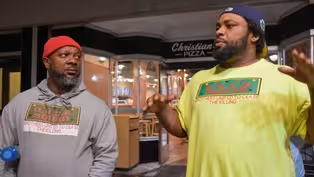
The BUCK Squad is helping keep the peace
Video has Closed Captions
Clip: S1 Ep19 | 4m 22s | The newest crime-fighters are former offenders (4m 22s)
Video has Closed Captions
Clip: S1 Ep19 | 9m 2s | Virginia sees more than a dozen homicides in state-run prisons. (9m 2s)
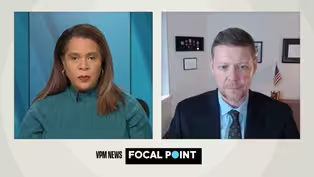
Video has Closed Captions
Clip: S1 Ep19 | 8m 31s | Do you trust the police? More than a quarter of Americans don’t. Why? (8m 31s)
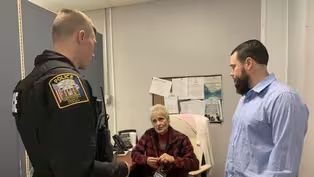
Policing reforms after “Black Lives Matter” demonstrations
Video has Closed Captions
Clip: S1 Ep19 | 4m 14s | Policing after Black Lives Matter protests in Richmond led to the Marcus Alert Law (4m 14s)
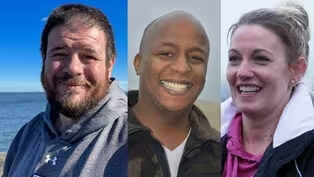
Public Safety | People of Virginia
Video has Closed Captions
Clip: S1 Ep19 | 48s | We asked Virginians what was most important for making communities safe and crime-free? (48s)
Providing Support for PBS.org
Learn Moreabout PBS online sponsorship
- News and Public Affairs

Top journalists deliver compelling original analysis of the hour's headlines.

- News and Public Affairs

FRONTLINE is investigative journalism that questions, explains and changes our world.












Support for PBS provided by:
VPM News Focal Point is a local public television program presented by VPM
The Estate of Mrs. Ann Lee Saunders Brown & Dominion Energy