Traverse Talks with Sueann Ramella
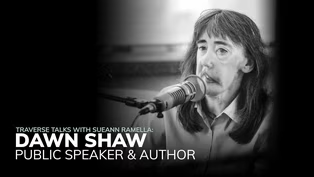
Public Speaker Dawn Shaw
10/21/2021 | 25m 59sVideo has Closed Captions
Public Speaker Dawn Shaw on the power of choice and resilience.
In this episode of Traverse Talks with Sueann Ramella, public speaker Dawn Shaw shares how resilience, perspective and the power of choice, help people find inner beauty. The removal of a tumor at birth left Shaw with facial paralysis. She is an author of three books, including her memoir Facing Up to It and more recently an inspirational guide: Facial Shift, Adjusting to an Altered Appearance.
Problems playing video? | Closed Captioning Feedback
Problems playing video? | Closed Captioning Feedback
Traverse Talks with Sueann Ramella is a local public television program presented by NWPB
Traverse Talks with Sueann Ramella
Public Speaker Dawn Shaw
10/21/2021 | 25m 59sVideo has Closed Captions
In this episode of Traverse Talks with Sueann Ramella, public speaker Dawn Shaw shares how resilience, perspective and the power of choice, help people find inner beauty. The removal of a tumor at birth left Shaw with facial paralysis. She is an author of three books, including her memoir Facing Up to It and more recently an inspirational guide: Facial Shift, Adjusting to an Altered Appearance.
Problems playing video? | Closed Captioning Feedback
How to Watch Traverse Talks with Sueann Ramella
Traverse Talks with Sueann Ramella is available to stream on pbs.org and the free PBS App, available on iPhone, Apple TV, Android TV, Android smartphones, Amazon Fire TV, Amazon Fire Tablet, Roku, Samsung Smart TV, and Vizio.
Providing Support for PBS.org
Learn Moreabout PBS online sponsorship(soft music) - [Sueann] Think about how you look.
How your face is shaped.
How your eyes are set.
And now imagine the way you look is so different from others.
Do you feel uneasy because you don't fit in?
If you could get surgery to normalize your appearance, would you?
When does fitting in become more about who you are, and not what you look like?
Author and speaker, Dawn Shaw, says beauty is an inside job, and that accepting your appearance and realizing your value is how to be resilient.
She shares some steps on how to do that on this episode of "Traverse Talks."
For those who are listening, can you describe your physical appearance and then your personality?
- [Dawn] Both my physical appearance and my personality are very difficult to describe.
How do you describe that?
My appearance, I see myself all the time so I don't think about it.
But basically, I have facial paralysis on the left side of my face.
What that has done is it causes my left eye to droop a little bit.
It doesn't blink.
It will close when the other eye closes.
But it does not blink independently.
I also, because I have no muscles that work and nerves, the left side of my face just kind of, it's just very still.
And the nerve damage caused me to be nearly deaf in my left ear, which is not a physical attribute I realize.
But it just kind of goes along with the package.
And my right side is animated.
It's normal muscle.
In fact, they actually had to kinda pare things down a little bit because it would almost overcompensate for the fact that my left side didn't move.
- [Sueann] So you were born with a tumor that was removed?
- [Dawn] Yes.
- [Sueann] There's a story that you've had some surgeries, but there's one particular surgery where you woke up and decided no more.
- [Dawn] I wish it was that simple.
It wasn't quite that simple.
- [Sueann] Will you tell us the story?
- [Dawn] It's not, it's certainly not the first time I'd had a surgery go wrong.
And I think it's easy for people to have this idea that medicine fixes everything.
That all you have to do is just go in and have a couple of procedures, and you'll be fine.
And to be honest, I think I suffered from some disillusionment when I was younger about just what was able to be done and what wasn't.
And the particular experience that you're speaking of is when I was 21, I had a surgery that was designed to flesh out the angular left side of my face, the paralyzed side.
Because really when you think about it, it's all about symmetry.
That's what people notice is when things are asymmetrical.
And so that surgery did not go well.
I woke up in intensive care.
I had a breathing tube down my throat because of the swelling was so intense.
They had my hands tied down so that I wouldn't rip the tubes out of my face in my semi-conscious state.
I was basically very miserable.
And the transplant didn't work.
They were trying to transplant fatty tissue from my abdomen into my cheek.
And actually, I had physical pain and discomfort from that scar on my abdomen for about a year.
So there's long-lasting effects.
It's not just, oh, it didn't work.
There's actually physical ramifications when something goes wrong.
- [Sueann] And then during that time of healing and pain, you came to a decision about surgeries or-- - [Dawn] Oh, I'd had it.
I had completely, it wasn't overnight.
In fact, I actually went back and talked to my surgeon again.
And we talked about what can we do next.
But then I realized, I didn't want to do this anymore.
Because every time you go into surgery, you're putting your life at risk.
And this was just one example, extreme example, of where it could've killed me.
And so the amount of difference that was being made for the physical and mental price that I was paying, it wasn't worth it.
I mean there was no way that they were ever gonna fix things completely.
It just was never going to happen.
And it doesn't take much for people to notice when someone looks different.
They're gonna stare, or they're gonna look, or they're gonna do a double-take or whatever.
And even if they'd got things most way back, it would still be a little bit off.
(light music) - [Sueann] Is it that time or before when you were really concentrating on working on the inner beauty, the person within?
- [Dawn] To be honest, the inner beauty stuff, honestly, really has only happened in about the last decade or so.
- [Sueann] Really?
- [Dawn] So we're talking about a surgery that happened in my twenties, and I'm now in my fifties.
So probably the most significant internal changes came in my forties.
- [Sueann] Was that just maturing into who you are?
Or was there something about that?
- [Dawn] A great part of it was at some point I decided I needed to write my memoir.
And it took me seven years to write that book 'cause it wasn't easy.
I was scrutinizing every aspect of my life.
- [Sueann] I mean, yes.
You were probably looking deep within yourself.
- [Dawn] Well and not only that, but when I wrote the first draft, my editor, she pointed out.
She says Dawn, you're telling about stuff.
But you're not really telling it from your heart.
- [Sueann] The authenticity, she wanted more.
- [Dawn] She wanted deeper emotion.
I needed to bring people into what I was writing.
I needed to describe it in such a way and yet do it authentically.
And of course, I mean, a lot of this is about my history.
I'm not going to remember those kind of details.
So I had to go back in my mind and think how would I have behaved?
What would I have said?
Because I've actually had people, how do you remember all that?
I don't.
Of course I don't.
There are some, yes.
There are some things that were written down for whatever reason, or there are things that stick in my head.
So I am confident that they happened almost exactly the way I told them.
- [Dawn] But my point is when I wrote that memoir, I realized a couple of things.
One, that I had a story that was worth sharing.
And I realized somewhere in there that I probably needed to become a speaker.
And I also knew that if I wanted to become a speaker, I had to make some changes.
I probably had a reputation of being a little bit cynical, maybe a little more on the negative side.
And I needed to change that.
- [Sueann] Where are you getting feedback from those who around you like you're a little rough?
- [Dawn] To some degree.
You know it's funny when you have a physical difference, speaking of feedback, sometimes people don't call you on your BS.
They let you get away with bad behavior because of your appearance because, oh, you've been through so much.
- [Sueann] 'Cause they feel sorry for you.
- [Dawn] Yes.
Or they don't want to add.
Meanwhile inside, they are feeling angry at you for what you've said.
They are hurt by what you've said, but they just internalize it, and let you continue doing it because they don't want to add to your pain and discomfort and whatever.
And I think that's actually fairly normal.
It's very difficult to confront people.
- [Sueann] This is why we surround ourselves by people that are honest and truthful but loving.
Because I've often heard this quote that you can tell the truth, but without love, it's malicious.
- [Dawn] Yes.
- [Sueann] So you package the truth with love, and it's like your behavior last night was pretty, pretty rough.
And here's why, and you're better than that.
- [Dawn] Well, and they're probably not gonna be too happy to hear it at first.
And what you hope is, I mean, I'm a processor.
I mean I'm usually gonna push back or have a bad reaction at first.
But then, I'm gonna sit on it, and I'm gonna think about it.
And there are times, painfully, I've gotten to a point where I not only can say, yeah, you know you were right.
But I could also say no, actually, I don't think so.
- [Sueann] I don't agree with that assessment of my behavior but thanks for the input.
(Sueann laughs) - [Dawn] Yeah, and that's hard too.
Because it's very easy to just fall into, oh wow, there's a flaw.
That person pointed out a flaw.
And I think that we tend to be most sensitive about the flaws that we perceive in ourself.
- [Sueann] Oh.
So you're already, you're just sensitive already.
And when somebody points something out, it's a hot button in you already.
- [Dawn] Yes, exactly.
- [Sueann] This is so interesting, Dawn.
Because in the past couple of months, I've noticed, not only just in society, but with some close friends, it's like constructive feedback.
Constructive criticism is good.
It's good for you.
- [Dawn] It's hard.
It's hard to give, and it's hard to take.
- [Sueann] Yes.
But don't we grow more as human beings and professionals when things are hard.
Like you're held to a standard, and you need to take in a hard look at that.
And find out, okay, can I do better?
I guess what I wonder is do most people just think right out of the shoot.
You're good to go.
You're never gonna need to change your personality or work on something.
- [Dawn] Well, they're delusional if they think that way.
- Right?
I mean, how could you not?
I mean, if you've gone a whole year, without somebody like holding you to your own crap.
(Sueann laughs) Then you don't have any real friends.
- [Dawn] Well, I mean I have horses, and I've done horse training.
And one of my Icelandic horse instructors actually said when you are leaving the horse alone, the horse thinks it's doing it right.
When you are correcting the horse, it understands that it needs to do something differently.
So if you don't say or do anything at all, that person thinks that what they're doing is perfectly acceptable, or maybe there's a part of them that knows that isn't, but they do it anyway because they've been getting away with it.
- [Sueann] Well, Dawn.
I have a nephew who became blind later in life.
And some family members go above and beyond assisting him in things that he should be able to do himself.
And I kind of I'm the mean auntie.
- [Dawn] No.
- [Sueann] 'Cause he'll be like will you give me a piece of cake?
And I was like it's right in front of you.
Get it yourself.
And they're like you should help him out.
Why?
The boy knows where it is.
He could probably sense it better than I can.
(Sueann laughs) - [Dawn] Yeah, that's I believe that is called enabling.
- [Sueann] Yes.
- [Dawn] Yeah, and you are, actually what you're doing is absolutely right.
- [Sueann] Well and you know, manners still matter if you have a impairment or not.
- [Dawn] Yes.
- [Sueann] And so I pretty much demand that he still has manners around me.
But yeah, I could see though how people would let things slide because they want enable, or they feel sorry for him.
But it's not fair to the person either.
'Cause you're not treating them the same.
- [Dawn] Right.
- [Sueann] So you probably had, so you had some feedback.
- [Dawn] Well, I've had, I've heard stories.
Not personal stories, but I've heard stories about people who have visual disabilities who people will literally grab them and walk across the street.
- [Sueann] Oh my.
- [Dawn] Or they will, it's like, if I'm in a grocery store, and somebody's in a chair or their lower stature, I, unless they actually indicate that they want help, I'm not gonna be like oh, here, let me get that for you.
I need to make sure that they want the help.
And I think that's a lot of-- - [Sueann] Like checking with them.
- [Dawn] People just jump in and do things for people when they don't really, they didn't need or ask for it.
- [Sueann] Isn't this interesting because you think you're helping?
- [Dawn] Right.
- [Sueann] But you have not given them the choice.
You've made the choice for them.
I think this is a whole thing in society, in general, that we are all honestly becoming more aware of because of various activists who are like, actually, I didn't ask for your help because I want to do it myself.
And then we're, we're now making people realize, ah, can I get this for you?
Do you need any help?
No, I'm good.
And that's okay.
- [Dawn] Yeah.
- [Sueann] Still be friendly about it.
- And respect.
- And yes.
- [Dawn] Well, I tell you.
There's also people who get really offended when people ask.
- [Sueann] Oh, really?
- [Dawn] I don't think that's fair either.
- [Sueann] I don't think that's fair.
I mean because they've asked.
(Sueann laughs) They're just trying to be friendly.
All right, so your parents took you everywhere and exposed you when you were a kid, which is great.
They didn't hide you away.
So put you in a situations where you were dealing with people at a young age.
What advice would you give parents today if they have a child who may be different?
- [Dawn] Well, first of all, what you just said.
Inject them out into the world because that was really valuable for me.
Now, what I will say is that my dad was defensive of me.
If children's stared at me, he would growl at them and stared them down.
And what it did, I mean on one hand, it made me feel protected and loved.
But on the other hand, it also made me defensive.
- [Sueann] Oh, interesting.
- [Dawn] And that was something that I did not fix, again, until much later.
I did not have connections with people, other people that had facial differences.
I grew up not knowing anyone.
And it wasn't until social media or internet that I got connected with more people.
- [Sueann] You got out of isolation.
You saw others with maybe similar facial disfigurements.
And how did that make you feel?
- [Dawn] Oh you know, it was kind of funny for me.
Because on one hand, I considered myself to be well-adjusted.
I don't understand sometimes when other people aren't.
And also, like I went to a camp up in Canada that was set up by an organization called About Face in Canada.
And I was gonna meet people.
I knew I'd met other people with facial differences.
I do have friends that have facial differences that I met before that.
But I almost felt like part of my uniqueness was being jeopardized.
- [Sueann] Interesting.
- [Dawn] Because I was going to be up there with other people that had similar, or I don't know, I mean nobody quite had the same look that I did.
But people that were, had facial differences.
- [Sueann] And how do you feel now?
Do you feel like your uniqueness was a bit muffled?
- [Dawn] I don't worry about it so much anymore.
I just roll with it.
I actually, I wish that I could come up with all the right things to say to people because there's so many people that have physical differences, facial differences that are afraid to go out.
- [Sueann] Yeah.
- [Dawn] And that makes me very sad.
And that's where I'm so grateful that my parents took me around.
I went to Disneyland recently.
It doesn't bother me.
- [Sueann] Have you always been that way that it doesn't bother you if people look or stare?
- [Dawn] You know, I think again, another irony is when I wrote my book and when I started paying more attention because it became part of my profession.
I think I might've, actually, started to notice it more.
- [Sueann] Interesting.
- [Dawn] And maybe because I had a certain level of confidence, I mean, I haven't always when it comes to relationship, that was a development.
But I believe that you get treated the way you expect to be treated.
And if I do not expect to be treated any differently, for the most part, people don't.
- [Sueann] Wow.
- [Dawn] When I go into a restaurant, I don't expect that they're gonna try to hide me at a back table.
Actually, what's funny about restaurants is I only have to show up a second time, and suddenly I'm a regular.
(Sueann laughs) 'Cause everybody recognizes me.
(light music) - [Sueann] So making the mirror your friend.
How do you work on your inner beauty?
- [Dawn] It takes practice.
I mean, people don't think about that.
I mean, there's a lot said about affirmations.
And I know people will kind of poo-poo, but oh yeah, I'll say something nice about yourself.
But actually it really helps.
Focusing on things that are positive about yourself and also perspective.
- [Sueann] How do you get perspective?
- [Dawn] For example, when somebody says something mean to you, you can internalize it.
And you can say that, oh, you know, that person really hurt my feelings.
And now I'm hurt and angry, and what they said must be true.
Or you think in terms of, no actually, what that person said to me is more about themself, not about me.
- [Sueann] It's projection.
- [Dawn] Yeah.
- [Sueann] And well, like you know somebody's going through a rough time, there's something about you that they have a thing about because they're working on their own crap.
- Right.
- [Sueann] And they just throw it at you.
And you're like that really wasn't about me.
- [Dawn] Well, that's where it actually, it kind of ties back to what you were saying earlier about constructive feedback.
- Criticism, yeah.
- Is you have to be careful to make sure that you're doing it in such a way that it's not reflective of yourself.
You'll say you hurt my feelings, or you know, when you said this, it actually really hurt my feelings because I felt like blah.
And that is constructive because it's coming from your point of view.
I am not, I believe me, I'm not an expert at constructive criticism.
I certainly, that's an area, that I could use a little work.
Like I said I tend to be more direct.
Like what the heck did you say that for?
- [Sueann] Well, I like getting to the point as well.
That was a really crappy job.
You think you can do better anyway.
(Dawn laughs) Could be couched in more nicer language.
So what we have here to work on inner beauty is focusing on positive things about yourself.
So affirmations, which I think are great because I feel like the brain people need to perceive that their brain is actually a muscle that they have to exercise.
And part of that is affirmations.
And then two, you said perspective.
- [Dawn] Right.
- [Sueann] And what else can we do to work on our inner beauty?
- [Dawn] Do things that you enjoy doing.
I mean I find that, as a speaker, I do vocal warmups, and I do the same vocal warmups that singers use.
In fact, I like to sing.
I actually can sing to a degree.
- [Sueann] Wonderful.
- [Dawn] So I find that when I do vocal warmups, it always makes me feel better.
If even if I'm in a crappy mood, if I do that, I feel better when I'm done.
- [Sueann] So it's as if you're encouraging people to really get to know themselves without the appearance.
And to like themselves and do what they like.
And then from that, it grows.
Do you think eventually people then rely less on physical beauty to get through the day?
- [Dawn] Well, you almost have to because physical beauty is temporary.
I mean there's a lot of people that do things that they might feel is an improvement like having facelifts and whatnot.
And I mean, I suppose, we might argue it's better than wrinkles, but I mean, aging is a normal natural process.
- [Sueann] I'm so glad you brought up aging.
Because I feel like a lot of our conversations about inner beauty and physical beauty is really youth based.
But we have a whole huge generation of people, and particularly women because beauty standards are pretty much hoisted on them, that are aging and having a really hard time making the mirror their friend.
- [Dawn] Yeah.
- [Sueann] What would you say to those who are aging about beauty?
- [Dawn] Well, if you are truly happy with yourself as a person, I mean, if you want to do something like Botox or get a nose job because you just want to, then fine.
But if you're doing it because you think it's going to improve how you feel about yourself or how other people look at you, you're doing it for the wrong reasons.
- [Sueann] So when you're doing your gigs and your speaking, I mean it takes a lot of energy.
So on top of the fact that, you know, you're out in society, do you feel like your energy is drained a bit more because not only are you giving your audience a talk but people are staring at you more just on the street?
- [Dawn] Oh, I don't think people are staring at me any more than they used to.
I mean, most of the time, if they're staring at me, I don't even notice.
I do kind of put a filter on.
I mean I just go about living my life.
- [Sueann] Good.
- [Dawn] And unless they actually say something to me.
- [Sueann] And what's the best way for somebody who's curious, or is it okay to approach somebody who's different and ask them questions?
- [Dawn] I think you have to have a reason.
I mean, with kids, kids will stare at me, and I will actually encourage them to ask me because I really feel like that education, first of all, knowing that I actually am an actual human being capable of two-way communication often times is at an event.
So are you having a good time?
And I could engage with them in a normal conversation.
And it's like, look, I can tell you're curious about my face.
Why don't you go ahead and ask me about it?
- [Sueann] And so if you're just at Safeway, and somebody was just walking by and they're like, Oh, hey, what's, what's-- - [Dawn] What's going on with your face?
- [Sueann] That is not acceptable.
- [Dawn] No.
I mean, it's like I say.
It's human nature to be curious.
It's always inappropriate to be rude.
- [Sueann] Agreed.
- [Dawn] I have to admit it.
It could be a fine line where people just don't know the difference.
- [Sueann] My husband has these white spots that came out when he was older after an accident.
It just didn't come back with the melatonin with the color.
- [Dawn] Okay.
- [Sueann] And it's pretty obvious on his face and-- - [Dawn] Blunt-forced trauma, maybe?
- Yes.
- Yeah, okay.
- [Sueann] It was a snowboarding accident.
Skin was scraped off on several places.
And then when it came back, it just came back white.
But it's usually during skiing too now, where people will stop him.
And their approach is usually like, you know, they're looking.
And most of the time, if they're polite, he'll tell them what happened 'cause they're genuinely curious.
Hey man, is that, is that natural?
Or did you dye it?
Which I think is such an interesting question.
Did you dye it?
- Like we all dye our skin and yeah.
(Sueann laughs) - [Sueann] And as his spouse, you know, I usually don't mind because most of the time, it's like an educational kind of a moment.
And they're younger people anyway.
And it usually ends with like, you're a rockstar kind of a thing.
And I have noticed that I don't notice any more.
So when people point it out, I'm like, oh.
- [Dawn] Yeah.
And I think that is something that I wanted to bring up is when you get to know somebody, you notice things less.
I mean I have good friends.
I could hardly describe them to you.
So tell me what your friend Susan looks like.
She's just Susan.
I know her when I see her.
(women laugh) You know.
- [Sueann] I love this so much because we really get to know who they are, not their bodies, and you pay attention to their hearts, right?
- [Dawn] I mean usually if you notice something about them, it's because they've brought it up.
- [Sueann] Yeah.
What other advice would you give people to try to get in touch with their inner beauty?
- [Dawn] Be around people that you enjoy being around that are positive that lift you up instead of tear you down.
- [Sueann] You're giving them permission to unhitch from unhealthy relationships.
- [Dawn] Yeah, that's a whole another topic.
I've definitely been in a couple of those.
But I do believe that it starts inside.
It's never overnight.
It's not fast.
I've, even though I made that decision in my early twenties, I didn't want surgery anymore, it still took a long time.
And it's hard not to rely on what other people think.
It's hard to step away from other people's opinions.
I mean, I cannot honestly say that I don't care what other people think.
But notice like in the title of my speech, my speech is called "The Power of Choice, How Not to Allow What Other People Think Influence How you Feel about Yourself."
It doesn't mean what other people say or do or think doesn't affect me.
It's how much it affects how I feel about myself.
It's still hurtful, but I move through it faster because I have a good self-image.
You're not immune.
I don't believe that any human being is going to totally become immune from other people's opinions.
- [Sueann] So you just have to work on your inner filters and processes and choices.
Dawn, thank you so much.
- [Dawn] Well, thank you so much for having me.
(light music) - [Sueann] Author and speaker, Dawn Shaw.
Such valuable lessons from her especially about how to take an impairment and use it to find inner strength.
You can learn more from Dawn on her YouTube channel.
And thanks for listening to "Traverse Talks."
I'm Sueann Ramella.
(light music)
Public Speaker Dawn Shaw - Conversation Highlights
Video has Closed Captions
Clip: 10/21/2021 | 3m 35s | Conversation highlights from public speaker and author Dawn Shaw. (3m 35s)
Providing Support for PBS.org
Learn Moreabout PBS online sponsorship












Support for PBS provided by:
Traverse Talks with Sueann Ramella is a local public television program presented by NWPB