CONNECT NY
Public Transportation
Season 8 Episode 6 | 56m 43sVideo has Closed Captions
Public Transportation
With the rising cost of gas and the devastating impacts of climate change, what are the alternatives to driving cars? Public transportation stations and stops are few and far between in many places, and those in rural areas often have no options at all. Cities struggle with the upkeep on vehicles, rails, and staff, and the cost remains high for both local governments and commuters.
Problems playing video? | Closed Captioning Feedback
Problems playing video? | Closed Captioning Feedback
CONNECT NY is a local public television program presented by WCNY
CONNECT NY
Public Transportation
Season 8 Episode 6 | 56m 43sVideo has Closed Captions
With the rising cost of gas and the devastating impacts of climate change, what are the alternatives to driving cars? Public transportation stations and stops are few and far between in many places, and those in rural areas often have no options at all. Cities struggle with the upkeep on vehicles, rails, and staff, and the cost remains high for both local governments and commuters.
Problems playing video? | Closed Captioning Feedback
How to Watch CONNECT NY
CONNECT NY is available to stream on pbs.org and the free PBS App, available on iPhone, Apple TV, Android TV, Android smartphones, Amazon Fire TV, Amazon Fire Tablet, Roku, Samsung Smart TV, and Vizio.
More State Government Coverage
Connect NY's David Lombardo hosts The Capitol Pressroom, a daily public radio show broadcasting from the state capitol.Providing Support for PBS.org
Learn Moreabout PBS online sponsorship>> WITH GAS PRICES DANCING AROUND $5 A GALLON, PERSONAL AUTOMOBILES CONTRIBUTING TO CLIMATE CHANGE AND MORE AND MORE NEW YORKERS GRAVITATING TOWARD URBAN CENTERS, WE WANTED TO EXPLORE THE STATE OF PUBLIC TRANSPORTATION IN UPSTATE NEW YORK - AND CONSIDER WHERE IT COULD FROM HERE.
ALL THAT, COMING UP NEXT - ON CONNECT: NEW YORK ♪ ♪ WELCOME TO CONNECT-NEW YORK, I'M DAVID LOMBARDO - HOST OF WCNY'S THE CAPITOL PRESSROOM, A DAILY PUBLIC RADIO SHOW BROADCASTING FROM THE STATE CAPITOL.
TODAY'S PROGRAM REVOLVES AROUND THE PUBLIC TRANSIT SYSTEMS NORTH OF NEW YORK CITY - AND WE'RE HOPING TO TOUCH ON EVERYTHING FROM THE DEPLOYMENT OF ELECTRIC BUSES TO SCOOTER SHARING PROGRAMS, AND EVERYTHING IN BETWEEN.
TO DO ALL THAT, WE'RE JOINED IN THE STUDIO BY CARM BASILE - CEO OF THE CAPITAL DISTRICT TRANSPORTATION AUTHORTIY.
AND NEIL BURKE - DIRECTOR OF SPECIAL PROJECTS FOR THE CITY OF SYRACUSE.
AND JOINING US REMOTELY IS LEAH GOLBY - PRESIDENT OF THE NEW YORK BICYCLING COALITION.
AND I WANT TO BEGIN OUR CONVERSATION WITH LEAH, WHO - ACCORDING TO HER BIOGRAPHY - STOPPED DRIVING A CAR REGULARLY IN 2007.
WHAT PROMPTED THE CHANGE AND HOW HAVE YOU TRAVERSED THE ALBANY AREA IN THE ENSUING YEARS?
So literally what prompted the change was my car wouldn't start one morning and I had a bunch of errands to run and I had seen the signs all over the place saying dump the bump lr pump and I said all right, I'm going to try this.
I started off walking and taking the bus.
I live in the city so your built-in environment is important for making the choice to not drive and I just, you know, took it from there.
After about two years I said I'm going try riding a bike.
I was terrified at first to ride a bike on city streets where at the time we had only one bike lane in the entire city.
And things have steadily improved since then.
>> So Carm, when you think about someone like Leah, who lives in your coverage area, what do you view as cdta's capacity to serve someone who wants to stop driving a personal automobile or dramatically decrease their use of it?
>> Well, Leah's story is consistent with what we have tried to do for the last 10 to 15 years, and that is to deepen the menu of services that we offer to people.
I have been doing this for a long time, and 20 or 30 years ago it was, you know, 40-foot bus up and down a street.
You know, at frequencies you could afford.
That is different today.
Right now it's frequencies that attract people and get people to where they want to go when they want to go.
And what we've done now is added the bike component, scooter component and soon our own car share program and made the system much more attractive to people like Leah who have a choice.
She had a choice.
She had a car.
Didn't start that day, but on her experiences with us not been good, I would bet that she would be driving today.
So it tells me that it's working , there is still work to be done but it is working.
We have a long way to go.
I found with interest that this program is transit systems north of Yonkers, because it is different.
It's the tale of two cities, the tale of two worlds almost.
But we need to be more like what our big brother and sister is downstate.
>> In New York City, and the New York City suburbs, mass transit isn't just the way people use to get to work.
It's how they go to dinner.
It's how they go to a baseball game.
It's how they socialize.
Is that something that is possible right now in Upstate, in the Capital District for example, can this be more than just your 9 to 5 transportation?
>> 10 years ago we aspired to be that.
We are getting there.
I know for a fact that we do that.
For example, our B.R.T.
lines provide service to people who want to go to Troy but live some Albany.
>> What is B.R.T.
lines.
>> Bus rapid transit.
Because they want to get to Troy quickly, easily and conveniently perhaps for a fight out, perhaps for drinks or dinner, whatever it might be.
It is happening in the Capital Region at least.
We aspire to be much more like our big city neighbors.
It can work.
But it takes more work.
It takes more thought.
It takes more choices.
It's not just buses.
It's buses and bikes and scooters and it's the design of that service to be in keeping with what people want and need, not just to get to and from work.
>> When do you find yourself still rely oning-- relying on your personal automobile?
Is it something in your personal repertoire?
>> It is.
I use the automobile about once a week for errands for big shopping.
But as soon as cdta drive gets on board, I will probably be using that some as well for errands because you know, I do share my car with my partner still.
I don't always have use of it.
>> So Neil, in Syracuse, I think one in four households don't have a car.
What does that mean for the public transit system you need to provide for your residents?
Does it mean that it becomes even more important?
>> Absolutely.
So Leah brings up a great point about choice ridership but there are people who are transit dependent as well.
At a baseline, our transportation transit system needs to serve those residents and we view our transportation network as a layer cake.
In transit is a significant layer but there are also other things interspersed there: Likability, walkability, bikebility, the infrastructure that serves our community and the land uses that make these transportation option possible rather than just a one size fits all mode.
When you look at the design of your built environment, that could have a serious impact on the mode that you choose or the mode that you are stuck with if you are dependent on one.
>> It seems like every politician who represents the Syracuse area, whether it's the mayor or members of Congress, the common thing they're talking about is the need for a speedy bus service in the City of Syracuse.
What is envisioned with your rapid bus transit, all of the conversation here and whenever there is money up for grabs, it's something that people are talking about that needs funding?
>> First and mother toast, it's great that we can look down the thru-way to cdta for very top tier examples of what can be done in mid sized cities like Albany, like Syracuse, Rochester, Buffalo.
So we are absolutely looking to our partners first to see what they did and what was successful: But where we see our strength is in working with the npo, Syracuse metropolitan transportation council.
They commissioned a study a few years ago outlining what does the region need?
Where would it make the most sense to layer these rapid style transit services?
And so we are looking to build off that.
Woo we are looking to work with all of our partners whether it's government or private institutions, our elected officials.
And we really want to layer on frequency on major corridors.
>> What do you need to get it up and running and how would you describe the status of this effort right now?
>> The status is ongoing.
It's increasing as we go.
There is more and more information in sort of attention being paid to it.
What we really need is to identify both capital dollars for things like new buses, new garages, things of that nature but also the operating dollars as well because when you layer on new service, you have more operators.
Have you more service or cleaners, you are expanding your bottom line.
>> Is this a thing where you need the federal government to make it rain or can the state potentially fund this or can you turn to the county or city taxpayers for it?
Who has got to open up the checkbook?
Who has a big enough checkbook for it?
>> A lot of these systems are funded by the F.T.A.
so we look to our federal partners first but that's not our only option.
We are going keep as many lines of communication open to expand the possibilities for us to fund this in one way or another.
Maybe it's a combination of things.
Maybe it's some federal dollars, some state dollars.
Local contributions, that remains to be seen, that exact road map but, you know, we are open to it and we are having these conversations now.
>> Could use of a transit analogy line was good.
What is the backstory on the rapid bus transit that was set up in the Capital Region?
How did this come to be?
Where did you get your money from and since you have driven this route before, maybe some pointers you can give Neil?
>> It's a long story.
It actually goes back plus 20 years.
We planned the first route back in the late 90s.
And it is federally funded.
The capital component of bus rapid transit is federally funded but that's not foreign, right?
The federal government is the primary funder of buses and garages and always has been.
So it's not different, but they have set it up as a separate program.
But we started with one line that operates east-west between Albany and Schenectady and planned for 40 miles of bus rapid transit.
We had a comprehensive plan.
We had a start and a finish.
Not sure we all thought we would get there to 40 miles, but by the end of next year, we will have completed a 40-mile network which connects to itself and connects to the rest of the system.
It's, you know, one lays on top of the other.
So that this whole notion of frequency and span, and what we mean by that, span, seven days a week, early in the morning to late at night, addressing your question about sort of fitting into people's lifestyles.
People's live style is not 9-5.
Lifestyle is, you know, 14, 16, 18 hour day, whatever it may be and includes weekends, right?
Saturday and Sunday.
Just because people may not work those days doesn't mean they don't need to travel.
So our bus rapid transit and our next level of service is seven days a week.
So what we are building and continue to build is a network of services that includes B.R.T., that people can rely on to be be there as part of their life; not as part of just their work life or their weekend life or, you know, whatever it might be.
It need to be part of their life seven days a week.
And that's was we've built.
>> Leah, as someone who relies heavily on public transit, do you have any bus rapid transit dreams in your head that keep kicking around, any roots would you like to see routes you would like to see or transit that would make life easier for you and people like you?
>> I really love the bus rapid transit concept.
You know, when I first read about it back in, you know, 2007 when I started bigging into this stuff, we didn't have B.R.T.
in the Capital Region.
And I was really excited to see how it could be-- it was being billed as, you know, train service without the tracks because I'm originally from New York City.
I'm used to taking the subway every place I go.
When I came up here, I was like, where's the subway?
How do I get from point a to point b?
And I was dreaming of a train line from transportation planners over the years, I learned that, you know, building commuter train line is really, really expensive and kind of a crazy dream but B.R.T.
can be a terrific substitute for it and I have found that it is great.
When we first started with our first B.R.T.
line in Albany, it was really an express bus line, but they have added some new features where buses can skip lights to keep things moving along.
Would I love to see bus lanes, especially on our more conJessed roads.
You know, and it's always-- it's always a challenge, a competition between the cars and the buses but I think with gas prices at the rate that they are right now, you have-- you will hopefully have more people thinking, hmm, maybe I should try the bus.
I think it's great.
One other feature of B.R.T.
that I haven't seen implemented here but have I seen implemented elsewhere, especially when you have a lot of people getting on the bus, you can have people get on using both doors or all three doors.
Some of our buses are so long that we have three doors, front, middle and back, I think.
And so being able to board quickly, I think, helps to keep things moving and I'm sure others can chime in on that.
>> Taking notes on that.
>> Whenever Leah talks, I learn something.
The beauty of talking with people like Leah, it's a regular user with a background in transportation planning.
So she sort of understands some of the challenges.
So the conversation goes at a high level really, really quick.
Like the third door and the second door boarding, you know, perfect world we would do that tomorrow.
The question for us is fair payment technology.
That really is a subway concept that Leah is talking about.
If you think it, the fare is paid before the customer gets to the subway.
So that requires a different type of fare collection which we are looking at, called off board fare collection.
We are getting to the point where that is feasible.
It wasn't feasible 10 or 15 years ago but it's feasible now that you are running these high level high service service networks.
So all these things.
It's amazing to me how you start to go up the latter something that was not doable or thinkable five or 10 years ago is thinkable and doable.
>> Neil, one of the things that Leah brought up is the idea of bus lanes and how they fit into our landscape right now, which is primarily designed for personal automobiles in Upstate cities.
As someone who has a role in city government, how do you go about thinking what should the balance should be because because there is 9 push and pull and maybe government needs to nudge people.
Not just bus lanes.
Have you to think about bike lanes.
How do you do all of that all at once because you can't shut down roads for any extended period.
You can't redesign the entire city.
So how do you make the most of that right now?
>> That's a great point.
From a transportation planning perspective, we always try and maximize our existing flur to the-- infrastructure to the extent possible.
So while we may not always be changing things like curb lines and the overall dimensions of the roadway, there are things that can be done using quicker and lower cost materials like pavement markings, like bus lanes, but also dealing with some of the pinch points relates to traffic signals themselves.
And there are tried and true ways transit signal priority is the term, tried and true ways to get buses through the intersection without delay.
And to hold that green as the signal can recognize that the bus is on its way or to shorten that red cycle to give the bus a green to get them through the intersection a little faster, to make sure that we are not bunching buses if we can avoid it and that we can, again, do as much as possible with our existing infrastructure and get the best bang for our buck what about bike lanes?
How do you envision a city, not just Albany but any city incorporating bike lines and what thanks them effective and makes them desirable for travel?
>> I think it's appealing to what people refer to as the interested but concerned, right there are people who are like wow, I see that person is riding a bicycle.
Could I do that?
No, it seems too dangerous.
Those are the ones that are considering it you want to get those folks comfortable riding bikes and you need to build a bike lane by itself.
It's helpful.
But a network is critical.
If you want to get more people on bikes, you need to make it safe, you need to make it appealing and you need to make it so that people can get where they want to go and where they need to go and also connecting the bike lanes to public transit where available because often particularly bike share but also personal bicycles are referred to the first mile and last mile of your trip because you are not going to have a bike lane on every street and you are not going to have a bus route on every street.
But you need to be able to make those connections so people can easily get where they need to go.
So having a bicycle master plan that focuses on a safe network for a community I think, really, really helps and you you know, reaching out to not just the added bicyclist but those people who are like I'd really like to start riding.
>> Leah brings up a great point about connects and also your perception as a cyclist or perhaps a potential cyclist of what is comfortable for you so here in Syracuse, we were fortunate to have the state make a very large investment with the Empire State trail over the past few years, which is a shared use path separated from traffic, physically separated from traffic for most of its pan, which provided you with a much different experience taggerring a different type of user than a curb side bike lane.
And while you need different options for cyclists understanding that your perception of safety may start or stop from you getting on to the bicycle in the first place.
So by offering a number of different facilities, different designs, differing levels you know, cities really hope to make those accommodations for not just folks like Leah but who might be on the fence even more so and who will not get on the bike unless they perceive themselves as having their own space separated and safe.
>> And that's maybe the next big step that Upstate New York needs to make.
When I talk about sidewalks people look at me like what do you care about sidewalks?
That's somebody else's job that's a critical piece of infrastructure.
Before you are a transit user, a customer is a walker, a pedestrian.
They walk to that stop so in my perfect world, every single bus route would travel along roadways that have sidewalks on both sides, every single bus route.
Every single bus route would travel along roadways where there are signalized intersections where that consumer can cross safely and then you take another step further and talk about Neil and Leah are talking about a network of protected bike lanes so that bicyclists who are often times transit users have safe and convenient places to ride their bike and they don't have that Leah moment where she says, I'm not sure I'm safe, I'm not sure I'm comfortable.
That's a big step.
That requires lots of cord anyways, cooperation and it can't just be the municipalities.
It can't just be the state or the Transit Authorities.
This is where have you to have real partnerships.
That's the utopia I'm shooting for.
Long way to go but in my community where I live just outside of Albany, Loudone-- Loudoun.
We were making it so students could ride the buses free of charge.
It was chicken and the egg.
A lot of students didn't ride.
Lo and behold, once the sidewalks were installed along the stretch that connects a campus to a commercial center, it helped the pedestrians but it also elevated the need for transit and all of a sudden transit ridership went up three fold.
So sidewalks, infrastructure can have a tremendous impact on whether or not a system like ours is successful.
>> That idea of walking to connect to the buses, is a really good chance a way to lead into the package we did, Melissa Benjamin traveled out to Buffalo which is going to be the beneficiary of a grant from the state that is going to help conduct a in you study and here what is she found out.
>> My friend B.J.
got stranded at the plaza.
He was stuck in below zero weather.
They were supposed to pick him up between 4:30 and 5:00.
They never came to pick him up until 6:45 to 7 clock at night.
I went to Mickey andid I said, could you help me, please?
He goes how would you like to get a bill started?
I said okay.
Let's do it.
So now I have been working on that bill since 2014.
I'm Stephanie speaker.
I'm mentally challenged.
I also have epilepsy.
I can't walk very far and I can't drive, either.
Because of my epilepsy.
So para transit, I depend on them to take me places where have I to go.
>> Under the Americans with Disabilities Act, para transit was created to give everyone access.
When you are talking about the disability community, you are talking about access and inclusion.
In order to get access to employment, in order to get access to things in the community and be inclusive, you need transportation.
So although there is transportation, it's limited transportation.
It needs to be expanded and when we talk to people in the disability community, over and over again, they say the current standard is just not good enough.
Have you to call them the day before to make your reservation.
You cannot make it the same day and have you to let them know when you want to be picked up and when you want to be taken home.
And if you do live three quarters of a mile of a bus stop you can't get them I'm hoping that my bill will pass and that para transit will get to go three miles from any bus stop so more people can get more places.
>> I see time and time again, it's a one sided argument in the sense that you either fit into our schedule or you don't get service.
And that is wrong.
We are beyond that now.
That 1990s thinking of the American with disabilities act has to expand.
The legislature is very supportive of the idea of expansion but I think they have other priorities and we have to make sure that this becomes, if not their main priority, one of the most important priorities in their legislative packet.
>> I'm a little nervous.
I'm waiting parentally to get this-- patiently to get this bill passed but I'll tell you, I got the best senator on the bill I had a Republican on the bill and I went to a veterans thing and I went up to him and I said, I need a senator that's a democrat.
Irsaid would you take on my bill.
He said consider it done.
So I got him, that's the head of transportation, on my bill.
>> Historically here in New York State and I think across the nation, communities have become more reliant on automobiles and less reliant on public transit and so what has happened is there has been a disinvestment from public transit.
There will be a lack of prioritization and with that, the para transit ridership, so what we are doing is we are lipping the page, we are making sure that public transit is a righter, making sure that those that utilize public transit systems within those services are a priority.
>> We had a hard time gettingsing the bill through the Assembly based on funding.
However, in his foresight and vision, we decided the public study would benefit the passage and funding of the bill.
>> Tim Kennedy called me and he asked me if I was sitting down.
I said yeah we were able to secure 750,000 for a grant that will study para transit services.
What this studley do is it will help us identify exactly how many funds and resources are needed in order to provide for the best quality para transit services necessary to give world class transportation to everyone that uses the system both here in western New York as well as across New York State.
We talk about civil rights, this is a right that needs to be facilitied, needs to be funded and need to happen, period.
Done, and that's what I'm hoping the legislature will do.
Take the results from this study and make sure we get results for our disability community.
>> We expect this para transit study is going to serve as a model to implement para transit services across New York State and it would not have happened without Stephanie, speaker and her leadership and her team that worked diligently to make sure that this voice was heard in Albany and ultimately we were able to deliver.
>> Keep on your Assembly people and get them to call up their Assembly people and senators to get the bill passed.
I think if I can change some things, I'm going to do it, I'll do whatever I can for us.
>> Carm, the greej on, what accommodations are there for people like Stephanie and in a perfect world where the state is making some of the investments that there were references to, what additional accommodations could there be?
>> Well, you know, there is no arguing that what Stephanie is advocating for is the right thing.
There has never been an argument.
Really the discussion was how do you do it?
You know, how do you do it and do it in a way that does not over promise and underdiffer?
-- and under deliver.
What I want to do is under promise and over deliver always.
So we have a system very much like the system in Buffalo and the system here in Syracuse, para transit system that operates whenever and wherever a fixed route service operates.
So the advantage that we have, the advantage that we have is a very good, a very solid six route network that operates, for the most part, in the urbanized area seven days a week.
For the most part, you know, late in the evening, early in the morning.
So our para transit service is available correspondingly at those times and in those places.
What Stephanie is advocating for, whether it be three miles or five miles outside that fixed route study is really what the study is going to focus on.
How do you do that, how do do you it in a way that is customer friendly but transit system doable?
And then how do you pay for that.
I can tell you that senator Kennedy and Assemblymember Magnarelli lead the Transportation Committees in the two houses, were really thoughtful and understanding and said wait a minute, let's walk before we run.
Let's do this study, let's put a framework on that and then lets implement whatever the recommendations end up being.
>> Isn't the answer going to be we need to invest money into this?
That the state and federal government who have the deep pockets need to dig in there and send money your way?
Expwrit is.
Why aren't we doing it today?
Why are we at three quarters of a mile from the fixed routes today?
It is also going to identify where are the population bases.
Where do people live.
Where do people need to go.
Do they travel in suburban areas or urban areas.
Are there travel patterns that are different from my travel pattern?
It puts perspective on it.
Yeah, I hate to say it's all about money because it's not.
It's not at the end of the day if you think about thing and put together solid plans, but you know, for-- let's be honest.
There is no dedicate funding for para transit services.
It comes out of the general operating budget.
Would I like to see dedicated funding as well so we could really put our money where our mouth is.
>> How do your services in Central New York and the Syracuse area approach this issue?
And I imagine you have the same problem about how do you prioritize what is a relative small population but expense population to service?
>> I think Carm put it well.
Current para transit service has been operating in its existing form for quite sometimes and we are very interested in the study not just to identify the dollars that will be needed to expand from three quarters of a mile out to three miles or perhaps a wider range, but what are the adjustments to services that can be made?
What are the adjustments to the framework of para transit that can be made?
There are new and novel ideas about how we can use technology to better serve and to better route things like para transit but we are very excited for the study to identify some of those things for us because our fixed route, much like in Albany and Buffalo, our para transit services ride on the back of regular fixed route services.
We need to change it or take a different look at it.
We are very interested in what the study can tell us.
>> Leah, serving this population of people with disabilities is an expensive proposition and not the only things that can be expensive in terms of expanding public transit and one of the things I want to turn to in that area is addressing rural and suburban populations because they're not as densely packed, it's harder to provide them services.
How do you think public transit systems and municipal leaders should go about trying to meet their needs?
Should the government be providing to pick up this costly tab of getting people where they need to go or the onus on the residents if they want to take public transit, they have to pony up a little extra because it's going to cost more to get around than these denser urban areas?
>> I think with everything, it's a balance, and it's about land use policies you know, where we were, where we are and where we need to go to have a sustainable future and from my perspective as the president of the New York bicycling coalition, we have members in every corner of the state in every population, and they all like to ride their bicycles.
Some of them ride it for commuting.
Some of them ride bicycles for pure leisure.
Other people ride bicycles because it is part of their job, right?
They're a delivery person or whatever.
So you know, we have people who ride bicycles for all kinds of reasons and we want to be sure that, on every road, that a person is riding a bicycle, that they can get where they need to go safely without injury or worse.
And so the New York bicycling coalition was really prawd the past couple of years to partner with other organizations informing the New York State safe streets coalition which is a coalition of over 100 organizationed who have been working to pass bills that make our roads and streets safer for everybody whether you are walking or riding a bicycle or using public transit or driving.
And so to get back to your qea on funding one of those is complete streets funding.
It is a package of eight bills, three bills passed and one was a complete street funding bill which which will incentivize municipalities to build streets and roads that are safe for everyone.
So the state will be kicking in to help municipalities build streets for everyone so that's one.
I think the beauty of this discussion at the state level is the realization that we now have everyone at least on the same page, well, same chapter, right?
>> Reading the same book in the same library.
But we are starting to talk about why more mobility, better services, more service is better for everyone this is more than just about the disabled people and people with disabilities.
This is about what we do and how we impact our communities and how we can make our communities better and stronger, especially from an economic development perspective.
You know, people in larger communities have long linked transportation and economic development and opportunity.
We are just getting into the game we are a little late to the game but starting to link it.
So in my mind, this is a green light in our efforts to make transportation, mobility infrastructure sort of a wider discussion topic.
Yes, this particular advancement will be good for people with disabilities.
But if it's good for people with disabilities, it's good for the community.
And it's good for everybody at the end of the day.
>> Neil, how, if at all, does public transit enter into the equation when officials in Syracuse are thinking about things like economic growth because traditionally, public transit has been refuge for low income workers and I have to imagine it's part of the Syracuse surge, no free ads but you want to have high wage jobs that you are creating and building and those people might be driving cars, prefer to drive cars.
So is this all part of the same conversation?
Or are these two different dialogues?
>> Absolute absolutely all part of the same conversation attracting high wage jobs and high wage earners on to public transportation is done by providing quality service and frequency.
And those are the exact same things that benefit the rest of the community as well so whether or not you are in a high wage job or low wage job, those same things benefit you as well so on the city side we look at infrastructure investment but also land use.
So right now we have a process going on called rezone Syracuse,ing which is an update to our very outdated zoning codes which gets into very, very detailed aspects of the built environment and also private development as well.
Are there parking minimums.
What does your building look like?
How does it interact with the built environment around it.
They're all cues to you as a potential transit user, motorist, pedestrian about what is ropt and what is expected of you in the urban environment.
So there is rezone and our municipal sidewalk program, which we launched just about a year ago it was a large effort to move it forward, something we had talked about for many, many years.
Not just maintaining sidewalks and reconstructing them but also clearing them of snow in the winter because if something is accessible to you during the summer but laden with snow in the winter, that is not something that is available to you.
Does it really count as walkable if it is only available, say six months out of the year here?
So investments in our sidewalk infrastructure, it seems base, it sounds kind of boring but those are the things that we are doing to lay the groundwork for a more walkable community, one that is more accessible and friendly to transit and then also cyclists as well.
So these are all pieces of the same larger discussion, but I think sometimes they are lost or thought of as individual pieces instead of one large picture.
>> So, you know, maybe the biggest advancement that we have made, we have done it quietly, is to work with developers and major employers to integrate our system with their planning process.
We have developers now who are working with us, use that in their approval process so these are towns in their area, hey, here what is we are doing with cdta and here is how we can reduce the number of parking spaces originally incorporated into our development.
This is life and developments that just broke ground on Broadway in the City of Albany.
Albany Medical Center the largest employer in the Capital Region, every single I.D.
card, employee I.D.
card is live on our method.
A method of fair payment on our buses.
Whether you are a doctor, a nurse, food service employee.
Your I.D.
card is live on our buses.
Hundreds of thousands of rides are taken every year by Albany Medical Center employees and they pay for those rides on a prearranged details.
But they're one of almost three dozen employers who work with us.
So there are ways to make this all work but it involves making the transit system part of this whole decision making process.
What do you want your community to look like?
Do you want it to be car only.
Don't do anything in this discussion.
Did you want it to be integrated, safe, environmentally sound community then we all need to get together and talk about these things.
It is doable.
It's a lot of hard work.
It's not just the government's responsibility.
Once we say it's the government's responsibility, nothing is going to happen because it's just-- that's just not fair.
It's everyone's responsibility but we have found that once we get over the hump, you can engage the development community because it makes business sense.
They want to talk to you.
They don't want to build a 300 car parking garage if they only need 250 spots it's only 50 spaces.
At 15,000 a space, that's a lot of money.
So we have integrated those scfertions.
>> I'm curious, as someone who is focused on bicycles how has the advent of electric bicycles and their proliferation around the state changed the public transportation game?
>> Electric bicycles are a tremendous game changer for bicycling across the state, particularly I think when we are able to start incorporating them into Upstate bike share systems.
Because.
That first mile last mile connection, electric bicycles are so much, they're like a bicycle, they look like a bicycle, they function like a bicycle, but you just get a little bit of a boost and you know, it really helps so it's great that New York State has legalized electric bicycles and I'm looking forward to them sometime soon being part of the cdhp cycle network which is what the cdta.
I hope they're able to implement electric bikes sometime soon but , you know, it's really-- it really is game changing.
>> Carm, do you want to break any news?
>> I'm surprised Leah doesn't know what we are doing because she usually knows before I know.
We have a,-- I believe it is 100 will be integrated into the bicycle network later this summer we have purchased 100 of these and everything we know is exactly what Leah said.
It is a game changer.
So we will take our base is about 550 bikes will go to 650 bikes with 100 of them or so being E-Bikes.
I wouldn't be surprised because there is no reason to expect that the adoption rate won't be extremely quick.
Next year to have 250.
But later this summer, Leah, 100 on the way.
>> Great!
>> So Neil in Syracuse, you guys have a bike share program as well as electric scooter program.
What is your experience been with that and are there any electric bikes in your repetoire?
>> Yes, so while I think Albany gets to brag that they have the B.R.T., 2 our turn to brag here in Syracuse is that we launched an all e-assist bike share in 2019.
And what we saw was that in comparison to the more traditional bike share with your standard bikes, people ride a little farther and they get to their destination a little quicker.
So we deal with topography in Syracuse.
I'm sure that's not a shock to anyone it flattens out the hills and while you are not going to be doing 50 miles per hour on an e-assist bike, it can make traveling up to east wood a little easier, a lot easier if you know you can grab a bike down from the hub and get there without being sweaty, without being out of breath.
>> The sweaty thing is a big advantage.
>> It's one of those things that the fact that you know you can get on the bike and feel like super man is one less reason not to do it and so while we now have a fleet of all e-aassist bikes and scooters as well.
These are also electric, we see adoption rates are high, usage is sky high aunderstand not just on weekends, not just Saturdays and Sundays.
These are not leisurely rides in the park.
These are Monday to Sunday, all times of day, people commuting to work, going to the store, class, all of the above.
We are seeing high usage and a lot of that has to do with the ease in which 3 these devices make it for you, the user to get from point a to point b to the next neighborhood over or the one past that where if you are on foot or maybe you don't want to wait for transit, this is that third option that makes a lot of sense.
>> Do you envision potentially expanding the fleet.
Do you think there is enough demand in the future and how do you make that kind of calculation?
>> We work very closely with our vendor, we went out to RFP, selected them based on their credentials.
We liked their offering so we work hand in hand with their local team.
They have a warehouse on tip hill, a couple of vans that they use to drive around and collect the bikes and scooters and rebalance the system so they're always out on the ground, but also behind that, we get the data as well.
So we can see where the hot spots, where are the new trips that we are seeing, you know, when the mets are playing over at mpt bike stadium.
>> The minor league team.
>> The Syracuse mets, we see that light up on the map because the games, you know, are going to start soon.
We see people taking the units over there.
So we have that both on the ground sort of anecdotal or granular level data but we also have that 30,000 foot view of where are people going, where are the hot spots so we know that we have room to run here and we do plan to expand and part of the beauty of our system is that we are no longer hub to hub based.
You can take the units anywhere in the city, start and end your ride right at your destination.
>> The hub to hub mod ale, is that what cdta primarily uses and if so, why is that?
And are there Ben if its to that opposed to leaving it in the middle of a sidewalk which people are not supposed to do but sometimes they will.
>> The advance to the question is pretty obvious, righted?
It forces you back to the hub, but our system is hub without the had you been.
So it forces you to hub.
You cannot bring it back to the hub.
You can leave it wherever you want to leave it but the credit card will reflect that.
>> It is behavior modification.
You can see the behavior change.
But this is another indicator, right?
So most people who don't use bikes think that this is just something that we do for leisurely travelers or, you know, it's nice to have, right, puts a smile on people's face.
Wrong.
The number one reason why people use bikes, very purposeful, they think about where they want to go.
The number one user in our system, the individual who uses it the most is a young physician at Albany Medical Center.
He uses bikes to do everything.
He is Leah on steroids.
He does not own a car.
He is not interested in a car.
But I met him.
I talked to him about how he uses the system.
He said listen, I'll give you-- yesterday, shot over to CVS, picked up prescription, threw it in the basket and away he went.
I do hundred of those trips a month.
And I had to think about it.
So it is a purposeful system that operates alongside of the transit system it's well designed, well maintained, just like it is here in Syracuse.
But I think that's just like the discussion with the legislature.
You know, about the importance of investing in public transit.
We have now gotten an understanding it is more than just buses.
>> Speaking of just investments as well as electric transportation, electric buses, how do we realize those, Carm?
How do we get a fleet of electric buss from, you know, Montauk to Buffalo?
How do we do it?
>> I thought there was another community.
>> That covers pretty much the whole state.
>> It's going to take time.
I think as a society on this we are a little impatient.
We said yes, it has to happen.
But at least in our industry it is going to take time.
For example, the cost of a unit, you know, a standard diesel bus is $450,000.
That's a lot of money, an electric bus is twice the cost.
It's $900,000.
And the technology, although maturing and maturing very, very fast, is not there yet.
All of the money, all of the additional costs are in the battery, battery life, the power.
The range is an issue, especially in our Upstate New York State climate, you can watch the range diminish in the winter when all the systems are being used.
But we are getting there.
We have eight very small number percentage wise, eight out of our 250 or so fleet.
Operationally, really not an issue.
Operationally we found really not any different than what our-- our drivers love them.
A lot more pickup get up and go, they merge in and out of traffic easier.
It really is the infrastructure.
It's the facilities, what we are doing now is we are carving out space for the infrastructure within very hold facilities, all of our facilities are 50 years old, I would venture, the Syracuse garage may be the newest garage in Upstate New York and it's 40 years old.
So we need to invest in facilities.
We are trying to shift that discussion with our funders to get them to understand we can only move as fast as the infrastructure allows us to move.
If you are building this from scratch, different story.
That's why I always ask for a little patience on this.
>> Where is Syracuse stand with all of this?
Is this something that, you know, is still an uphill battle, something where you need a lot of federal dollars to make it happen or something that you figure out a way to make happen magically basically?
>> So cost is a factor obviously.
So the cost of an electric bus is roughly double that of say a diesel bus.
And then you get to the area of facilities, you know, you are going to have a sub fleet, you need to carve out space for new charging equipment.
It's just a different way of operating buses than we are used to.
And here in Syracuse, we went all in on natural gas.
So-- >> Oops.
>> Well, there are benefits to this as well because it is lower emission significantly when compared to diesel.
But also natural gas makes for an easier transition to say hydrogen, which is another developing technology for transit.
So while we can't say we are going to do one or the other absolutely, we are here and it's a great time to watch these technologies mature and sort of battle it out and see who is going to be the most applicable for our market but also we are not too atypical from Albany, Buffalo, Rochester, Binghamton, you name it.
So I think you will see this play out slowly, it will feel like over the next few years but once it happens, it will probably happen all at once.
>> So finally, Leah, we have about 30 seconds, as our resident rider here, do you feel optimistic after this conversation?
Do you feel pessimistic?
Status quo?
Where is your head at?
>> I feel very, very optimistic.
I was really-- I mean, I can't wait to visit Syracuse in the wint winter and walk on their sidewalks.
Thank you for that, leadership.
That's terrific and something that we battle with and we are struggling to fix in the City of Albany.
I have been advocating for better sidewalks, shoveling since I came here as a college student a very long time ago.
But I'm optimistic about the buses, I'm optimistic about electric buses; in particular, I love everything that cdta is doing is, you know, I mean they're just like-- and it's not just because I live here.
>> We are out of time.
OUR GUESTS IN THE STUDIO HAVE TRANSPORTATION AUTHORITY CEO CARM BASILE AND SYRACUSE DIRECTOR OF SPECIAL PROJECTS NEIL BURKE, AND JOINING US REMOTELY WAS NEW YORK BICYCLING COALITION PRESIDENT LEAH GOLBY.
ON BEHALF OF THE ENTIRE TEAM AT WCNY - I'M DAVID LOMBARDO - THANKS FOR WATCHING.
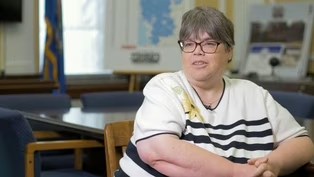
Fighting for Paratransit Expansion
Clip: S8 Ep6 | 5m 36s | Fighting for Paratransit Expansion (5m 36s)
Providing Support for PBS.org
Learn Moreabout PBS online sponsorship
- News and Public Affairs

Top journalists deliver compelling original analysis of the hour's headlines.

- News and Public Affairs

FRONTLINE is investigative journalism that questions, explains and changes our world.












Support for PBS provided by:
CONNECT NY is a local public television program presented by WCNY