State of Affairs with Steve Adubato
Quadeer Porter; Reshma Saujani; Michael Maron
Season 9 Episode 8 | 26m 57sVideo has Closed Captions
Quadeer Porter; Reshma Saujani; Michael Maron
Quadeer Porter, Founder and Executive Director of Brothers Building A Better Nation, discusses the importance of providing young men in Newark a safe space. Reshma Saujani, Founder & CEO of Moms First, highlights her approach to child care and paid family leave. Michael Maron, President & CEO of Holy Name, explores the uncertainties in the healthcare field and the physician shortage.
Problems playing video? | Closed Captioning Feedback
Problems playing video? | Closed Captioning Feedback
State of Affairs with Steve Adubato is a local public television program presented by NJ PBS
State of Affairs with Steve Adubato
Quadeer Porter; Reshma Saujani; Michael Maron
Season 9 Episode 8 | 26m 57sVideo has Closed Captions
Quadeer Porter, Founder and Executive Director of Brothers Building A Better Nation, discusses the importance of providing young men in Newark a safe space. Reshma Saujani, Founder & CEO of Moms First, highlights her approach to child care and paid family leave. Michael Maron, President & CEO of Holy Name, explores the uncertainties in the healthcare field and the physician shortage.
Problems playing video? | Closed Captioning Feedback
How to Watch State of Affairs with Steve Adubato
State of Affairs with Steve Adubato is available to stream on pbs.org and the free PBS App, available on iPhone, Apple TV, Android TV, Android smartphones, Amazon Fire TV, Amazon Fire Tablet, Roku, Samsung Smart TV, and Vizio.
Providing Support for PBS.org
Learn Moreabout PBS online sponsorship- [Narrator] Funding for this edition of State of Affairs with Steve Adubato has been provided by The Russell Berrie Foundation.
Making a difference.
The Turrell Fund, a foundation serving children.
Rowan University.
Proudly serving New Jersey for 100 years.
EJI, Excellence in Medicine Awards.
A New Jersey health foundation program.
The North Ward Center.
The Adler Aphasia Center.
Valley Bank.
Johnson & Johnson.
And by PSE&G.
Powering progress.
Promotional support provided by BestofNJ.com.
All New Jersey in one place.
And by Insider NJ.
[INSPRATIONAL MUSIC] - Hi, everyone, Steve Adubato, we kick off the program welcoming back once again, Quadeer Porter, who's founder and executive director of a terrific organization called Brothers Building a Better Nation, a 2022 Russ Berrie Awardee for Making a Difference.
Quadeer, good to have you back.
- Thank you so much to having me back.
I'm so excited to be here.
- You got it.
By the way, go on our website.
It's up there right now to check out the previous interview with Quadeer.
Tell us exactly again what the organization is and the most pressing needs of the folks you serve in 2025.
- Absolutely, Brothers Building a Better Nation is a nonprofit organization based in Newark, New Jersey.
And our main purpose is to dismantle systemic barriers that are causing brothers in our community either self harm or put 'em at risk of self harm.
And so one of the most pressing issues we're currently seeing right now is that a lot of brothers need mental healthcare and somebody to talk to.
And so we actually expanded our services to meet that.
We actually got contracted with Medicaid, and now we're able to do intensive in-community services, which means therapy right in the home for these young men and also mentorship services and tutoring services for brothers as well, between the age of 4 and 21.
So, we've made some progress since the last time you met us.
- So, let me ask you this.
In 2025, with the world around us changing quickly, lots of uncertainty and challenges, to what degree do you believe black men, younger black men, in particular, are more at risk and challenged than ever before?
- Right now, they are going through, especially when you look at the statistics, suicide and self-harm is ranked the third most route for avoidable deaths for this population, for us brothers of color, and a lot of times, because we hold everything inside, and especially now in today's conditions, a lot of us are, especially, we're seeing them as after COVID, the COVID pandemic.
A lot of youth was not actively in school.
And so a lot of the youth that went back to school had some challenges in school, led to frustrations.
So a lot of these after effects led to different mental health behavioral health effects, especially at this age range between 14 and 21.
And that's what we're really trying to address right now, is that it was not only that feeling of that, there being other not seen, it's now this feeling of them being left behind and not being heard.
And so those are the things that we're seeing on the ground level right now is really showing brothers that you are seen, you are heard, and just trying to find a safe space for them, which is hard for them to find.
- I don't know if statistics bear this out, but there are folks who believe that in the African American community to have therapy, that getting help for mental health challenges is more challenging because there's some degree of resistance, skepticism.
Do you buy that?
- Yes, I mean, historically, we've seen it.
Mental health and behavioral health was actually used as a tool to incarcerate people of color from the Jim Crow era to all the way up to the '90s.
Misdiagnosis of people of color is is high.
For example, schizophrenia, there was a big study that was done from, I think it was the University of Chicago, that dealt with that, so it's a big fear when it comes to hear mental health.
But the biggest thing that we argue is that this is why it's important to have culturally competent care.
Right now, there's not a lot of brothers in the mental- - Explain that, Quadeer, culturally competent care, please.
- Yes, culturally competent care is we are getting care with somebody that you can recognize, somebody you can empathize with, somebody that looks like you, and somebody that you can feel has walked through your shoes a little bit.
And that's what we're able to deliver.
- You know what's so interesting about that?
You talk about the need for culturally competent care, people who look like you, people who have some experiences like you.
I'm not gonna get into a whole discussion about diversity, equity, inclusion, which, listen, that's a different, it's in some ways, it's a different discussion.
But the reality is having people who understand your experience requires a degree of diversity in the healthcare community, including mental health therapists.
Please, Quadeer, talk about that.
- I absolutely do agree.
You automatically see when the young men see somebody that looks like them, they connect to the guy, especially during puberty, right?
When you're going through puberty and a lotta times these young men are either angry or they're exhibiting what looks like anger, but it's not really anger.
They're just, like I said, just normal things that young men go through, but on the outside, it looks like they're something that is a threat.
And so by meeting somebody that says, like, "Hey, listen brother, understand what you're going through, and this is how either you exercise or you do these common things to help you calm down, this is what it looks like," and it's not a person that's timid and fearful of them and automatically wants to call 911 to bring them away, if somebody's able to deescalate them because they understand some of the social pressures they went through.
- You know what's interesting, right now, you're pursuing your master's in social work.
- Yes.
- Because?
- Because there needs to be more brothers in this field.
When I was first trying to get into this field and find my young men therapists, there was hardly anybody that looked like them.
And the brothers that were looking like them, they were overbooked for months ahead of events.
So I said, the least I can do is try to, if I'm gonna be serious about what I am doing, that I have to join the battle against, you know, against my mental health disparities going on in my community and go back to school and learn the right way to do it.
So that's why I signed up for a Rutgers School of Social Work, and it's been a blessing in my life.
- Last question, why are you so passionate about this cause?
- It's because I feel like I've found my life purpose, and it's hard to really put into words, but it's a feeling.
It's similar to how you, Mr. Adubato, when a camera turns on.
It's natural.
It's something that you can't really put into words.
It's just something that, when it happens, you feel is right, and that's what I feel like my work.
I've lived 34 going on 35 years on this earth right now.
And these last five years, I finally found, like, it was something that when I wake up, I'm naturally doing, and I'm always done.
I just never knew what it was.
And it turned out to be just this organization, Brothers Building a Better Nation because I was just tired of people seeing us as threats and people that was looking to tear up the community.
I wanna show that we're loving, compassionate, and we're empathetic individuals that just needs care like anybody else.
And that's what resonated with me, what continues to fuel me.
- You know, Quadeer, I'm a student of leaders, leadership, what causes people to be great leaders.
And sometimes it's hard to describe in words, but you know it when you see it, and you know it when you see one, a leader, and there's no substitute for the degree of passion you have, but I'll say this.
You found your calling, and others are benefiting because of that, and all of us in the public television community wish you and your colleagues at Brothers Building a Better Nation all the best.
Keep doing what you're doing and keep coming back and giving us an update.
Congratulations and more work to be done.
Well done, Quadeer.
- Thank you so much.
- You got it.
I'm Steve Adubato.
That's a leader, Quadeer Porter.
Stay with us.
We'll be right back.
(grand music) - [Announcer] To see more State of Affairs with Steve Adubato programs, find us online and follow us on social media.
- We're now joined by Reshma Saujani who's Founder and Chief Executive Officer of a great organization called Moms First.
Reshma, great to have you with us.
- Thank you, Steve, for having me.
- You got it.
This is part of our ongoing programming, trying to get folks to better understand the need for accessible, affordable, quality childcare.
Part of the first 1000 Days Policy Coalition, the graphic will come up.
What is your organization and how is it tied to this first 1000 Days Policy Coalition around childcare?
- Yeah, so Moms First is a national organization that's mobilizing America's 85 million moms for structural supports that are gonna help moms.
I spent a large part of my, you know, the past 10 years of my life building an organization called Girls Who Code to close the gender gap in computer science and technology.
And I saw firsthand that when we don't have a structure of care, when we don't have affordable childcare, when we don't have paid leave, there is no gender equality.
And so Moms First is working closely with the 1000 days coalition, including Burke Foundation, to really make sure that early access childcare is at the top of the agenda.
- Well, let me ask you, you mentioned Girls Who Code and connecting it to AI right now, how are you quote leveraging AI as it relates to your advocacy efforts around childcare?
- Yeah, so we've built a tool in partnership with OpenAI and my friend Sam Altman called Paidleave.ai.
We found that two out of five parents take advantage of paid leave.
- Because?
- They don't know it exists.
One, lack of awareness.
Two, it's really complicated.
You go on the government website and you're like, you don't know if you're eligible.
And most people don't have three hours to spend sitting on customer service trying to figure out whether they can access paid leave or not.
So they give up, right?
Which leaves a lot of dollars on the table.
$10,000, right.
Is as much as you can get in benefits that parents forego because they just don't have the time or they don't think that they're eligible.
- What's your advice to them, Reshma?
I mean, tell 'em right now, and by the way, the coalition's website's up right now.
Let's also put up Moms First so people can go to the Moms First first website.
- Thank you.
- What should people be doing when they're like, this is overwhelming to me.
- Go to Paidleave.ai.
And you'll very quickly know - - Paidleave.ai.
- [Reshma] Am I eligible?
How much money can I get?
And what are my next steps?
- A fair part of this Reshma, as you're talking about this is quote navigating the system.
Not easy.
- Not easy at all.
- And nor do people have time, not to mention partly because of childcare issues, but I'm curious about this.
How did you become so passionate about this cause?
- Because, you know, Steve, I've spent my whole life trying to elevate women and girls.
And in many ways Steve, I thought the problem was me.
I thought, well, if women had more confidence, if they got a mentor, if they got a sponsor, if I read this book, if I power pose before this conversation, that the problem is women.
And I realized during the pandemic, like I think a lot of mothers did, I think a lot of parents did, and was like, oh wait, I'm not the problem.
The system, the structure is a problem.
I'm set up to fail before I even had my cup of coffee.
- What do you mean, hold on, I'm set up to fail before the morning cup of coffee or whatever.
What is that?
What do you mean by that?
- What I mean by that is that 40% of parents are in debt because the cost of childcare.
What I mean by that is 50% of Americans live in childcare deserts.
And so most people in this country gotta work to put food on the table to pay for the diapers.
And I can't work without childcare, period.
But still as a country, many states, we refuse to fix the childcare crisis.
You know, we refuse to give people paid leave benefits.
So to me the what we need to do as a country, as a society, as an activist for women and girls is fix childcare, fix paid leave.
When we do that, we will give every working family the opportunity to march up into the middle class.
- Reshma, let me ask you this.
There are some who oppose paid family leave, who are resistant to paid family leave and many in policymaking positions in Washington and in the State House in New Jersey.
What do you say to them?
- I say you're wrong.
I say that if you care about the economy, you know, if you care about, quite frankly working families, you need to provide them structural supports and benefits that come.
- And pushback is the cost you say.
- Yeah, and I would say it pays for itself.
You know, there are plenty of studies that prove that out on paid leave and we just released a study on childcare.
You know, we did a study with businesses that showed that the ROI of providing childcare benefits is as high as 425%.
- How, how does that work?
How do you even get to that?
- Well, how it works is like when a company offers childcare benefits, people don't miss work, right?
They stay employed.
You don't have to replace your workers.
If the average, you know, the average amount of time where you replace a worker, I think is nine months.
If you provide them childcare benefits is as high as 23 months.
So you retain workers, which saves you money.
And let me talk about this from, I live in New York City and you know, and it is so expensive to raise a child, for example, in New York City.
I think 40% of parents that have children under the age of five just leave because you don't have a lot of options as a working parent.
You can either reduce your hours or drop out of the workforce or go into debt.
None of those are great.
And so what happens is people just leave the city.
And last year alone, because our city refused to fix childcare benefits, we lost $23 billion in revenue.
Like, it not only makes economic sense to provide paid leave and childcare, it's just dumb if you don't.
And so this is happening in cities, in states like New Jersey, across the country, working families are leaving.
They're going to places that are more affordable.
- I'm sorry for interrupting, Reshma.
In time we have, let me ask you this.
We're interviewing every candidate for governor in the state of New Jersey, New Jersey and Virginia, the only two states in the nation that have gubernatorial elections in the year after the presidential.
For the next governor of the state of New Jersey, after Governor Murphy leaves in January of 2026, what should be, in your view, their highest policy agenda as it relates to childcare?
What should it be?
- I think it should be like, what are you gonna do to fix it, period.
And gimme a concrete plan.
You know, what are the steps that you're gonna take?
What's the policy?
You know, I guess I'm a big believer in universal childcare.
I think the next governor, I've been pushing our governor here in New York to do something about it.
I've been pushing the mayoral candidates to come up with a plan.
But I think that if you can figure out a way, you know what I mean?
Just like we have with K-12 education to provide universal childcare to every single child.
You know what I mean?
That makes economic sense.
It's not just doing what's right for working families, but it makes economic sense and you're gonna see the payoffs.
Can I just say one thing, Steve?
- Sure, go ahead.
- We were the first nation to provide free K through 12 education.
And when we did it, people said, you're crazy.
Why would you invest all that money in educating your kids?
And we had a theory that if we did that we would become unstoppable.
America would be the most powerful country, the most educated country in the world.
And guess what?
That bore out to be true.
And so if you're gonna invest in K-12 education and make it free, why wouldn't you do the same thing from zero to six?
It just makes sense.
- Well said.
Reshma Saujani is Founder and Chief Executive Officer of Moms First.
Their website has been up along with the first 1000 Days Policy Coalition, their website as well.
Reshma and other folks are part of that coalition.
Reshma, thank you so much for joining us.
We appreciate it.
- Thank you, Steve for having me.
- You got it, stay with us.
We'll be right back.
(grand music) - [Announcer] To see more State of Affairs with Steve Adubato programs, find us online and follow us on social media.
- We're joined once again by our good friend, Mike Maron, President and Chief Executive Officer of Holy Name, one of our longtime underwriters and partners in the world of healthcare.
Good to see you, Mike.
- Good to see you too, Steve.
- Hey, Mike, how's the world of healthcare doing in March of 2025, when we're taping this program?
How you doin', no uncertainty out there, right?
- No, it is as smooth as it's ever been in my entire career.
I don't know what you're talkin' about.
- What would you say the number one challenge you are facing as the leader at Holy Name is right now as a healthcare leader?
- Well, probably that, the uncertainty every single day.
It's impossible to plan because you don't know what's comin' around the corner, and things are moving at an accelerated pace.
So that to me is probably the most disturbing.
I think the bigger challenge, the other big, big challenge is we have a tendency to forget the reason why we're here, and that's to care for our fellow human beings and those in our community that need our help, and all the other stuff, the business of medicine, the challenges that are there, the businesses of just what's goin' on in the world around us has definitely had a very negative impact.
- Mike, along those lines, caring for the patients you serve every day, the role of, excuse me, artificial intelligence and healthcare evolving rapidly.
Talk about your thoughts on that specifically.
- Yeah, so I think that early on in its stages, but obviously, very, very promising.
These large language models that are gonna get used, if they can draw upon accurate data, are gonna be incredible in accelerating and adding precision to both diagnostics and therapeutics and in the means in which we communicate those results.
So you can have the diagnostics, you can have the therapeutics, but if you can't communicate it to the patient effectively and efficiently, you kinda lose a good percentage of the benefit, and AI is gonna play a role in all of that.
- Mike, along those lines, is this connected PAIX, it's pronounced P-A-Y, but it's actually spelled P-A-I-X.
What is PAIX Technologies and how is it connected to the world of healthcare?
- So, Holy Name is very unique.
In my 38 years here, we've always developed and written our own software.
Several years ago, we started offshoring a lot of our development work to teams in India.
And then about a year ago, Sai Kandamangalam, our CIO, came to me and he said, "We can save significant money, "if we just develop our own "offshore IT software development company."
And so, we green-lighted that.
The board green-lighted it, and PAIX Technologies was born.
So that is our India-based company that now employs around 300 people, and they do software development for us in conjunction with the team here.
And what's exciting about that, Steve, is it accelerates our development process.
We are now in a 24 hour continuous cycle.
So what our team works on in the day here, they hand off to the team there.
At the end of the day, it's their morning, they work through our night, we come back in the next day and we pick up.
- Shift gears, Mike.
We started a series simply called Tomorrow's Physicians, the graphic will come up.
Physician burnout is what it is, also nursing burnout, right.
So the pipeline for future physicians is critical.
Talk about your engagement, your involvement, with graduate medical education and also its connection to one of our higher ed partners, Rowan University, please.
- We're now partnered with Rowan to provide graduate medical education in New Jersey.
We also partner with Mount Sinai in New York, but Rowan is our New Jersey-based primary partner.
Holy Name is the first health system in New Jersey to launch a new graduate medical education program in decades.
And so, this a independent ACGME approved.
- What's that?
Is that an acronym for?
- ACGME is the Academy of Graduate Medical Education, so it is the oversight body, the regulatory body, that makes sure that residency programs meet a national standard of performance so that postgraduate residents are being treated and educated appropriately.
- Why is that so important, Mike, right now?
- Because there's a huge physician shortage that we're on the cusp of, Steve, and it's only gonna accelerate and get worse over the next five to 10 years.
- Why would it get worse, Mike?
- Because doctors are burned out.
The challenges in medicine that we are seeing and feeling every day have become unbearable, and so there's fewer physicians entering into the profession.
Those who do would much prefer to do bench research or other types of medicine as opposed to primary or direct patient care, secondary, tertiary care, and so finding people who have that long standard tradition of commitment to caring for the community, the doctors you and I grew up with, that's a bygone era, and it's become more and more difficult.
And the population's grown, so we need more, the challenges are greater.
We're living with more and more chronic diseases that need more and more regular attention, and finding and developing the professionals to care for us has become probably, not probably, it is the number one biggest challenge facing the industry.
- One more question, Mike, and by the way, check out previous interviews we've done with Mike.
Look at our website, SteveAdubato.org.
We talked about end of life care and the work that Mike and his colleagues are doing there, but also a previous interview, several interviews you've done about the work that Holy Name is doing in connection with Haiti.
Now talk about uncertainty and challenges in our country, but in this case, in Haiti.
The hospital, remind folks what the hospital is in Haiti that you're involved in, and where things are in Haiti right now as it relates to their healthcare situation.
Got about a minute left.
- So since 2010, Holy Name has taken over Hopital Sacre Coeur, which is in Milot, Haiti.
It's in the northern part of the country.
It's a 250 bed general acute hospital that we've operated.
The challenges are great in Haiti.
Talent acquisition is impossible.
Those that can leave the country are still trying to get out.
The turmoil is mostly concentrated in the South, so we're fortunate with that.
It is in the Port-au-Prince area.
We're about 90 miles away, which is about a 10 hour drive away from where that is.
But we worry about the contagion spreading north.
We worry about all the other implications.
Getting resources in and out of the country are extremely challenging and difficult, and forget out, just getting 'em in.
And so, we deal with that every day.
Fortunately, so far in the North, we are stable, we are consistent, but it is not a great prognosis there.
- Check out the Holy Name website to find out more about the initiative.
Hey Mike, good to see you, and thank you for joining us once again.
- Thank you, Steve, real honor.
- Well, it's mutual.
I'm Steve Adubato, and we thank you so much for joining us, and I promise we'll see you next time.
- [Narrator] State of Affairs with Steve Adubato is a production of the Caucus Educational Corporation.
Funding has been provided by The Russell Berrie Foundation.
The Turrell Fund, a foundation serving children.
Rowan University.
EJI, Excellence in Medicine Awards.
The North Ward Center.
The Adler Aphasia Center.
Valley Bank.
Johnson & Johnson.
And by PSE&G.
Promotional support provided by BestofNJ.com.
And by Insider NJ.
- The EJI Excellence in Medicine Awards was established in 1939, shining a light on New Jersey's health care leaders.
Current awards include the Excellence in Medicine, Research, Medical, Education and Community Service.
EJI also funds annual scholarships to medical, dental, pharmaceutical and physician assistant students throughout the state.
Learn more at EJIAwards.org.
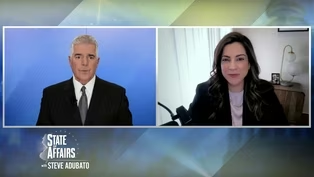
CEO of Moms First discusses her approach to child care
Video has Closed Captions
Clip: S9 Ep8 | 9m 29s | CEO of Moms First discusses her approach to child care (9m 29s)
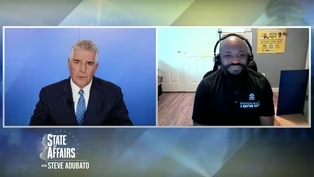
Creating mentorship opportunities for young men in Newark
Video has Closed Captions
Clip: S9 Ep8 | 9m 9s | Creating mentorship opportunities for young men in Newark (9m 9s)
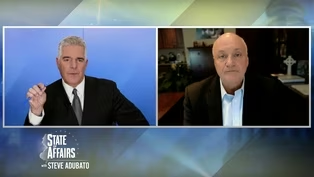
President of Holy Name talks uncertainties in healthcare
Video has Closed Captions
Clip: S9 Ep8 | 9m 13s | President & CEO of Holy Name addresses the uncertainties in the healthcare field (9m 13s)
Providing Support for PBS.org
Learn Moreabout PBS online sponsorship
- News and Public Affairs

Top journalists deliver compelling original analysis of the hour's headlines.

- News and Public Affairs

FRONTLINE is investigative journalism that questions, explains and changes our world.












Support for PBS provided by:
State of Affairs with Steve Adubato is a local public television program presented by NJ PBS