State of Affairs with Steve Adubato
Quadeer Porter; Steve Margeotes; Susan Stephanson Martin
Season 6 Episode 16 | 26m 49sVideo has Closed Captions
Quadeer Porter; Steve Margeotes; Susan Stephanson Martin
Quadeer Porter, founder of Brothers Building a Better Nation, sits down with Steve Adubato to highlight his nonprofit organization which supports incarcerated adults; Steve Margeotes, Ph.D. Executive Director, Main St. Counseling Center, highlights the impact of the pandemic on mental health; Susan Stephenson-Martin, M.S., Director, WIC Program NJMS Pediatrics, provides insight on WIC programs.
Problems playing video? | Closed Captioning Feedback
Problems playing video? | Closed Captioning Feedback
State of Affairs with Steve Adubato is a local public television program presented by NJ PBS
State of Affairs with Steve Adubato
Quadeer Porter; Steve Margeotes; Susan Stephanson Martin
Season 6 Episode 16 | 26m 49sVideo has Closed Captions
Quadeer Porter, founder of Brothers Building a Better Nation, sits down with Steve Adubato to highlight his nonprofit organization which supports incarcerated adults; Steve Margeotes, Ph.D. Executive Director, Main St. Counseling Center, highlights the impact of the pandemic on mental health; Susan Stephenson-Martin, M.S., Director, WIC Program NJMS Pediatrics, provides insight on WIC programs.
Problems playing video? | Closed Captioning Feedback
How to Watch State of Affairs with Steve Adubato
State of Affairs with Steve Adubato is available to stream on pbs.org and the free PBS App, available on iPhone, Apple TV, Android TV, Android smartphones, Amazon Fire TV, Amazon Fire Tablet, Roku, Samsung Smart TV, LG TV, and Vizio.
Providing Support for PBS.org
Learn Moreabout PBS online sponsorship- [Narrator] Funding for this edition of State of Affairs with Steve Adubato has been provided by The Russell Berrie Foundation.
Making a difference.
The Healthcare Foundation of New Jersey.
The Turrell Fund, supporting Reimagine Childcare.
RWJBarnabas Health.
New Jersey Sharing Network.
New Jersey'’s Clean Energy program.
Lighting the way to a clean energy future.
Valley Bank.
The Fidelco Group.
And by The Adler Aphasia Center.
Promotional support provided by ROI-NJ.
Informing and connecting businesses in New Jersey.
And by NJ.Com.
Keeping communities informed and connected.
[INSPRATIONAL MUSIC] - Hi everyone, I'm Steve Adubato.
It is my honor to introduce someone I met hosting the Russ Berrie Making a Difference Awards because this gentleman does make a difference, a big difference.
He's Quadeer Porter, founder and president of Brothers Building A Better Nation, 2022 Russ Berrie Making a Difference honoree.
Good to see you, Quadeer.
- Good to see you as well.
- It's great, listen, I saw this video when I introduced you and met you in the crowd, applauded for you, but I wanna make sure everybody sees it right now.
A little bit about Brothers Building A Better Nation.
Quadeer Porter of Newark created Brothers Building a Better Nation to support young men of color who were incarcerated or have a criminal history as they begin to create a better future for themselves and their families.
He invest deeply in his clients, offering mentorship, employment services, housing assistance and counseling.
The nonprofit started several years ago, where I moved from the Pavilion Apartments to to my first house, and I saw a lot of brothers on the streets there going through a lot of things I was going through.
So then I started getting a lot of knocks on the doors, asking me,you know, how was I able to get out of, you know, like having a parent that was you know, addicted to drugs and getting out of poverty and how was I able to go to college.
So I kept on seeing these questions coming.
And so I decided that instead of me just doing one offs for them, why not use all the tools that I got over the years while working at Rutgers, working at Memorial Sloan-Kettering and these other places, and make a nonprofit out of it?
They needed work.
They needed job training.
They needed case management.
You know, there's a lot of complex systems in Newark, New Jersey, and the federal government for these programs that a lot of people have a hard time navigating.
So I put all those things into organization, and I and I created it.
A lot of times the people in my community want to see somebody doing well.
Then it becomes infectious and everything.
I want them to become the role model that I know they can be.
I see the beauty in Newark, and I want it to continue to grow and contribute to it as well.
And I feel as though I owe it to my great-grandfather to my family, and also the people that are unborn in Newark yet to make this place more beautiful, because you continue to run away from a problem.
But the problem is always going to be there if you don't try to, try to solve So Quadeer, there it is.
I mean, that's your organization.
Those are the folks you're helping.
How proud are you?
- Oh, I'm extremely proud.
It's a blessing to be able to make an impact to some of these brothers' lives and continue to grow.
And so that's what we're really looking to do.
- Let me ask you this, you're born and raised in Brick City in Newark, New Jersey.
You've seen all kinds of things in your life.
What impact do you believe what you have seen growing up has impacted the kind of leader you are today, making a difference?
- I think the ability to be empathetic with a lot of brothers' causes, a lot of brothers' situations that are causing them to not be able to kind of get over the hump.
'Cause a lot of times, a lot of these young men have been ostracized in their community because they've gotten into some kind of either drug trade or they might have done some things in school that might have made them go to be incarcerated.
And when they go back to the community, sometimes they're being seen as monsters, unfortunately.
And what we wanna do is really just reintroduce these brothers to the community.
And not only that, show them a better way also.
Not all the brothers that's in our program all have been incarcerated, have gone to jail or been in drugs or gangs.
Some of them are just generally wanting direction and a brotherhood.
And that's where we look to serve and be.
- Quadeer, let me ask you this.
When you do what you do, when you make the difference you are making with Brothers Building A Better Nation, what impact do you believe it's having on some of the young men that you're working with in terms of their desire, willingness, and ability to make a difference for others?
- I believe it reinvigorates hope inside themselves.
A lot of times, they have been trying to going through the system, or they tried to get section eight, welfare, they've tried to be in re-entry programs.
- Section eight housing, affordable housing.
Just, let's be clear, but go ahead.
- Oh yes, absolutely.
And a lot of times, they feel like they hit a rock in a road and they can't get over that.
And that's where we come in.
We pretty much come in and we help them get over that hump, show them brotherhood, and help them network with other organizations in the city to help them get the resources that they need.
So we just pretty much reinvigorate hope back into them that there is a way to get over whatever challenges they're facing.
- Mm, let me ask you this.
When you win the Russ Berrie Making a Difference Award, and we'll show everyone the website and some might ask, hey, why are you showing us the website?
Well, the Russ Berrie Awards were created over two decades ago to recognize people who are making a difference in their communities.
Unsung heroes, if you will.
And I've been honored to host that event from the beginning.
The website is up for you to nominate somebody.
For you to say, I know of someone like Quadeer who's making a difference.
When I was there and I watched you, we all watched you and applauded for you.
That moment, right?
Given what you've experienced, what has that award, because it's a cash award, what has it meant to you and the work that you're doing?
- All the funds have gone to the nonprofit and to the brothers that's enrolled into the program.
It's been a windfall for us because one of the things that, as we know with nonprofits, is trying to get funding because we have a somewhat radical idea.
We basically pay a weekly stipend to the individuals in our program.
And we help them pay for either fines or legal fees that they're having.
And that's something that is just not around in our neighborhood.
They pay them sometimes small stipends but paying them weekly and case management and also the other elements that we have, it's hard to find.
And so that's what really allowed us to expand and try new things, and we've seen great positive results.
So it's just been a blessing in disguise and we're excited to be starting to pull some data about our findings also.
- One more question, before we let you go.
And again, congratulations on behalf of everyone in the public broadcasting family.
We wish you and your team at Brothers Building A Better Nation, all the best.
But my last question is, for those who think they know, for those who think they know, not what it's like, but have a preconceived idea, stereotype if you will, of young men in cities like Newark and what they're about and what they're capable of.
For the vast majority of those young men, why are so many people so wrong about their perception of you and those who live in the community with you?
- I think a lot of people forget that they're human and they have feelings and they cry and get discouraged just like everyone else.
Just sometimes we show our frustration in different ways.
And a lot of times, all we have to do is lend a helping hand and not fear them or fear us.
We're just trying to figure this thing out called life.
And a lot of these young men are young, they're between ages of 16 and 29, so they don't even know- - I'm sorry Quadeer, what do they need the most?
Not any one thing, but what do they need the most?
- Yes, they need guidance, and they need guidance and they just need brotherhood.
- But there's specific services.
Like you said, there's housing, there's employment opportunity, there's educational support.
And they need for someone to believe in them and that's what you've done.
Hey, Quadeer, listen, we are proud of you.
We will continue to be here to support the work that you are doing and others who have won this award who make a difference, particularly in communities where the challenges are overwhelming.
And we wish you and your brothers at Brothers Building A Better Nation all the best.
Quadeer, thank you.
And I'll make sure your website's up so people can find out more and if they want to give and volunteer, that's what they should do.
Thank you, Quadeer.
- Thank you so much.
- Wish you all the best.
Stay with us, we'll be right back.
(grand music) - [Announcer] To watch more State of Affairs with Steve Adubato, find us online and follow us on social media.
- We have him back, our good friend, Dr. Steve Margeotes, Executive Director at Main St Counseling.
Good to see you, Steve.
- Thank you, Steve, good to see you always.
- Let everyone know what Main St. is all about, and why it matters now more than ever.
- Well, Steve, we're in our 42nd year, I am the founder, and our mission has always been accessible mental health services, and we've succeeded with that.
We now have 505 clients we're seeing weekly.
The need is overwhelming, we're at full capacity.
And I just can't highlight enough what the pandemic has done to people; depression, anxiety more domestic violence, right down the line, it's a terrible time.
- Let me ask you, Steve, for people who argue, "Listen, it's a pandemic, it's temporary, I'll get past this."
And again, we've interviewed a lot of healthcare professionals on the front lines, over the past couple years, and what they are facing, in terms of anxiety, pressure, depression, being the target of violence, a whole range of things, is one thing.
For the rest of us regular folks, who are not doing such heroic things, who say, "Hey, listen, I don't need help, I can get through it myself."
What do you say to them?
- Steve, I think it's a myth, and I think it's a common reaction that you minimize things, "It's not that bad, I'll get through it.
Other people have had it tougher."
As we've talked about before, I think you gotta tackle this head on, you gotta embrace it.
You know, you gotta understand what's happening to everybody because of the effects.
Everybody is short on patience, everybody is tired.
It doesn't take much to go over the edge, because I think, really, the effects have been minimized.
The isolation alone, Steve, I mean, we've been- - Talk about that, sorry for interrupting, Steve, define isolation, 'cause I worry about my mom and others who don't have act... they're not as active as they used to be.
But it's not just people of a certain age who wind up feeling, and being, more isolated; it's all kinds of people.
What is it, and what impact does it have?
- Steve, it's a helplessness, "I can't go out, I'm not supposed to socialize.
Have you received a booster, have you received a vaccine?
How do I know am I gonna get sick?"
It's this constant isolation, which results in helplessness.
We've been doing telehealth for 27 months.
And one of the biggest comments has been, you know, "Thank God I still have you, but I miss my room, I miss the building.
I miss the soothing atmosphere of Main St." You're trying to run sessions and there's one computer in, you know, the kitchen area, there's lack of confidentiality.
A lot of clients have coped by now running sessions in their car.
- You know, Steve, it's interesting...
Put our website up, put Steveadubato.org up, and I'll tell you why.
I want folks to check out an interview we did with state Senator Vin Gopal.
And Senator Gopal was so candid in this interview, it was specifically about mental health issues and some legislation he's involved in, in that regard.
But he talked about his own challenges, and the reason I raise it is because it's so rare for such a public person to do that.
And I remember, on my own end, I talked about my own challenges, in that regard.
And I don't know what I would do without my therapist, he knows who he is, I think he watches sometimes.
That being said, how important is it for public people?
Again, it's a private issue, of course it is.
But for some folks, prominent state senators, prominent public officials, prominent people in the media, for all of us to help de-stigmatize mental health, by being public, while it is a private issue.
It's nobody... My wife's like, "It's nobody's business."
I know, but, Steve, help me on this.
- I think it's validating.
I think when they see public officials going for therapy, whether it's media, sports, music, I think that the interpretation is, "Well, see, they're going, you know, and they're not ashamed to talk about it."
And I think it's validating, and I think that cannot be emphasized enough.
Mental health is health.
And I think that when public figures endorse it, it helps the cause.
Only about 60%, whatever study you look at, Steve, highlight people who need help, can get it, for a variety of reasons.
- Wow, Steve, talk about violence, mental health issues and violence.
You ever notice when there's a horrific event, Texas' horrific event happened there, we don't know what...
Listen, it's happening way too often.
Why don't we stop talking about guns, gun control or gun safety, let's talk about mental illness.
Do you believe that there is a direct correlation, for some who are dealing with serious mental health issues?
And I can know it's patient-by-patient, and their proclivity to be violent and dangerous, and be engaged in murdering of other innocent people.
- I think you just said it right there, "innocent people".
I think, you know, there's a segment of the population that feels inadequate, helpless, powerless, resentful of people that have a future or have hope.
You know, I don't think it's an accident that a lot of times when these happen in school, you're talking about children that have hope, that are looking forward to the future, that are innocent.
- Hold on, by the way, when I was talking about innocent people, I was talking about innocent victims.
You may be interpreting it differently, but you may be talking about the perpetrator not innocent when they do something like that, obviously.
However, what the heck would that have to do with school children?
- I think school children, my take, are looking forward to the future.
They're innocent, they're hopeful, they still believe in the future.
And I think when you're that mad, and your future doesn't look bright, I want to take it out on you as well.
Domestic violence, high rate of deaths with domestic violence and suicide when there's a gun in the house.
There's so many mad people, and I think you have to address the mental health, that you need a way to check-out in your anger.
But when you have tools right there, easily accessible, it's a deadly combination.
- Question, serious mental health challenges facing our children, many of whom had not even gotten into a classroom like kindergarten, 1st grade, until they had to get into a classroom two years into this thing, Steve.
- I think- - Social interaction, et cetera.
- All that, I think it creates additional anxiety.
It's an additional worry, you know, "Is it gonna happen to my school?
How do I know I'm safe?"
I think these types of situations increase everybody's reaction to the possibility.
It comes under trauma, Steve, and how you react to traumas, in some ways, even more important than the trauma itself.
So you walk into a classroom, and you're hoping for the best, and the adults will take care of me.
But the more you see this happen, it's tough to believe in anything.
So you're scared, you're worried.
- Yeah, and P.S., let's make sure we acknowledge our public school educators, or educators of all types.
Steve, I know this is unfair, but 30 seconds on this, if, in fact, the confidentiality between doctor and patient, therapist and patient, is sacrosanct, but the therapist has a real sense to believe that a patient is potentially dangerous, what is the ultimately responsibility?
Is it to society and innocent people who'd be victims, or... Go ahead, real quick.
- I mean, from graduate school on, Steve, they always talk about, "If a client talks about harming themselves or others, that confidentiality gets broken."
And we talk about that to clients, it is confidential, except in these two situations.
- Thank you for clarifying, that's Steve Margeotes, we'll have him back on again.
Every time we learn from him.
Dr. Steve Margeotes, Executive Director of Main St. Counseling, based in West Orange, New Jersey.
- West Orange, New Jersey, we're still here 42 years later.
- Right up the road, hey, thank you, Steve, all the best.
We'll talk soon.
- Thanks, Steve, always a pleasure, take care.
- You got it.
Stay with us, we'll be right back.
(grand music) - [Announcer] To watch more State of Affairs with Steve Adubato, find us online and follow us on social media.
- We're now joined by Susan Stephenson-Martin, director of the Rutgers New Jersey Medical School, Women, Infants & Children, that is the WIC, W-I-C program.
Good to see you, Susan.
- Good afternoon.
- Let everybody know, as we put up, (coughs) excuse me, information about WIC, what is WIC and why more important than ever?
- So Women is a federally funded program for, as you said, women, infants and children, and we are a program that supplements nutrition, let's say, for low-income, or nutrition intervention program for low-income women, and infants, and children, to provide breastfeeding support, primarily, but formula supplementation to women in need, and nutrition education and counseling for pregnant moms, and then obviously nutrition intervention for children from one through fives.
- So, the baby formula shortage, we are in the summer of 2022, we hope that if this program winds up and repeats, it's not as bad as it is now.
How does this baby formula shortage and the finger pointing, the blaming, it doesn't solve any problems.
More importantly for us, for the people who are disproportionately affected, who are those people and how are they disproportionately affected, those women?
Please, Susan.
- So these women are women that are under the 185th percentile of poverty, they are- - Define that for everyone, so we understand what that means.
- 185th percentile of poverty, meaning that they're below the poverty, that they're at a 185% below the poverty level.
- They are struggling and challenging to pay their bills, and to live their lives, and support their families.
- Correct.
- Please.
- They're also at nutrition risk, so WIC is two-pronged, so not only are they below the poverty level, they are at nutritional risk, both their selves, their infants or their children.
So why this formula shortage affects them disproportionately?
Is obviously, one, you just mentioned, they need this formula supplementation so that they can provide nutrition to their children because they're unable to afford, or hopefully afford all of the needs for their children, so this program supplements that need in another way of saying.
In addition, the formula shortage affected the most vulnerable populations because the Abbott formula company supplied our specialty formulas for those children that were either having an allergic reaction or had some kind of GI issues, so those children especially needed that special formula.
So when Abbott closed, it put a strain on the other formulas that were available for those particular children.
- Susan, hold up, hold the point right there, is it a fact that Abbott, that company had 40%+ of the baby formula market in the country?
- Well, I don't know their percentage for the country, but I can tell you for WIC, Mead Johnson is our contracted formula.
Abbott formula, we sourced that formula for our exempt formula, so those specialty formulas like Alimentum and things like that.
So the exact percentage of what they produce for nationwide, but as you can imagine for supply chain, if a huge hub is gone, then it puts taxing on the other manufacturers that are in the field, so even though it didn't affect those manufacturers, now we had more of the population needing those formulas and using that supply.
- Okay, so for women watching right now, for families of those women, for friends of those women who hear stories about women trying to figure out what their other options are for their children and starting to make choices about what to mix, and what makes sense for their children or not, and they are not pediatricians, and who the heck really knows, the question here, as we put up that website, Susan, how could that, and should that help people?
- That should help people by finding a, one, how to return their formula, any recall formula they may still have.
Remember, we've been doing this since February, so hopefully the recall formula has been coming in, secondly, it should help them be able to find a vendor or a supply manufacturer that they can find the formula that they need, two, it should also help them with how to feed their children or child safely by not diluting formula, not using formula that's not approved, things like that, and finally, it should also help with any status updates as to what changes there are, governmentally or through the WIC Program, whether what waivers are approved, and how we're expanding the use of WIC, whether it be now we can use bigger sizes for the formula, so the sizing has grown, different manufacturers we're trying to get into waivers as possible, so that will keep them updated as to what the changes are, their physicians could now approve two formulas at a time, so they don't have to get doubly approved.
- Susan, let me ask you, how much could the state of New Jersey do if they wanted to make policy changes that would improve the baby formula crisis, versus a national, international, Abbot issue, the federal government regulating and stopping production at Abbot as they did?
How much of it can New Jersey influence, control, versus, "Hey, it's much bigger than that"?
- Well, New Jersey can definitely influence the nation conversation, if you will, or policies that are being instituted, because each state has a WIC program, and those state agencies or state officials do talk to our national level, so we have the Federal Nutrition Service and they then talk to the USDA.
So that communication trickles down and quite often the state impacts what the policy is gonna be because we're boots on the ground, so they're educating at the federal level what's happening at the local level and how those policies can help us at the local level, those changes, I should say - Susan Stephenson-Martin from the Rutgers Medical School, the director there, Women, Infants & Children, the WIC program, incredibly important topic, not going away, this issue and this challenge, we'll have you back again.
Susan, thank you so much.
- Thank you so much, Steve.
- I'm Steve Adubato, we thank you so much for watching, See you next time.
- [Narrator] State of Affairs with Steve Adubato Is a production of the Caucus Educational Corporation.
Funding has been provided by The Russell Berrie Foundation.
The Healthcare Foundation of New Jersey.
The Turrell Fund, supporting Reimagine Childcare.
RWJBarnabas Health.
New Jersey Sharing Network.
New Jersey'’s Clean Energy program.
Valley Bank.
The Fidelco Group.
And by The Adler Aphasia Center.
Promotional support provided by ROI-NJ.
And by NJ.Com.
- Hi, I'’m Dr. Shereef Elnahal.
Did you know that there are nearly 4,000 New Jerseyans waiting for a life-saving transplant?
And 67 percent of those people are people of color.
Just one organ and tissue donor can save 8 lives and enhance the lives of over 75 people.
Let'’s come together to raise awareness in our diverse communities.
Donation needs diversity.
You have the power to make a difference.
For more information, or to become an organ and tissue donor, visit: www.njsharingnetwork.org.
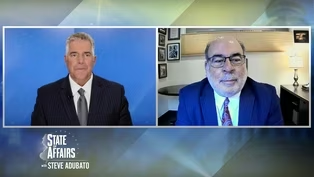
The Impact of the Pandemic on Mental Health
Video has Closed Captions
Clip: S6 Ep16 | 9m 55s | The Impact of the Pandemic on Mental Health (9m 55s)
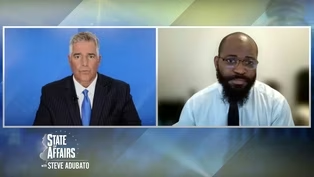
Support for Incarcerated Adults Re-entering the Community
Video has Closed Captions
Clip: S6 Ep16 | 10m | Support for Incarcerated Adults Re-entering the Community (10m)
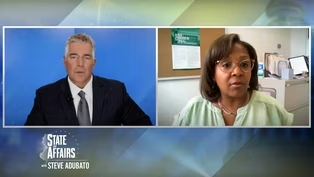
The Ways WIC Programs are Serving Parents and Babies
Video has Closed Captions
Clip: S6 Ep16 | 7m 45s | The Ways WIC Programs are Serving Parents and Babies (7m 45s)
Providing Support for PBS.org
Learn Moreabout PBS online sponsorship
- News and Public Affairs

Top journalists deliver compelling original analysis of the hour's headlines.

- News and Public Affairs

Today's top journalists discuss Washington's current political events and public affairs.












Support for PBS provided by:
State of Affairs with Steve Adubato is a local public television program presented by NJ PBS