One-on-One
Quadeer Porter/Kristy,Hailey Whilden/Nadine Wright-Arbubakrr
Season 2025 Episode 2828 | 27m 46sVideo has Closed Captions
Quadeer Porter/Kristy,Hailey Whilden/Nadine Wright-Arbubakrr
Quadeer Porter, Founder and Executive Director of Brothers Building A Better Nation, discusses providing young men in Newark a safe space. Kristy Whilden and Hailey Whilden, founders of Hands Up Silent Theatre, discuss their inclusive approach to theater for the Deaf. Nadine Wright-Arbubakrr, Founder & Executive Director of Nassan’s Place, examines the needs of urban children with autism.
Problems playing video? | Closed Captioning Feedback
Problems playing video? | Closed Captioning Feedback
One-on-One is a local public television program presented by NJ PBS
One-on-One
Quadeer Porter/Kristy,Hailey Whilden/Nadine Wright-Arbubakrr
Season 2025 Episode 2828 | 27m 46sVideo has Closed Captions
Quadeer Porter, Founder and Executive Director of Brothers Building A Better Nation, discusses providing young men in Newark a safe space. Kristy Whilden and Hailey Whilden, founders of Hands Up Silent Theatre, discuss their inclusive approach to theater for the Deaf. Nadine Wright-Arbubakrr, Founder & Executive Director of Nassan’s Place, examines the needs of urban children with autism.
Problems playing video? | Closed Captioning Feedback
How to Watch One-on-One
One-on-One is available to stream on pbs.org and the free PBS App, available on iPhone, Apple TV, Android TV, Android smartphones, Amazon Fire TV, Amazon Fire Tablet, Roku, Samsung Smart TV, LG TV, and Vizio.
Providing Support for PBS.org
Learn Moreabout PBS online sponsorship- [Narrator] Funding for this edition of One-On-One with Steve Adubato has been provided by The Russell Berrie Foundation.
Making a difference.
RWJBarnabas Health.
Let’s be healthy together.
The North Ward Center.
The Fidelco Group.
Robert Wood Johnson Foundation.
Working for a more a healthier, more equitable New Jersey.
New Jersey Sharing Network.
PSEG Foundation.
Johnson & Johnson.
And by The New Jersey Education Association.
Promotional support provided by NJ.Com.
Keeping communities informed and connected.
And by NJBIZ.
Providing business news for New Jersey for more than 30 years, online, in print, and in person.
- This is One-On-One.
- I'm an equal American just like you are.
- The way we change Presidents in this country is by voting.
- A quartet is already a jawn, it’s just The New Jawn.
- January 6th was not some sort of violent, crazy outlier.
- I don't care how good you are or how good you think you are, there is always something to learn.
- I mean what other country sends comedians over to embedded military to make them feel better.
- People call me 'cause they feel nobody's paying attention.
_ It’s not all about memorizing and getting information, it’s what you do with that information.
- (slowly) Start talking right now.
- That's a good question, high five.
(upbeat music) - Hi, everyone, Steve Adubato, we kick off the program welcoming back once again, Quadeer Porter, who's founder and executive director of a terrific organization called Brothers Building a Better Nation, a 2022 Russ Berrie Awardee for Making a Difference.
Quadeer, good to have you back.
- Thank you so much to having me back.
I'm so excited to be here.
- You got it.
By the way, go on our website.
It's up there right now to check out the previous interview with Quadeer.
Tell us exactly again what the organization is and the most pressing needs of the folks you serve in 2025.
- Absolutely, Brothers Building a Better Nation is a nonprofit organization based in Newark, New Jersey.
And our main purpose is to dismantle systemic barriers that are causing brothers in our community either self harm or put 'em at risk of self harm.
And so one of the most pressing issues we're currently seeing right now is that a lot of brothers need mental healthcare and somebody to talk to.
And so we actually expanded our services to meet that.
We actually got contracted with Medicaid, and now we're able to do intensive in-community services, which means therapy right in the home for these young men and also mentorship services and tutoring services for brothers as well, between the age of 4 and 21.
So, we've made some progress since the last time you met us.
- So, let me ask you this.
In 2025, with the world around us changing quickly, lots of uncertainty and challenges, to what degree do you believe black men, younger black men, in particular, are more at risk and challenged than ever before?
- Right now, they are going through, especially when you look at the statistics, suicide and self-harm is ranked the third most route for avoidable deaths for this population, for us brothers of color, and a lot of times, because we hold everything inside, and especially now in today's conditions, a lot of us are, especially, we're seeing them as after COVID, the COVID pandemic.
A lot of youth was not actively in school.
And so a lot of the youth that went back to school had some challenges in school, led to frustrations.
So a lot of these after effects led to different mental health behavioral health effects, especially at this age range between 14 and 21.
And that's what we're really trying to address right now, is that it was not only that feeling of that, there being other not seen, it's now this feeling of them being left behind and not being heard.
And so those are the things that we're seeing on the ground level right now is really showing brothers that you are seen, you are heard, and just trying to find a safe space for them, which is hard for them to find.
- I don't know if statistics bear this out, but there are folks who believe that in the African American community to have therapy, that getting help for mental health challenges is more challenging because there's some degree of resistance, skepticism.
Do you buy that?
- Yes, I mean, historically, we've seen it.
Mental health and behavioral health was actually used as a tool to incarcerate people of color from the Jim Crow era to all the way up to the '90s.
Misdiagnosis of people of color is is high.
For example, schizophrenia, there was a big study that was done from, I think it was the University of Chicago, that dealt with that, so it's a big fear when it comes to hear mental health.
But the biggest thing that we argue is that this is why it's important to have culturally competent care.
Right now, there's not a lot of brothers in the mental- - Explain that, Quadeer, culturally competent care, please.
- Yes, culturally competent care is we are getting care with somebody that you can recognize, somebody you can empathize with, somebody that looks like you, and somebody that you can feel has walked through your shoes a little bit.
And that's what we're able to deliver.
- You know what's so interesting about that?
You talk about the need for culturally competent care, people who look like you, people who have some experiences like you.
I'm not gonna get into a whole discussion about diversity, equity, inclusion, which, listen, that's a different, it's in some ways, it's a different discussion.
But the reality is having people who understand your experience requires a degree of diversity in the healthcare community, including mental health therapists.
Please, Quadeer, talk about that.
- I absolutely do agree.
You automatically see when the young men see somebody that looks like them, they connect to the guy, especially during puberty, right?
When you're going through puberty and a lotta times these young men are either angry or they're exhibiting what looks like anger, but it's not really anger.
They're just, like I said, just normal things that young men go through, but on the outside, it looks like they're something that is a threat.
And so by meeting somebody that says, like, "Hey, listen brother, understand what you're going through, and this is how either you exercise or you do these common things to help you calm down, this is what it looks like," and it's not a person that's timid and fearful of them and automatically wants to call 911 to bring them away, if somebody's able to deescalate them because they understand some of the social pressures they went through.
- You know what's interesting, right now, you're pursuing your master's in social work.
- Yes.
- Because?
- Because there needs to be more brothers in this field.
When I was first trying to get into this field and find my young men therapists, there was hardly anybody that looked like them.
And the brothers that were looking like them, they were overbooked for months ahead of events.
So I said, the least I can do is try to, if I'm gonna be serious about what I am doing, that I have to join the battle against, you know, against my mental health disparities going on in my community and go back to school and learn the right way to do it.
So that's why I signed up for a Rutgers School of Social Work, and it's been a blessing in my life.
- Last question, why are you so passionate about this cause?
- It's because I feel like I've found my life purpose, and it's hard to really put into words, but it's a feeling.
It's similar to how you, Mr. Adubato, when a camera turns on.
It's natural.
It's something that you can't really put into words.
It's just something that, when it happens, you feel is right, and that's what I feel like my work.
I've lived 34 going on 35 years on this earth right now.
And these last five years, I finally found, like, it was something that when I wake up, I'm naturally doing, and I'm always done.
I just never knew what it was.
And it turned out to be just this organization, Brothers Building a Better Nation because I was just tired of people seeing us as threats and people that was looking to tear up the community.
I wanna show that we're loving, compassionate, and we're empathetic individuals that just needs care like anybody else.
And that's what resonated with me, what continues to fuel me.
- You know, Quadeer, I'm a student of leaders, leadership, what causes people to be great leaders.
And sometimes it's hard to describe in words, but you know it when you see it, and you know it when you see one, a leader, and there's no substitute for the degree of passion you have, but I'll say this.
You found your calling, and others are benefiting because of that, and all of us in the public television community wish you and your colleagues at Brothers Building a Better Nation all the best.
Keep doing what you're doing and keep coming back and giving us an update.
Congratulations and more work to be done.
Well done, Quadeer.
- Thank you so much.
- You got it.
I'm Steve Adubato.
That's a leader, Quadeer Porter.
Stay with us.
We'll be right back.
- [Narrator] To watch more One on One with Steve Adubato find us online and follow us on Social media.
- Hi, I'm Jacqui Tricarico, Senior Correspondent for "One-on-One."
So pleased to be joined now by mother and daughter Kristy and Hailey Whilden, who are the co-founders of Hands Up Silent Theatre, a theater for both the deaf and the hearing located in Millville, New Jersey.
Thank you both so much for joining us.
- Thank you for having us.
- Thank you for having us.
- And I definitely have to mention Russ Berrie Awardees this past year, 2024 Making a Difference Award winner.
So congratulations on that.
Russ Berrie is a funder of our program as well, and we know that they love to shine a light on the amazing work people are doing throughout the community.
So congratulations.
- Thank you, I really appreciate that.
- Of course, Kristy, I'd love to start with you, first, tell us about your personal struggle with hearing loss, because it happened in your adult life.
Explain to us what happened and how you found out that you were slowly losing your hearing.
- Sure, so I was a music educator for 10 years.
I owned my own music academy in Tuckahoe, New Jersey.
I had some other teachers there that worked for me that taught, like, guitar and some other instruments, but I was the head piano teacher.
So our claim to fame was that, I think, it was five of our students were invited to play at Carnegie Hall in New York City.
So that was a really exciting time for us and we were on top of the world.
And then, I started to notice that the kids were saying, "Hey, Mom, turn the TV down, it's too loud."
Or we're driving in the car, and it's like, "Mom, turn the music down, it's too loud."
And I was like, "I really need to get that checked out."
So then I learned I have hereditary progressive sensory and aural hearing loss, which also my father has.
But, normally, it doesn't hit someone until they're in their early to late seventies.
So it happened to turn on for me when I was 33, so that's when it started to decline.
They say I'll lose about 5% of my hearing every year until it's gone.
- Wow, okay, so fast forward and, you know, this is a lot of information to take in for you and your family, your children.
So, Hailey, when did this idea for Hands Up Silent Theatre come into play?
What was going on at that time, and why did you and your mom come up with this idea?
- So it really started when she first told me that she was losing her hearing.
I was only 11 at the time, and being a little girl, I was terrified that I was gonna lose communication with my mom.
I thought I wasn't gonna be able to talk to her and have her all throughout my life.
Obviously, that isn't true.
She went on to get her American Sign Language degree, her associates degree, and her professors allowed me to come with her.
I actually went on to get the same degree.
But, with that, we formed a joint love for the language.
And, at the time, we were going to see Broadway shows all the time, not all the time, that'd be a little crazy, for my birthday every year.
- I love Broadway too.
- I would love to go all the time.
- Me too.
- Every year, we were going for my birthday.
And when she started to notice that she was losing her hearing, she paid more attention to the interpreters, and we noticed that the interpreters were on the ground, and they were only lit up by a small light, and it was very hard to see them.
I got to see all of the amazing costumes, the lights, the performance in its entirety, and my mom was looking at this person in the corner.
And, from that, we saw the inequality in the arts, and my mom suggested that we create a choir using sign language.
And me being a kid, I was like, "That's kind of boring.
We should do a theater."
And so that's really how Hands Up Silent Theatre was born.
Yeah.
- That's awesome.
And the theater brings so many people together.
Kristy, talk about how this theater is different.
Right now you and I are communicating over Zoom, but we're using close captioning so you know what I'm saying.
On a stage when actors are performing, like Hailey said, you're looking at the interpreter to the side, you're not immersed in the actual what is happening on stage.
So talk about how Hands Up Silent Theatre works.
What's going on?
- Sure, so when our students come to us, like 95% of them have never signed before.
A lot of them never even danced or even came to theater before.
And they come to us looking for a family, really, we are one giant family.
So how it works is the kids come to us and we teach them the songs in American Sign Language.
We teach them how to voice with it.
So we use what's called SimCom, which is Simultaneous Communication of ASL and voice at the same time.
So that way it's 100% accessible, not just accessible, but equal for you as a hearing person to be looking up on the stage and enjoying the lights, the costumes, the sounds, everything, and it's just as equal for the deaf community member to be looking up on the stage to see the play in their own language as well.
- What has been the reaction from the theatergoers in the community?
Because this started out kind of small, right?
It's grown pretty big.
How many people can you fit in that theater?
- Well, we started out with seven kids and just a grand idea.
And, that year, we ended up putting on "The Lion King" in a theater that was probably about 400.
And we didn't fill it by no means, but it was taken really well.
So, from there, we went onto a theater that was about 220 and our kids grew to about 20 kids.
And we sold out that theater a couple years in a row, so then that's when we moved to Millville.
And then, we used the Levoy Theatre, which now has approximately 700 seats, and now, last year, we sold out our first show there.
So, like, that was very exciting.
So now we have approximately 40 students.
And what's really great about this is it's not just teaching them theater, it's teaching them about a different culture and also a different language, and some of our kids have really taken this on.
Like, for example, we have a student that's at Bloomsburg University who is becoming an interpreter.
We have one that went to Flagler College who's become a deaf educator.
We have another one who has aspirations of becoming a lawyer for the deaf, another one that wants to be a psychiatrist for the deaf.
So, like, we are opening these kids' eyes to different possibilities for different occupations in the future too, which is really exciting.
- Yeah, like you mentioned, ASL is another language that I believe we all should be learning to be able to communicate with the deaf community.
And, Hailey, how are you taking these life experiences with your own career path, your own educational path?
What are you studying right now?
- So I actually just finished my degree in psychology, my bachelor's degree in psychology.
Before that, I got my associate's in American Sign Language and deaf studies.
I recently got married and I moved to Kentucky, so, unfortunately, I'm not there every week with the kids.
But I started teaching lessons here, private lessons, and I've gotten really good feedback from my students.
They say they really enjoyed learning and they're so glad that I'm here for them, and I'm so happy to hear that.
I, of course, come back when I can to see the kids and help out.
I also do private lessons with the kids whenever they need it, so.
- That's wonderful.
And like I mentioned at the beginning, you are both Russ Berrie Making a Difference winners.
What has that recognition meant to both of you?
- I was actually surprised.
I didn't know it was a thing.
And I got this nomination, I was like, "Wow, what is this?"
So to be able to go there and to be on that stage with all those incredible people, it's really...
It was mind-blowing, 'cause it's actually kind of um... - Hailey, what's the word when you finally feel like what you do matters?
- Validated?
- Validated.
- That's a good one.
- That this is actually a really important thing and that other people are seeing it in that way as well.
So like I was super honored to be nominated for this award.
- It was definitely such an honor to be invited onto the stage, even though my name wasn't technically on the award.l They did let me speak, and I thought that was very kind of them.
And it was amazing to meet so many incredible people.
- An honor well deserved for both of you doing great work.
I can't wait to get my kids down to the theater to see one of the performances.
Thank you both so much for joining us today.
- Thank you so much.
- Thank you.
- Thank you.
- You can come down in May, we are doing (indistinct).
- Awesome, I can't wait.
Thanks.
- Thank you.
- All right, we'll be right back after this.
- [Narrator] To watch more One on One with Steve Adubato find us online and follow us on Social media.
- Hi everyone, Steve Adubato.
We kick off this program as part of our series, "Making a Difference," not-for-profit leaders, making a difference every day, and we have our longtime friend, Nadine Wright-Arbubarkrr, who is the president and founder of a terrific organization called Nassan's Place.
Nadine, good to see you, my friend.
- Good to see you as well.
- You got it, let me also make it clear that Nadine is a 2024 Russ Berrie, Making a Difference winner.
Nadine, tell everyone as we put up Nassan's Place, the website, tell everyone what it is and why it's so significant, and so personal for you.
- Well, Nassan's Place is out of love of a mother for her child and wanting to have resources within her own community, not only for her child, but for others.
I am the proud mother of a soon to be 20-year-old, 6'6", 320 pounds, he'll be 20 years old on July 28th, and our journey has been a long journey.
It has been good days and bad days, but Nassan's Place is inspired by my own son, Nassan, on the autism spectrum, who was diagnosed back in 2006.
When we got the diagnosis, it was life-changing, but I also went on a search to find programs and services that will help me better understand, or to help give me some types of assistance.
I am born and raised in the great city of Newark, and now currently live in the great city of East Orange.
And when I couldn't find programs and services, I kept asking, "Why aren't there no services here for children on the autism spectrum in urban inner cities?"
And the question came back, "Well, why don't you, as a mother, do something about it," in my head.
And so I set out on a journey in 2012 and started a nonprofit, called Nassan's Place that will help children and families, like my son, to be able to find access to program services.
And truth be told, I was just looking for a mental break, right?
I needed respite, I needed someone to take him for a little bit or to help me better understand what I was dealing with because it was very challenging.
But after I started doing a lot of research, I was able to find programs and services.
They just didn't exist in urban cities of Essex County.
And Nassan's Place was born, and it has definitely changed so many lives, including mine, but it also has opened up the doors to educate more families to get rid of that stigma, but more importantly, to educate our community.
- You left a career in banking.
20, 25 years in banking, and you said, "I'm gonna do this."
The biggest lesson you've learned in leading a not-for-profit that is so personal, and there are so many challenges leading a non-profit, not the least of which is money, biggest lesson you've learned in doing this over the past 12 years, - I learned to be more patient, to lean on my faith, because my faith has brought me through those days where I thought I could not go on, because even though I am running this organization, I live autism every single day, and just like any other parent, I go through my challenges, and one of the things that has helped me more than anything is my faith, and to believe that I can never give up.
And even when there were those days where I did want to, my faith showed me that I could not, and I know that I live in my purpose right now.
So faith is what keeps me going.
These families who are in so much of the need to have support, and I call children in underserved, inner city communities, the forgotten ones.
I don't want them to be the forgotten ones.
I want the world to know that these children can do anything any other children can do if they just got the right opportunities.
And through the support of so many amazing people, and I call them earthly angels, throughout the years, we've been able to make a difference in the lives of these children.
But the one thing that has kept me steadfast is my faith and my commitment to making sure these children, all children, get the supports and services that they need within their own communities.
Some of the key services needed by family members of folks like Nassan, how old again, right now?
20?
- Nassan will be 20 on July 28th.
- Okay, we're taping it right before that.
Some of the things that are needed are?
- The services that are needed so desperately is programming, such as an afterschool program, such as Saturday respite, such as emergency respite.
One of the things that I'm dealing with now more than I've ever dealt with before is the need for emergency respite.
The state does do very well in providing some of these services, but when a parent is going through what I call an emotional breakdown, and I get those calls in the middle of the night or during the day, we send in staff to go in and give that parent some much needed de-stress time, and that is so important, because if that parent is not mentally able to take care of that child, then where does that leave the child?
So emergency respite is something that I've noticed that we've needed.
Not only that, I'm dealing with food insecurity.
So many of these families now don't have enough food by the end of the month to feed their children.
And some of 'em require a special diet that is a little more costly.
And not to mention homelessness.
So there's so many variants, and when I started Nassan's Place, I was just looking, actually, for some programming and respite.
I had no idea that the social service impact was so huge for the autism community in urban inner cities.
- Nadine, you're one of the winners, a select elite group of winners of the Russ Berrie Award for Making a Difference, 2024.
What did and does that mean to you?
- Wow.
To be honored by this prestigious foundation means the world to me, because I know that they take very seriously the sacrifices that so many of us that are on this non-journey path takes.
So to actually be amongst all of these amazing and distinguished honorees and all the amazing work that they do, I'm truly honored and I'm humbled, but what was so even more, I guess great for me is that when Russell Berrie created this award, he thought about the sacrifices of people like Nadine and the Nadines and the countless other people out there who are doing the work, who made sacrifices.
As you mentioned earlier, I worked in a banking career for 25 years.
That was my career.
I gave that up because I wanted to go into the nonprofit and do work within my community and I wanted to serve.
And so we all make these sacrifices, and so often we, as the individuals, don't get that recognition, and what the Russ Berrie Award did is it recognized the sacrifices and it thanked us for the sacrifices that we had done personally.
So I was truly grateful to be one of the top three, and out of 330 nominees, and I gotta tell you, I was truly, truly taken back 'cause my daughter, Naya, submitted the nomination for me.
- That's beautiful.
Listen, the series can be called "Making a Difference," and they're all different folks trying to make a difference every day in the not-for-profit community, but to see how you have grown, how the organization has grown, how Nassan has grown, it's incredibly inspiring.
And wish you and your team all the best, your son, Nassan, all the best, and you are making a difference.
Thank you, my friend.
- Thank you.
- You got it, I'm Steve Adubato.
That's a real leader.
We'll see you next time.
- [Narrator] One-On-One with Steve Adubato is a production of the Caucus Educational Corporation.
Funding has been provided by The Russell Berrie Foundation.
RWJBarnabas Health.
Let’s be healthy together.
The North Ward Center.
The Fidelco Group.
Robert Wood Johnson Foundation.
New Jersey Sharing Network.
PSEG Foundation.
Johnson & Johnson.
And by The New Jersey Education Association.
Promotional support provided by NJ.Com.
And by NJBIZ.
- How long you been waiting?
- About a half hour.
- Brutal.
This keeps up, I'm gonna miss my pickleball game.
- I've been waiting eight years for a kidney.
What can you do?
(gentle music) - [Narrator] Over 100,000 people in the US are waiting for a life-saving transplant.
But you can do your part in an instant.
Register as an organ donor today at NJSN.org.
Creating mentorship opportunities for young men in Newark
Video has Closed Captions
Clip: S2025 Ep2828 | 9m 6s | Creating mentorship opportunities for young men in Newark (9m 6s)
Examining the needs of children and families with autism
Video has Closed Captions
Clip: S2025 Ep2828 | 9m 9s | Examining the needs of children and families with autism (9m 9s)
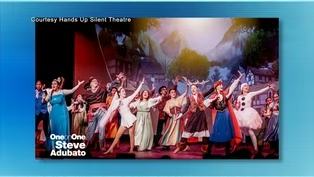
Inclusive alternatives to theater for the Deaf community
Video has Closed Captions
Clip: S2025 Ep2828 | 10m 13s | Inclusive alternatives to theater for the Deaf community (10m 13s)
Providing Support for PBS.org
Learn Moreabout PBS online sponsorship
- News and Public Affairs

Top journalists deliver compelling original analysis of the hour's headlines.

- News and Public Affairs

Today's top journalists discuss Washington's current political events and public affairs.











Support for PBS provided by:
One-on-One is a local public television program presented by NJ PBS