
Racine Zoo
Season 12 Episode 13 | 26m 48sVideo has Closed Captions
Feed a rhino or walk next to kangaroos as host Angela Fitzgerald visits the Racine Zoo.
Hop along with kangaroos, come face to face with a lion or feed a rhino as Angela Fitzgerald takes you behind the scenes at Racine Zoo. Right along Lake Michigan, this long-established zoo offers an up-close look at animals while connecting to global conservation efforts. Then check out more stories from around Wisconsin.
Problems playing video? | Closed Captioning Feedback
Problems playing video? | Closed Captioning Feedback
Wisconsin Life is a local public television program presented by PBS Wisconsin
Funding for Wisconsin Life is provided by the Wooden Nickel Fund, Mary and Lowell Peterson, A.C.V. and Mary Elston Family, Leon Price & Lily Postel, Stanley J. Cottrill Fund, UW...
Racine Zoo
Season 12 Episode 13 | 26m 48sVideo has Closed Captions
Hop along with kangaroos, come face to face with a lion or feed a rhino as Angela Fitzgerald takes you behind the scenes at Racine Zoo. Right along Lake Michigan, this long-established zoo offers an up-close look at animals while connecting to global conservation efforts. Then check out more stories from around Wisconsin.
Problems playing video? | Closed Captioning Feedback
How to Watch Wisconsin Life
Wisconsin Life is available to stream on pbs.org and the free PBS App, available on iPhone, Apple TV, Android TV, Android smartphones, Amazon Fire TV, Amazon Fire Tablet, Roku, Samsung Smart TV, and Vizio.
Providing Support for PBS.org
Learn Moreabout PBS online sponsorship- Announcer: The following program is a PBS Wisconsin original production.
- Angela Fitzgerald: Coming up on Wisconsin Life: Meet a Milwaukee comic artist bringing his characters to life, an Oregon café owner brewing connection with each cup, a family coming together in New London for a sweet annual tradition, [group cheers] and an animated tale sharing one man's journey finding a home in La Crosse.
- Ernesto Rodriguez: I kissed the ground and, "Thank you, God."
- Angela: That's all ahead on Wisconsin Life.
[bright music] - Announcer: Funding for Wisconsin Life is provided by: the Wooden Nickel Fund, Mary and Lowell Peterson, the A.C.V.
and Mary Elston Family, the Stanley J. Cottrill Fund, UW Health, donors to the Focus Fund for Wisconsin Programs, and Friends of PBS Wisconsin.
[playful music] - A big, wild welcome from the Racine Zoo!
I'm Angela Fitzgerald, and this is Wisconsin Life.
Today, we visit this nonprofit zoo that sits on 32 acres of Lake Michigan shoreline in Racine.
[playful music] Started more than 100 years ago, the zoo was founded in 1923 with just a pair of deer and three monkeys.
The zoo has evolved, with 75 different species and more than 300 animals that call this place home.
Many of which are native to our state, while others are a bit more exotic.
From reptiles to mammals, there is so much to explore and interact with here.
This accredited, nonprofit zoo supports conservation efforts locally and abroad.
All while offering hands-on education to support their mission to "improve the bond between people and nature."
- Child: So cute!
It's sleeping.
They're like... - I'll roam and roar through the paths here, but let's pounce into our first tale.
That takes us to Milwaukee to meet a comic artist bringing characters he created in his childhood to life.
- Jeff Balke: All the characters have to look the same.
- Angela: Jeff Balke carries lots of titles.
- Animator, creator... Colorist.
[laughs] - Angela: Jeff is also a self-taught comic artist.
- Jeff: This is fun.
I just, I love the colors.
- Angela: In his Milwaukee home office, the essentials include his dog, Benny, Crocs, and crayons.
- Saturday morning cartoons.
That's the best way I can really put it.
I don't go too crazy with details.
- Angela: For more than 18 years, Jeff has been coloring and creating comic book characters.
- Jeff: Boop, boop, boop.
It's like second nature now.
I can look at something black and white and I can physically see what it's gonna look like colored.
Very simplistic.
Looks like it'd be easy to draw.
Looks like it'd be easy to draw.
Can't wait to color the tutu.
[chuckles] I get to be me.
I get to do everything I wanna do.
Create a whole different world.
Take people out of reality and just take everyone away, including myself, from the everyday life.
[playful music] - Angela: He also draws on everyday life to create his characters.
One of 'em, for sure, is probably my alter ego, and that's my main character, Stanley.
He's a fun guy and funny guy.
I actually had all my characters when I was a kid.
I kinda had 'em all in my mind.
As I grew up, I got older, I said, "I wanna start creating them."
That's what I did, Stanley and Friends.
A lot of it was from my childhood.
The fun stuff that I physically have gone through or am going through.
- Angela: For Jeff, creating comics is more than childhood fantasy.
The support of his parents and teachers changed the trajectory of Jeff's passion and profession.
- Oh, completely.
I went from being the kid that just went to sketching whatever on a piece of paper, but now, it's a career.
They were never those parents that said, "Oh, have a backup.
"Do something else.
Be a lawyer."
They were always very supportive of me doing this.
This is something I've wanted to do my entire life.
[chuckles] - Angela: Through the years, Jeff has created more than 100 characters.
- Jeff: That's one eye.
- Angela: But there are six creatures that capture the heart of his attention.
- Jeff: Stanley is the first character I created.
He's a little squirrel.
His girlfriend, Natasha, is also a squirrel.
Chester, little chipmunk.
He's a little off the wall, little kind of crazy, kooky.
Billy Billington, he is our duck.
Baby Fang, he's a little wolf cub.
He does nothing but eat.
Eat, eat, eat, eat, eat.
Yeah, I definitely created that character.
And then, we have Bandit.
And they just all blend very well together in all the books, especially when you start writing it.
You can totally see all of their attitudes and everything just mixing perfectly together.
Proud of these little guys.
- Angela: A point of pride for Jeff is having his characters appear in Storm King comics.
- Jeff: Like, this one is Stanley and the Haunted House.
"So, how are we gonna catch these ghosts?"
Poof!
"With this!
One snap, and we've got them."
"Ha ha, Stanley.
Funny."
"Okay, guys, let's..." For that book, I did the story.
So, I created the characters.
I also did the writing.
That's actually my first writing gig.
It's Halloween.
How can you not have fun with it?
You know, it's my favorite holiday.
- Angela: And what surprises him most about a life in comics?
- That I can get paid.
[laughs] I mean, really, that's the biggest thing.
It's just amazing.
And the infamous and most popular "Dancing Skeletons," our first animation, coming to life later this year.
I have a lot of fans out here in the Midwest, a lot in Wisconsin.
Just the joy of actually being able to do what I wanna do and create a whole new world with my characters.
[laughs] I love doing this.
This is probably one of my favorite pictures.
I like this one.
A lot.
I really wanted people to just enjoy themselves, get out of reality for just even a minute to read one of the books.
[deepens voice] Welcome to Faerie Tale Theater.
That's really what I want people to do.
Storm King Theater, oh, there we go.
- Angela: Next up, we visit Oregon, where a café owner is working to foster inclusivity.
[playful music] - Elizabeth Donoghue: We wanted to provide something that downtown Oregon didn't have, which was an inclusive, welcoming, cheerful place that affirms the neurodivergent community.
It affects every demographic.
No matter what your race is, your socioeconomic background, your level of education.
The neurodivergence shows up everywhere.
And it's not a visible disability.
My name's Elizabeth Donoghue.
I've owned the Kickback Café for just a little over three years.
We wanted a space where not only were we going to intentionally employ folks from that community, but we were gonna make sure that people understood they were very, very welcome here.
And just to create communities within communities.
We just have fun with this space.
I have a background in baking.
But my husband was suffering with some mental and physical health issues.
And this would've been a good ten years ago or more now.
And we had to make the decision to take him out of the workforce.
And it took quite a while, and our savings were dwindling.
In addition, two of my children are autistic, and two of my children have ADHD.
So, I started baking from home, and there was a big demand for it.
So, I was looking around for that commercial kitchen space, and I found The Chocolate Caper here in Oregon, which was a long-standing business, over 30 years already.
So, I needed to lay the foundations for my own family.
I know that at least two of my children will struggle in a traditional workforce setting.
Well, they're not gonna struggle here, you know?
And I'm able to extend that same grace to everyone.
[groovy music] People don't realize how simple accommodations are.
When people hear "accommodations," I think as employers, they feel very intimidated by that word.
But it's really very simple, and it's really mostly communication.
People are encouraged to just tell us that you need to step away.
Tell us if you're having a hard day and you need to leave because it's too much for you, and you're not gonna be penalized for that.
We also don't force conformity.
There's a million ways to do a good job.
If we're providing wonderful service, that's all that matters here.
[groovy music] What I find is that by treating employees like actual people, they really rise to the occasion for you.
- Mateo Kretschman: I work at Kickback here, and I really enjoy it.
When I worked at other jobs, I didn't really talk with many people there.
I was kind of just working and just would go there, work, and go home.
When I come to Kickback, I talk with mostly everyone.
And it just, that makes me feel more welcome than I already am.
Kickback is a very special place, one of a kind.
- Tyson Purcell: And it says right on the door that it's for, like, neurodiverse environment, and I'm neurodiverse.
I have ADHD.
And I was like, "Oh, well, yeah, let's go check this place out."
And as soon as I stepped in, I was like, "Yeah, this place is kinda quirky and, you know, it's interesting."
At the time, I had been kind of going through a depressive episode.
And I was just trying to get back on my feet.
And, you know, I'd been fired from jobs before.
And, you know, I kind of was in that pattern.
So, when I came in and sat down for the interview, they're like, "Yeah, we understand.
"We have other ADHDers "who have gone through the same exact sort of thing.
And we get it."
Having to unlearn that kind of negative talk has taken me so many years.
Most of my other jobs are, "How can I hide my ADHD?"
Instead of just, say, "This is who I am.
Can you help me work with what I've got?"
So, it's all about that work environment.
And then, you add the fact that, like, you know, the pumpkin muffins are really tasty.
You know, that's nice.
[chuckles] [gentle accordion music] - Elizabeth: I think we should just all be more curious about each other, right?
And so, I'm happy to be on the forefront of something that people are maybe not as aware of or not as exposed to.
And to show them that it's not scary.
Once you learn more about anyone, it's less and less intimidating.
'Cause it's not really just the neurodivergent, right?
We all deserve to be treated like human beings, and everyone has a fundamental right to earn a living.
So, how do you get that for people?
Sometimes, you have to create it yourself.
And that's what we did.
[gentle accordion music] - I'm at the Racine Zoo getting a behind-the-scenes look, checking our their conservation efforts and how they care for the variety of animals here.
[playful music] That care happens rain or shine, from little penguins to large lions, with Executive Director Beth Heidorn leading the pack.
- Beth Heidorn: So, we are part of AZA, which is the Association of Zoos and Aquariums.
So, we adhere to the gold standards of care, animal welfare, animal well-being, and all of us, together, to both in your local areas as well as internationally are taking care of the planet.
Our job is to make connections between people and nature.
What we want really to have happen is that people, kids, adults, become stewards of this planet.
We're all on one planet together, so we gotta make sure that we take care of it, and making those wonderful connections so people feel, they get that empathy, they understand it, they're going to take care of it.
- That connects to your conservation efforts?
- Absolutely.
We do conservation efforts, both local, national, and even international.
So, we even send some of our funds to international areas for international giraffe conservation, African penguins.
So, we are global in our efforts.
- And is there a main thing that you want visitors to the zoo to take away from their experience?
- Yeah, I want them to understand that, first of all, we're a community zoo.
We're 102 years old, and we have had people that have come here when they were little, and now they're parents or grandparents or great-grandparents, and we'll take 'em all.
As you can see, you've had a really good day, you're close to lots of different things, and that makes that connection.
We are for all ages, we're fairly flat, so we've got the stroller moms that come, we've got senior groups that come, and everybody in between.
We have programming for all ages, and we just wanna be here for everybody so that they can see how valuable an accredited zoo is.
- Angela: I love that.
Is there anything else that you'd like to talk about that we haven't already discussed?
- Well, actually, what I'd like to know was what was your favorite part of today?
- Hmm.
Well, I will say I appreciate it, in general, the way the zoo was organized, it felt like there was not this big divide between myself and the animals, which, on the surface, could feel scary a little bit.
[both chuckle] But at the same time, it was nice to have that close encounter with them.
So I appreciate that design element.
- Beth: Right, and I think that's also why people love this zoo.
They're not so far away that you don't really appreciate them, but they are a little, so you can respect them.
- Right, absolutely.
- So, you get that close once you get the respect.
So, I appreciate that, thank you.
I love this zoo.
This is a small but mighty little zoo, but I tell you, I have the best staff here and we have the most amazing animals.
So, come on out!
You gotta come see us at the Racine Zoo!
- Angela: Now was my chance to get an even closer look, heading behind the scenes to feed a 3,000-pound animal that demands nothing but respect... - This is Temu.
- Angela: ...a rhino.
Can she be pet?
- It's like a treat, yep.
[Angela exclaims] There you go.
[Angela laughs] Some rhino slime!
She did good.
She did great.
- Thank you.
- Yes, of course.
- Angela: Whether it's being slimed by a rhino or hopping with the kangaroos, there are wild times to be had here.
[playful music] Now, we go to New London to tap into a family with a sweet annual tradition bringing generations together.
[gentle music] [birdsong] - Jenifer Richart: There is nothing like being in the woods this time of year.
Spring is here before it's anywhere else.
Something about it just is grounding.
The sun hits you just right.
And it's warm out here.
You're in the ten acres that we do maple syruping in.
In order for us to tap trees, a lot of the snow melts.
Moss starts to grow.
- Bridget Wenman: It's just a absolutely beautiful place to be in this time of year, in the spring.
- Dave O'Brien: Well, we're here at the O'Brien Maple Grove.
It's where we grew up.
Our grandparents settled out here.
And most of the families in this area of the county are all settled from Ireland.
[pipe band playing "Amazing Grace"] - Jenifer: The parade in New London is pretty amazing.
- Bridget: Every year at Saint Patrick's weekend, they change New London to the city of New Dublin.
They change all the signs.
My parents were pretty involved in that celebration.
- Reporter: I'm here with Bob O'Brien, the commentator and color host for today's parade.
- Bridget: My dad emceed that parade for years.
- Bob O'Brien: And here comes a bunch of Irish farmers.
Those Irish farmers are very, very good farmers, you know that?
They spread an awful lot of fertilizer, and that's what makes them so good.
[co-emcee laughs] - Dave: My dad tapped about 125 trees.
We would can 100 quarts a year.
And my dad just did it as a hobby.
Now, for us kids, it was a chore.
- I was out here from five, six, seven years old, as were my brothers and sisters.
I didn't like it.
[chuckles] - Charlie O'Brien: When I was four years old, sitting on the tank, and just there while everyone else was doing the hard work, pouring the buckets into the tractor.
[syrup splashes] - Bridget: We have three generations of people that come out and enjoy the property, spend some time collecting syrup.
- Dave: So, my dad died in 1988, and at that point, my oldest brothers were getting closer to retirement.
And they really took it from there, and it's expanded substantially.
They said, "We have more of us that can help.
Let's tap 750 taps."
And it really turned it to start where we're at today, which is we built this beautiful, brand-new sap shed, thanks to my brother Gene.
And it went from being a place that we gathered in the spring to 12 months out of the year.
As more of the family members get involved, they invest their time, their kids get involved, and it really brings the family together.
- It was never about making money.
It was about making maple syrup for the family.
- And really working hard and playing hard.
And that's what we do when we're out here.
[lively Irish folk music] - Dave: Saint Paddy's Day, though, it's kind of like a family reunion.
- Jenifer: Saint Paddy's weekend is really about coming home, and it's all family.
And so, the conversations are deeper.
You know everybody.
Even if there's 100 people, you still know everybody.
Once we step in to the gathering into the sugar shack, I mean, as soon as we're in there, it's food and companionship.
- Betty: We thank you for the beauty of this surrounding.
The forethought of our ancestors that came to this country.
- Jenifer: Our family has a lot of storytellers, and it took the storytelling and put it up on the walls.
- I picked out this one, and my four stones there are for my daughters.
I have four daughters.
[gentle harp music] - Its whole purpose is to keep us together.
- I'm sure that's why our family has remained as close as we have been.
If we didn't have this, it would be weddings and funerals.
- Bridget: It's all about passing it to the next generation and spending time together.
There's nothing better than that.
[gentle music] [birdsong] - Angela: Our final story is an animated journey narrated by Wisconsin Public Radio's Maureen McCollum.
She traces the journey of Ernesto Rodriguez from Cuba to La Crosse.
It's part of the WPR Reports: Uprooted podcast, which explores the untold stories of Cuban exiles who were sent to Wisconsin in 1980.
- Maureen McCollum: In the summer of 1980, Ernesto Rodriguez stood on the shores of the Port of Mariel.
He was about to board a fishing boat with 80 other people and leave the only home he'd ever known: Cuba.
- Erne: And then, when they ask me, "You wanna leave Cuba?"
I go, "Yeah, because I don't wanna be there."
- Maureen: Erne is one of the 125,000 Cubans who left the island as part of the Mariel boatlift.
Protests and discontent led to a rare moment, when President Fidel Castro opened the doors to Cuba and allowed his residents to leave for the United States.
Almost 15,000 of these exiles, like Erne, ended up in Wisconsin.
Erne shared his life story with me as part of the Wisconsin Public Radio podcast WPR Reports: Uprooted.
Once Erne boarded the boat with his fellow exiles, they were bound for Florida.
- Erne: The ocean, in the beginning, was calm.
But when we was in the middle, the wind just start.
[imitates wind blowing] And that's when a lot of boats sink, people drowned.
When I got to Key West, as soon as I get out the boat, I kiss the ground and, "Thank you, God."
- Maureen: Shortly after arriving, Erne was put on a plane with other Cuban exiles and sent to Sparta, Wisconsin.
At Fort McCoy, Erne worked in the kitchen and showed American cooks how to make Cuban food.
- Erne: They said, "What the heck's Cuban food?"
And then, I show him how to make a congri and chicken fricassee.
One day, he said, "Do you guys like macaroni and cheese?"
"What the hell is macaroni and cheese?"
- Maureen: In this kitchen, Erne became friends with two cooks: the Brandstetter brothers.
Their parents, Annette and Roger, would become Erne's sponsors.
- Erne: She was the best, the best mom.
I never had a mom.
I thought of her as my mom.
Every birthday, she's making me a upside-down pineapple cake.
Every birthday.
Sometime I say, "Mom, I don't want this no more!"
And she told me, "Erne, happy birthday!
Come and get your cake!"
I had to love her that family.
Because nobody do that for a Black guy in another country.
- Maureen: For the next few decades, Erne worked across the upper Midwest.
He also started a family.
Erne is now in his 60s.
He's put roots down in Wisconsin.
He has a tight community of friends, other Cubans who arrived during the Mariel boatlift.
They play music together, they help each other through tough times, and they talk about their dreams of someday visiting Cuba again.
- Erne: I have a lot of family that I never met before, like a niece and nephews.
Great-niece, great-nephews.
Any time I talk to them, it's, "When you gonna coming?
When you gonna coming?"
- Maureen: Like many Cubans who came to Wisconsin during the Mariel boatlift, Erne has been in a legal limbo for decades.
He has not been able to visit Cuba because he has not been able to become a citizen.
That is, until the summer of 2023.
- Erne: They said, "Yeah, make him citizen."
I'm happy, I'm just excited, you know?
Waiting for 42 years.
It's big, big step, becoming an American citizen.
- Judge: Ernesto.
[applause] - Maureen: As a U.S.
citizen, Erne will be able to cast the first election ballot in his entire life.
And he's a step closer to seeing his family in Cuba.
- Erne: Well, the first thing I gonna do is go to my hometown.
See if I recognize where I used to live, see if the house still there.
And then I go to Havana, party in Havana.
- Maureen: He'll finally return to the shores of Cuba, the country he left on that fishing boat more than 40 years ago.
He'll visit with family he hasn't seen in decades, and maybe even have that party in Havana.
And then, he'll return to his chosen home in Wisconsin.
[gentle music] - I've had a wild time with the goats and all the animals at the Racine Zoo.
If you'd like to explore more of the stories we shared today, visit WisconsinLife.org.
You can also reach us at stories@wisconsinlife.org or on our socials.
Until our next adventure, I'm your host, Angela Fitzgerald, and this is our Wisconsin Life.
Bye!
[bright music] - Announcer: Funding for Wisconsin Life is provided by: the Wooden Nickel Fund, Mary and Lowell Peterson, the A.C.V.
and Mary Elston Family, the Stanley J. Cottrill Fund, UW Health, donors to the Focus Fund for Wisconsin Programs, and Friends of PBS Wisconsin.
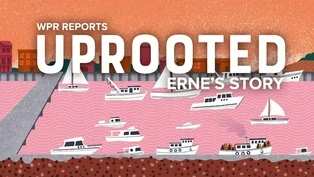
From Cuba to La Crosse: Erne's story from 'WPR Reports: Uprooted'
Video has Closed Captions
Clip: S12 Ep13 | 4m 44s | Follow Ernesto Rodriguez from Cuba to Wisconsin from the "WPR Reports: Uprooted" podcast. (4m 44s)
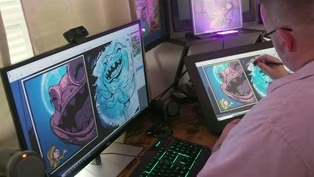
Bringing 'Stanley and Friends' to life
Video has Closed Captions
Clip: S12 Ep13 | 4m 28s | Milwaukee's Jeff Balke turned childhood sketches into a career with Storm King Comics. (4m 28s)
Preview: S12 Ep13 | 30s | Feed a rhino or walk next to kangaroos as host Angela Fitzgerald visits the Racine Zoo. (30s)
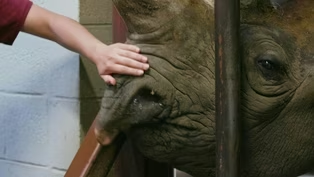
A rhino encounter at a 'small but mighty' zoo
Video has Closed Captions
Clip: S12 Ep13 | 3m 33s | Angela feeds a rhino and explores conservation efforts at the 102-year-old Racine Zoo. (3m 33s)
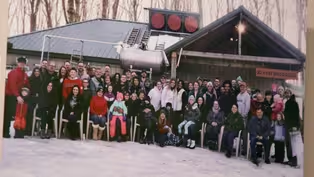
Three generations tap maple trees during Saint Patrick's season
Video has Closed Captions
Clip: S12 Ep13 | 4m 30s | The O'Brien Maple Grove produces gallons of syrup and generations of memories. (4m 30s)
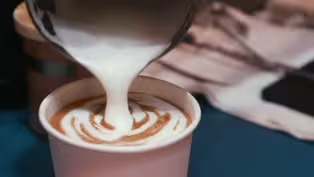
Creating work-life balance at Kickback Cafe
Video has Closed Captions
Clip: S12 Ep13 | 5m 34s | An Oregon coffee shop offers an inclusive workplace that prioritizes well-being. (5m 34s)
Providing Support for PBS.org
Learn Moreabout PBS online sponsorship












Support for PBS provided by:
Wisconsin Life is a local public television program presented by PBS Wisconsin
Funding for Wisconsin Life is provided by the Wooden Nickel Fund, Mary and Lowell Peterson, A.C.V. and Mary Elston Family, Leon Price & Lily Postel, Stanley J. Cottrill Fund, UW...