
Ralph Waldo Emerson's Mentorship of Henry David Thoreau
Clip: Episode 1 | 9m 9sVideo has Closed Captions
Thoreau moves in with Ralph Waldo Emerson's family, but personal tragedy strikes both families.
Ralph Waldo Emerson invites Thoreau to move in with his family, and Emerson mentors Thoreau to help him improve his writing craft. However, Thoreau begins to bristle at the luxurious lifestyle of the wealthy Emerson family. Personal tragedy strikes both families as Thoreau's brother, John, dies and is followed soon after by Emerson's son, Waldo. These deaths radically impact Thoreau's life.
From
Problems playing video? | Closed Captioning Feedback
Problems playing video? | Closed Captioning Feedback
Episodes presented in 4K UHD on supported devices. Major funding for HENRY DAVID THOREAU was provided by The Better Angels Society and its members: The Keith Campbell Foundation for the...
Ralph Waldo Emerson's Mentorship of Henry David Thoreau
Clip: Episode 1 | 9m 9sVideo has Closed Captions
Ralph Waldo Emerson invites Thoreau to move in with his family, and Emerson mentors Thoreau to help him improve his writing craft. However, Thoreau begins to bristle at the luxurious lifestyle of the wealthy Emerson family. Personal tragedy strikes both families as Thoreau's brother, John, dies and is followed soon after by Emerson's son, Waldo. These deaths radically impact Thoreau's life.
From
Problems playing video? | Closed Captioning Feedback
How to Watch Henry David Thoreau
Henry David Thoreau is available to stream on pbs.org and the free PBS App, available on iPhone, Apple TV, Android TV, Android smartphones, Amazon Fire TV, Amazon Fire Tablet, Roku, Samsung Smart TV, and Vizio.
♪ Ralph Waldo Emerson: My good Henry Thoreau made this else solitary afternoon sunny with his simplicity and clear perception.
How comic is simplicity in this double dealing, quacking world?
Everything that boy says makes merry with society, though nothing can be graver than his meaning.
Laura Dassow Walls: Henry was funny and loved to pull people's legs, but underneath all that, Emerson also saw a kind of rebelliousness against convention and against the kind of immorality that he thought was all too common around him, and that was the kind of thing that Emerson looked for.
Narrator: Emerson was pleased with the arrangement, telling a friend that Thoreau was "a writer "you may one day be proud of, a noble youth full of melodies and inventions."
Ralph Waldo Emerson: My dear Henry, will you not come up to the cliff this p.m.
at any hour convenient to you, where our ladies will be greatly gratified to see you?
And the more they say, if you will, bring your flute.
♪ Henry David Thoreau: I am living with Mr.
Emerson in very dangerous prosperity.
Laura Dassow Walls: "Very dangerous prosperity."
Well, a big house with servants, good food, leisure.
I think there was a little bit of resentment there.
He knew very well that his family wasn't living in that kind of luxury.
Creature comforts have a way of allowing us to forget the friction with reality that is at the heart.
I see Thoreau as needing friction.
[Birds chirping] Henry David Thoreau: I seem to see somewhat more of my own kith and kin in the lichens on the rocks than in any books.
Meet me on that ground, and you will find me strong.
[Fire crackling] Narrator: On Christmas Eve, Henry confided to his journal one of his innermost wishes.
♪ Henry David Thoreau: December 24, 1841.
I want to go soon and live away by the pond, where I shall hear only the wind whispering among the reeds.
It will be success if I shall have left myself behind.
[Bird chirping] Narrator: On New Year's Day, John Jr.
cut his ring finger while shaving.
Sandra Harbert Petrulionis: They wrapped it up with a bandage, thinking absolutely nothing of it, and by the time it was looked at by a physician, he pronounced it tetanus, which they called lockjaw at the time, and said there was absolutely nothing anyone could do.
[Wind blowing] Narrator: Henry rushed home.
Laura Dassow Walls: Henry stayed with John right through to the end.
Henry David Thoreau: He was perfectly calm, ever pleasant while reason lasted, and gleams of the same serenity and playfulness shone through his delirium to the last.
Narrator: On January 11, 1842, John Thoreau died in his brother's arms.
He was just 27 years old.
♪ Laura Dassow Walls: They were the closest of friends, the closest of brothers.
For Henry, I think with John's death, half of him died, too.
Then Thoreau collapsed.
Kristen Case: He contracts what looks like also lockjaw, and this turns out to be a kind of sympathetic response of his nervous system.
He was so devastated that he, in fact, died a kind of death himself.
Narrator: Another tragedy struck shortly thereafter.
The Emersons' young son Waldo died suddenly of scarlet fever.
♪ A month later, Thoreau wrote a condolence note, hoping that the slow lifting of his own grief would give Emerson some solace.
Henry David Thoreau: March 11.
Dear Friend, The sun has just burst through the fog, and I hear bluebirds, song-sparrows, larks, and robins down in the meadow.
[Birds chirping] The wind still roars in the wood as if nothing had happened out of the course of nature.
Every blade in the field-- every leaf in the forest-- lays down its life in its season as beautifully as it was taken up.
So is it with the human plant.
♪ Laura Dassow Walls: Henry writes how he hears and feels John's presence everywhere in the woods and fields that they used to travel.
Nature starts to speak to him in a way that it really hadn't, I think, quite before, and he starts to listen, and he is reborn.
After John's death, he writes his first great nature essay, "The Natural History of Massachusetts."
♪ Henry David Thoreau: We must look a long time before we can see.
I walk in nature with a sense of greater space and freedom.
Nature will bear the closest inspection.
She invites us to lay our eye level with the smallest leaf, and take an insect view of its plane.
I explore, too, with pleasure the sounds which crowd the summer noon, and which seem the very grain and stuff of which eternity is made.
To him who contemplates a trait of natural beauty no harm nor disappointment can come.
Surely joy is the condition of life.
Laura Dassow Walls: From then on, he has a mission to spend as much of his writing time as possible to express what he sees and hears and feels outdoors, and I think this is really the birth of the Henry that we know.
♪ Narrator: After returning to live with the Emersons, Thoreau spent as much time as he could reading, writing, and going for long, solitary walks around Concord.
Douglas Brinkley: Emerson mentored him, gave him books to read.
There was this whole other realm of great world literature that Emerson put Thoreau onto.
Narrator: Emerson was now the editor of "The Dial."
He asked Thoreau to work on a new column called "Ethnical Scriptures," introducing readers to Eastern religious traditions like Hinduism and Buddhism.
♪ Clay Jenkinson: Every society faces the fundamental questions of life.
What are we called upon to do in our life?
What happens when we die?
And for most of the history of Western civilization, we have simply accepted the Bible.
What about Islam?
What about Judaism?
What about Hinduism?
What about Confucianism?
David McCullough: I often think about where you could put a lens down on the map of the United States and take what you would get in that lens to reflect the substance and the cast of characters and the importance of and the nature of the history of our country.
Concord, Massachusetts, is to me a good choice.
You not only have the start of the Revolution, with the battles of Concord and Lexington, but you have the creative residences and workplaces of people like Ralph Waldo Emerson and Hawthorne and Louisa May Alcott and Henry David Thoreau.
How these clusters of brilliant people can emerge and flourish and change how we view the world, is one of the mysteries of history.
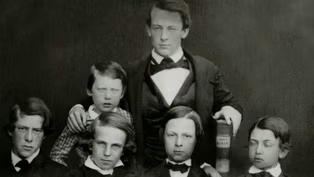 New
NewHenry David Thoreau and Transcendentalism
Video has Closed Captions
Clip: Ep1 | 5m 9s | Thoreau is introduced to Ralph Waldo Emerson and the radical ideas of transcendentalism. (5m 9s)
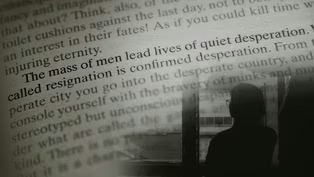 New
NewAn Introduction to the Words and Life of Henry David Thoreau
Video has Closed Captions
Clip: Ep1 | 8m 20s | Henry David Thoreau spent his life experimenting and contemplating on how to live a good life. (8m 20s)
Providing Support for PBS.org
Learn Moreabout PBS online sponsorship












Support for PBS provided by:
Episodes presented in 4K UHD on supported devices. Major funding for HENRY DAVID THOREAU was provided by The Better Angels Society and its members: The Keith Campbell Foundation for the...