
Read in Color/Carpentry Camp
Season 49 Episode 36 | 26m 46sVideo has Closed Captions
Read in Color/Carpentry Camp | Episode 4936
A new initiative here in Detroit that promotes children’s books about diversity and inclusion. We’ll get the details on the “Read in Color” project. Plus, high school students help rebuild a Detroit neighborhood while learning valuable job skills. And, a special report on training for family caregivers. Episode 4936
Problems playing video? | Closed Captioning Feedback
Problems playing video? | Closed Captioning Feedback
American Black Journal is a local public television program presented by Detroit PBS
Read in Color/Carpentry Camp
Season 49 Episode 36 | 26m 46sVideo has Closed Captions
A new initiative here in Detroit that promotes children’s books about diversity and inclusion. We’ll get the details on the “Read in Color” project. Plus, high school students help rebuild a Detroit neighborhood while learning valuable job skills. And, a special report on training for family caregivers. Episode 4936
Problems playing video? | Closed Captioning Feedback
How to Watch American Black Journal
American Black Journal is available to stream on pbs.org and the free PBS App, available on iPhone, Apple TV, Android TV, Android smartphones, Amazon Fire TV, Amazon Fire Tablet, Roku, Samsung Smart TV, and Vizio.
Providing Support for PBS.org
Learn Moreabout PBS online sponsorshipJust ahead on "American Black Journal," there is a new initiative here in Detroit that promotes children's books about diversity and inclusion.
We'll get the details on the Read in Color project.
Plus, high school students help rebuild a Detroit neighborhood while learning valuable job skills.
And a special report on training for family caregivers.
Don't go away.
"American Black Journal" starts right now.
(soft bright music) ANNOUNCER: From Delta Faucets to Behr Paint, Masco Corporation is proud to deliver products that enhance the way consumers all over the world experience and enjoy their living spaces.
Masco.
Serving Michigan communities since 1929.
Support also provided by the Cynthia & Edsel Ford Fund for Journalism at Detroit Public TV.
ANNOUNCER: The DTE Foundation proudly supports 50 years of "American Black Journal" in covering African-American history, culture and politics.
The DTE Foundation and "American Black Journal" partners in presenting African-American perspectives about our communities and in our world.
ANNOUNCER: Also, brought to you by AAA, Nissan Foundation, Impact at Home, UAW, solidarity forever, and viewers like you.
Thank you.
(lively music) Welcome to "American Black Journal."
I'm Stephen Henderson.
September is National Literacy Month and two nonprofits have teamed up to get books that celebrate diversity and inclusion into the hands of children.
The Little Free Library has launched its Read in Color initiative in Detroit neighborhoods with the help of a community partner: Brilliant Detroit.
Hundreds of books that promote racial and social justice and give voice to BIPOC and LGBTQ communities are gonna be distributed in book sharing boxes at 14 locations all across the city.
Detroit is one of several cities participating in this national program.
I got the details from the CEO of Brilliant Detroit: Cindy Eggleton.
Cindy Eggleton, welcome to "American Black Journal."
It's a total pleasure to be here with you in particular.
Yeah, it's really great to see you.
So let's start with this program for National Literacy Month that you're involved with with the Little Free Library.
What is it and how can people get involved?
Yeah, so I'm just really thrilled that this has been brought here with national Little Free Libraries.
So what it's called is Read in Color.
It was launched after George Floyd's murder.
And the idea here is to assure that there are books in the middle of neighborhoods that may not be served by libraries or stores, et cetera, that are representative of black and brown people in particular.
And we are one of several national cities that have gotten this, so I'm excited about it.
It will be at 14 locations throughout the city.
Right now, we have installed it in four of our locations.
I'll tell you how we're doing it.
And basically, these little libraries are filled up with beautiful books that are free, that are also from authors of color, and also purchased from local bookstores of color.
So it's really a whole cycle bringing it together.
And in many of the neighborhoods we serve, kids don't have enough access.
There's book deserts, et cetera.
It is critically important that we are able to see ourselves in the books we read as we grow.
We know that it impacts literacy.
We know that it impacts how kids do in school and also adults are in life.
But in addition to that, it really helps set the tone for your hopes and dreams and a better society where we see ourselves and what is around us.
So we're thrilled.
We're hoping to keep this continued.
We have gotten at least 2,500 books right now.
But we are already, our Little Free Libraries are out of books every day, which means that they're being used, and so we wanna keep adding and put as many books in there as possible.
Yeah.
So for folks who don't know, we should spend just a little time talking about what Brilliant Detroit is, what it does, and where it exists in our city.
Yeah, so let me tell you that and then I'll also tell you how that rolls out for each of the neighborhoods.
So Brilliant Detroit exists to create kid success neighborhoods where kids in families, we say belly to eight, have everything that they need in education, health, and family support in the middle of the neighborhood in a walkable area.
It is done in partnership with the neighborhoods.
We don't go into any neighborhood unless invited in.
And once invited in, we hire from the neighborhood and we repurpose a house, this is where we connect in terms of some of your projects, into really a community hub.
And we're about five and a half years old and what I'm really delighted about is that in that time, we've grown to be committed to 14 neighborhoods.
12 locations are existing.
We serve 7,500 people right now, and I would tell you that that growth is entirely because of the neighborhoods.
Because to me, the true assets of Detroit are in the neighborhoods.
We meet so many heroes.
And in fact, that with this rollout is how we're doing each neighborhood when they get a Little Free Library.
We're lifting up somebody from the neighborhood and telling their story as it connects to literacy and books.
What that's looked like is in one of our neighborhoods an eight-year-old boy wrote a book with his dad, so we were able to highlight that.
In another neighborhood, they have an intergenerational reading group.
We were able to highlight that.
Another group, we had a little girl that literally came to our location every day and got a book.
And so each neighborhood has so much beautiful things, but it is because of them.
And we've been able to raise reading levels three levels in this work and actually show outcomes in health and family support that are pretty solid and strong.
But again, it's because the neighborhood owns us as much as us.
And since you've been doing this for five years, I mean, let's think about some of the things that have happened in our neighborhoods over the last five years and the challenges that we face.
But I'm asking everybody right now what they're seeing and hearing as we come out of what we hope at least was the worst of the pandemic.
But of course, we all experienced everything that happened over the last year and a half in these neighborhoods and to our neighbors.
I would love for you just to talk about what things look like in the places where Brilliant Detroit exists right now.
Yeah, so this is where I said my saying of heart and head has changed a heart, head and shoulders.
Our work is built on relationships.
And so we've heard firsthand, I'm gonna give you a couple of examples of what we've seen and heard and how we've moved to support.
So first off, we started out of the gate calling people that are in our network and that we work with every week.
So we had a pretty good indication of how they were feeling and what support they needed.
And we pivoted in some ways to make sure that we were supporting people because we need each other, right?
It's a basic human need.
The first day of really what many called the lockdown we got a call from one of our participants.
It was a Saturday.
She had an eight day old baby.
She was out of formula, she was nervous to breastfeed, and that was her situation.
So we were able to serve her and get formula over there.
And my head and heart, I'm like, "Buy up 30 boxes of formula."
Our staff says, "Do you have any clue what that costs?"
And so we put out a call to the community and we received so many supplies and supports to help others, which that story was repeated again and again and again.
Another thing to say what was happening for people at an individual level, even on our own staff who are all from neighborhoods, is that people were losing people, and we talk about that, but we don't talk about it enough.
And on our own staff, every single staff has lost 1 to 17 people that are close to them.
That's a lot of loss.
And we were able to give $500 out to 750 families during this time in three waves.
The first wave we found that 30% of the families were gonna use that to bury somebody.
That's the situation.
That's collective stress and trauma.
What it means in terms of education right now, we just participated in a study with New America locally and nationally, 30% of parents said, what do they want for this new year?
They want social, emotional support for their kids over academics.
So that tells you what I think we all have to step into and why this work for us is so critical and life giving and life taking, really.
To really take note of we are all going through this, we are in this together.
How can we support each other?
I say, one day you're lifted, one day you need to lift somebody up, and I think that really rings true.
I did see a lot of beauty of people wanting to help others and come together in that way, but it's difficult.
The last thing I would say to that is before the pandemic, look it, our systems weren't working for people.
They just weren't.
And what I think our goal needs to be is not just how do we get through this, but how do we create a system that works better for kids and families?
And that's really hard when you're in the middle of a crisis, and so that's what I wake up every day thinking about.
Yeah.
So let's quickly remind people where they can find information about these Free Little Libraries and these wonderful books that you are giving.
So go on our website.
There's a map of where we are all across the city.
Go and take as many books as you need.
The little libraries are emptied and filled up every day.
If you wanna support in any way, we're doing reading groups around these.
Additionally, if you wanna donate books, all of that is needed and you can get ahold of us at info@brilliantdetroit.org.
This is one thing we can all actually do and it's a needed piece.
Yeah, and we'll put all that information on our website as well.
Cindy Eggleton, it is always great to see you.
It's especially great to see you since I haven't seen you in, I think, more than a year and a half, just like everybody else, but thanks for joining us here on "American Black Journal."
Thank you for having me.
We've got an update now from the neighborhood where I lived as a young child on Detroit's west side, and where my nonprofit, The Tuxedo Project, is located.
The Michigan Regional Council of Carpenters and Millwrights is building a training center in our neighborhood to help give more Detroiters opportunity for careers in the skilled trades.
This summer, the union started a bootcamp for high school students to give them hands on training in carpentry.
As part of Detroit Public Television series on the future of work, One Detroit's Bill Kubota reports on how the teens are learning really valuable job skills.
BILL: Detroit's west side, the Tuxedo neighborhood near Grand River, Livernois, and the Jeffries Freeway.
Abandoned houses common here, but this summer, signs of progress.
Along with this demolition order, some new construction down the street.
It's Carpentry Camp, a summer program put on by the carpenter's union to get high school students interested in the trades.
You gotta be careful.
Do not go further.
We're not here to make them carpenters.
We're here to introduce them to carpentry so they can touch it, feel it, do it, make the mistakes on it, make sure they understand that it's not life-ending if they do make a mistake and how to fix it.
BILL: The Carpenters and Millwrights Union has a stake in this neighborhood.
Their new trade school is going up here right along I-96.
Part of the school's mission, get more Detroiters working in construction.
It's unfortunate because a lot of kids today don't believe that this option is out there for them.
They don't even know about it.
You're gonna have to bring this saw.
Remember, we have to make a center cut.
BILL: Cortez Asbury's done this camp before.
Now he's headed for a carpentry apprenticeship with the union.
But it's so good.
You do something new every day.
We teach them a little bit of math.
We teach them how to read a tape measure and we teach them how to do basic skills projects.
Good.
Done.
All right.
At 15, I came here.
It was kind of hard.
Nobody's gonna know how to do it at first.
After it was done, you look at it, you love it, I love it.
I want to stay forever.
BILL: 31 participants this year.
Last year, COVID got in the way.
Start it straight on an angle.
BILL: This time, it's community service for the Tuxedo neighborhood.
Back in April, we put out a bunch of applications for residents to have work done on their houses.
We got almost a hundred projects.
Are we gonna get a hundred projects done?
Absolutely not.
But we are gonna get done the most needy that we see that we have to do.
All right, where's the top one now?
The top one is secured in now.
You know, these are the small projects that we can do to give back.
It's absolutely free, no charge to the resident, and these kids are getting paid.
BILL: Jamal Al said the students are learning teamwork, communication, and how to execute plans.
And we got one source of power here.
Where's it at?
Who can tell me?
The generator.
Get the generator out now.
We try to explain to them what we're doing, how we do it, and then we let them do it, and kids are gonna make mistakes.
They've never done this before.
You gotta put it right in the middle.
We're doing porches, handrails and porch rails.
BILL: Here a porch beyond expectations, a major project for a crew of beginners, a showcase of what they can do.
Well, it took about five days and it was pretty much an entire remodel.
All of these Detroit homes are pretty old, so the porch, it was probably around like 80 years old, and we had to pretty much demo the whole thing.
We had to take the frame down and completely build it back up from scratch.
You know what?
This is a great neighborhood.
You know, people can drive through it and see that the houses are deteriorating.
They just can't afford to fix them up.
BILL: What happens after this for these kippers?
We have six kids are old enough to go to work.
Out of the six, four of them are being placed.
So they've already gone into our apprenticeship program.
They graduated and they're moving in to the next step and the next phase of this program.
We got screws?
There's some right there.
They're going to work.
They're getting jobs.
BILL: Is this a career for you or what?
I feel like it's a journey for me.
I'm gonna do this forever.
We teach 'em about the money.
We teach 'em about the benefits.
We teach 'em about a great middle-class living with pensions.
Family always tells me that they proud of what I'm doing.
That I'm gonna be prepared for my future.
BILL: Ivan Walker, a senior at Detroit's Renaissance High School, he's planning for college, but eyeing a trade school too along with a degree in computer engineering.
But is it an either or?
Why are you doing this if you're gonna do that?
Well, I always wanted to have a plan B.
There's no point, I'm not gonna put all my chips on black.
I wanna be prepared for anything because life can throw anything at you.
BILL: Mahmoud El Jamali, he's a former camper, now helping out.
An architecture student at the University of Detroit Mercy.
I'm going to college, but I still wanna do this.
I love this stuff.
I wouldn't be able to do 50 years of just blueprint making.
I'm a hands-on guy.
And after my four years in college architecture, I'm most likely gonna come into the union, do my four years there, and have the skills of a carpenter, an experienced carpenter, and be an architect.
This is just our organization.
There's 17 other crafts just like us in the trades that are out there and we're trying to push for kids to understand what the trades are.
I've always wanted to help rebuild Detroit.
It's gonna be a long process to really get these houses back in the shape that they should be, but it can definitely happen.
And a quick programming note.
Part 2 of the PBS series the "Future of Work" is gonna air September 8th at 10:00 pm right here on Detroit Public Television.
The deal has changed.
The old deal was I went to school for 12 years.
I acquired a set of skills.
Those skills took me through a 30-year-working life and then I got to retire at 65 with a nice defined benefit plan.
Well, the new deal is now there are no guarantees.
There's no certainty.
Now this series takes a look at changes in the workplace and how they're affecting employees, employers, educators, and communities.
Finally, today it's estimated that 53 million Americans are caring for an aging family member and a lot of people fall into this role without any real preparation.
The good news is that there is some help available in a report for the New York & Michigan Solutions Journalism Collaborative.
Producer AJ Walker takes a look at a program in Detroit that teaches individuals how to handle the really complex responsibilities that come with being a caregiver.
AJ: If you ever find yourself in a position where you become a caregiver, it can be overwhelming.
That's why St. Patrick Senior Center offers classes to help people get prepared and equipped to handle the task.
Anita Kanakaris overseas caregiver training at St. Patrick's and tells us more about the programs they offer.
Most of them are six weeks long.
They meet once a week.
The caregiver program for dementia is once a week for six weeks for two hours, and the powerful tools for caregivers is once a week for six weeks for two and a half hours.
And by and large, the response we get from people after taking part is, "Wow, I didn't know that I had choices," "I didn't know what my mother is going through," "now I understand a little better," "I can deal with her behavior," or "I'm important too and I need to take care of myself."
AJ: Depending on the medical state of the person you're caring for, it takes a lot of understanding, skill, and patience to help them.
Tools you can develop by attending the training which they offer for free.
One of the programs that we offer to help caregivers through this is called Creating Confident Caregivers.
It's specifically designed for caregivers who are caring for somebody with dementia still living at home.
When we have the first session of the class, some people come in with the attitude, "Oh, mama's just being difficult.
We never got along."
But as the class progresses and they learn about the different stages and the losses that the person experiences, they lose their ability to reason, they lose their ability of perception, they lose their ability to speak.
And so when something happens around them, they may have a catastrophic reaction.
AJ: The other class they offer is just as important because without these skills, the person you're caring for could suffer.
The focus there is on the caregiver.
So we show them some videos of people who have gone through this process to let them know, first of all, that they are not alone.
And then we talk about the losses that they've experienced.
Maybe it's the loss of the relationship with the person.
Maybe if it's your spouse, maybe it's the loss of intimacy.
The person doesn't recognize you anymore and that's really tough.
And then again, caregiving challenges can be so overwhelming.
So we tell them, "You have to take time for yourself."
"You have to care for yourself."
"You are important because if you don't take care of yourself, how are you going to take care of that person that you're caring for?"
AJ: Larry McCoor takes care of his 90-year-old mother Minnie.
He took courses at St. Patrick's to help him get prepared for the job ahead.
The course is on various events that could possibly happen.
So we would do seminars or training exercises where we would learn the correct procedure on what to do if in the event this would occur or that would occur.
AJ: You think those things are helpful?
I think they are.
So far, I haven't had to encounter any of those particular things, but if an event should happen, then I'd know what to do.
Part of the training is noticing the attitude, noticing if a patient is depressed or what have you, just various things you have to look out for and know how to handle it, how to address it.
AJ: As Larry's mom Minnie sits resting on her couch, he isn't far away.
In fact, he lives in the same building she does to make sure he's close by in case she needs him.
You need some water for your medicine?
I don't need anything right now.
AJ: So Larry uses this time to get on with the day's chores.
Cleaning is part of his regular routine of taking care of his mother.
I have to depend on Larry more so not because... See sometimes when I wake up in the morning time, if I'm having to raise up too quick, then the whole room goes turning.
They say I had a mild stroke at the brain.
AJ: But with Larry by her side, just an elevator ride away, she feels comfort knowing she'll be taken care of.
Well, I just thank God for him.
AJ: Why is that?
Because if it wasn't for him, I'd have to get a stranger, and I don't be wanting strangers around me.
AJ: Larry says taking care of his mom keeps him busy.
There's a lot of traveling involved.
Bills have to be paid.
Different doctor's appointments that have to be met.
He's my backbone, I'll put it that way.
I couldn't have asked God for a better son.
AJ: To help a loved one keep a sense of self-reliance and independence, Kenneth Cara says they train caregivers to take note of what their patients can still do.
Adrian Piner is manager of the Community Living Supports Program at St. Patrick's.
She says caregiving can come with really unexpected emotional challenges for the caregiver.
Some challenges we have is they don't have enough time to themselves.
So I either can put them in a respite program so that caregiver is allowed to get a break from the daily grinds of being a caregiver.
I mean, that just eases the burden for maybe two and a half hours for that one day in the week.
It's just about making those decisions and understanding what we need as caregivers.
AJ: Because if you want to be an excellent caregiver, like Minnie says Larry is, you have to be ready to put in a lot of work and a little love.
There's nothing he won't do for me.
There's nothing he won't do for me.
I can call him anytime of day of the night, he gonna come see about his mama.
And I hope you'll join me Thursday, September 9th, at 7:00 PM for a virtual public forum called Caregivers on the Front Lines.
Our guests are gonna explore solutions for a lot of the challenges that are faced by caregivers and you'll have an opportunity to ask them some questions.
This free live event is presented as part of Strides for Seniors, an annual celebration of Detroit neighborhood's senior centers.
You can join the forum on Detroit Public TV's Facebook page.
That's gonna do it for us this week.
Thanks for watching.
You can find out more about our guests at americanblackjournal.org.
And as always, you can follow us on Facebook and Twitter.
We'll see you next time.
(lively music) ANNOUNCER: From Delta Faucets to Behr Paint, Masco Corporation is proud to deliver products that enhance the way consumers all over the world experience and enjoy their living spaces.
Masco.
Serving Michigan communities since 1929.
ANNOUNCER: Support also provided by the Cynthia & Edsel Ford Fund for Journalism at Detroit Public TV.
ANNOUNCER: The DTE Foundation proudly supports 50 years of "American Black Journal" in covering African-American history, culture and politics.
The DTE Foundation and "American Black Journal" partners in presenting African-American perspectives about our communities and in our world.
ANNOUNCER: Also, brought to you by AAA, Nissan Foundation, Impact at Home, UAW, solidarity forever, and viewers like you.
Thank you.
(bright music)
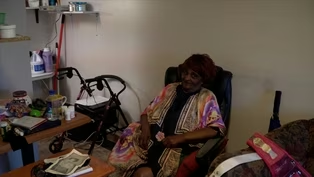
Video has Closed Captions
Clip: S49 Ep36 | 6m 8s | Caregivers | Episode 4936/Segment 3 (6m 8s)
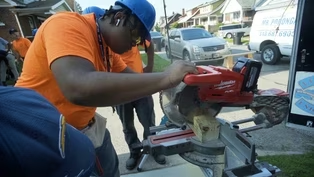
Video has Closed Captions
Clip: S49 Ep36 | 5m 47s | Carpentry Camp | Episode 4936/Segment 2 (5m 47s)
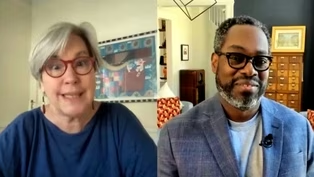
Video has Closed Captions
Clip: S49 Ep36 | 9m 40s | Read in Color | Episode 4936/Segment 1 (9m 40s)
Providing Support for PBS.org
Learn Moreabout PBS online sponsorship
- News and Public Affairs

Top journalists deliver compelling original analysis of the hour's headlines.

- News and Public Affairs

FRONTLINE is investigative journalism that questions, explains and changes our world.












Support for PBS provided by:
American Black Journal is a local public television program presented by Detroit PBS