
Rebellion in the Backcountry | Trail of History
Episode 57 | 26m 46sVideo has Closed Captions
Revolutionary War battles in the Carolinas helped win independence.
Explore Revolutionary War battles in the Carolinas and the Southern Campaign through living history at the Battle of the Waxhaws, Ramsour’s Mill and Huck’s Defeat. Rebellion in the Backcountry reveals how Patriot militia, Loyalists and British forces clashed across the Carolina backcountry and helped turn the fight for American independence on Trail of History.
Problems playing video? | Closed Captioning Feedback
Problems playing video? | Closed Captioning Feedback
Trail of History is a local public television program presented by PBS Charlotte
Sponsored by Bragg Financial
Support provided by:

Rebellion in the Backcountry | Trail of History
Episode 57 | 26m 46sVideo has Closed Captions
Explore Revolutionary War battles in the Carolinas and the Southern Campaign through living history at the Battle of the Waxhaws, Ramsour’s Mill and Huck’s Defeat. Rebellion in the Backcountry reveals how Patriot militia, Loyalists and British forces clashed across the Carolina backcountry and helped turn the fight for American independence on Trail of History.
Problems playing video? | Closed Captioning Feedback
Where to Watch Trail of History
Trail of History is available to stream on pbs.org and the PBS app.
Providing Support for PBS.org
Learn Moreabout PBS online sponsorship(rousing music) - [Announcer] This is a production of PBS Charlotte.
(rousing music) - [Narrator] In the history books, we often hear about Lexington, Concord, Valley Forge, and Yorktown, each one marking a key moment in the American Revolution.
(cannon booming) But to understand how the Revolution was won, you have to look south.
- [Zach] It was death for the British by a thousand cuts.
- [Narrator] From the fall of Charleston to the surrender at Yorktown, the British faced a fight they never fully expected in the southern colonies.
Coming up, three local reenactments open a window on the Southern campaign, and the fighting that unfolded across the Carolinas.
From the Battle of the Waxhaws, to Ramsour's Mill and Huck's Defeat, these events help reveal how the Revolution played out in the backcountry.
- You smell it, you hear it, you can feel it, you can touch it.
- To experience that fight for freedom in a space where that fight actually happened is spectacular.
- [Narrator] At the Battle of the Waxhaws, see how history doesn't always match the story handed down.
- We needed a story, we needed a villain.
- [Narrator] In Lincolnton, meet a young man helping carry history forward as part of the next generation of reenactors.
- The stuff they wear, the weapons they use really fascinates me.
I've been doing a lot of studying.
- [Narrator] And at Huck's Defeat, meet a woman bringing forward voices who are often left out of the American Revolution.
- They're fighting because they're hearing these words, the liberty, they're hearing freedom, they're hearing a better life.
- [Narrator] All that and more on this episode of Trail of History.
(uplifting music) (serene music) From the towering skyscrapers of uptown Charlotte to the sprawling suburbs across the region, it's hard to imagine this land is wilderness, filled with wildlife, and indigenous nations like the Catawba, Cherokee, and Waxhaw, who made their home here.
But by the mid 1700s, as land in the northern colonies became harder to find, European settlers began moving south, into the backcountry of Colonial North and South Carolina.
Many came as subsistence farmers, searching for land and a better life.
They settled far from the coast, but even their isolation could not shield them from revolution.
The American Revolution didn't happen all at once.
It built over years as taxes, protests, and growing resentment pushed the colonies closer to a break with Britain.
Historian Hugh Dussek says one major turning point came in 1765.
- One can trace it all the way back to 1765 with the Stamp Act when the British attempted to tax the colonies, and this precipitated a lot of resentment and anger in the American colonies.
We can see many incidents along the way, such as the Boston Massacre of 1770, or a Boston Tea Party of 1773.
But the publication of "Common Sense" by Thomas Payne really crystallized the American revolutionary point of view.
- [Narrator] According to historian Zach Lemhouse, even the South wasn't immune from the growing unrest.
- In the lead up to the American Revolution, you had people in the backcountry starting to decide where their loyalties lied.
- [Narrator] Then on April 19th, 1775, the first shots of the American Revolution rang out in Massachusetts at Lexington and Concord, a moment later remembered as the shot heard round the world.
- Now the war, which started then, didn't go at all well for the British at the beginning.
There was a stalemate in the north, particularly after the Battle of Saratoga in 1777, which was a failure of a British plan to divide the northern colonies.
And with the involvement of the French then, and George Washington didn't give up.
- [Narrator] With the war stalling in the north, British leaders turned their attention to a new plan, one they believed could restore royal control, by looking south.
- The British came up with this second plan, a Southern strategy, which was to work with the Loyalists in the South.
We could reestablish royal control in the South and work our way up north.
- South Carolina was always on the king's radar.
There were quite a few Loyalists in the American colonies.
South Carolina, by many accounts, had more Loyalists in it than any other colony, except for New York.
- [Narrator] But on June 28th, 1776, just days before the Declaration of Independence was adopted in Philadelphia, Patriot forces on Sullivan's Island successfully defended Charleston from British invasion.
But four years later, in 1780, the war in the north had reached a stalemate, so the British turned south with a new strategy and a new focus on the Carolinas.
Under the command of general Henry Clinton, British forces captured Charleston on May 12th, 1780.
- [Hugh] This was a major American loss when the American General Benjamin Lincoln surrendered with some 5,000 American troops.
- With the fall of Charlestown, in one fell swoop, the Patriots lose one of the wealthiest port cities in North America.
The rebel government of South Carolina crumbles.
- [Narrator] After the fall of Charleston, General Clinton returned to New York, leaving Lord Cornwallis in command of the Southern campaign.
The British believed Loyalist support in the South could help restore royal control.
- As it turned out, there Cornwallis found himself embroiled in this struggle between Patriots and Loyalists in the backcountry of the Carolinas.
- [Narrator] It's a Friday night in downtown Waxhaw, and a group of Revolutionary War enthusiasts have formed ranks for what has become an annual tradition, a march through town, and it draws a crowd.
The sight of soldiers and civilian reenactors stops people in their tracks.
- Really cool.
It's really neat to see kind of history in motion in downtown Waxhaw.
- [Narrator] The march kicks off the annual Battle of the Waxhaws event, hosted by the Museum of the Waxhaws.
- Downtown is so alive at night with families and people around town.
We wanted to bring the history from the museum into the downtown Waxhaw.
- [Narrator] Then on Saturday and Sunday, the museum welcomes visitors to step into the Carolina backcountry and experience life during the American Revolution.
- It's more than just a battle weekend.
We have living history, we have settlers taking over the whole entire museum grounds, and they do their encampment, and they truly live in the 18th century for the weekend.
What's amazing about our living history units and our reenactors is that they want to talk to you, they want you to learn, and they want you to experience things.
It's a hands-on experience.
- We were born and raised in this area, in the State of South Carolina.
So, this area is steeped with history, and every chance we get, we like to come out to these events.
- More by the twist.
And we are interpreting petty settlers.
So, the people who are local produce farmers, local dairy farmers, to bring their wares and sell them to the army that's encamped in the neighborhood.
The army rations were pretty abysmal.
- [Narrator] While many come to events like this for the military demonstrations, historian Carin Bloom says the revolutionary era tells a much larger story.
- The American Revolution is different from the War for Independence.
The Revolution was a social, ideological, political, economical, it was a true revolution, and the war, the military fighting part of that, was a piece of that.
And I think it's really important to portray the civilian side of the military conflict, because just like modern militaries, an army depends on its civilian support.
- [Narrator] And in the Carolina backcountry after the fall of Charleston, the war no longer felt distant.
For many families, it arrived right at their doorstep.
- There were people who suddenly, the home front is the battlefield, and their homesteads, their places where they live and work and spend their times become the battlefield, and that's something that we as modern Americans don't really have a concept of.
- [Narrator] Patriot forces would again feel the pain of defeat just 17 days after the fall of Charleston.
On May 29th, 1780, a Patriot force from Virginia under Colonel Abraham Buford was overtaken near the Waxhaws.
Officially known as the Battle of the Waxhaws, the engagement is often remembered as Buford's Massacre.
And each year, the Museum of the Waxhaws reenacts this early turning point of the Southern campaign.
But like many stories passed down from the Revolution, what exactly happened at the Waxhaws depends on who told it and why.
- Buford was actually leading a relief column.
Going to Virginia Brigade, we had Virginia regiments in Charleston.
He didn't know that the city had been encircled.
As they're marching south and he crossed into South Carolina, the only surviving general of the South Carolina Army, General Huger, meets them and tells them, "There's no need to go to Charleston anymore.
The city has fallen."
So at that point, he turns around, he starts to return home.
- [Narrator] But word of Buford's location made its way back to Cornwallis, and he ordered Banastre Tarleton to track him down.
- He catches him just outside of Waxhaws.
It's three o'clock in the afternoon.
He sends one of his officers up to demand his surrender.
Hopefully uses his notoriety saying, well, it's Tarleton, you'll surrender.
- [Narrator] That's when the story takes another turn.
Buford chose to fight.
- Buford had a three-to-one ratio against Tarleton.
He could very easily defeated Tarleton.
Tarleton forms his men in line, they draw their sabers.
Tarleton ordered his charge.
They go in, Buford fires his one volley.
- [Narrator] Then chaos.
- What happened next is a source of controversy.
Did the Americans try to surrender and the British refused the surrender?
Tarleton claimed that his horse was shot from under him and he lost control of his men.
- Tarleton was a fighter.
He would always be in the mix of it.
He's leading one of the wings.
So as they're charging, his horse is shot out from underneath him, he's now caught under his horse.
It is full melee.
The cavalry is charged, the infantry is charged.
They're caught in the adrenaline of the moment.
It's just mass confusion, to eventually, Tarleton gets out from under his horse, he sees what's going on, he actually stops the fight.
- [Hugh] But whatever happened, at the end of the battle, you had a hundred Americans who'd been killed, 150 wounded, and only five British.
- [Narrator] For the Patriots, it was another painful defeat on the battlefield.
But in the war for public opinion, the story of what happened at the Waxhaws took on a life of its own.
- We needed a story, we needed a villain.
Gosh, we just lost another army, we just lost the Southern army, we just lost our major city, Buford just got beaten.
What can we do?
Let's call it a massacre, and let's call Tarleton Bloody Ban.
We need the villain.
It wasn't a massacre.
We call information operations today psychological warfare, and what Tarleton did was he used it to his advantage.
He's like, "Oh, okay," because now he has a reputation.
He's gonna use that reputation to his advantage.
Because now if he rides up people go, "Oh, it's Bloody Ban," they're not gonna fight.
- [Hugh] Many people still today in South Carolina still hold feelings about Banastre Tarleton.
- [Narrator] While the legend still persists, historians like Erick Nason say reenactments give them a chance to share with the public what likely happened, versus stories passed down over time.
- People get to know the actual truth of what happened versus legend or misinformation that surrounds some of these events.
- [Narrator] By early summer of 1780, it might have looked like the British plan was working.
Charleston had fallen, Buford's force had been defeated, and British leaders still believe Loyalists in the South would help restore royal control.
But in the Carolina backcountry, things were about to get even more complicated.
Each year, the Lincoln County Historical Association hosts a reenactment and encampment to share the story of the Battle of Ramsour's Mill.
- The people who come are totally immersed in history, and more and more young people are coming out.
- [Narrator] Young people like Bo Pendleton.
- I just have a real passion for the American Revolution and the Civil War.
The stuff they wear, the weapons they use really fascinates me.
I've been doing a lot of study into the flintlocks.
- [Narrator] He's even started reenacting himself.
- I've been at Waxhaw, marching in, letting people see all the history.
- [Narrator] Located less than a mile from downtown Lincolnton, the Ramsour's Mill battlefield sits close to homes, businesses, and a community that grew up around it.
- Surprised at how many people don't know that they're sitting on a battlefield, that they're living on a battlefield, that we have a school named Battleground Elementary School that is built on the battlefield.
That's our purpose, our mission, to let people know about the history of Lincoln County.
- [Narrator] And for anyone wondering what happened here in June of 1780, the event offers several ways to step into the story, including a walking tour led by local historian Bill Anderson.
- And he immediately set up outposts throughout South Carolina.
- [Narrator] Or by watching the battle reenactment brought to life by dedicated living history enthusiasts.
(gunshot booming) - Lincoln County was important to the region at the time.
It was a crossroads - [Narrator] Because of that location, as many as 1,300 Loyalists gathered at Ramsour's Mill to organize, stage, and collect supplies.
- They were planning to assemble here.
However, General Cornwallis, who was leading the British Army had instructed the leadership Loyalists to wait for the summer, collect their harvest, and wait for the British Army to arrive in the fall.
- [Narrator] But according to Anderson, word of the Loyalist encampment at Ramsour's Mill soon reached Patriot militia forces in the region.
- The wigs were militia units from Rowan County, as well as throughout the western North Carolina, including Mecklenburg County and Lincoln County.
- [Narrator] So on the morning of June 20th, 1780, Patriot militia forces made their move.
- Those forces marched all night, arrived early in the morning, and attacked the Loyalists encamped on the hillside.
It was 400 Patriots against as many as 1,300 Loyalists.
There was a back and forth skirmishes, lasted about an hour or so.
And in the end, the rebels were able to force the Loyalists off the hill, down towards the the Ramsour's Mill itself, and they crossed the creek and were dispersed later that afternoon.
- [Narrator] It was a clear victory for the Patriots, and a major setback for Cornwallis.
- He was very angry when he heard about this loss at Ramsour's Mill, because this had happened prematurely.
He hadn't yet made his plan to get into North Carolina, where he really needed these Loyalists.
- [Narrator] The Battle of Ramsour's Mill became one more cut in Britain's plan to gain the upper hand in the American Revolution.
But for those who study this ground, it represents more than just a battlefield.
It holds a connection to the people who lived through that moment.
- I can't imagine not being involved in the history.
And we are so, so, so lucky to have this here in Lincoln County, that we can celebrate and commemorate.
I have found that history is more important when it's the people, not just the dates.
They were just like us, but they worked a whole lot harder, I think, than maybe we did.
Because if you imagine, if you've gone into the cabin now and seen what these ladies are doing in there, it was survival.
- Many of us have deep family roots in Lincoln County.
We like to come here to try to understand how our ancestors lived.
We appreciate what they have done for the the country at large.
(uplifting music) - [Narrator] Head south from Lincolnton into Western York County and you'll find another regional treasure, Historic Brattonsville.
- Historic Brattonsville is an 800-acre historic plantation with eight original structures and 33 relocated or reconstructed structures dating from the 18th and 19th centuries.
We interpret the American Revolution because there's also a revolutionary war battlefield part of our 800 acres, the Battle of Williamson's Plantation, also known as the Battle of Huck's Defeat.
- [Narrator] And every July, that Revolutionary War story takes center stage.
- We will have a annual Huck's Defeat celebration.
We have costume interpreters and reenactors out for the weekend.
We'll have a cavalry demonstration, an artillery demonstration.
Even though there wasn't artillery at the Battle of Huck's Defeat, people like to see the cannon.
(cannon booming) - [Narrator] Historic Brattonsville provides more than a backdrop.
For living history enthusiasts like Taylor Osborne, it offers a chance to step into a Southern Revolutionary War story that often gets overlooked.
- It's a good way to educate the public on the history of the Revolution.
Most of the battles in the South are overlooked, and they're some of the most important battles of the war.
The war was won in the Carolinas.
- [Narrator] And if you're wondering what it takes to immerse yourself in the 18th century, it starts with time, research, and lots of dedication - To actually put together the kit, the uniform, and then some of us do first person, so actually researching individuals where we'll do a portrayal of an actual officer.
So there's a lot of time and effort that goes into it.
- [Narrator] While the battle reenactments often get the top billing, Brattonsville offers a much wider view of the revolutionary era.
- So when you think of history, you don't see the women, you see a lot of the men, the founding fathers, you see these war generals, you see George Washington, who did both.
The women were hardcore.
They were just battle hardened, even without even going to battle.
They had to fend for themselves, they had to provide, they had to take care of their children, they had to do it all without the modern technology that we have today.
And then they also had to watch their husbands, their sons, their brothers, everybody go off to war.
And they would either stay on the home front and protect their home front, like Martha Bratton did, who was here during Huck's Defeat, or actually go with them and be camp followers.
And they weren't just there, but they were actually involved in that they were just so empowering to women, both today and historically.
- [Narrator] But women are not the only people whose roles have often been left out of the American Revolution story.
In some cases, enslaved and free Black men also fought in the war.
- As far as the Patriots and the Loyalists, they had enslaved men and free Black men fighting for them.
With the Loyalist side, there are more opportunities for freedom.
But you also have men fighting on behalf of the Patriots because they themselves wanna show loyalty to the Patriots.
They're fighting because they're hearing these words, the liberty, they're hearing freedom, they're hearing a better life, or they're hearing that they can stay loyal to the British and they'll get a reward from Great Britain.
- [Narrator] And here at Brattonsville, in July of 1780, an enslaved man named Watt played a critical role in the events leading up to the Patriot victory at the Battle of Williamson's Plantation, also known as Huck's Defeat.
At the time, Colonel William Bratton was encamped with other Patriots about 15 miles away.
- On the east side of the Catawba River, present day Fort Mill, near a very prominent crossing in the river called Nation Ford, Patriot militiaman organized themselves under Thomas Sumter, the Gamecock, if you know your South Carolina history.
- [Narrator] Meanwhile, British Captain Christian Huck was scouring the South Carolina backcountry for Patriots, moving from farm to farm, including the home of Colonel William Bratton.
- Bratton wasn't there, but his wife, Martha was.
Now, she'd been warned that Huck was on the way, and she dispatched an enslaved person called Watt to go and find Colonel Bratton and alert him to what was going on.
Huck then went with his force, about 120, to the Williamson Plantation nearby.
- [Narrator] What happened the next morning on July 12th, 1780 is the story that's brought to life every summer at Brattonsville.
- Now, by this point, news of Huck's whereabouts have arrived at Thomas Sumter's camp on the Catawba River, and a contingent of Patriots under the command of Colonel William Bratton and a few others is sent, three groups of soldiers under Huck's command.
You have two groups of Loyalist militiamen, you have provincials from the New York volunteers, and you have the British Legion Dragoons.
The two companies of Loyalist militiamen, they are farthest away from the house, and that's who Bratton and his men are going to encounter first.
They're sleeping in one of the agricultural fields of Williamson's plantation.
It's 5:00 a.m., right?
They are not prepared for a fight.
- [Narrator] As Bratton's men moved into position, the element of surprise held.
But that changed when a Loyalist guard found sleeping at his post suddenly woke up.
- In about the time that Bratton and his men come within range of these Loyalist militiamen camping in the field, that guard wakes up, and the Patriot that Bratton left behind executes his duty and shoots that guard.
And the rapport from that gun alerts the Loyalist militia that are sleeping in the field, and that's when Colonel Bratton and his men opened fire.
After Bratton and his men make quick work of those Loyalists, they proceed on closer to the house, and that's where they find Captain Huck and his Dragoons.
So when the first shots of the battle were fired, Huck was actually inside the home, and he steps out onto the front porch to see what's happening, to investigate the gunfire, and thinking fast, the Williamson family actually closes and barricades the doors so Huck can't get back inside, and he has left his green Dragoon coat inside the house, so he can't get back into retrieve his coat.
So he's forced to mount his horse and lead several cavalry charges in his white shirt sleeves.
So after trying but failing to lead several of these cavalry charges, Huck is forced to retreat.
And as he's attempting to retreat, two Patriot militiamen level their guns simultaneously, a guy named John Carroll and a guy named Charles Miles, and they level their guns at Huck as he's riding away, and they fire simultaneously.
Huck is struck in the back of the head and he falls from his horse.
(gunshots cracking) The Battle of Huck's Defeat is a small skirmish in the grand scheme of things.
By all accounts, it lasted 15 minutes or less.
However, despite its brevity, it's a very important battle, at least regionally, because it boosts Patriot morale at a time in this conflict when Patriot morale was very low.
(gunshots cracking) - [Narrator] After Huck's Defeat, the Carolinas became a patchwork of large battles and smaller skirmishes, from Hanging Rock in Camden, to Charlotte, King's Mountain, Cowpens, and Guilford Courthouse.
Each fight added pressure, slowly wearing down British resolve.
- It was a death for the British by a thousand cuts, for lack of a better term.
You have all these small skirmishes and battles.
In South Carolina, you have well over 200.
The British are forced to expend so much attention on the Southern colonies, and they are stuck in the Southern colonies fighting Patriots who fight in an irregular way.
And they expend so much effort, so much manpower here in the Carolinas that they are ultimately forced, Cornwallis, who was in charge of the Southern Theater, is ultimately forced out of South Carolina into North Carolina to Guilford Courthouse in present day Guilford County, North Carolina, and from there, he is forced to go to Yorktown.
- [Narrator] Lord Cornwallis surrendered at Yorktown in October of 1781.
Two years later, the American Revolutionary War officially ended with the signing of the Treaty of Paris.
When you experience reenactments like the battle of the Waxhaws, Ramsour's Mill, or Hucks's Defeat, you gain a different kind of perspective, one rooted in the places where history actually happened.
- You are fortunate when you get a chance to experience history in the place that it happened, getting to be at Brattonsville, the property where William and Martha lived, property where Watt was enslaved, getting to experience these stories in the place where it actually happened.
- This is a lot more impactful sometimes than maybe sitting in a history classroom trying to memorize facts, figures, and dates.
- I think when people think the American Revolution, especially if you're not from the South, they're not familiar with the history of the South, you think those big battles, the Battle of Trenton when Washington crosses the Delaware, you think the fall of New York, but the American Revolution was fought, won in the South.
When historians say that the war was fought and won in the South, they're not engaging in hyperbole.
It was.
The battles might not have been as big or as well known outside of this area, but the South won the American Revolution.
- [Narrator] The American Revolution came at a heavy price, but outta that struggle came what many have called a grand experiment, a new nation built on ideals, still tested and debated today.
Here in the Carolina backcountry, places like the Waxhaws, Ramsour's Mill, and Brattonsville offer a closer look at the people and the sacrifices that helped shape the fight for independence.
Thank you for watching this episode of Trail of History.
(uplifting music) (rousing music) - [Announcer] A production of PBS Charlotte.
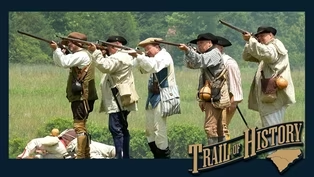
Rebellion in the Backcountry Preview | Trail of History
Preview: Ep57 | 30s | Revolutionary War battles in the Carolinas helped win independence. (30s)
Providing Support for PBS.org
Learn Moreabout PBS online sponsorship













Support for PBS provided by:
Trail of History is a local public television program presented by PBS Charlotte
Sponsored by Bragg Financial