Chicago Tonight: Latino Voices
Recalls Have Some People Rethinking Where to Buy Food
Clip: 9/5/2024 | 7m 4sVideo has Closed Captions
A look at what's being done to help people access food locally.
Efforts to encourage local food sourcing are creating broader opportunities to address health equity.
Problems playing video? | Closed Captioning Feedback
Problems playing video? | Closed Captioning Feedback
Chicago Tonight: Latino Voices is a local public television program presented by WTTW
Chicago Tonight: Latino Voices
Recalls Have Some People Rethinking Where to Buy Food
Clip: 9/5/2024 | 7m 4sVideo has Closed Captions
Efforts to encourage local food sourcing are creating broader opportunities to address health equity.
Problems playing video? | Closed Captioning Feedback
How to Watch Chicago Tonight: Latino Voices
Chicago Tonight: Latino Voices is available to stream on pbs.org and the free PBS App, available on iPhone, Apple TV, Android TV, Android smartphones, Amazon Fire TV, Amazon Fire Tablet, Roku, Samsung Smart TV, and Vizio.
Providing Support for PBS.org
Learn Moreabout PBS online sponsorship>> For many in advocating how to lead a healthy life can be challenging.
And after numerous recalls and reports of black mulls leaky ceilings and flies at a boar's head plan that led to a listeria outbreak.
People are rethinking where they get their food from efforts to encourage local food sourcing is creating broader opportunities to address health equity.
Joining us now with more are Westland, Ashton, the co-director of the Food Systems, Action Lab at the Illinois Institute of Technology and Rookie, a curvy Johnson, the vice-president of community, health, equity and engagement at Rush University Medical Center.
Thank you both for joining us now.
This is a really interesting conversation.
Nobody wants to talk about food recalls and West Linn.
I want to start with you.
Although many recalls are for undeclared allergens.
Does the increasing awareness of things like listeria, outbreaks and poor production facilities say something about mask food, productive production.
Yeah.
So our food system is really dependent on these long supply chains.
>> All right.
So our food is coming from all over the country and really all over the world and contamination can happen at any point in that And so there is real awareness about contamination.
Possibility along the supply chain and is increasing people's awareness and interest in more local sourcing to say that something that people should be more concerned about.
>> Well, it's I think in general, our food system is very safe.
All right.
So the Food Drug Administration has really developed a system where we can identify where contamination happened.
What batches were contaminated and where those shipments go whether it's in grocery stores and whatever part of the country.
So from a tracking and transparency perspective that the FDA does a great job of understanding where contamination happens.
I think, you know, like that the challenges that we caught control when that contamination happens and because of the length of our supply chains.
It likely to happen anywhere from the processing plant to that the storage facilities to biggest into the grocery store.
>> In as some hospitals like rush are also working to directly address things like food, insecurity as part of the safety a staying healthy.
How do you engage with the community to find out those needs?
>> So one of the things that we do first of all is understand that via focus groups be being out in the community, working with community organizations working with partners in the city and the county is such to just understand where needs are.
And then the other thing that we do is screening patients when they're in the hospital.
So when they come in, we find out from patients.
If they are food, insecure, basically asking the question trying to understand if they have access to food over the next couple of weeks.
And if we find that they are food, insecure, they are giving a prescription to our Veggie Rx Pantry and our food is medicine program.
So they're able to get a prescription for healthy produce proteins shelf stable food.
And then we also connect them with a community health worker who can follow up with them, who can also work to connect them to benefits.
And I want to talk about the hospitals on new initiative.
>> The conversation that started, there's a a billboard right that says who gets the chance to be healthy?
We all want the chance to be healthy.
But what is what is that reality?
What would you say is the concept of them?
Yeah.
So that really came out of a desire to spark a conversation.
We knew with the Democratic National Convention just being a couple blocks away that there be a lot more attention on Chicago and particularly the West side.
And and so when we think about the need to have front and center, this ongoing conversation about who gets the chance to be healthy.
We wanted it to be big and bold.
>> And up there and continue to track conversation with elected officials with businesses with a community partners as well as community members and to think about how we can continue to engage with each other and think through new ideas and approaches to making finding a way to help people become help as healthy as possible.
>> And was Lynwood.
You say it was can you would you say that can locally sourced food to be a way to help slow this problem and protect people?
Yeah, definitely.
>> Traditionally our our food has sourced from very large produces.
And I think that pandemic really highlighted the fragility of that system and created more awareness and opportunity for locals are saying so here in Chicago now we have local produces from African-American communities from the Latino communities who really stepped up during the pandemic to provide emergency food to their community.
And with that include also getting into schools.
What does that said?
The pandemic kind of like opened up this box to say there are these local produce says who are the business of growing food, not just for profit, right?
I mean, everybody wants to be able to support their families, but also to feed their communities.
And so since the pandemic, there has now been an infusion of more investment by the U.S. Department of Agriculture by the Illinois State Department of Agriculture into local food and really supporting our local farm eyes who are, you not necessarily in the city of Chicago, but in suburban Cook County as well as the color counties to help them grow their business is that they can feed call, not teaching people how to eat healthy.
You would say And we talked about, you know, there's a program that some of local 4 sources, food goes into public schools.
What would you say is importance of having locally sourced food?
>> At schools?
>> I think there's, you know, sort of 2 positive sort of outcomes from that one.
It is the way in a means to help young people, children get a closer look at food.
Sources.
It is a way to bring it to life for them.
I know one of the things that we try to do is we actually have educators who will work with teachers to develop lessons to think about growing food, but also how healthy food can contribute to strong bodies and strong winds.
And so again, having local food producers helped to bring all of those pieces
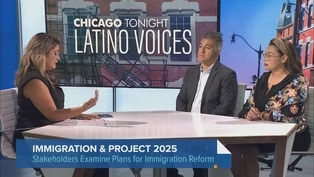
What Presidential Candidates Have Planned for Immigration Reform
Video has Closed Captions
Clip: 9/5/2024 | 11m 22s | Immigration has been a hot topic of discussion for both presidential candidates. (11m 22s)
Providing Support for PBS.org
Learn Moreabout PBS online sponsorship
- News and Public Affairs

Top journalists deliver compelling original analysis of the hour's headlines.

- News and Public Affairs

FRONTLINE is investigative journalism that questions, explains and changes our world.











Support for PBS provided by:
Chicago Tonight: Latino Voices is a local public television program presented by WTTW